
Graduate recruiting: Definition, process, and proven strategies
Discover actionable strategies and hacks to attract top graduate talent. Build a strong pipeline with innovative graduate recruitment techniques today!

TL;DR
- A structured graduate recruitment strategy fills roles 31% faster and retains early hires 18% longer than ad hoc approaches.
- Internship pipelines convert at 58% when structured correctly, compared to just 4% for cold graduate applicants.
- Graduates build their employer shortlist 14 months before applying, making campus brand investment a long-cycle commitment, not a quick-win tactic.
- Skills-based assessment at the screening stage consistently outperforms CV review for high-volume graduate hiring pipelines.
- The GRAD Framework (Ground, Recruit, Assess, Develop) gives enterprise HR teams a repeatable four-pillar system for graduate hiring.
- Offers extended within 14 days of assessment completion see significantly higher acceptance rates from graduate candidates.
- The 12-month retention rate and 36-month promotion rate are the real ROI metrics for graduate recruitment, not time-to-fill alone.

Graduate recruiting is the structured process of identifying, attracting, assessing, and hiring recent university graduates into entry-level or scheme roles.
It operates under different constraints from experienced hiring: the candidate pool is larger, the decision window compresses around academic calendars, and the cost of a poor hire compounds through the 18-month training period that follows.
Graduate hiring fell 5.1% among employers running formal training programs in 2025 and will continue to fall, according to High Fliers Research. Yet organizations with a deliberate graduate recruitment strategy continue to outperform those without one on every metric that matters: speed, cost, and first-year retention.
 ChatGPT
 Gemini
 Claude
 Grok
Grok Perplexity
What is graduate recruitment?
Graduate recruitment is the practice of sourcing, assessing, and hiring candidates who have recently completed a university degree into entry-level roles.
Unlike experienced hiring, which selects on track record and domain expertise, graduate recruitment selects on potential, adaptability, and foundational skills that predict long-term performance.
The graduate recruitment cycle differs from other hiring in two operational ways: timing is fixed by university calendars, with most intake windows running September to November, and candidate volume is high while CV signal quality is low. Both constraints mean that attraction work must begin 12 to 18 months before the offer stage, and assessment must move beyond CV review to surface the best candidates.
A well-run graduate recruitment program connects academic talent with professional roles through a defined pipeline that starts on campus and ends with a structured 90-day onboarding track.
Organizations that treat graduate recruitment as a system, not a seasonal event, consistently outperform those that treat it as reactive volume hiring.

Why structured programs outperform ad hoc graduate hiring
Graduate hiring outcomes are determined long before a candidate accepts an offer. Organizations that build ongoing relationships with students through internships, campus engagement, and structured development programs create stronger talent pipelines and higher-quality hires.
The advantage comes from three key areas:
• Internship-to-hire pathways provide access to pre-qualified candidates who already understand the organization and its culture. This reduces sourcing effort and lowers recruitment costs. • Standardized assessment and selection processes shorten decision-making timelines, enabling hiring teams to move candidates through the pipeline faster. • Structured onboarding helps graduates transition into their roles more effectively, leading to lower attrition rates.
SHRM’s Talent Trends research found that integrated graduate programs produced 41% lower 18-month attrition compared to organizations running disconnected campus events and reactive screening. Attrition at month 6 or month 12 is always an onboarding failure that started at the moment the program ended.
Building a structured internship pipeline is the key to ensuring the single highest-return investment available to enterprise HR teams running large annual graduate hiring programs.
Pro Tip: Calculate your cost-per-graduate-hire by source channel. Most teams find that intern-converted hires cost roughly half the all-in amount of career-fair sourced hires once recruiter time, assessment platform costs, and ramp-to-productivity are included.
How the graduate recruitment process works
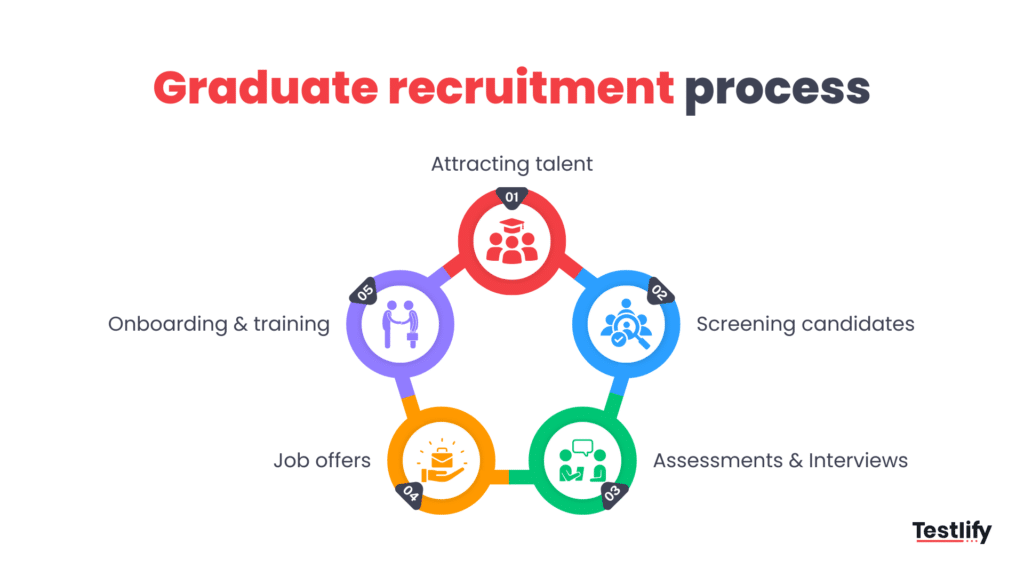
The graduate recruitment process follows five stages, each structured around a discrete decision point about whether to move a candidate forward. The key distinction from experienced hiring is that assessment depth must be highest at the screen-to-assess transition, not at the interview stage, because CV signals are weak at the graduate level.
Stage | Activity | Decision point |
|---|---|---|
Attract | Campus events, social media, internship programs, job boards | Is this candidate in the right talent pool? |
Screen | Skills-based assessment, application review | Does this candidate meet role-specific threshold criteria? |
Assess | Structured interviews, async video, case studies | Does this candidate have the potential to perform? |
Offer | Role clarity, salary band, career progression path | Is the package competitive enough to win the offer? |
Onboard | 90-day structured development program | Is this graduate set up to succeed in year one? |
The screen-to-assess transition is where most graduate programs lose quality candidates and introduce bias. Replacing CV filtering with a 20-minute role-specific skills assessment at that stage reduces recruiter time on early screening and surfaces stronger candidates from a broader range of academic backgrounds.
What motivates today’s graduate candidates?
Today’s graduates are looking beyond salary and focusing on opportunities that support long-term career growth. They want employers that can demonstrate clear development pathways, meaningful learning opportunities, and a positive employee experience.
The factors that influence application and offer decisions most include:
• Clear career progression with defined milestones and advancement opportunities. • Structured learning programs supported by mentors, managers, and regular feedback. • Authentic employee experiences that validate the organization’s culture and values. • Transparent salary ranges and benefits information shared early in the hiring process. • Flexible work arrangements that support work-life balance and individual productivity.
Graduate candidates often begin evaluating potential employers months before they apply for a role. Organizations that communicate these priorities effectively are more likely to attract stronger applicants and improve offer acceptance rates.
The most successful graduate recruitment programs align their employer brand with what candidates genuinely value. When graduates can see a clear path for growth, development, and flexibility, they are more likely to join and stay with the organization.
Key Takeaway: If your careers page has no employee-generated content, no recent graduate testimonials, and no specific salary bands, you are losing candidates at the awareness stage before they reach your application form. The 14-month shortlist window is where your employer brand either works or does not.
9 graduate recruitment hacks to attract top talent
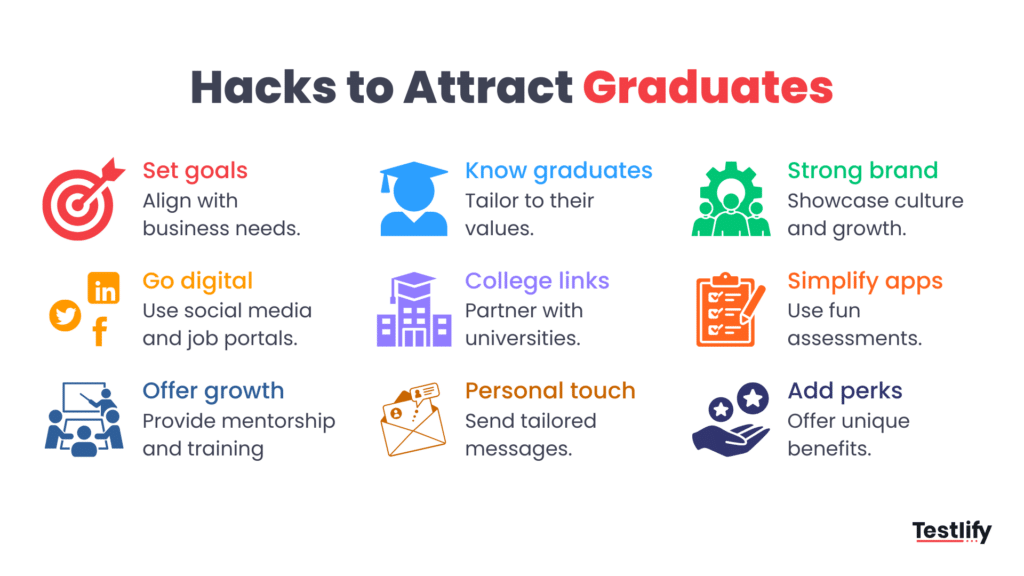
Most organizations apply experienced-hire tactics to graduate recruiting and get poor results. These nine strategies are built for the specific constraints of graduate hiring: high application volume, low CV signal quality, and candidates who decide their employer shortlist months before applying.
1. Set clear hiring goals
Define how many graduates you need, by role and department, before opening applications. A hiring goal without a role breakdown leads to over-recruiting in visible functions and under-recruiting in roles that are harder to pitch to campus audiences.
Set outcome metrics alongside intake targets: 12-month retention rate, assessment conversion rate, and offer acceptance rate. Without defined benchmarks, you have no way to evaluate whether your graduate recruitment strategy is working.
2. Know what today’s graduates want
Gartner’s 2026 Talent Acquisition data shows that 55% of a graduate’s employer shortlist is built from peer conversations and social channels, not career fairs. Graduates prioritize salary transparency, a named career progression path, and a culture they can verify through employee-generated content rather than corporate marketing.
Tailor your messaging to specific role milestones at 6, 12, and 24 months rather than generic growth language. Generic employer value propositions lose to specificity in the graduate market every time.
3. Build a strong employer brand
Showcase authentic culture and real growth stories through employee-generated content on LinkedIn, Instagram, and your careers page. Graduates who see current employees discussing career progression apply at a significantly higher rate than those who encounter only company-produced materials.
Assign recent graduates as employer brand ambassadors on campus and on social media. Peer-to-peer credibility outperforms any paid employer brand campaign at the graduate level.
4. Go digital with your outreach
Job portals and LinkedIn are the highest-volume channels for graduate applications, but social media is where shortlist decisions are made. A consistent presence showing real roles and real people reaches graduates earlier in their decision cycle than any inbound job ad.
Mobile-first application experiences are a baseline requirement, not a differentiator. Graduates who encounter a multi-step desktop-only application process abandon it at a rate of up to 50% before completing, according to industry benchmarks.
5. Build college links
Partner with three to five target universities through module sponsorships, guest lectures, and capstone project collaborations rather than attending general career fairs. Gartner’s 2026 data shows graduates from universities where an employer had a substantive academic relationship applied at 4.2 times the rate of those with no organizational connection.
Identify two or three faculty members in your target departments whose students most closely match your hiring profile. A direct relationship with those professors is worth more than ten campus stand presences per year.
6. Simplify the application process
Replace lengthy multi-stage applications with a 20-minute role-specific skills assessment as the first step. Candidates complete shorter, task-based applications at a significantly higher rate, and you get better signal than CV review provides at the graduate level. See CVs vs online assessments for a comparison of both methods.
Assessment completion drops by up to 25% for tests longer than 45 minutes, according to industry benchmarks. Keep the first assessment short and role-relevant, then reserve deeper evaluation for candidates who pass that gate.
7. Offer growth and mentorship
A named mentor and a structured 90-day development plan are more effective first-year retention drivers than salary adjustments for graduates. Graduates who can see a specific 12-month career path with milestone reviews stay longer and perform better than those placed in open-ended roles.
Pair graduates with their mentor before the start date. The pre-start connection reduces first-week anxiety and builds organizational commitment before day one. Graduates who complete a structured 90-day track show 41% higher 18-month retention than those placed in ad hoc roles after week four.
8. Add a personal touch to outreach
Send messages referencing a candidate’s specific degree program, dissertation topic, or internship experience rather than generic program descriptions. Personalized outreach in graduate recruiting generates response rates two to three times higher than template messages.
Follow up within 48 hours of application submission with a specific next step and timeline. Graduate candidates manage multiple application processes simultaneously, and a clear prompt response signals respect for their time.
9. Add perks beyond base salary
Offer benefits that matter specifically to graduates: student loan support, remote or hybrid flexibility, professional development budgets, and wellness allowances. These perks cost less per head than equivalent salary increases and score higher in graduate candidate surveys.
Remote or hybrid flexibility is cited by 61% of employers as a top driver of graduate application volume, according to SHRM 2025. Position flexibility as a feature of the role in your job adverts, not as a benefit mentioned only at the offer stage.
For enterprise teams managing high application volumes, automated screening tools reduce the recruiter time needed to run these strategies at scale. The candidate screening automation guide covers how to build the workflow without introducing screening bias.
Benefits and drawbacks of graduate recruiting
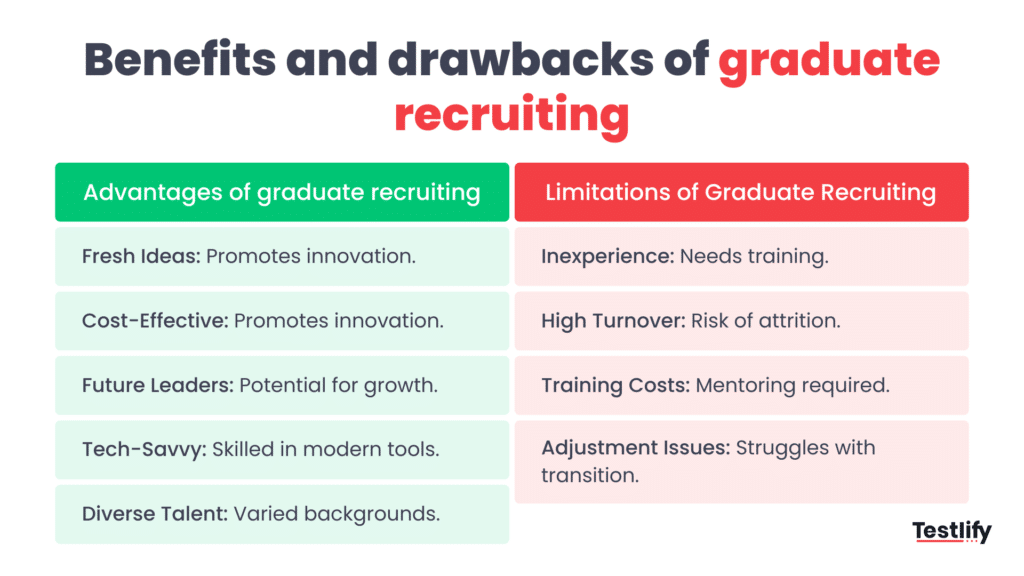
Graduate recruitment offers a distinct value proposition compared to lateral or experienced hiring, but it comes with real constraints that require active management. The advantages compound over a 3 to 5 year horizon; the disadvantages are front-loaded and manageable with the right onboarding and development investment.
Advantages of graduate recruiting
- Lower initial cost: Entry-level salaries typically run 15% below mid-career market rates for equivalent output capacity after the ramp period ends.
- Long-term pipeline: Graduates hired into structured programs become mid-level managers in 3 to 4 years without additional external recruitment spend.
- Current skills currency: Recent graduates bring up-to-date academic knowledge in fast-moving fields including AI tools, data literacy, and domain-specific frameworks that experienced hires may not have encountered.
- Diversity of intake: Sourcing from multiple universities and disciplines produces more varied cognitive and cultural backgrounds than lateral hiring from the same industry talent pool tends to deliver.
- Trainability: Graduates arrive without entrenched habits or process assumptions, making them more responsive to organizational culture and more adaptable to internal workflows.
Disadvantages of graduate recruiting
- Ramp time: Most graduates take 6 to 9 months to reach full productivity. The development cost is front-loaded and requires sustained manager bandwidth during the ramp period.
- Higher early attrition risk: Graduates without a defined career progression track treat the first role as a platform for exploration. Without a clear 12-month development roadmap, 18-month attrition runs high.
- Training investment: Structured development programs cost recruiter time, manager capacity, and platform expense that must be factored into the true cost-per-hire calculation.
- Adaptation gap: The shift from academic work to professional deliverables is harder for some graduates than others, requiring active support structures rather than passive availability from a line manager.
Pro Tip: The most common mistake in graduate programs is building a strong attract-and-hire machine without an equally strong 90-day development track. High attrition at month 6 or 9 is not a recruitment failure; it is an onboarding failure that started when the structured program ended at week four.
Graduate recruitment vs experienced hiring
Graduate recruitment operates on different inputs, success metrics, and timelines from experienced or lateral hiring. The table below captures the seven key structural differences that HR teams need to account for when designing a graduate-specific process.
Aspect | Graduate recruitment | Experienced hiring |
|---|---|---|
Primary selection signal | Potential, adaptability, foundational skills | Track record, domain expertise, prior output |
Screening method | Skills-based assessment, structured interviews | CV review, portfolio, reference checks |
Onboarding depth | 90-day structured track, mentorship, development plan | Minimal: focus on quick role integration |
Employer brand priority | High: campus presence, social proof, EVP content | Lower: role specifics and compensation lead |
Decision cycle | Fast (14-day target): candidates have competing offers | Variable: candidates often juggle one or two processes |
Long-term lens | Pipeline investment: future manager and leadership layer | Immediate gap-fill: replace or add capability now |
Attrition risk | Higher at 18 months without structured development | Lower if role-fit was correctly assessed at hire |
Teams running both graduate and lateral hiring simultaneously need different assessment tools, different success metrics, and different onboarding tracks for each cohort. The lateral hiring strategy guide covers the experienced hiring side in detail.
Measuring graduate recruitment success
Five metrics tell you whether your graduate recruitment strategy is working. Track all five together because measuring time-to-fill in isolation tells you nothing about whether the hires made at speed are performing and staying.
- Time-to-fill (entry level): Benchmark is 30 days or fewer from application to offer. Programs running longer than 45 days consistently lose candidates to faster competitors.
- Offer acceptance rate: High-performing programs achieve 80% or higher. Acceptance rates below 70% usually indicate a compensation gap or a career progression narrative that is not convincing at the offer stage.
- Application-to-offer conversion rate: Healthy programs run at 8 to 12%. Conversion below 5% means the assessment process has too much friction; conversion above 20% means the screen is too loose and downstream quality will suffer.
- 12-month retention rate: Target 75% or higher. This is the single most important metric for graduate programs because it captures both hire quality and onboarding effectiveness in one number.
- 36-month promotion rate: What percentage of your graduate cohort is still with you and performing at mid-level three years out? High-performing programs track 40% or higher; this is the ultimate ROI metric for the investment in structured graduate recruitment.
Key Takeaway: Most graduate programs track time-to-fill and offer acceptance rate, then stop. The 12-month retention rate and 36-month promotion rate are where the real ROI case for structured graduate recruitment is built or lost. If you are not tracking both, you do not have a complete picture of whether your program is working.
For a complete view of the metrics that matter across the full hiring cycle, the recruitment KPIs guide and the HR hiring cycle breakdown provide benchmark context for each of these five numbers.
Final thoughts
A graduate recruitment strategy built on the GRAD Framework (Ground, Recruit, Assess, Develop) gives enterprise HR teams a repeatable system for filling roles faster, at lower cost, and with higher first-year retention. The data from LinkedIn, SHRM, and CIPD point in the same direction: structured programs outperform ad hoc approaches on every metric that matters at the 12-month and 36-month mark.
Testlify’s graduate assessment suite scales the Assess pillar of the GRAD Framework without adding recruiter time. Pre-built role-specific skills tests, async AI audio interviews, and a real-time funnel analytics dashboard make it possible to run high-volume graduate screening with the rigor you would apply to senior roles.
Book a demo to see how enterprise HR teams use Testlify to build the Assess pillar of their graduate recruitment strategy.

Related resources
View all
HR & recruitment
What is balanced scorecard (BSC)? A guide for 2026

HR & recruitment
Top employee selection methods to hire the best talent

HR & recruitment
Top digital record keeping tips for recruiters

HR & recruitment
Top 8 HR priorities to look at in 2026

HR & recruitment
Recruiting active candidates: How and where to find?

HR & recruitment
Key compliance trends in 2026-27
Get started.
Hire on proof, not resumes.
Run your first skills-based assessment free — no credit card required.