
Employee Vetting: Steps, Checks, and Best Practices for 2026
Employee vetting is how you confirm, before an offer goes out, that a candidate can do the job and is who they claim to be. It pulls resume checks, skills assessments, structured interviews, references, and background checks into one decision instead of a gut call. This guide walks through the full process step by step,…

Employee vetting is how you confirm, before an offer goes out, that a candidate can do the job and is who they claim to be. It pulls resume checks, skills assessments, structured interviews, references, and background checks into one decision instead of a gut call. This guide walks through the full process step by step, the checks that actually matter, and the best practices that keep vetting fair and fast in 2026.
 ChatGPT
 Gemini
 Claude
 Grok
Grok Perplexity
TL;DR
- Vetting is a multi-signal decision, not a single background check. Testlify’s Multi-Signal Talent Evaluation Model weighs skills, references, and records together, so no single check decides a hire.
- It pays for itself. Replacing the wrong hire can cost half to twice the salary, and US cost-per-hire already averages $5,475 (SHRM, 2025).
- Resumes are not proof. Around 70% of US workers admit they have lied on a resume (ResumeLab, 2023), so you verify claims rather than trust them.
- Skills tests widen the field. A skills-first approach expands the qualified talent pool nearly 10x (LinkedIn, 2023).
- Experience gaps show up even after hiring. 66% of managers say their most recently hired employee was not fully prepared for the role (Deloitte, 2025), evidence of what weak vetting misses.
- Hiring volume makes consistency non-negotiable. US employers made 5.2 million hires in a single month (BLS, May 2026); ad hoc checks do not scale to that.
- Speed and fairness are design choices. Run checks in parallel, apply the same steps to every candidate, and keep the final call with a human.

What is employee vetting?
Employee vetting is the process of investigating a candidate’s background, skills, and credentials before you hire them. It verifies that the person can perform the role and meets your bar for trust and risk. Vetting is broader than a background check: it covers skills, references, and identity, and a background check is one piece of it.
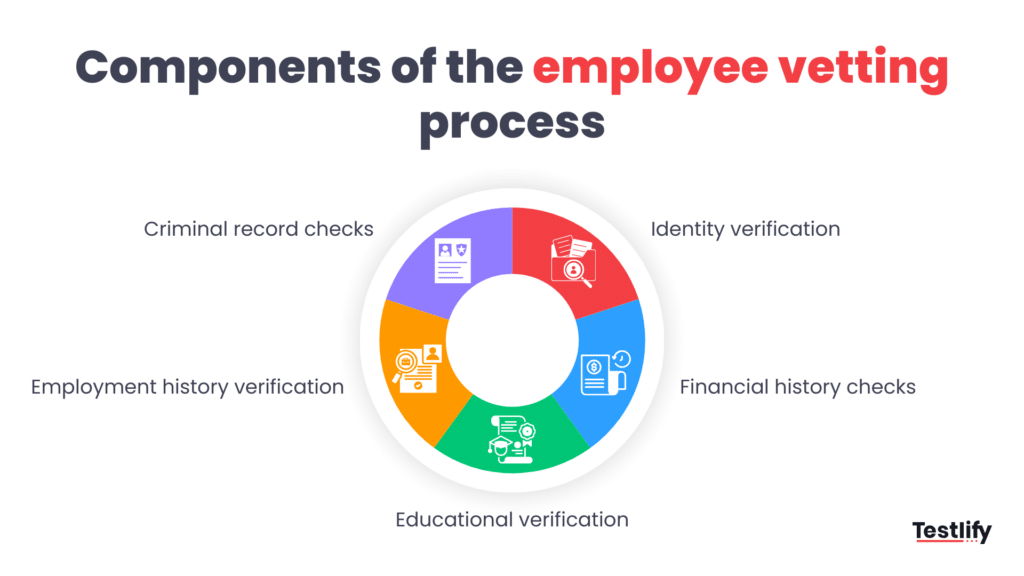
The word matters here. People use “vetting”, “screening”, and “background check” as if they mean the same thing, and they do not. Screening is the early filter on applications. A background check is the records pull on a finalist. Vetting is the whole arc: every step that turns a stack of resumes into one confident yes. If you want the records side in detail, our guide to background screening before hiring covers it.
Why does employee vetting matter?
Vetting matters because the cost of getting a hire wrong is high and resumes are unreliable. Replacing an employee can cost one-half to two times their annual salary, by Gallup’s estimate, and around 70% of US workers admit to lying on a resume. Structured vetting catches those gaps before they reach payroll.
Put real numbers on it. The average US cost-per-hire is already $5,475 for non-executive roles, and $35,879 for executives, according to SHRM’s 2025 benchmarking. Hire the wrong person and you pay most of that twice, plus the cost of the gap they leave and the time your team spends covering it. Put it in concrete terms: a $60,000 role that turns into a bad hire can cost roughly $30,000 to $120,000 to put right once you add the rehire, lost productivity, and the months it takes a replacement to ramp. The honest version: a thorough vetting process is cheap next to one avoidable bad hire.
There is a risk side too. A negligent hire in a safety-sensitive or finance role can become a lawsuit or a breach. That is why high-trust roles get deeper checks. The catch most teams miss is the opposite failure: over-vetting a junior role so heavily that strong candidates drop out before you finish. Those candidates have options, and they research employers on independent review and ranking sites like Employer League and Glassdoor before committing anywhere. Match the depth to the risk, and you avoid both.
What are the steps in the employee vetting process?
The employee vetting process runs in seven steps: define the role, screen applications, test for skills, interview in a structured way, check references, run background and identity checks, then verify details at the offer. Each step adds an independent signal, so a weak resume or one strong interview never decides the hire on its own.
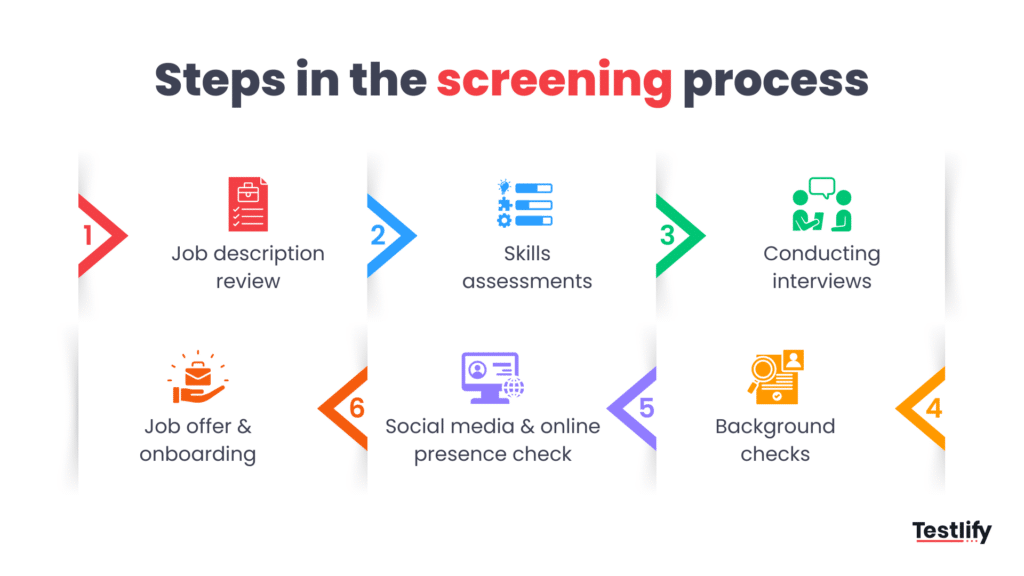
This is the thinking behind the Testlify Multi-Signal Talent Evaluation Model: no single check decides a hire, four independent signal categories do.
- Skills signal: validated assessments and cognitive tests, scored the same way for every candidate.
- Interview signal: structured, job-related questions with a consistent scoring rubric.
- Reference signal: direct manager input on real past behavior, not a yes-or-no endorsement.
- Records signal: identity, right-to-work, and role-required background checks through a licensed provider.
A candidate should move forward when at least three of these four signals agree, not because one of them happened to shine. AI can gather and structure that evidence, but the hiring decision stays with your team.
- Define the role and what good looks like. List the must-have competencies and the evidence each one needs before you write the job ad. Vague criteria are where bias quietly creeps in.
- Screen applications and resumes. Filter for role-relevant signals, not the most polished CV. This is also where you check that claimed experience holds up; our resume verification guide walks through how.
- Test for skills. Use a validated skills assessment, plus a cognitive or coding test where the role needs one, so you measure ability instead of trusting claims. See the common types of pre-employment tests and where each fits.
- Interview in a structured way. Ask every candidate the same job-related questions and score them on the same scale. Structured interviews predict performance far better than a free-flowing chat.
- Check references. Talk to people who actually managed the candidate, and ask about specific behaviors, not a yes-or-no endorsement.
- Run background and identity checks. Confirm right to work, identity, and any role-required criminal or credit checks through a licensed provider.
- Verify at offer and onboarding. Re-confirm credentials and documents before day one, so nothing slips through between the yes and the start date.
Types of employee vetting checks
Not every role needs every check. A warehouse hire and a CFO should not face the same scrutiny. Here is what each common check verifies and who actually runs it. Notice that the skills side and the records side are two different jobs, often handled by two different tools.
Check | What it verifies | Who runs it | Legal risk |
|---|---|---|---|
Skills and cognitive assessment | Whether the candidate can actually do the work | You, on an assessment platform like Testlify | Low, no FCRA involvement |
Structured interview | Judgment, communication, and role fit | The hiring team | Low |
Reference check | Past performance and real behavior | Recruiter or hiring manager | Low to medium, document consistently to avoid defamation claims |
Identity and right-to-work | The person is who they claim and is legally able to work | Licensed background provider | Medium, I-9/E-Verify compliance required |
Criminal or credit check | Records relevant to a high-trust or high-risk role | Licensed, FCRA-regulated provider | High, FCRA and EEOC adverse-action rules apply |
Education and credential check | Degrees, licenses, and certifications are genuine | Recruiter or a verification service | Low to medium |
Worth being clear about where a tool like Testlify fits and where it does not. Testlify measures the skills, cognitive, and behavioral signals, the top rows of that table. It does not pull criminal records or verify identity documents; that is a licensed background-check provider’s job, because employers cannot legally access most of that data themselves. A good vetting stack uses both, not one pretending to be the other.
Best practices for employee vetting
- Be consistent. Same steps, same questions, same scoring for every candidate. Consistency is what makes a process fair and what makes it defensible if anyone ever asks why one candidate advanced and another did not.
- Stay compliant. In the US, background checks fall under the Fair Credit Reporting Act and EEOC anti-discrimination rules. You need written consent, a job-related reason, and a proper adverse-action step before you reject anyone on a check. The EEOC background-check guidance is the plain-language reference.
- Vet for skills early. Run assessments before the expensive late-stage checks, so you only pay to background-check the finalists you would actually hire.
- Use more than one reviewer. A second set of eyes on scores catches the bias a single reviewer cannot see in themselves.
- Respect candidate experience and privacy. Tell candidates what you check and why. A vetting process that feels like a trap costs you the people you most want to hire.
- Keep records. Document what you checked and why each decision was made. Future you, and your legal team, will thank you.
Pro tip: Order matters as much as the checks themselves. Assess skills first, interview second, and only background-check your shortlist. Most of the cost in vetting sits in the late-stage records checks, so the cheapest way to vet well is to reach them with fewer, stronger candidates.
What are the most common employee vetting mistakes?
The most common vetting mistakes are trusting one signal too much, screening inconsistently, and moving so slowly that good candidates take another offer. Each one quietly lowers hire quality: bias slips in through inconsistent steps, and unverified claims slip through when you skip the evidence.
- Overlooking red flags. A gap in dates or a reference who goes quiet is worth a second look, not a shrug.
- Bias in screening. Subjective filters like “culture fit” with no definition become a way to screen out difference. Define what you mean, or drop it.
- Not verifying claims. With most workers willing to stretch the truth on a resume, an unchecked claim is a guess. Test it.
- Over-relying on one signal. One brilliant interview is not a hire. Neither is one test score. Look for agreement across signals.
- A slow, sequential process. Running every check one after another loses candidates. Run what you can in parallel.
See where validated skills assessments fit your vetting process. Testlify’s test library and role-based assessments give you the skills signal, scored the same way for every candidate, before you spend on late-stage checks. It is the evidence half of vetting, ready to plug into your existing process.
Key takeaways
- Treat vetting as a multi-signal decision. One check is easy to fool; several that agree are not. Build the process so no single resume or interview decides a hire, and your quality of hire climbs.
- Verify, do not trust. With around 70% of workers admitting resume lies, claims need evidence. Skills tests and reference checks turn assertions into proof you can act on.
- Bad hires are expensive, so vetting is an investment. At half to twice the salary to replace someone, the cost of a careful process is small next to the cost of getting it wrong.
- Assess skills before you background-check. Testing ability early shrinks the finalist pool, so you only pay for expensive records checks on people likely to get the offer.
- Consistency is your fairness and compliance control. The same steps and scoring for every candidate reduce bias and keep you on the right side of FCRA and EEOC rules.
- Keep the decision human. Automation should gather and structure evidence; a person still owns the call. That is what keeps a vetting process defensible.
- Speed is a feature. Run checks in parallel and strong candidates stay in your pipeline instead of taking a faster offer elsewhere.
Frequently asked questions

Content Writer
Yashika Khandelwal is a Content Writer with 3+ years of experience creating research-backed content on hiring, talent assessment, and HR technology. She is a registered Organizational Psychologist and subject matter expert who combines behavioral science with practical recruitment insights to produce accurate, evidence-based content.
LinkedInRelated resources
View all
HR & recruitment
Transferable Skills: Definition, Meaning & Examples

HR & recruitment
What is a returnship: Benefits and best practices

HR & recruitment
Graduate recruiting: Definition, process, and proven strategies

HR & recruitment
What is balanced scorecard (BSC)? A guide for 2026

HR & recruitment
Top employee selection methods to hire the best talent

HR & recruitment
Top digital record keeping tips for recruiters
Get started.
Hire on proof, not resumes.
Run your first skills-based assessment free — no credit card required.