
Top 15 HackerRank Alternatives and Competitors in 2026
Discover 15 powerful HackerRank alternatives to streamline your hiring process and assess candidates with confidence.
The best HackerRank alternative in 2026 depends on what you are hiring for: Testlify if the same platform has to screen engineers and non-technical hires, CoderPad for live final-round interviews, Codility or HackerEarth for algorithm screening at volume, and Glider AI or WeCP when you want candidates to build something real. This guide compares 15 HackerRank alternatives and competitors on question realism, proctoring, role coverage, integrations and published pricing.
We rebuilt the list in September 2026 with verified pricing where vendors publish it, and with the reasons hiring teams give for switching, so you can shortlist two or three platforms and trial them instead of reading 15 vendor pages.
TL;DR
- HackerRank is still a fine choice for algorithm-first engineering screens. Teams leave when per-seat pricing climbs, candidates rehearse the puzzle bank, or they need to assess roles outside engineering.
- Testlify is our pick for mixed hiring: 3,500+ tests across technical, cognitive and role-specific skills, AI interviews and proctoring on one plan that starts at $139 a month with published pricing.
- For pure coding screens at volume, Codility and HackerEarth are the closest like-for-like rivals. For live interviews, CoderPad. For hands-on project tasks, Glider AI and WeCP.
- Free "alternatives" like LeetCode, Codewars and Exercism are practice sites, not hiring tools. They help candidates prepare; they do not score candidates for you.
- Cheating is now the deciding factor for many buyers: 6% of candidates in Gartner's 2Q25 survey admitted to interview fraud, and 84% of developers use or plan to use AI tools, so proctoring depth beats puzzle volume.
 ChatGPT
 Gemini
 Claude
 Grok
Grok Perplexity
Why do companies look for a HackerRank alternative?
Companies look for a HackerRank alternative for five reasons: pricing that scales with recruiter seats rather than with hiring volume, algorithm puzzles candidates have already practiced, thin coverage of non-engineering roles, reporting that stops at a score, and AI-assisted cheating that a plagiarism checker alone cannot catch. Most buyers hit two or three of these at once.
The cheating problem is the newest, and it has changed the buying criteria. Gartner's second-quarter 2025 survey of 3,000 job candidates found that 6% admitted to interview fraud, either posing as someone else or having someone else pose as them, and Gartner expects one in four candidate profiles worldwide to be fake by 2028. On the tooling side, 84% of developers use or plan to use AI tools in their work, up from 76% a year earlier, according to the 2025 Stack Overflow Developer Survey. A timed algorithm question that an assistant can solve in seconds no longer tells you much about the person who submitted it.
The demand side is not easing either. The U.S. Bureau of Labor Statistics projects 10% employment growth for software developers, quality assurance analysts and testers from 2025 to 2035, with about 106,100 openings a year and a 2025 median wage of $135,980 for developers. Each mis-hire at that salary is expensive, which is why teams want an assessment that predicts on-the-job work rather than contest performance.
There is a second, quieter reason. Skills themselves are moving. The World Economic Forum's Future of Jobs Report 2025 estimates that 39% of workers' existing skill sets will be transformed or become outdated between 2025 and 2030. A platform locked to classic data-structure questions ages faster than one that lets you write role-specific tasks, add AI-fluency scenarios and re-weight scoring as the job changes.

How we evaluated these HackerRank alternatives
We scored each platform on eight criteria, weighted towards what predicts a good hire rather than what looks good in a demo. The research on selection methods is clear on one point: work samples and structured, job-related tasks predict performance better than credentials or years of experience. Sackett and colleagues' 2022 reanalysis in the Journal of Applied Psychology puts structured interviews and job-knowledge tests near the top of the validity ranking and general years of experience near the bottom, and Roth, Bobko and McFarland's 2005 meta-analysis in Personnel Psychology found work sample tests carry meaningful predictive validity when they are job-relevant and scored consistently.
- Question realism: can you assess the actual work (debugging, reading code, building a feature, SQL on a real schema) rather than only puzzles?
- Proctoring depth: identity checks, browser control, AI-assistance detection and reviewable evidence, not just a plagiarism score.
- Role breadth: does it cover data, product, sales, support and leadership hires, or only engineers?
- Reporting: skill-level breakdowns and benchmarks a hiring manager can act on, plus multi-reviewer scoring.
- Integrations: results flowing into the ATS without manual copying.
- Pricing transparency: we list prices only where the vendor publishes them. "Contact sales" is noted as exactly that.
- Candidate experience: Hausknecht, Day and Thomas's 2004 meta-analysis of applicant reactions found they track perceived job-relatedness and fair treatment, so a realistic task is also a better candidate experience.
- Defensibility: U.S. employers are judged against the Uniform Guidelines on Employee Selection Procedures (29 CFR Part 1607), so job-related tasks with documented scoring beat a black-box score.
One honest caveat about this list. Several tools below compete directly with Testlify. We name them because a HackerRank alternatives page that names nobody is useless, and we have tried to describe each one the way its own customers would. Where a rival is the better fit, we say so.
How do HackerRank competitors compare at a glance?
The table below is the fastest way to shortlist. "Published pricing" means a price is on the vendor's public pricing page as of September 2026; everything else is quote-based.
Platform | Best for | Assessment types | Proctoring | Published pricing |
|---|---|---|---|---|
Testlify | Technical plus non-technical hiring on one platform | Coding, cognitive, personality, role-specific, AI interviews | Webcam, ID, browser, AI-assistance detection | Yes, from $139/mo |
LeetCode | Candidate practice, algorithm prep | Algorithm and data-structure problems | Minimal | Yes (consumer plans) |
Coderbyte | Junior and mid-level developer screens | Coding challenges, take-home projects | Basic | Yes |
PMaps | Composite tech plus behavioral screening | Coding, cognitive, behavioral, AI voice screening | AI monitoring | No |
CoderPad | Live pair-programming interviews | Collaborative coding, take-home | Session recording | Yes |
TestTrick | Budget screening for small teams | Coding, aptitude | Basic | Yes |
HireVue | High-volume video screening | Video interviews, game-based assessments | Interview recording | No |
Glider AI | Hands-on simulations for experienced engineers | Project tasks, cloud environments | Plagiarism, copy-paste detection | No |
Codility | Algorithm screening at enterprise volume | Timed coding tasks | Plagiarism detection | No |
WeCP | Customizable stack-specific tests | Coding, DevOps, data science environments | AI proctoring | No |
Saville | Psychometrics for leadership hiring | Cognitive, personality, situational judgment | Not applicable | No |
Xobin | All-in-one screening for agencies and SMBs | Coding, aptitude, psychometric, domain tests | Webcam, AI monitoring | Yes |
HackerEarth | Coding contests plus hiring | Coding tests, hackathons | AI proctoring | No |
TestDome | Short pre-interview screens | Coding and skills questions | Basic | Yes |
Adaface | Conversational screening | Chat-based technical and aptitude tests | Basic anti-cheating | Yes |
1. Testlify
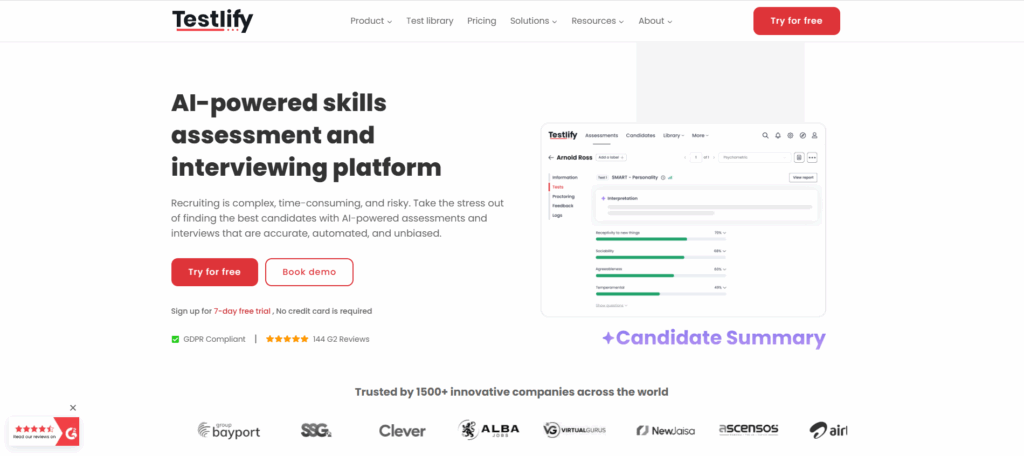
Testlify is an AI-assisted, human-led skills assessment platform built for teams that hire engineers and everyone else. Where HackerRank is a developer-skills product first, Testlify's library spans coding tests in 45+ programming languages, cognitive ability, personality, language and role-specific assessments, plus conversational AI interviews over video, audio and phone.
The practical difference shows up in the workflow. A recruiter can build an assessment from the library or from custom questions, invite candidates automatically, let proctoring run in the background, and hand a scored, ranked shortlist to the hiring manager. AI summarizes the evidence; a human makes the call. That is the Testlify Multi-Signal Talent Evaluation Model in practice: combine coding evidence, cognitive evidence, an AI interview and reviewer feedback so no candidate advances on one strong test or one polished interview.
Key features
- 3,500+ science-backed tests and 180,000+ validated questions across technical, aptitude and behavioral skills
- 25+ custom question types including coding tasks, file uploads and situational judgment, with weighted, section-level scoring
- AI video, audio and phone interviews with 150+ interview templates
- Proctoring that covers webcam snapshots, photo ID verification, tab-switch and copy-paste monitoring, and AI-assistance detection, with the evidence kept for human review
- Global benchmarks, candidate comparison and multi-reviewer scorecards
- ATS integrations including Greenhouse, Lever, Workday, SmartRecruiters and Zoho Recruit, plus APIs and webhooks
- White-label branding, custom domain and custom candidate emails
Best for
Mid-market and enterprise teams that need one assessment platform for engineering, data, sales, support and operations hiring, and want proctoring that goes beyond a plagiarism score. Read the Testlify vs HackerRank comparison for a feature-by-feature view.
Limitations
- Not a live pair-programming tool. Teams that want an interviewer typing alongside the candidate still pair Testlify with CoderPad or a video call.
- No hackathon or employer-branding contests of the kind HackerEarth runs.
- Phone AI interviews are metered at $0.18 per minute on top of the plan.
Testlify pricing
Testlify publishes its pricing, which most platforms on this list do not. The Standard plan is $139 a month billed annually ($1,668 a year) and includes 100 candidate credits ($16.68 per credit, $21 for extra credits), 3 user seats ($15 per additional seat per month), unlimited assessments, AI interviews, proctoring and custom branding. White labeling and integrations are add-ons at $2,388 a year each. A Custom plan covers organizations assessing 25,000+ candidates a year and adds advanced proctoring, ID verification, SSO, an uptime SLA and a dedicated success manager. There is a 7-day free trial with no credit card, a 30-day money-back guarantee, and base pricing is locked for 24 months.
2. LeetCode
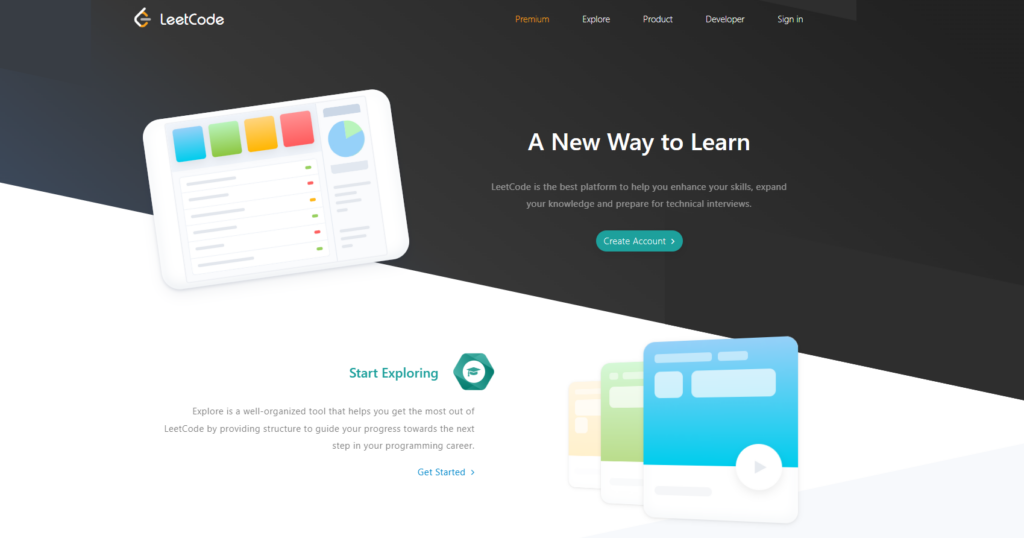
LeetCode is the platform candidates use to prepare for interviews at large technology companies, and that is exactly why it shows up in HackerRank alternative searches. Its library of algorithm and data-structure problems is the reference set for the whole industry. But it is a practice site first, with a lighter employer product bolted on, so treat it as a benchmark for what your candidates have already rehearsed rather than as your screening tool.
Key features
- Thousands of algorithm problems across three difficulty levels, tagged by company and topic
- Support for the mainstream languages: Python, Java, C++, JavaScript, Go and more
- Weekly contests and a global rating system
- Integrated editor with real-time execution and submission history
- Active discussion forums where solutions are shared, which matters for cheating risk
Best for
Engineering teams that want candidates to arrive prepared, and hiring managers who need a shared vocabulary for "medium" and "hard" problems.
Limitations
- Puzzles rather than job tasks, with little support for system design or project work
- Minimal customization, proctoring and recruiter analytics
- Solutions to most problems are public, so a timed LeetCode-style screen measures recall as much as skill
- Weak ATS integration
3. Coderbyte
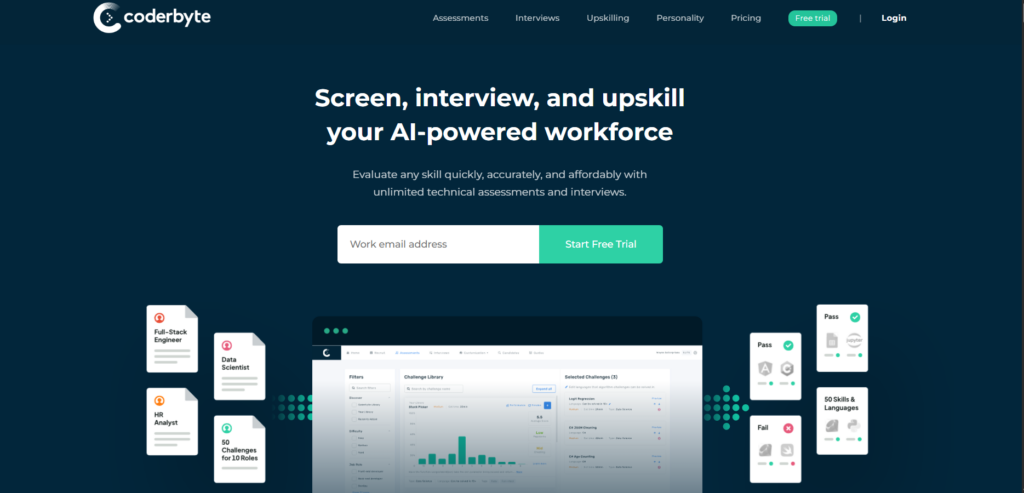
Coderbyte is a lighter-weight assessment platform that startups and mid-sized companies pick when they want a straightforward developer screen without an enterprise procurement cycle. It mixes short coding challenges with take-home projects and interview kits, and it publishes its prices.
Key features
- Front-end, back-end and full-stack challenges in a wide language set
- Take-home projects and structured interview kits
- Automated scoring with candidate ranking
- Custom challenge creation for specific roles
Best for
Screening junior and mid-level developers at companies hiring a handful of engineers a quarter. See our separate Coderbyte alternatives guide if you have outgrown it.
Limitations
- Smaller question library than enterprise platforms
- Basic reporting, little behavioral or soft-skill coverage
- Limited proctoring and ATS options
4. PMaps
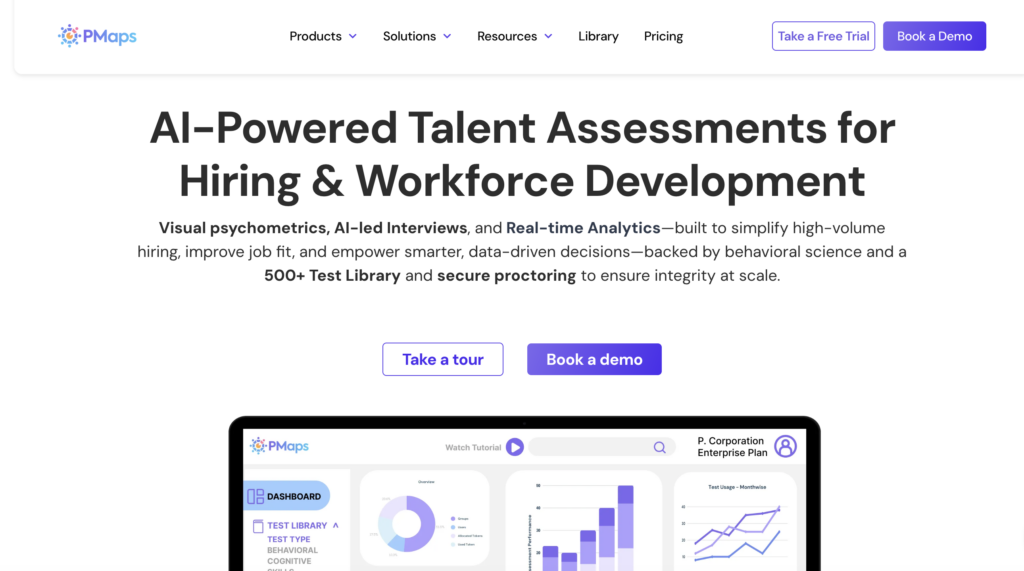
PMaps positions itself as a talent-intelligence platform rather than a coding-test tool. It combines coding assessments with cognitive testing, behavioral profiling and AI voice screening, and produces a composite score that is meant to answer "is this person job-ready" rather than "did they pass the test".
Key features
- Coding tests for front-end, back-end and full-stack roles
- Automated evaluation of spoken communication and technical articulation
- Cognitive, behavioral and role-based skill measurement in one composite score
- AI monitoring for remote assessment integrity
Best for
Enterprise and high-volume tech recruiting in markets where communication screening matters as much as code, such as IT services and BPO engineering teams.
Limitations
- Enterprise features usually need onboarding support to configure
- Pricing is not published and depends on volume
- Less transparent about how the composite score is built than a skill-by-skill report
5. CoderPad
CoderPad is the live interview room. An interviewer and a candidate write, run and talk through code together in a shared environment, which makes it the natural replacement for HackerRank's interview product rather than for its screening product. It is the tool engineering managers ask for by name when they are tired of whiteboards.
Key features
- Real-time collaborative editor with shared execution across 30+ languages and frameworks
- Session recording and playback for calibration between interviewers
- Pair-programming and whiteboard-style interaction
- Reusable interview templates and question banks, plus a take-home option
- Video-conferencing integrations
Best for
Final-round and onsite-replacement interviews for mid-level and senior engineers, where you want to see how someone reasons out loud.
Limitations
- Not built for automated early-stage screening or bulk testing
- Every session costs interviewer time, so it does not scale to hundreds of applicants
- Thin analytics and benchmarking, and no aptitude or behavioral testing
6. TestTrick
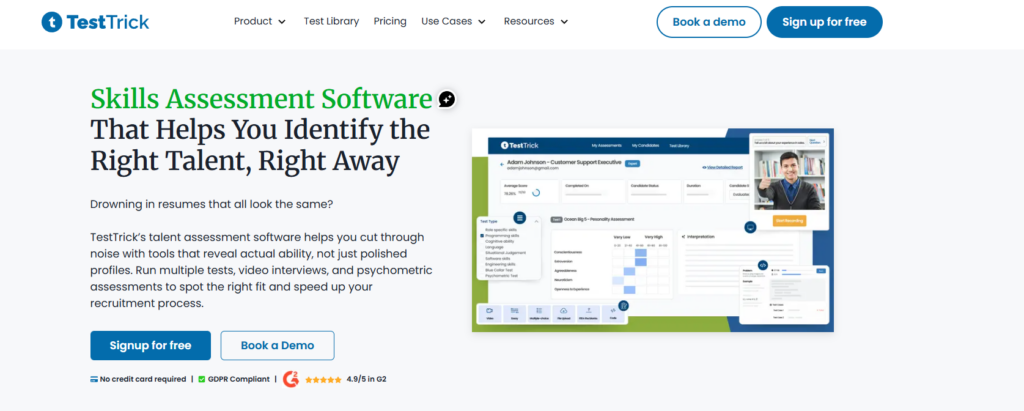
TestTrick is a budget-friendly assessment tool aimed at startups, small IT teams and recruitment agencies. It offers pre-built coding and aptitude tests, a simple test builder, and a candidate dashboard, without the depth (or the price) of an enterprise platform.
Key features
- Pre-built coding assessments in common languages
- Basic aptitude and logical reasoning tests
- Automatic evaluation with standardized score summaries
- Simple custom test creation for non-technical recruiters
Best for
Entry-level and junior developer screens where budget is the deciding constraint.
Limitations
- Limited library of advanced or specialized challenges
- Weak reporting, proctoring and plagiarism detection
- Few integrations, and not suited to senior or high-volume hiring
7. HireVue
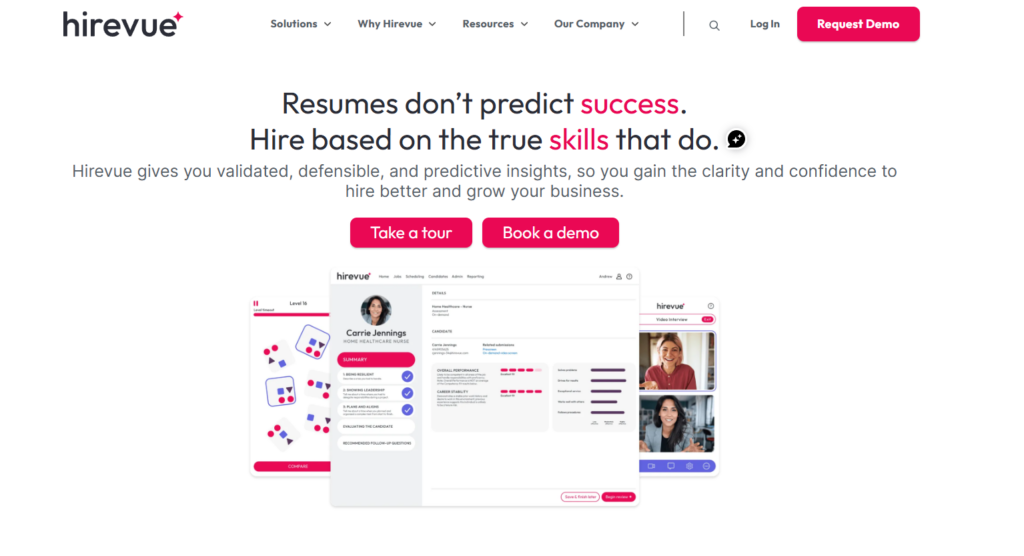
HireVue is a video-interviewing and game-based assessment platform used by large enterprises for graduate, entry-level and customer-facing hiring at volume. It appears on HackerRank alternative lists because it solves the same top-of-funnel problem, but it does so with recorded interviews and gamified cognitive tests rather than code.
Key features
- On-demand and live video interviews with structured question sets
- Game-based cognitive and behavioral assessments
- AI-assisted scoring of recorded responses
- Automated scheduling, reminders and major ATS integrations
- Enterprise security and compliance tooling
Best for
High-volume campus and customer-service hiring where you need to screen thousands of applicants on communication and behaviour.
Limitations
- Shallow technical and coding assessment, so engineering teams still need a coding tool
- AI-scored video raises transparency questions. The EU AI Act classifies AI systems that screen or evaluate job candidates as high-risk, which adds documentation obligations for employers in scope
- Enterprise pricing and a heavier implementation
8. Glider AI
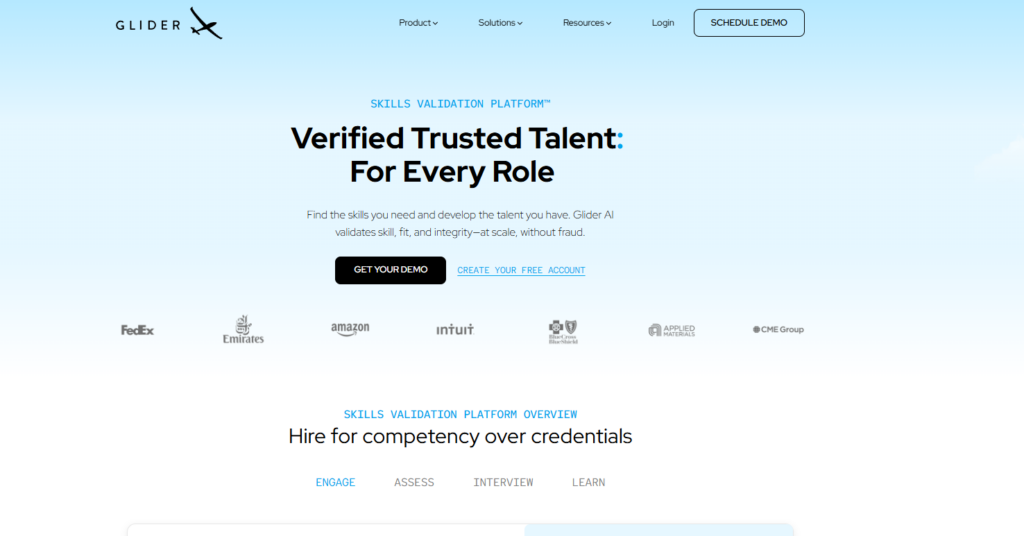
Glider AI takes the work-sample idea seriously. Instead of multiple-choice questions or isolated algorithm problems, candidates complete hands-on tasks in cloud-based environments that mirror the job: deploy a service, fix a bug in a real codebase, wrangle a dataset. That realism is its selling point and its cost.
Key features
- Project-based simulations in live cloud development environments
- Role-specific templates for engineering, data science and cloud roles
- Plagiarism and copy-paste detection with manual review options
- Skill-gap and competency reports
Best for
Experienced-hire evaluation where a two-hour realistic task is acceptable to candidates, and enterprise teams running skills-based hiring programs.
Limitations
- Setup takes time and needs agreement on what "good" looks like for each role
- Higher price than screening-first tools, and pricing is not published
- Too heavy for quick, high-volume first screens
9. Codility
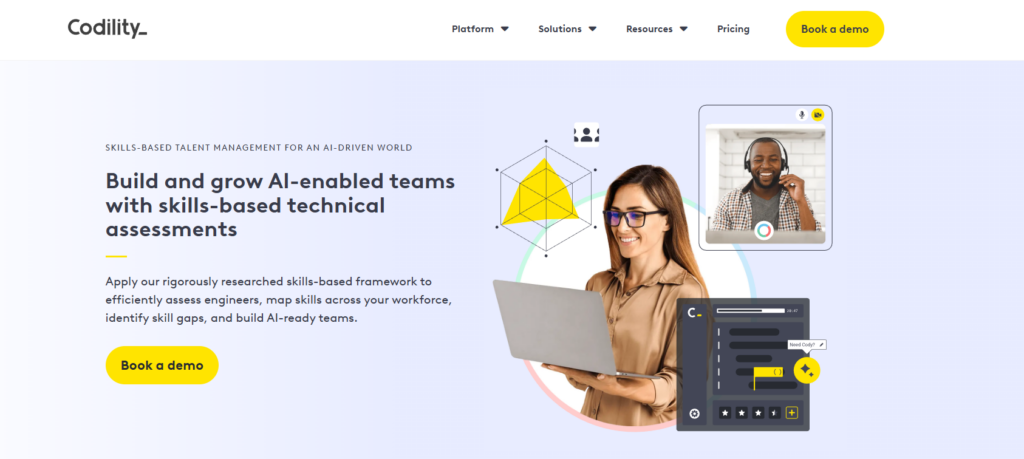
Codility is the most direct like-for-like HackerRank competitor on this list. It screens developers with timed coding tasks that reward correctness and efficiency, benchmarks candidates against global data, and is built for mid-sized and enterprise teams processing large applicant pools.
Key features
- Timed coding challenges at several difficulty levels
- Automatic performance scoring against global benchmarks
- Custom task creation and plagiarism detection
- Recruiter dashboards with side-by-side candidate comparison
Best for
Enterprise engineering screening where algorithmic problem-solving is the core requirement. Our Codility alternatives guide covers when it is not.
Limitations
- Speed-and-algorithms emphasis over real-world development and system design
- A candidate experience many engineers describe as rigid
- Little coverage of communication, collaboration or non-technical roles
10. WeCP
WeCP (We Create Problems) sits between the simple screening tools and the enterprise suites. Its pitch is customization: stack-specific coding tests, cloud IDEs for back-end, front-end, data-science and DevOps roles, and AI proctoring, aimed at startups, mid-sized companies and agencies that want more control than a template library gives them.
Key features
- Customizable assessments across multiple technologies and environments
- Cloud-based IDEs for realistic tasks
- AI-based proctoring and candidate ranking
- Role-specific question templates and recruitment-platform integrations
Best for
Teams hiring for niche stacks (DevOps, machine learning, cloud) who want to shape the test to the job.
Limitations
- Interface and reporting are less polished than the market leaders
- Complex tests often need technical input to set up
- Pricing is quote-based
11. Saville
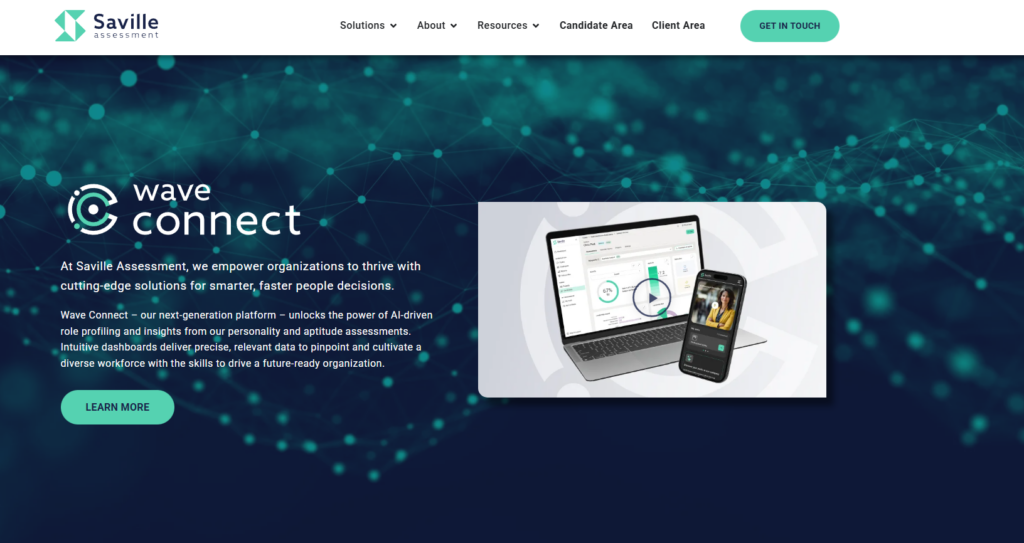
Saville is a psychometrics provider, not a coding platform. It appears here because some teams searching for a HackerRank alternative are really asking a different question: how do we assess judgment, personality and potential for leadership and graduate roles? Saville's validated cognitive and behavioral instruments answer that.
Key features
- Cognitive ability and critical-thinking assessments
- Personality profiling and situational judgment tests
- Leadership-potential and succession tools
- Multi-language delivery and enterprise reporting
Best for
Leadership, management and graduate hiring, and succession planning in large organizations.
Limitations
- Minimal hands-on technical or coding assessment
- Customization and implementation usually involve the vendor
- Higher cost and longer timelines than self-serve tools
12. Xobin
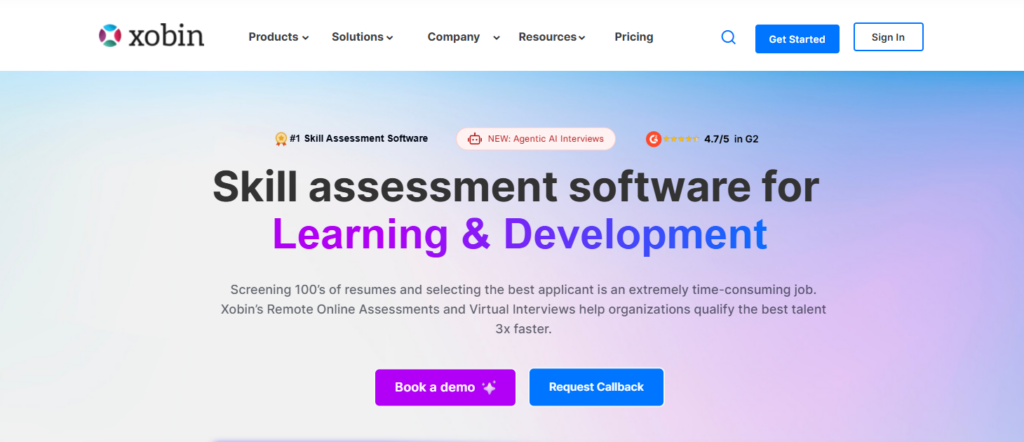
Xobin is an all-in-one screening platform with a broad library of coding, aptitude, psychometric and domain tests, remote proctoring, and published pricing. It is popular with recruitment agencies, staffing firms and mid-sized companies that want one place to run every pre-employment test.
Key features
- Large pre-built library across technical and non-technical roles
- Webcam proctoring and AI-based monitoring
- Automated scoring, ranking and skill benchmarking
- Custom test creation, branding and ATS integrations
Best for
Agencies and SMBs running standardized screens across many client roles.
Limitations
- Interface can feel cluttered to new users
- Reporting depth and some features are tied to higher tiers
- Candidate experience varies by test type
13. HackerEarth
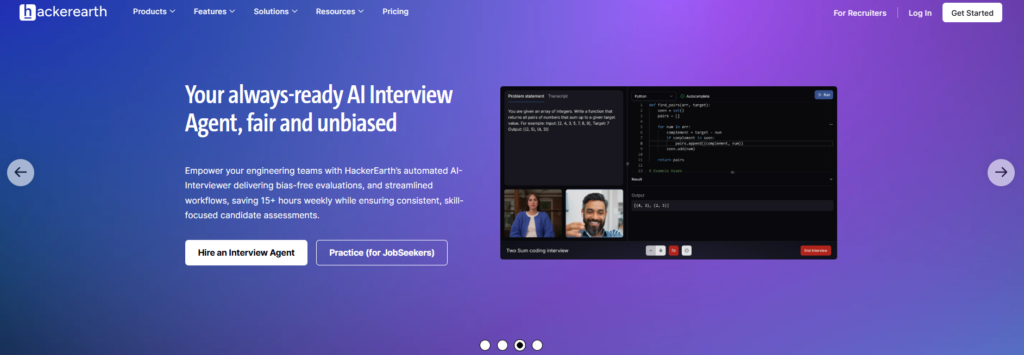
HackerEarth is the other name people confuse with HackerRank, and the products overlap heavily: customizable coding assessments, automated evaluation, AI proctoring, and integrations with the major applicant tracking systems. Its distinctive edge is the developer community and hackathon engine, which large employers use for employer branding as much as for hiring.
Key features
- Customizable coding assessments with automated scoring
- Online hackathons and competitive programming contests
- Developer community access and talent-branding tools
- Candidate analytics dashboard and ATS integrations
Best for
Large-scale engineering campaigns and campus hiring where a branded contest is part of the sourcing strategy.
Limitations
- Configuration is complex for first-time users
- Advanced hiring and branding features push the price up, and pricing is not published
- Little coverage of soft skills or non-engineering roles; see our HackerEarth alternatives roundup
14. TestDome
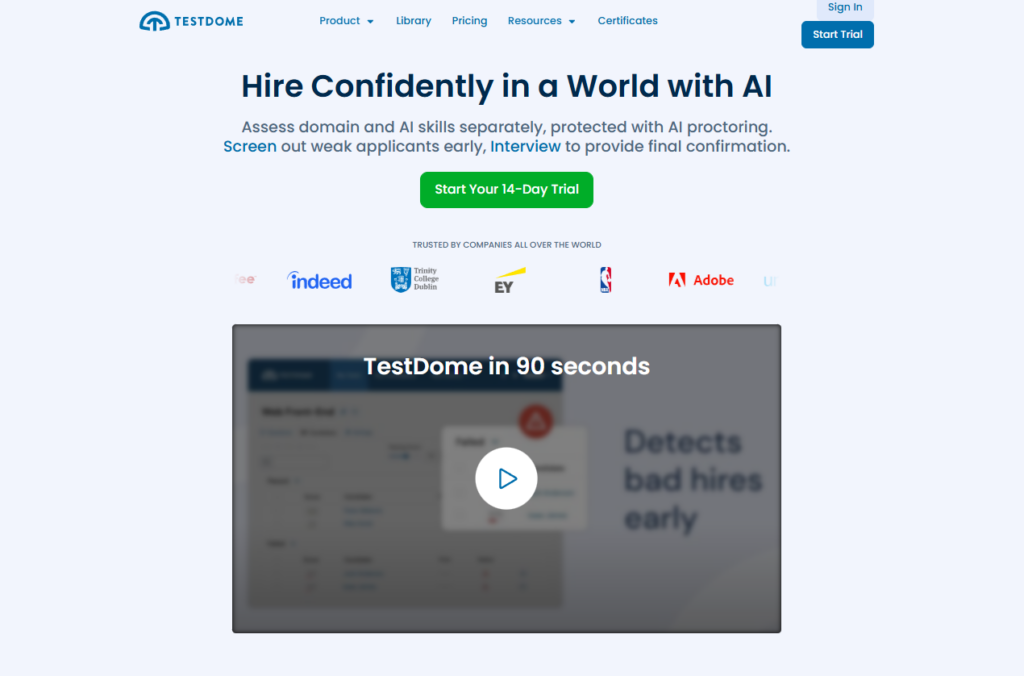
TestDome is built around short, practical tests that candidates finish in well under an hour, which keeps drop-off low at the top of the funnel. It publishes pricing, grades automatically, and covers both coding and general professional skills at a level suited to junior and mid-level roles.
Key features
- Short coding and technical skill tests with instant grading
- Multiple-choice and scenario questions
- Candidate ranking and public skill certificates
- Custom test creation
Best for
Quick pre-interview screens for junior and mid-level developers and QA engineers at small businesses.
Limitations
- Not deep enough for senior or specialized roles
- Small library, minimal project-based work and basic reporting
- Limited branding and customization
15. Adaface
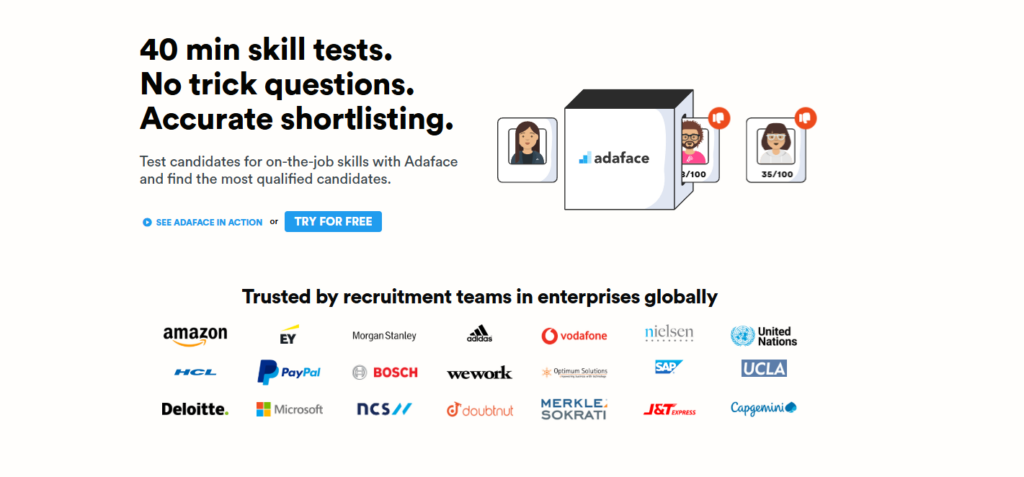
Adaface delivers assessments through a conversational, chat-style interface instead of a traditional test screen, on the theory that a dialogue keeps candidates engaged and reduces drop-off. It covers technical, analytical and business roles with scenario-driven questions and publishes its prices.
Key features
- Chat-based assessment interface
- Role-specific technical, aptitude and situational questions
- Automated scoring and candidate reports
- Customizable flows and ATS integrations
Best for
Companies that lose candidates to drop-off in early screening and want a friendlier format for software, data and business roles.
Limitations
- Limited support for complex coding projects and system design
- Basic anti-cheating compared with full proctoring suites
- Reporting customization is restricted and some features sit on higher tiers
Free HackerRank alternatives and websites like HackerRank
Free HackerRank alternatives exist, but almost all of them are practice sites for developers, not hiring tools for employers. LeetCode, Codewars, Exercism, Codeforces, CodeChef and Project Euler are free (or freemium) websites like HackerRank where candidates sharpen algorithms and language skills. They are excellent preparation. They do not proctor, score against your rubric, or push results into your ATS.
For employers, "free" usually means a trial. Testlify's 7-day trial needs no credit card, and several tools on this list (Coderbyte, TestDome, Xobin) offer free tiers with tight candidate limits. If you have engineers on staff and want to own the stack, open-source projects such as OpenRank on GitHub let you self-host coding contests and evaluate candidates, at the cost of maintaining the platform yourself.
The trap here is using a free practice site as your screen. Solutions to popular problems are public, and 84% of developers now use AI tools, so a public puzzle mostly tests whether the candidate looked it up. A short, private, role-specific task with proctoring tells you far more per minute of candidate time.
Pro tip: Ask candidates which practice sites they use. If your screen is drawn from the same public bank, swap it for a private task built on your own codebase or data. You will learn more in 40 minutes than a 90-minute algorithm gauntlet tells you.
Need a DevSkiller, HackerEarth or Qualified.io alternative?
Many readers reach this page after searching for alternatives to another platform. The same criteria apply, but the reason for switching differs by tool, so here is the short version for each.
DevSkiller alternative: what to look for
DevSkiller is known for RealLifeTesting-style project tasks. Teams looking for a DevSkiller alternative usually want the same realism with a broader role library, simpler setup, or clearer pricing. Testlify covers the project-style coding tasks and adds cognitive, personality and AI-interview signals on published pricing; Glider AI and WeCP match the realism for pure engineering roles.
HackerEarth alternative
If HackerEarth's configuration overhead or quote-based pricing is the problem, Codility is the closest like-for-like swap for algorithm screening and Testlify is the swap when you also hire outside engineering. Keep HackerEarth if branded hackathons are core to your sourcing.
Qualified.io alternative
Qualified.io (now part of Andela) focuses on language-specific coding assessments with real code and unit tests. A Qualified.io alternative should keep the "real code, real tests" model: CoderPad for live sessions and take-homes, Testlify or Coderbyte for automated screens with project-style questions.
MixRank alternatives (a different kind of tool)
Searches for MixRank alternatives land here because of the name, but MixRank is a sales-intelligence and contact-data tool, not an assessment platform. If you meant HackerRank, the 15 tools above are your list. If you genuinely need a MixRank alternative for prospecting data, you are looking at the sales-data category (ZoomInfo, Apollo and similar), which we do not cover.
What is the best HackerRank alternative in 2026?
For most hiring teams, Testlify is the best HackerRank alternative in 2026 because it is the only platform on this list that combines a 3,500-test library across technical and non-technical roles, AI interviews, proctoring with AI-assistance detection, ATS integrations and published pricing on one plan. Codility is the better choice if you only run algorithm screens at volume, and CoderPad if you only need live interviews.
Here is how that plays out in an illustrative case. Picture a 400-person fintech that hires 12 back-end engineers and 8 customer-support specialists a quarter. On a coding-only platform, engineering gets a screen and support gets a resume sort. On Testlify the same recruiter runs a 45-minute back-end assessment with a debugging task, a cognitive test and an AI interview for engineering, and a role-specific support assessment with a typing test and a situational-judgment section for support. Both shortlists arrive scored, proctored and synced to the ATS, and the hiring managers compare candidates on the same scorecard. The evidence is mechanically combined before anyone's gut gets involved, which matters: Kuncel and colleagues' meta-analysis found that mechanically combining assessment data predicts outcomes as well as or better than experts recombining the same information by judgment.
When is HackerRank still the right call? If your entire hiring problem is screening thousands of software engineers on algorithms, your interviewers already speak that language, and you have no plans to assess other roles, HackerRank or Codility will serve you well and switching buys little. The case for a change is strongest when role breadth, proctoring depth or pricing transparency is the pain.
Bottom line: Choose the platform for the roles you will hire next year, not the roles you hired last year. A tool that only screens engineers becomes a second tool the moment the sales team asks for help.
Try Testlify free for 7 days
Run one real assessment for a role you are hiring now. Start a free trial (no credit card) with 3,500+ tests, AI interviews and proctoring included, or book a demo and we will build the first assessment with you.
Key takeaways
- The reasons to switch are specific, not vague. Per-seat pricing, rehearsed puzzle banks, thin non-technical coverage, score-only reporting and AI-assisted cheating are the five drivers. If none applies to you, stay put; a freshness-driven platform change costs more than it returns.
- Proctoring depth is now the top criterion. With 6% of candidates admitting to interview fraud and 84% of developers using AI tools, a plagiarism score is not enough. Look for identity checks, browser control, AI-assistance detection and evidence a human can review.
- Work samples beat puzzles. The selection-science literature puts job-related tasks and structured interviews near the top of the validity ranking, so favor platforms that let you test the actual work, not just data structures.
- Match the tool to the funnel stage. Testlify, Codility, HackerEarth and Xobin screen; CoderPad interviews; Glider AI and WeCP simulate; Saville and HireVue assess behaviour at volume. Two tools are fine; five are a workflow problem.
- Published pricing is a signal. Only a handful of platforms on this list publish prices. A vendor that will not quote publicly makes it hard to budget for growth, and per-seat models punish you for involving more hiring managers.
- Free means practice, not screening. LeetCode, Codewars and Exercism prepare candidates. Use them to understand what your candidates have rehearsed, then screen with something private.
FAQs

Director of Marketing
Akash Patange is the Director of Marketing at Testlify, where he works closely with HR leaders and recruiters to help organizations improve hiring outcomes. He writes about talent assessment, recruitment technology, and data-driven hiring practices.
LinkedInRelated resources
View all
Alternatives
Top 15 HackerEarth Alternatives and Competitors
Alternatives
Top 15 Vervoe Alternatives and Competitors in 2026
Alternatives
Top 15 Hiremojo Alternatives and Competitors
Alternatives
Top 15 Coderbyte Alternatives and Competitors
Alternatives
Top 15 TestDome Alternatives and Competitors in 2026
Alternatives
Top 15 Hirevue Alternatives and Competitors
Get started.
Hire on proof, not resumes.
Run your first skills-based assessment free — no credit card required.