
Testlify vs. HackerRank: Which Skills Assessment Platform is Best for HR Teams?
Testlify vs. HackerRank: Discover which skills assessment platform best suits your hiring needs
Testlify and HackerRank both screen candidates on skills instead of resumes, but they are built for different hiring problems. HackerRank is a developer assessment platform: coding challenges, live technical interviews, plagiarism checks. Testlify is a broader pre-hire assessment and interviewing platform that covers coding alongside cognitive, psychometric, situational and role-specific testing, with conversational AI interviews on top.
So the choice is rarely about which tool has more checkmarks. It is about how many kinds of roles your team hires for, and how much of that hiring happens outside engineering.
 ChatGPT
 Gemini
 Claude
 Grok
Grok Perplexity
TL;DR
- Pick HackerRank if nearly all of your screening is software engineering and you want a deep, well-known coding challenge library plus live technical interviews.
- Pick Testlify if you hire developers and everyone else, and you would rather not buy a second platform for sales, support, finance or operations roles.
- Testlify publishes its prices. Starter is $139 a month billed annually for 100 candidate credits, and the ladder is public up to the point where volume pricing takes over.
- Coding depth is closer than most comparison pages admit. Testlify runs a real VS Code editor in the browser, multi-file projects, up to 20 test cases per question, and scored SQLite database questions.
- The honest gap on the Testlify side is live human interview panel scheduling. Testlify does not coordinate calendars for a panel of interviewers.
- Proctoring is where the two diverge most: Testlify turns a candidate's phone into a second camera and blocks the session until that camera is live.

What is Testlify?
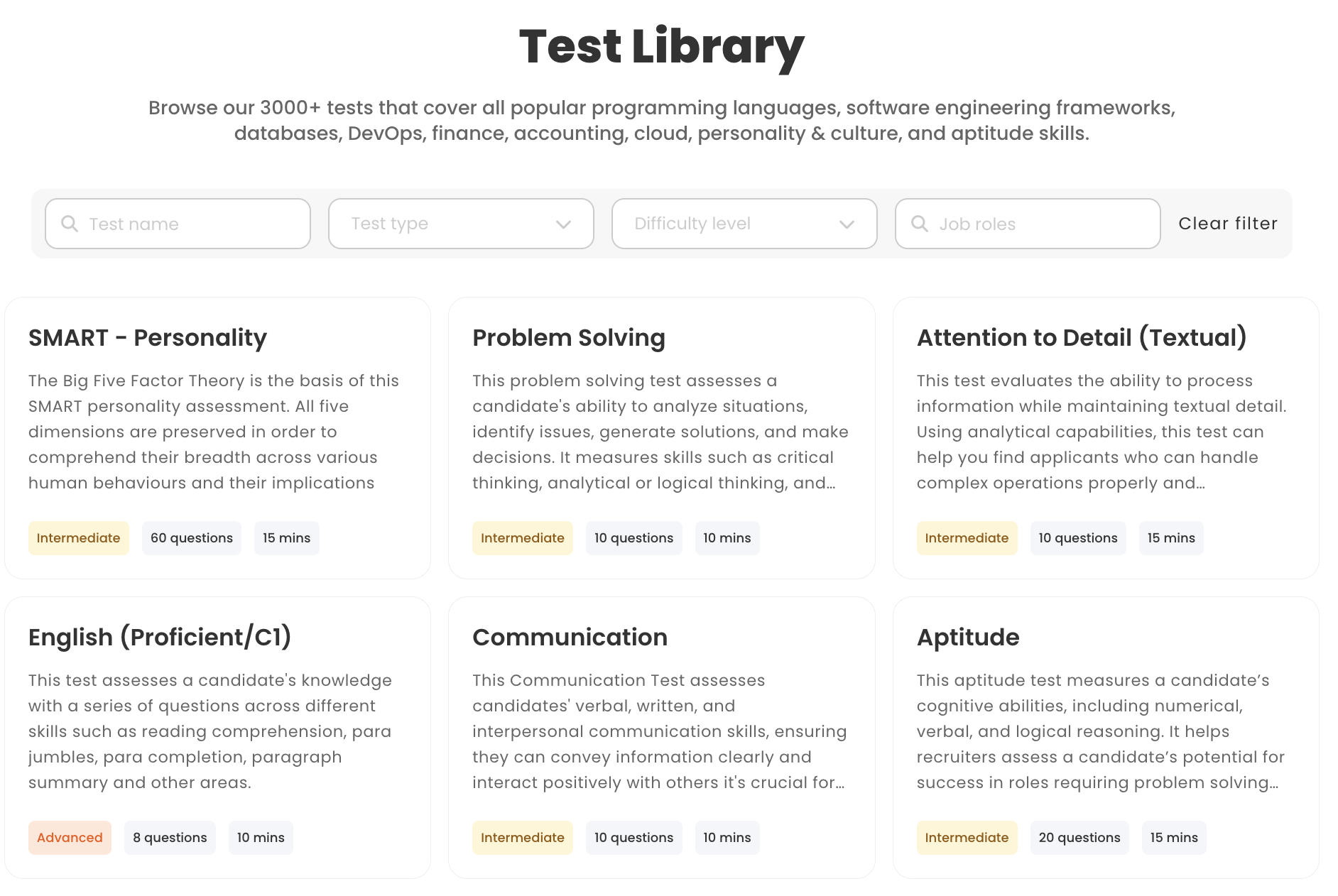
Testlify is an AI-assisted, human-led talent assessment platform. Teams build an assessment from a library of more than 3,500 tests, send it to candidates by link, and get a scored report with skill-level breakdowns, benchmarking and integrity evidence. Coding is one category among thirteen, next to cognitive ability, psychometric, situational judgement, language, software skills, simulation and blue-collar testing.
Key features
- More than 25 question types, including coding, typing, practical work samples, and live-scored tasks inside Microsoft Office and Google Workspace files.
- Conversational AI interviews in video, voice and phone formats, with selectable AI avatars, voices and custom prompts.
- Item-level psychometrics surfaced to recruiters: difficulty index, discrimination index and a quality-risk flag per question.
- An AI checker that classifies a written answer as human, AI generated, or mixed.
- Dual-device proctoring, plus around 20 other integrity measures across identity, environment, browser lockdown and AI-assistance detection.
- More than 100 ATS integrations, so an existing system of record stays the system of record.
Pros
- One platform covers technical and non-technical hiring, which matters if engineering is a minority of your requisitions.
- Published pricing you can budget against without a sales call.
- AI scoring ships with a human-override toggle and an in-product disclaimer that AI scores are guidance, not decisions. That is the line compliance teams ask about.
Cons
- No scheduling for live human interview panels. If you need calendar coordination for a four-person loop, that lives elsewhere.
- Chromium desktop only for candidates. The mobile app is a capture fallback for audio and video, not a way to sit a full assessment on a phone.
- White labeling, SSO and the ATS integration bundle are paid add-ons on the self-serve tiers, at $2,388 a year each, and are included only on the Custom plan.
Best for
Teams under roughly 200 people who hire across functions and want evidence on every role, not just engineering. Often the buyer here is a founder or an operations lead who owns hiring outcomes without doing recruiting full time.
What is HackerRank?
HackerRank is a developer skills platform built around a large coding challenge library and a technical interviewing product. Engineering teams use it to screen candidates on programming problems, run live pair-programming interviews, and check submissions for plagiarism. It has been in the market for over a decade and is one of the names most engineers recognise on sight, which is a genuine advantage for candidate familiarity.
Key features
- A deep library of coding questions across many programming languages and computer science topics.
- Live collaborative coding interviews, with the interviewer watching a candidate work in real time.
- Keystroke playback on submissions, which replays how a solution was actually built rather than only what was submitted.
- Plagiarism and AI-assistance detection tuned to code specifically.
- Role-based assessment templates for common engineering positions.
- ATS integrations and developer-community reach through hackathons and contests.
Pros
- Depth in one thing. For pure software engineering screening, the question bank and the interview tooling are mature.
- Keystroke replay is genuinely useful evidence in a technical debrief, and few assessment platforms have anything like it.
- Candidate recognition. Engineers have usually seen the interface before, which reduces friction.
Cons
- Coverage stops near the edge of engineering. Sales, finance, customer support and operations roles need a second tool.
- Pricing is not fully published. Higher tiers are quoted, which makes budgeting harder for a small team.
- Behavioural, cognitive and situational signals are not part of the platform, so a candidate who codes well but cannot communicate looks identical to one who can.
Best for
Engineering-heavy organisations screening developers at volume, where the hiring bar is defined almost entirely by code quality and the recruiting team is comfortable running non-technical hiring somewhere else.
Testlify vs HackerRank: feature comparison
The rows below are the ones that actually change a buying decision. A longer grid mostly measures who wrote the grid.
Capability | Testlify | HackerRank |
|---|---|---|
Primary focus | All roles, technical and non-technical | Software engineering |
Test library | 3,500+ tests, 13 categories | Coding and technical questions |
Coding editor | VS Code in browser, single or multi-file projects | Browser code editor, live pair coding |
Test cases per coding question | Up to 20, visible or hidden, per-case scoring | Supported |
AI-assisted coding assessment | Vibe coding: candidates direct AI to a working solution | Not offered as a scored format |
Cognitive and psychometric tests | Yes | Not part of the platform |
Situational judgement and role-specific tests | Yes | Not part of the platform |
Office and Workspace work samples | Scored Word, Excel, PowerPoint, Docs, Sheets, Slides tasks | Not part of the platform |
One-way video interviews | Yes | Yes |
Two-way conversational AI interviews | Video, voice and outbound phone, with AI avatars | Not offered |
Live human interview panel scheduling | No | Live technical interviews, scheduled |
Dual-device proctoring | Phone becomes a second camera, session blocked until active | Not offered |
AI-generated answer detection | Human, AI generated, or mixed classification | Code plagiarism and AI detection |
Item-level psychometrics | Difficulty index, discrimination index, quality risk | Not surfaced |
White labeling | Yes, paid add-on on self-serve tiers | Not offered |
ATS integrations | 100+, paid add-on on self-serve tiers | Yes |
Published pricing | Full tier table public | Higher tiers quoted |
Compliance | SOC 2 Type II, ISO 27001, GDPR, CCPA, NYC Local Law 144 | GDPR, ISO 27001 |
How do the test libraries compare?
Testlify carries more than 3,500 tests across 13 categories covering 4,500+ roles, so one platform handles a backend engineer, a paid-media analyst and a warehouse supervisor. HackerRank's library is deeper inside software engineering and stops there. If engineering is most of your hiring, that depth wins. If it is a third of it, breadth wins.
Here is the part most comparison pages skip. The shape of technical hiring is shifting underneath both tools. The US Bureau of Labor Statistics projects employment of software developers, quality assurance analysts and testers to grow 10 percent from 2025 to 2035, against a 3 percent average across all occupations. Over the same decade it projects employment of computer programmers to decline 7 percent, with median pay of $100,390 in May 2025.
Read those two numbers together. The roles that are growing are the ones where writing syntax is a small part of the job. The roles that are shrinking are the ones where it was most of the job. A screening process built only around algorithm puzzles is optimising for the half of the market that is getting smaller.
Testlify's test library spans cognitive ability, personality and culture, situational judgement, language, typing and blue-collar categories alongside programming. That breadth is the whole argument for it.
How deep is each platform's coding assessment?
Deeper on the Testlify side than the checkmark grids suggest. Testlify runs a real VS Code editor inside the browser, supports single-file questions and multi-file projects, allows up to 20 test cases per question with visible or hidden cases and per-test-case scoring, imports test cases in bulk from CSV, and scores SQLite database questions. Authors can also let candidates run the test cases themselves before submitting.
Then there is vibe coding, which is Testlify's answer to a problem every technical hiring team is arguing about right now. The product describes it plainly: vibe coding lets candidates direct AI tools to reach a working solution instead of writing syntax manually. Rather than banning AI from the assessment, it makes AI direction the thing being scored.
That matters because the tools are already in the building. Stanford's 2025 AI Index recorded 78 percent of organisations using AI in 2024, up from 55 percent the year before. And Gallup's Q4 2025 workplace data put frequent AI use, meaning at least a few times a week, at 26 percent of US employees overall and 12 percent using it daily. In technology roles the same measurement was 57 percent frequent and 31 percent daily. Screening a developer on their ability to write code without AI is measuring a workflow that fewer of them use every quarter.
HackerRank's coding depth is real and well established, and its keystroke playback is a better forensic record of how a solution was built than anything in the Testlify reports. For a team whose entire hiring bar is code quality, that is a fair reason to stay.
Pro tip: before you compare libraries, pull last year's requisitions and count them by function. Companies that think of themselves as engineering companies are often surprised by how small the engineering share turns out to be once sales, support, finance and operations roles are added up. That one count settles this decision faster than any feature table.
How do the interview formats compare?
This is the widest gap, and it runs the opposite way from what the category name suggests.
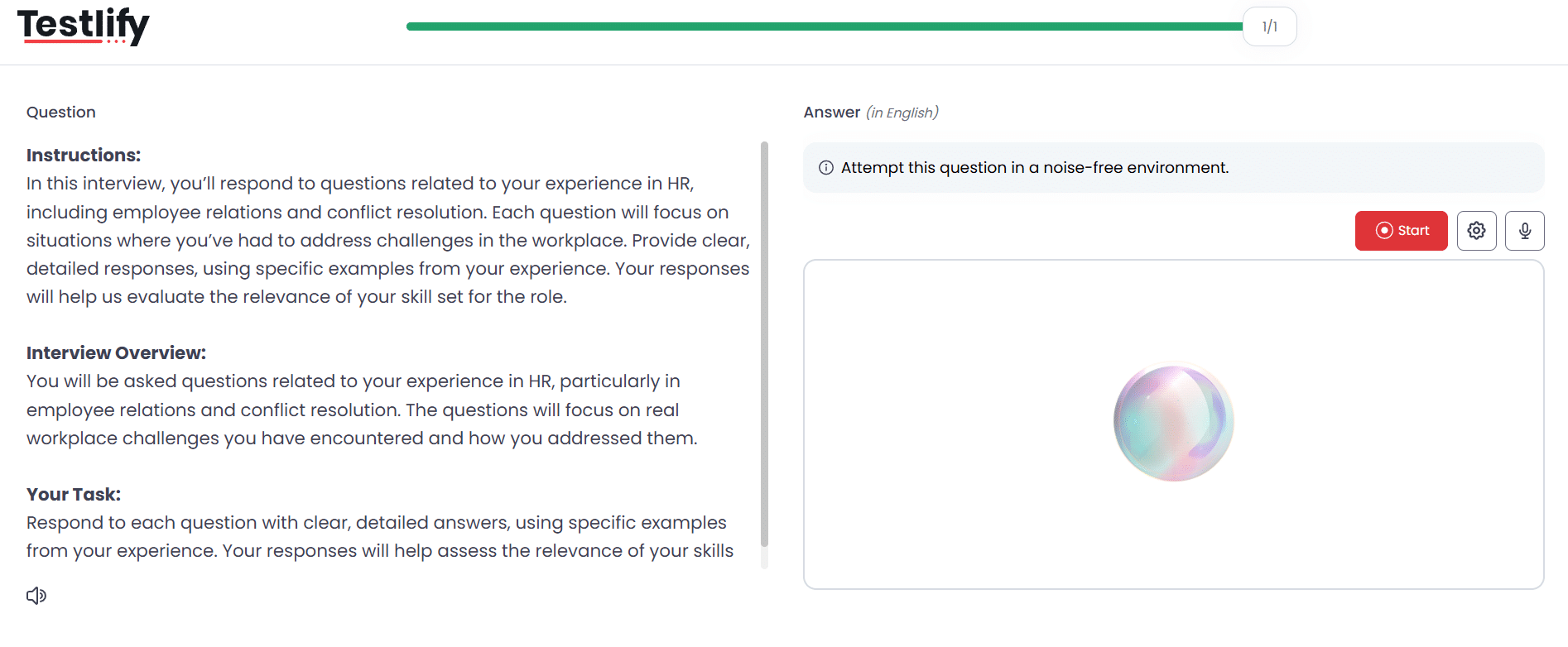
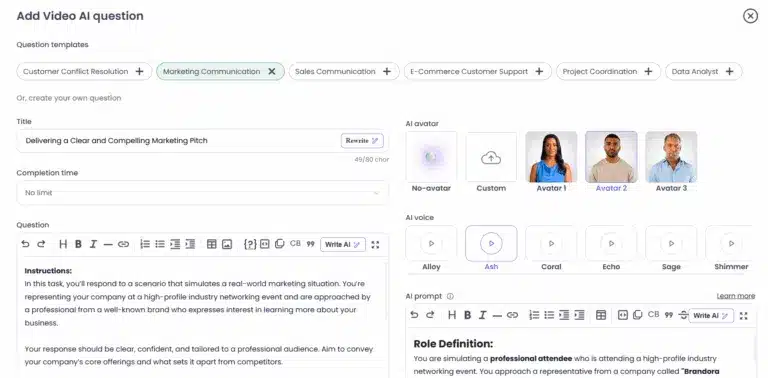
Testlify runs one-way asynchronous video, two-way conversational AI video and voice interviews, and outbound AI phone interviews billed at $0.18 a minute. The AI interviewer is configurable: pick an avatar, pick a voice, set a persona and context, write custom prompts, or start from one of 150+ interview templates. Recording controls cover attempt limits, recording time, completion time and auto-start with preparation time. Transcripts are automatic and multilingual, generated for recordings of at least 30 seconds. Answers are auto-scored, and a human reviewer can override the score. During a live AI voice interview the candidate is muted while the AI speaks, which is a small detail that tells you the turn-taking is genuine rather than a set of recorded prompts.
HackerRank's interviewing product is live and human: an interviewer and a candidate in a shared coding environment, in real time. It is very good at what it does and it is a different job. It also solves something Testlify does not, which is scheduling and running a live panel.
So the honest split: Testlify automates the first-round conversation across every role. HackerRank supports the deep technical conversation for engineering roles. A team hiring 30 support agents wants the first. A team hiring 5 staff engineers wants the second. A team doing both is the reason this page exists.
Which platform stops cheating more reliably?
Testlify covers a wider surface; HackerRank goes deeper on the specific problem of copied code.
Testlify ships three proctoring presets, Standard, Strict and Custom, over roughly 20 measures: full-screen enforcement, tab-switch detection, face detection and single-presence verification, photo ID verification with a face match against the ID, periodic webcam snapshots, session and screen recording, copy-paste tracking, multi-monitor restriction, AI-tool and browser-extension detection, IP proctoring, location tracking and a candidate honesty agreement. Results are colour-flagged, and the wording is deliberately careful: a yellow flag reads that some behaviour was not ideal and a quick manual review is recommended, not that the candidate cheated. Auto-termination is a separate opt-in setting with a threshold the recruiter picks.
The standout is dual-device proctoring. The candidate's phone becomes a second camera positioned to capture both the candidate and the laptop screen, and it is a hard gate: the assessment will not start until mobile monitoring is active, and disconnecting is logged and reported. Very few assessment platforms offer this at all.
HackerRank's integrity work is narrower and sharper. Code plagiarism detection against known solutions is a specific, difficult problem and it has spent years on it. If your only integrity worry is a candidate pasting a solution from a forum, that focus is an advantage.
Testlify also publishes what happens to the evidence afterwards, which matters for a privacy review: face verification data is deleted after 30 days and consent can be withdrawn at any time, video and audio responses are removed after 6 months with advance warnings, and screen and camera recordings are kept for a configurable number of days. Details sit in the proctoring documentation.
What do Testlify and HackerRank actually cost?
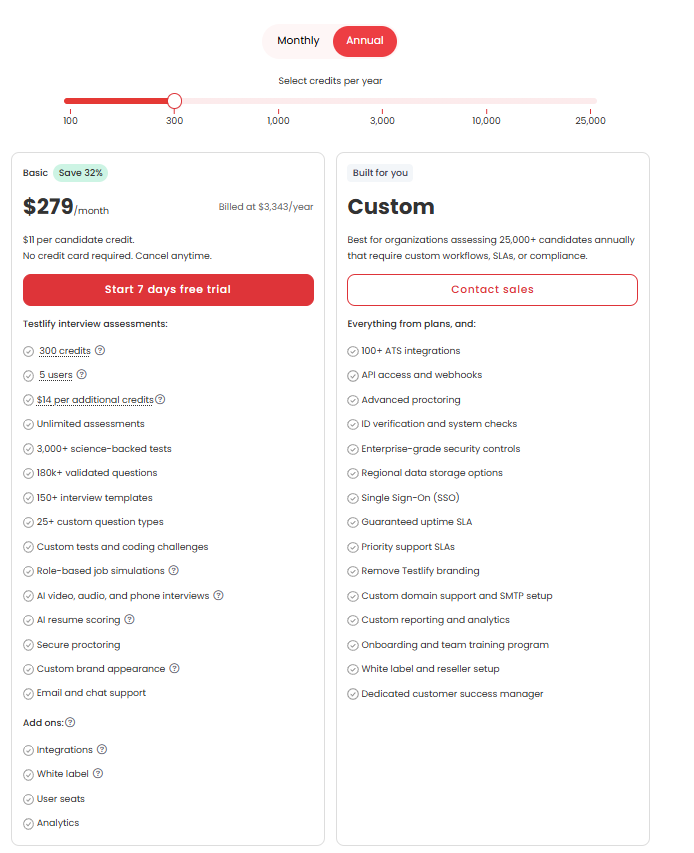
Testlify publishes the whole ladder. Pricing is a credit-volume selector crossed with a monthly or annual toggle, where one credit equals one started assessment by a qualified candidate. Credits do not roll over.
Tier | Credits per year | Price, billed annually | Per credit | Seats |
|---|---|---|---|---|
Starter | 100 | $139 a month, billed $1,668 a year | $16.68 | 3 |
Basic | 300 | $279 a month, billed $3,348 a year | $11.16 | 5 |
Business | 1,000 | $699 a month, billed $8,388 a year | $8.39 | 10 |
Premium | 3,000 | Contact sales | Volume-based | 20 |
Enterprise | 10,000 | Contact sales | Volume-based | 30 |
Custom | 25,000+ | Contact sales | Volume-based | 40 |
Monthly billing is a different set of numbers for the same tier names, with smaller credit bundles. Extra seats are $15 per seat per month on every tier. There is a 7-day free trial with no card, a 30-day money-back guarantee, price locked for 24 months, and a 25 percent non-profit discount. Metered items are billed separately: AI phone interviews at $0.18 a minute, system check at $0.25, face verification at $0.50 an attempt.
Two things to budget for honestly. White labeling and the 100+ ATS integration bundle are $2,388 a year each on the self-serve tiers and are included only on Custom, and SAML SSO with 2FA is also a paid add-on there. Anyone who tells you every feature is included on every plan is reading the marketing bar rather than the price table.
HackerRank does not publish the same level of detail. Its tiers are structured from a small starter plan up to enterprise, and the higher ones are quoted by sales. That is normal for enterprise developer tooling, and it is a real friction point for a 40-person company trying to compare two numbers on a Tuesday afternoon.
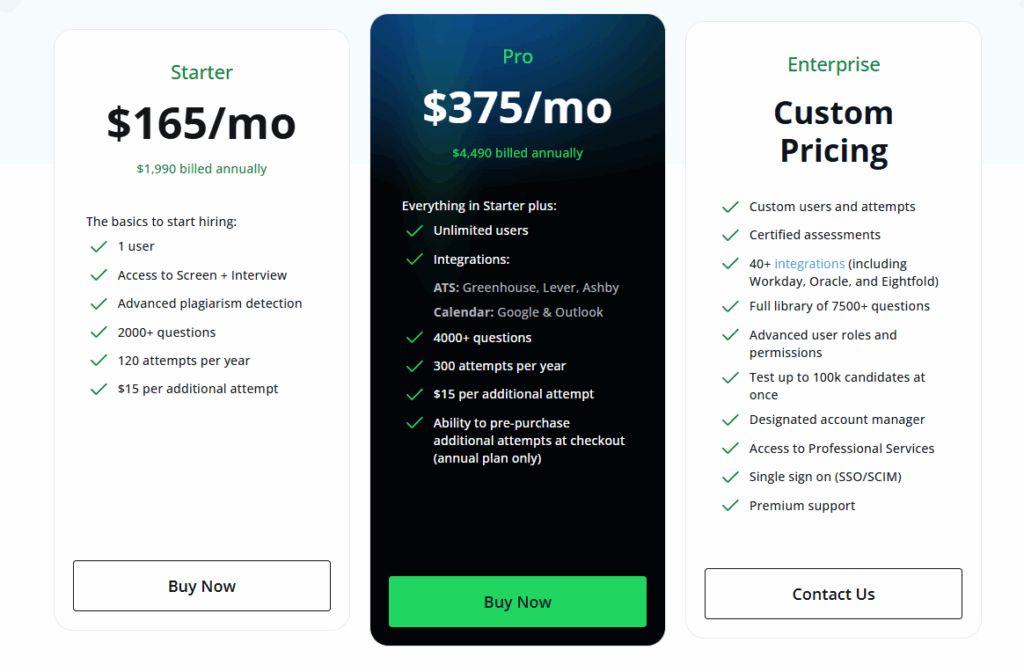
Full current figures on the Testlify pricing page.
Which platform should you choose?
Run the requisition count first. If more than about 70 percent of your hiring is software engineering and the bar is code quality, HackerRank's depth and its live technical interviews are worth the narrower scope and the quote-based pricing.
If your hiring is mixed, Testlify is the better fit, and the argument is not feature count. It is the Testlify Multi-Signal Talent Evaluation Model: candidates should advance when several independent, role-relevant signals point the same way, not when one strong signal does. A coding score is one signal. Add a work sample, a situational judgement test, an AI interview with a scored transcript and reviewer feedback, and you get a decision you can defend six months later when someone asks why this person was hired.
That framing also explains the awkward case in the middle. A team that hires 10 engineers and 40 non-engineers a year and runs two platforms is paying twice, training recruiters twice, and comparing candidates in two scoring systems that do not talk to each other. Consolidation is usually worth more to them than the last 10 percent of coding depth.
One caveat worth stating plainly. If your engineering interview loop depends on live pair programming with a senior engineer watching, Testlify will not run that session for you and will not schedule the panel. Plan for that rather than discovering it in week three.
Under 200 people and no applicant tracking system yet? Testlify also ships a simple built-in hiring pipeline: job requisitions, an application form, job-board publishing and an applied to shortlisted flow. It is deliberately basic. If you already run Greenhouse, Workday or Lever, keep them and connect Testlify as the screening layer instead.
Where to go next
Pull last year's requisitions, split them by function, and price both options against that number rather than against a feature grid. Then run one real role through a shortlist of two tools before signing anything. If you want to see how the multi-signal version looks on a role you are hiring for right now, book a demo and bring the job description. You can also start on the free trial and build the assessment yourself from the coding test library.
Key takeaways
- Function mix decides this, not features. HackerRank is deeper in software engineering; Testlify covers engineering plus every other function. Count last year's requisitions by function before you compare anything, because a team where engineering is under half of hiring will end up buying a second platform if it picks the narrower tool.
- Coding depth on Testlify is closer than the grids suggest. A browser VS Code editor, multi-file projects, up to 20 scored test cases and SQLite questions are not a token coding module. If you rejected broad assessment platforms on coding depth two years ago, that objection is worth re-testing.
- The labour market is moving away from syntax-only screening. BLS projects software developer roles up 10 percent and computer programmer roles down 7 percent over 2025 to 2035. Screening built purely on algorithm puzzles is tuned to the shrinking half, so build in judgement and communication signals now rather than at the next re-tool.
- AI is already in the candidate's workflow. Gallup measured 57 percent of technology employees using AI frequently at work in Q4 2025. Assessments that ban AI outright test a workflow fewer developers use; scoring how a candidate directs AI is the more durable signal.
- Proctoring breadth versus plagiarism depth is a real trade. Testlify's dual-device camera gate and 20-plus integrity measures cover identity and environment; HackerRank goes deeper on copied code. Pick by the failure mode you actually fear, because buying both is rarely justified.
- Price the add-ons, not the headline. Testlify's tiers are public from $139 a month, but white labeling, SSO and the ATS bundle are $2,388 a year each on self-serve plans. A budget built on the headline tier alone will be short by roughly $5,000 a year if you need two of the three.
- Know the boundary before you sign. Testlify does not schedule live human interview panels. If a senior engineer must watch a candidate code in real time, that stays with a dedicated technical interviewing tool.
FAQs

Director of Marketing
Akash Patange is the Director of Marketing at Testlify, where he works closely with HR leaders and recruiters to help organizations improve hiring outcomes. He writes about talent assessment, recruitment technology, and data-driven hiring practices.
LinkedInRelated resources
View all
Competitor Comparisons
Testlify vs. HackerEarth: Which Skills Assessment Platform is Best for HR Teams?
Competitor Comparisons
Testlify vs. Hiremojo: Which Skills Assessment Platform is Best for HR Teams?
Competitor Comparisons
Testlify vs. Coderbyte: Which Skills Assessment Platform is Best for HR Teams?
Competitor Comparisons
Testlify vs TestDome: Skills Assessment Platforms Compared
Competitor Comparisons
Testlify vs. Hirevue: Which Skills Assessment Platform is Best for HR Teams?
Competitor Comparisons
Testlify vs. iMocha: Which Skills Assessment Platform is Best for HR Teams?
Get started.
Hire on proof, not resumes.
Run your first skills-based assessment free — no credit card required.