
Autonomous AI hiring agents for enterprise: a 2027 guide
What AI hiring agents can run alone, where people must stay in charge, which rules apply and how enterprise TA teams should pilot one.

Picture a recruiter opening the ATS to find hundreds of new applicants and a calendar full of screens still to book. Autonomous AI hiring agents for enterprise take that work on, running sourcing, outreach, screening and scheduling toward a goal such as a shortlist.
This guide shows what agents can run alone, where people must stay in charge, which rules apply and how to pilot one. A person sets the goal and the limits, and the agent asks for help when a decision needs human judgment.
TL;DR:
- An autonomous AI hiring agent plans and runs multi-step recruiting work toward a goal, then hands judgment calls to a person. A chatbot or copilot only answers or drafts when asked.
- In 2026, agents run sourcing, outreach, prescreening and scheduling well. No mainstream tool runs hiring from job post to offer with no human decision.
- Most enterprises should aim for supervised autonomy: the agent runs the steps, and people review the shortlist, every rejection and every offer.
- Gartner reports that 82% of HR leaders plan to implement agentic AI by 2026, and warns about vendors relabeling chatbots as agents.
- NYC Local Law 144 already requires a yearly bias audit and candidate notice. EU high-risk rules for AI in hiring apply from 2 December 2027.
- Agents shortlist fairly only when they have real skills evidence, such as scored tests and structured interviews, not just resume keywords.
 ChatGPT
 Gemini
 Claude
 Grok
 Perplexity
What are autonomous AI hiring agents for enterprise?
Autonomous AI hiring agents for enterprise are AI systems that pursue a hiring goal across several steps and tools with little step-by-step instruction. Unlike a chatbot or a rules engine, an agent decides which action comes next, checks whether it worked, and escalates to a recruiter when it reaches a decision it should not make alone.
The word "agent" is stretched in vendor marketing. Gartner's view of agentic AI in HR calls this "agentic AI washing": assistants relabeled as agents without real power to act.
The table below separates the three kinds of tool enterprise buyers are shown in demos.
Feature | Rules-based automation | AI assistant or copilot | AI hiring agent |
|---|---|---|---|
Starts work | When a fixed trigger fires | When a person asks | When given a goal |
Decides the next step | No, follows a script | No, the person does | Yes, within guardrails |
Uses several tools | Only the ones wired in | Rarely | Yes: ATS, email, calendar, job boards |
Example | Send a test invite when status changes | Draft an outreach message | Source, contact, prescreen and schedule for a role |
Human role | Builds the rules | Directs every task | Sets goals, reviews checkpoints, decides |
For the wider trends behind this shift, see agentic AI in recruitment.

How do autonomous AI hiring agents work?
Autonomous AI hiring agents work in a loop: a person sets the goal and guardrails, the agent plans the steps, acts inside connected tools, checks the result against the goal, and either continues or escalates. Every action is logged, so the team can see what the agent did and why.
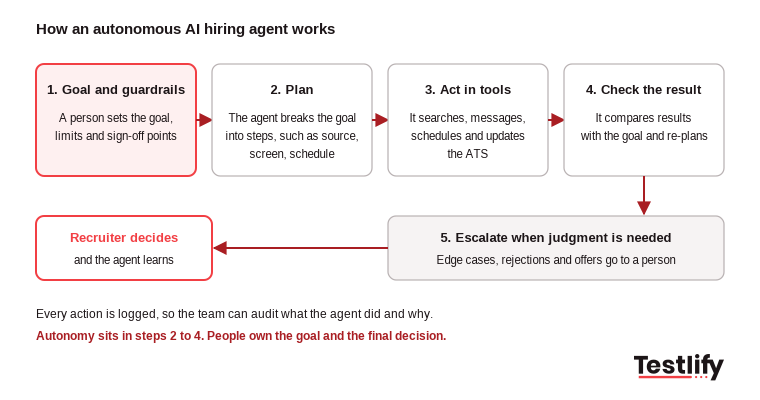
The loop has five stages, and each one has a clear owner, either the agent or a person. The steps below show how a recruiter's goal becomes a checked result.
- Goal and guardrails: The recruiter or TA ops team defines the outcome (for example, 10 qualified candidates for a support role in two weeks), the budget, the channels and the points where a person must sign off.
- Plan: The agent breaks the goal into steps: search the ATS and job boards, rank applicants, send outreach, book screens.
- Act in tools: The agent works inside the ATS, email, messaging and calendar systems it has permission to use.
- Check the result: The agent compares progress with the goal and changes course, for example by widening a search when replies are low.
- Escalate: Edge cases, unclear fits, rejections and offers go to a person. The recruiter's decision feeds back into the next cycle.
The quality of the loop depends on the data the agent can read. An agent that only sees resumes will rank candidates on resume signals.
An agent that sees scored skills tests and structured interview results can rank on evidence of ability.
What can AI hiring agents do on their own today?
AI hiring agents can already run the repetitive, rules-heavy parts of recruiting on their own: sourcing, first outreach, answering candidate questions, prescreening and interview scheduling. Judgment-heavy steps, such as final selection, rejections, offers and negotiation, still sit with people in every mainstream product described by the sources we reviewed.
LinkedIn is one example of how far a large platform goes. Its Hiring Assistant is sold as an AI recruiting agent that turns intake notes into a sourcing strategy, runs searches, reviews applicants from LinkedIn and the ATS, prescreens by voice or text and schedules interviews.
LinkedIn also states that it "will only do the tasks you want it to do."
Based on LinkedIn data from July 2026, recruiters using it reviewed 83% fewer profiles to find qualified matches and found interview-quality applicants 33% faster.
Hiring task | Can an agent run it alone in 2026? | What a person should still do |
|---|---|---|
Sourcing and search | Yes, within set criteria | Approve the criteria |
First outreach and follow-up | Yes, with approved templates | Spot-check tone and accuracy |
Candidate questions (FAQ, status) | Yes | Handle complaints and accommodations |
Interview scheduling | Yes | Nothing routine |
Prescreen and skills assessment | Yes, with structured, scored steps | Set pass marks, review borderline cases |
Shortlist ranking | Partly | Review the shortlist and the evidence |
Rejection | Should not | Confirm every rejection |
Offer and negotiation | No | Own it fully |
Pro tip: Ask every vendor which row of this table its agent acts on without a click from a person. "Autonomous" in a demo often means automatic drafts that still need approval.
How much autonomy should an enterprise give an AI hiring agent?
An enterprise should give an AI hiring agent supervised autonomy: the agent runs multi-step work within guardrails, and people review the outcome at fixed checkpoints such as the shortlist and every rejection. Full autonomy, where people only see exceptions, rarely suits hiring because rejections carry legal and candidate-experience weight.
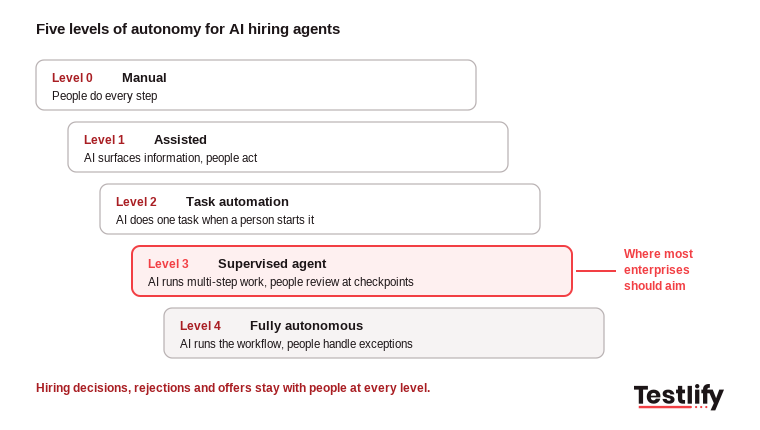
A useful way to picture this is a scale of five levels, which vendors such as Phenom also use in their buyer guides:
- Level 0, manual: People do every step.
- Level 1, assisted: AI surfaces information, people act.
- Level 2, task automation: AI completes one task when a person starts it.
- Level 3, supervised agent: AI runs multi-step work, people review at checkpoints.
- Level 4, fully autonomous: AI runs the workflow, people only handle exceptions.
Autonomy is set per task, not per product. Scheduling can safely run at level 4 while shortlisting stays at level 3 and offers stay at level 0. Gartner's talent acquisition trends for 2026 describe high-volume recruiting going "AI-first" and say hands-on monitoring is a must: define the reasonable range of outcomes ahead of time and watch for deviations.
Why are enterprises adopting AI hiring agents now?
Enterprises are adopting AI hiring agents because recruiting teams face high application volumes and hard-to-fill roles with flat headcount, and recruiting is where HR already uses AI most. Agents promise to take over coordination work so recruiters spend time on candidates and hiring managers.
The pressure is clear in the numbers. SHRM's 2026 Talent Trends survey of 2,094 HR professionals found that 68% had difficulty recruiting full-time employees, and 53% of those said it was harder than a year earlier.
Recruiting is also the most AI-ready HR function: SHRM's 2026 research on AI in HR found 27% of organizations apply AI in talent acquisition, more than any other HR area, mostly for job ads, application screening and interview scheduling.
Intent is high too. Gartner reports that 82% of HR leaders plan to implement agentic AI by 2026, and predicts that by 2030, 50% of HR tasks will be completed through AI agents.
For enterprise TA teams, the practical gains are:
- Speed: Sourcing, outreach and scheduling run around the clock, so first-round interviews no longer wait on calendars.
- Consistency: Every applicant gets the same screening steps and the same criteria.
- Recruiter time: Admin moves to the agent, and recruiters spend more time with hiring managers and finalists.
- Reach: Agents can search wider talent pools and follow up on every applicant, not only the first page of results.
What are the risks of autonomous hiring agents?
The main risks of autonomous hiring agents are errors repeated at scale, bias carried over from past hiring data, weak accountability, candidate distrust and projects that never deliver value. An agent that makes a wrong call makes it for hundreds of candidates before anyone notices.
- Errors at scale: A bad search filter or misread requirement repeats across every requisition the agent touches.
- Inherited bias: Agents that learn from past hiring decisions can repeat past patterns. Pass-through rates by group need regular audits.
- No clear owner: When an agent rejects a candidate, someone must be accountable for that decision.
- Candidate trust: Candidates who never reach a person, or never hear back, lose trust in the employer brand.
- Failed projects: In June 2025, Gartner predicted that more than 40% of agentic AI projects would be canceled by the end of 2027 because of rising costs, unclear business value or weak risk controls, as reported by HR Brew.
Key takeaway: The risk of an AI hiring agent grows with the decisions it makes alone. Keep agents fast on coordination and slow on rejection, and audit both.
What rules apply to autonomous AI hiring agents?
Two rules set the bar for enterprise use of autonomous AI hiring agents: New York City's Local Law 144, which applies now, and the EU AI Act, whose high-risk rules for hiring apply from 2 December 2027. Both expect bias checks, transparency with candidates and human oversight of AI that scores or filters people. The graphic below turns those expectations into six governance controls, and the list after it shows how each rule applies.
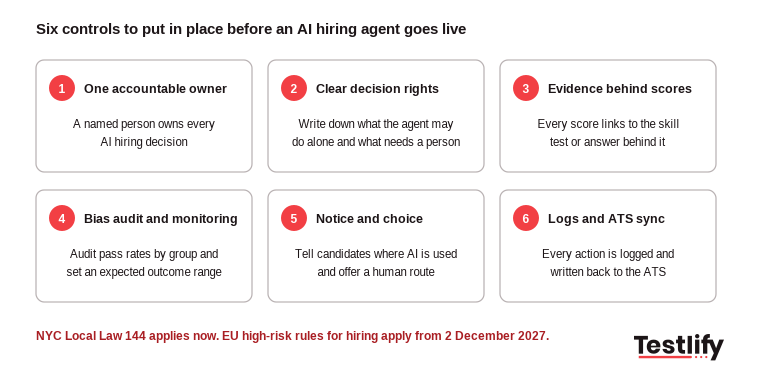
Three points show what these rules mean for an enterprise using an AI hiring agent:
- New York City: Under Local Law 144, employers can use an automated employment decision tool only if it had a bias audit within one year before use, the audit results are public, and candidates get notice 10 business days before use. The city has enforced the law since July 5, 2023.
- European Union: AI used to filter applications or evaluate candidates is high-risk under the AI Act. The European Commission's May 2026 announcement confirmed that high-risk rules for areas including employment apply from 2 December 2027, giving employers time to prepare risk management, human oversight and record-keeping.
- Candidate choice: Gartner advises recruiting leaders to explain how they use AI in hiring and to let candidates opt out of AI interviews.
Your legal team should map each agent action to these rules before go-live. For a wider checklist, see legal compliance in recruitment automation.
Why do AI hiring agents need skills evidence?
AI hiring agents need skills evidence because an agent can only rank candidates on the data it reads. Resumes show where someone worked and which keywords they used.
Scored skills tests and structured interviews show what a candidate can actually do, in the same format for every applicant.
This matters more as candidates use AI to write resumes and cover letters. When every application looks polished, resume-based ranking separates people less well.
An agent that triggers a role-based assessment after the first prescreen, then reads the scores, can build a shortlist a recruiter can defend.
Good skills evidence for an agent has four traits:
- Structured: The same questions and scoring criteria for every candidate in a role.
- Scored per skill: A score for each skill the role needs, not one opaque number.
- Explainable: A reviewer can open the answer behind each score.
- Trustworthy: Proctoring and identity checks confirm the work is the candidate's own.
This is the shift behind skills-based hiring: decide on proof of skill, then let automation handle the logistics around it.
How do you evaluate autonomous AI hiring agents for enterprise?
Evaluating autonomous AI hiring agents for enterprise starts with one question: which decisions does the agent make without a person, and how can you check them? From there, test integration, evidence, governance and candidate experience on a live account with a real requisition, not a curated demo.
Ask every vendor:
- Which steps does the agent complete without human approval, and can we change that per step?
- Is the agent built into our ATS, connected to it, or a separate tool that syncs data back?
- Can a reviewer see the evidence and reasoning behind every ranking and rejection?
- Do you have an independent bias audit, and how do you monitor pass-through rates by group after launch?
- How do candidates learn that AI is involved, and how do they reach a person?
- What does the audit log record, and can we export it?
- Who on our side approves changes to prompts, criteria and thresholds?
Integration deserves extra time. Workable's guide for enterprise TA leaders describes three patterns: an agent native to the ATS, an outside assistant connected to it, and a point tool that syncs results back.
Native agents keep one system of record. Point tools add sync delays and another vendor for security review.
How should an enterprise roll out an AI hiring agent?
An enterprise should roll out an AI hiring agent in phases: one hiring stage, one role family and one region first, with clear metrics and human review, then widen only when results hold. A phased start limits the cost of mistakes and builds the audit trail regulators expect.
- Pick the stage: Start where volume is high and judgment is low, such as scheduling or first-round screening for support or sales roles.
- Set guardrails and owners: Name one accountable owner, write down what the agent may do alone, and set the expected range of outcomes.
- Add skills evidence: Put a scored assessment or structured AI interview before any shortlist the agent builds.
- Run a parallel test: For two to four weeks, compare agent shortlists with recruiter shortlists on the same roles.
- Measure: Track time to shortlist, pass-through rates by group, candidate satisfaction, hiring manager acceptance of shortlists and quality of hire.
- Widen step by step: Add roles, regions or autonomy levels only when the numbers and the bias checks hold.
Where does Testlify fit with autonomous AI hiring agents?
Testlify is not a fully autonomous hiring agent. Testlify is an AI-native skills assessment and interviewing platform that gives agents, ATS workflows and recruiters the scored skills evidence they need to shortlist fairly, with people making the final call.
- Skills evidence: 3,500+ validated tests and 25+ question types, built from a job description, with a score per skill. Browse the test library.
- Structured AI interviews: Video AI, Voice AI and Chat AI interviews ask role-based questions and score every answer against the same criteria. Learn more about AI interviews.
- Automation with human review: The AI resume screener gives explainable match scores and can auto-advance by threshold, and workflows send the next assessment automatically. Reviewers see the evidence behind every score.
- Trust and fit: 20+ proctoring checks, assessments in 15+ languages, two-way sync with 100+ ATS and HRIS tools, and a third-party NYC Local Law 144 bias audit of Testlify's matching model completed on June 16, 2023.
Enterprise teams can see security, data residency and SSO options on the Testlify enterprise page.
Ready to give your hiring process better evidence?
Whatever level of autonomy you choose, the shortlist is only as good as the evidence behind it. Start a 7-day free trial of Testlify, no credit card required, and build a role-based assessment from your own job description. Prefer a walkthrough first? Book a demo to see how Testlify fits your hiring process.
Frequently asked questions (FAQs)

Co-Founder and CTO
Jiten Modi is Testlify's CTO and leads a 50-person engineering organization. He writes on technical hiring, evaluating developers with real-world assessments, and building engineering teams.
LinkedInRelated resources
View all
AI in recruitment
AI hiring disclosure: what employers must tell candidates

AI in recruitment
Automated candidate screening at scale: a practical playbook

AI in recruitment
Responsible AI in hiring: the decisions your team still owns
AI in recruitment
Role simulations in hiring: how to design, run and score them

AI in recruitment
What tools offer AI-generated questions for custom assessments?

AI in recruitment
How does Testlify’s AI scoring handle open-ended answers and code quality?
Get started.
Hire on proof, not resumes.
Run your first skills-based assessment free — no credit card required.