
Responsible AI in hiring: the decisions your team still owns
Responsible AI in hiring comes down to who decides. Set decision rights, check tools for bias, earn candidate trust and meet the 2027 rules.
Responsible AI in hiring means using AI tools in recruitment in a way that is fair, explainable, disclosed to candidates and overseen by people who own the final decision. My view is simple: a vendor cannot sell you responsibility. Your hiring team earns it through the decisions it keeps, the checks it runs and what it tells candidates.
 ChatGPT
 Gemini
 Claude
 Grok
 Perplexity
TL;DR
- Responsible AI in hiring is fair, explainable, disclosed AI use where a named person owns every hiring decision.
- The employer stays accountable for outcomes, even when the tool comes from a vendor.
- Let AI run admin and score structured work, let it recommend shortlists, and keep final rejections, offers and accommodation requests with people.
- Trust is low: Gallup found only 31% of Americans trust businesses to use AI responsibly in 2025.
- NYC already requires a yearly bias audit and 10 business days' notice. EU rules for AI in employment apply from 2 December 2027.
- Check selection rates by group before go-live and on a fixed schedule, and set your limits before you look at results.

What does responsible AI in hiring mean?
Responsible AI in hiring means four things in practice: the tool measures what the job needs, its results are checked for unfair gaps between groups, candidates know where AI is used, and a person can explain and overturn any outcome. Remove any one of the four and the process stops being responsible.
The UK government's Responsible AI in Recruitment guide groups the same ideas under safety, transparency, fairness, and contestability and redress. It also lists the risks by hiring stage. Screening tools trained on past hiring data can copy old bias or punish career gaps, which hits parents, carers and disabled candidates. Interview tools that read faces or eye contact can disadvantage neurodivergent candidates, and transcription can be less accurate for regional or non-native speakers.
Responsible AI is a narrower idea than responsible hiring in general, but it rests on the same habit: treat every candidate the way you would want your own process explained in public.
Why is responsible AI in hiring a team decision, not a vendor feature?
Responsible AI in hiring is a team decision because the employer, not the software vendor, makes the hire and carries the legal and reputational risk. US anti-discrimination law looks at outcomes, and a biased result from a bought tool is still the employer's result. A vendor can supply audits and documentation. Only your team can decide how the tool is used.
Most pages on this topic are written by vendors describing their own controls. Those controls matter, but they cover the model, not your process. The same well-audited tool becomes risky when a recruiter auto-rejects everyone under a score nobody agreed on, or when a hiring manager treats an AI summary as the interview.
NIST's AI Risk Management Framework puts "Govern" first for that reason: someone has to own the risk before anyone can measure or manage it. In hiring, that owner is usually the head of talent acquisition, with legal and HR operations alongside.
[AKASH INPUT: one example from a hiring team where the tool was fine but the process around it was not, and what changed.]
Testlify has written before about the ethical side of AI in recruitment. This post goes one step further: who decides what, and how you prove it.
Which hiring decisions should AI make, recommend or never touch?
Hiring decisions fall into three groups. AI can run admin and score structured work on its own. AI can recommend shortlists and summaries that a person approves. Final rejections, offers, accommodation requests and appeals should stay with people. Writing this split down before rollout is the most useful single step a team can take.
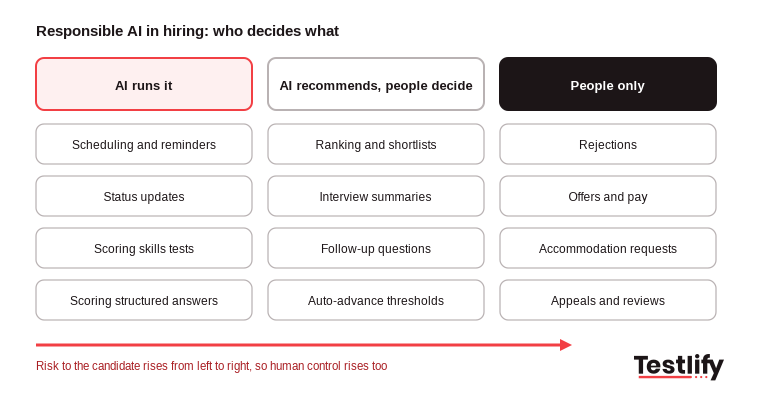
Decision | Who decides | Why |
|---|---|---|
Scheduling, reminders, status updates | AI runs it | Low risk, easy to correct, saves recruiter hours |
Scoring a skills test or structured answers | AI scores, a person can review | Same criteria for every candidate, scores can be explained |
Ranking and shortlisting | AI recommends, a person approves | Errors here remove people silently |
Interview summaries and notes | AI drafts, the interviewer edits | Summaries can drop context or tone |
Rejection at any stage | A person decides | High impact, must be explainable and open to challenge |
Offers and pay | A person decides | Accountability and pay equity |
Accommodation requests and appeals | A person decides | Requires judgment and legal care |
The table changes with risk. Auto-advancing candidates who pass a clear skills threshold is lower risk than auto-rejecting those who miss it, because a wrong rejection is invisible. A structured interview or a skills test gives AI something fair to score. A resume alone gives it far less.
Pro tip: Name an owner for every row in the table, by role, not by team. "TA operations manager approves all shortlists" is a control. "The team reviews outputs" is not.
Why does candidate trust make responsible AI in hiring urgent?
Candidate trust makes this urgent because most people do not yet believe businesses use AI responsibly. According to Gallup's 2025 survey of 3,007 US adults, 31% trust businesses a lot or some to use AI responsibly, up from 21% in 2023, while 28% do not trust them at all.
Hiring teams are adopting AI faster than that trust is building. LinkedIn's Future of Recruiting 2025 report found that 37% of organizations are integrating or experimenting with generative AI in recruiting, up from 27% a year earlier, and that those teams save about 20% of their work week. The same report found 61% of talent acquisition professionals believe AI can improve how they measure quality of hire.
That gap is an opening. When most employers say little about AI, the one that explains it plainly on the careers page and in the invite email stands out. Candidates who understand how they will be assessed are more likely to finish the process and less likely to assume the worst about a rejection. Good candidate experience now includes AI disclosure.
What do the laws on AI in hiring require in 2026 and 2027?
The laws on AI in hiring share three demands: test the tool for bias, tell candidates, and keep a person accountable. New York City has enforced its rules since July 5, 2023. Illinois added AI rules to its Human Rights Act from January 1, 2026. The EU's high-risk rules for AI used in employment apply from 2 December 2027.
Rule | Where | What it asks of employers | Status |
|---|---|---|---|
Local Law 144 | New York City | Bias audit within one year before use, public audit summary, candidate notice 10 business days before use | Enforced since July 5, 2023 |
Human Rights Act amendment (HB 3773) | Illinois | No AI use that discriminates, no zip codes as a proxy, notice when AI is used in employment decisions | In effect from January 1, 2026 |
EU AI Act, high-risk employment systems | European Union | Human oversight and monitoring by deployers, logging, documentation, quality data from providers | Applies from 2 December 2027 |
EU AI Act, transparency rules | European Union | Tell people when they interact with an AI system such as a chatbot | From August 2026 |
Federal anti-discrimination law | United States | Outcomes judged under existing law whoever built the tool | Applies now |
The NYC Department of Consumer and Worker Protection explains Local Law 144 in plain terms. For EU hiring, the European Commission's AI Act page lists CV-sorting software as a high-risk example and confirms the AI Omnibus moved the employment date from August 2026 to December 2027.
Treat the extra 16 months as build time, not breathing room. Teams that hire across the US, UK and EU will find it simpler to meet the strictest rule everywhere than to run three processes. For a wider view of the rules around testing, see our guide to legal compliance for hiring tests.
How do you check an AI hiring tool for bias?
Checking an AI hiring tool for bias means comparing outcomes across groups at each stage the tool touches. Teams compare selection rates by sex, race and ethnicity and, where lawful, age and disability, look for large gaps, find the cause, fix it and check again on a fixed schedule.
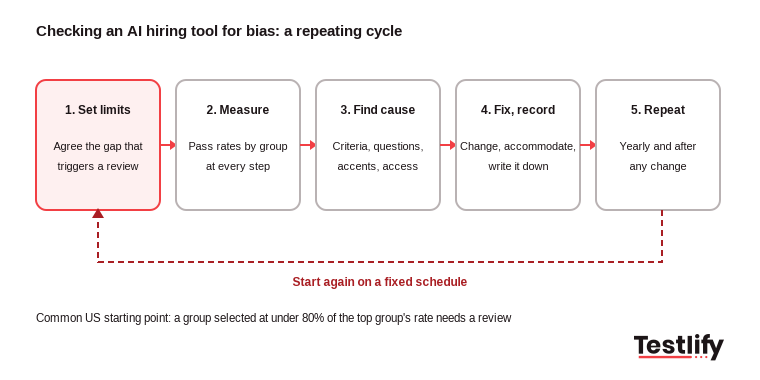
- Set your limits first: Agree what size of gap triggers a review before you see any results. A common US starting point is the four-fifths rule: a group selected at under 80% of the top group's rate signals possible adverse impact.
- Measure each stage: Look at pass rates for screening, assessment and interview separately. A fair test can sit inside an unfair funnel.
- Find the cause: Large gaps usually trace to a criterion that is not job related, a question that favors one group, or a tool that misreads accents or assistive technology.
- Fix and record: Remove or reweight the cause, offer a reasonable accommodation route, and write down what changed and why.
- Repeat on a schedule: Re-run the check at least once a year and after any change to the tool, the role or the candidate pool.
Skills-based steps help here. Our guide on using skills assessments to reduce bias covers how job-related tests narrow the gaps that resume screens often widen.
What evidence should you ask an AI hiring vendor for?
AI hiring vendors should give you evidence, not promises: a recent independent bias audit, test results across groups, a plain description of the model and its training data, its limits, and how often they re-test. The UK government's recruitment guide lists these same items as the evidence buyers should request from suppliers.
- Model type and purpose: What the tool does, what it was built for, and what it should not be used for.
- Training data: Where the data came from and how protected groups are represented in it.
- Performance by group: Accuracy and selection results across groups, in a market like yours.
- Bias audit: A recent independent audit, its date, and whether the summary is public.
- Explainability: How a recruiter can see why a candidate got a score. Look for algorithmic transparency in the product, not only in a policy.
- Testing schedule: How often the vendor re-tests, and how you will hear about changes.
- Human controls: Whether you can review, override and log every automated outcome.
Key takeaway: If a vendor cannot answer these seven points in writing, the tool is not ready for decisions about people, however good the demo looks.
How do you roll out responsible AI in hiring in 90 days?
A responsible AI in hiring rollout takes about 90 days in three steps: map and decide in the first 30 days, pilot and test in the next 30, then launch with monitoring in the last 30. The plan keeps people in charge from the first day and leaves an audit trail regulators can follow.
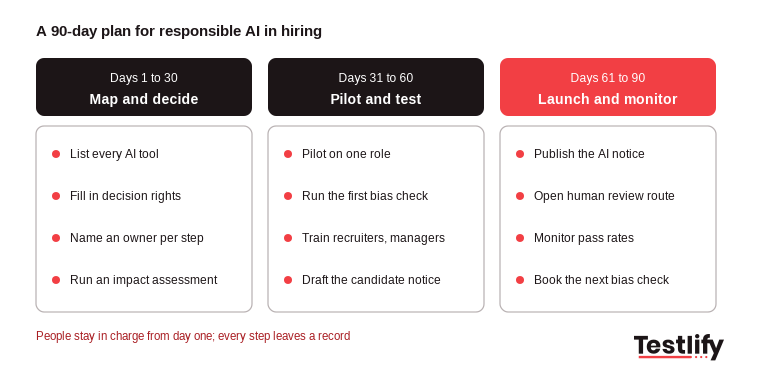
- Days 1 to 30, map and decide: List every AI tool that touches hiring, fill in the decision table above, name owners, and run an impact assessment with legal and data protection.
- Days 31 to 60, pilot and test: Pilot on one role with a diverse group of candidates, run the first bias check, train recruiters and hiring managers, and draft the candidate notice.
- Days 61 to 90, launch and monitor: Publish the AI notice on your careers page, open a route for candidates to ask for human review, and set the date of the next bias check.
The UK guide follows the same order: governance and impact assessment before buying, a pilot and staff training before go-live, then repeated testing, feedback and redress once live. Order matters more than speed.
Where should your team start?
Your team should start by writing down which hiring decisions AI may make, recommend or never touch, then check that every AI step in your process sits on the right side of that line. Testlify publishes the results of its own NYC bias audit, and the same questions apply to any tool you use. For more on fair, practical AI use, read our guide to AI hiring practices that find top talent.
Frequently asked questions

Content Writer
Yashika Khandelwal is a Content Writer with 3+ years of experience creating research-backed content on hiring, talent assessment, and HR technology. She is a registered Organizational Psychologist and subject matter expert who combines behavioral science with practical recruitment insights to produce accurate, evidence-based content.
LinkedInRelated resources
View all
AI in recruitment
Role simulations in hiring: how to design, run and score them
AI in recruitment
What tools offer AI-generated questions for custom assessments?
AI in recruitment
How does Testlify’s AI scoring handle open-ended answers and code quality?
AI in recruitment
How to use AI in recruiting using Testlify
AI in recruitment
AI recruitment platforms: Buyer’s guide

AI in recruitment
Will AI replace recruiters in 2026? The real answer
Get started.
Hire on proof, not resumes.
Run your first skills-based assessment free — no credit card required.