
Global recruitment: Advantages and disadvantages
Thinking of hiring internationally? Break down the pros and cons of global recruitment and find out if tapping into a global talent pool is right for your team.

The ManpowerGroup 2025 Global Talent Shortage Survey found that 74% of employers worldwide are struggling to find skilled professionals. And when key roles stay open, the impact is not small.
Estimates suggest $8.5 trillion in revenue could be left on the table simply because companies can’t fill critical positions. That’s why more teams are turning to global recruitment.
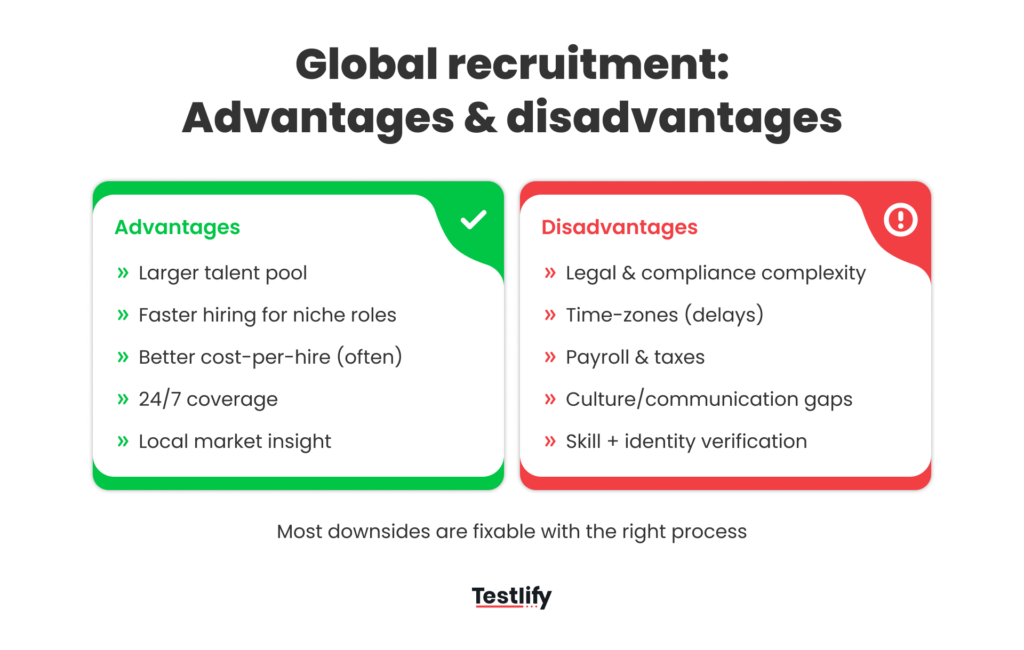
Hiring internationally opens up a much larger global talent pool, especially for skills that are rare in local markets. But it’s not a free win. Along with the advantages of global recruitment come real trade-offs like,
- Time zones
- Hiring coordination
- Compliance with local labor laws
- Issues around contracts, payroll and taxes.
In short, understanding the advantages and disadvantages of global recruitment is a core recruitment strategy for any business that wants to scale.
Explore More: What is global recruitment? Pros, importance, best practices
 ChatGPT
 Gemini
 Claude
 Grok
Grok Perplexity
TL;DR – Key takeaways
- Tap into a massive global talent pool to secure specialized skills that are difficult to find in local markets.
- Lower your operational costs by reducing office overhead and leveraging salary bands from diverse international markets.
- Maximize productivity with a 24/7 “follow-the-sun” workflow that keeps projects moving across different time zones.
- Solve complex legal and hiring challenges by using an Employer of Record for compliance and standardized tests to verify candidate skills.
- Build a sustainable remote culture by prioritizing skill over location and switching to asynchronous communication to avoid meeting fatigue.

Advantages of global recruitment
Global recruitment is a practical move for companies facing local talent shortages. When you shift from a local search to a global one, you unlock a few clear advantages.
You get a much larger talent pool
Instead of being restricted to candidates within commuting distance of your office, global recruitment lets you tap into a much larger talent pool. By searching globally, you can find specialists (like AI researchers or blockchain experts) that may be hard to find in one local market.
When your options expand beyond one city or region, your chances of finding a strong candidate are much higher.
You can reduce cost-per-hire by cutting time-to-hire
While it sounds complex, hiring globally can actually be cheaper and faster if done right. You can use global assessment platforms and AI that can reduce your time-to-hire. With standardized screening and the right tools, teams can often reduce time-to-hire (30%-75%).
On top of hiring efficiency, remote global teams can save an average of $11,000 per employee every year. You may also find the same skill level at salary bands that are a better budget-fit, depending on the role and region.
Your company can work 24/7
A global team can enable a follow-the-sun workflow. You can set up a simple hand-off system. A team in India finishes a task and hands it to a team in Europe, who then hands it to a team in the US. With this approach, the work literally never stops.
Global teams also make it easier to offer extended customer service and technical support coverage. This leads to higher customer satisfaction because someone is always online to help.
You learn about new markets faster
If you want to sell your product in a new country, you need people who live there to help you navigate the ground level challenges. Global hires bring local context about local culture, language nuances, and buying habits.
Some research suggests that diverse companies are 70% more likely to capture new markets successfully because they understand those customers better than their competitors do.
Your team becomes more creative and diverse
Companies with diverse management teams see 19% higher revenues from innovation. When people from different backgrounds work together, they solve problems in different ways. This helps your team avoid groupthink and leads to more creative products.
Diverse teams are more likely to question default assumptions, which leads to better decisions over time.
Disadvantages of global recruitment
Hiring across borders isn’t always smooth, and it often brings a unique set of challenges. If you don’t have a solid plan in place, the “limitless” talent of a global search can quickly turn into a logistical nightmare. Let’s take a look at them one by one.
Complex legal and compliance rules
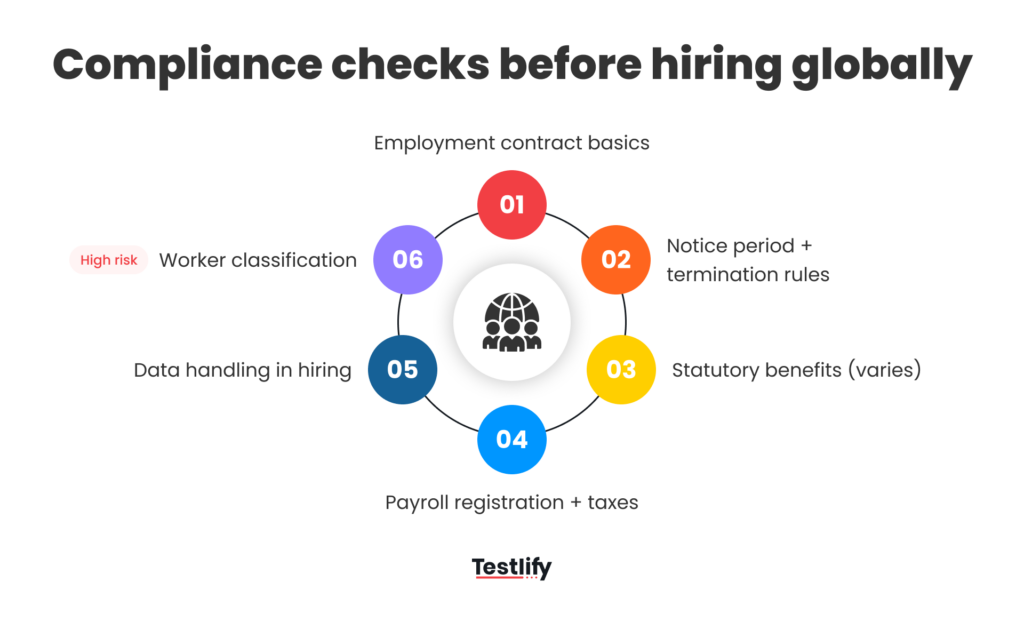
Every country has its own employment rules. What’s standard in one location may be restricted or regulated in another. For example, some countries have mandatory 13th-month pay requirements, while others have strict rules around notice periods and contract termination.
A major risk in 2026 is treating a full-time worker as a “contractor” to save money. Governments are cracking down on this, and the fines for “misclassification” can cost a company thousands in back taxes and penalties.
Time zone and communication delays
While 24/7 work is an advantage, it also creates “lag” in daily communication. HBR research shows that even a one-hour time difference can reduce real-time communication by 11%. When your team is spread across the world, simple questions that used to take 5 minutes can now take hours to answer.
Finding a time for an all-hands meeting becomes nearly impossible. Someone will always be waking up too early or staying up too late, which can lead to burnout.
Payroll and tax headaches
Paying someone in a different country is much more complicated than a simple bank transfer.
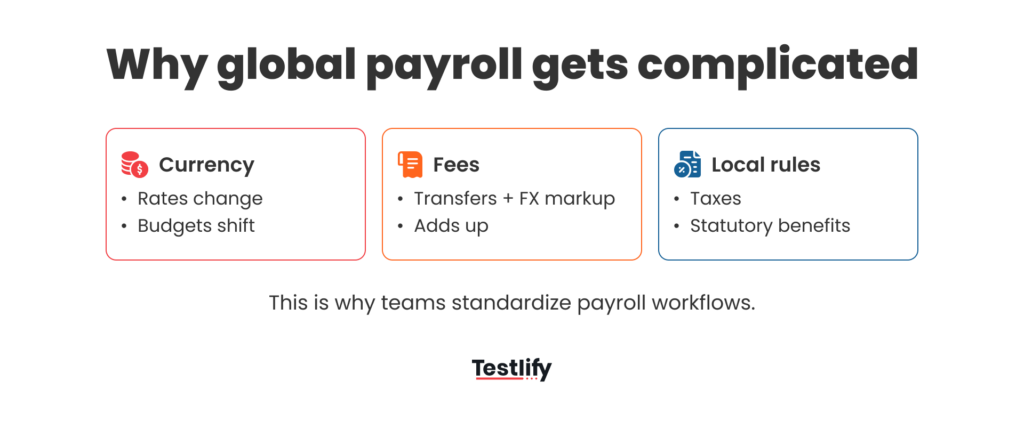
- Currency fluctuations: Exchange rates change every day. If the value of your currency drops, your payroll costs can suddenly spike without warning.
- Hidden fees: Traditional banks often charge 3% to 5% just to move money across borders. For a large team, these fees add up to thousands of dollars in lost money every year.
- Local benefits: You have to manage local health insurance, pensions, and social security for every country you hire in, which is a massive administrative burden.
Cultural and language barriers
Even if everyone speaks the same language, they might not “communicate” the same way. It requires deep thought behind this to understand.
Some cultures value direct feedback, while others find it rude. Some cultures prioritize strict deadlines, while others are more flexible.
Holiday confusion is also an issue. Every country has different public holidays. If you don’t track them, you might find your entire development team is offline on a day you have a major product launch.
Difficulty in verifying skills and identity
When you can’t meet a candidate in person, it is much easier for them to misrepresent their skills.
With more people using AI to write their resumes in 2026, it is harder than ever to tell who actually has the skills. Without the right tools, it is difficult to know if a candidate’s technical skills are as strong as they claim, which increases the risk of a “bad hire” that costs the company time and money.
In volume hiring, there’s also a rising risk of proxy interviews, which makes identity verification and interview integrity harder.
How to reduce the disadvantages [practical fixes]
The good news is that none of these disadvantages are deal-breakers. With a few smart tools and a clear plan, you can automate most of the “boring” administrative work and focus on building your team. Below are the most practical ways to fix the common problems of global recruitment.
Use an Employer of Record (EOR)
Instead of trying to learn the tax laws of 50 different countries yourself, hire an Employer of Record (EOR).
An EOR is a company that officially hires your workers for you in their local country. They handle the legal contracts, local taxes, and payroll compliance so you don’t have to worry about getting fined or sued.
Shift to asynchronous work
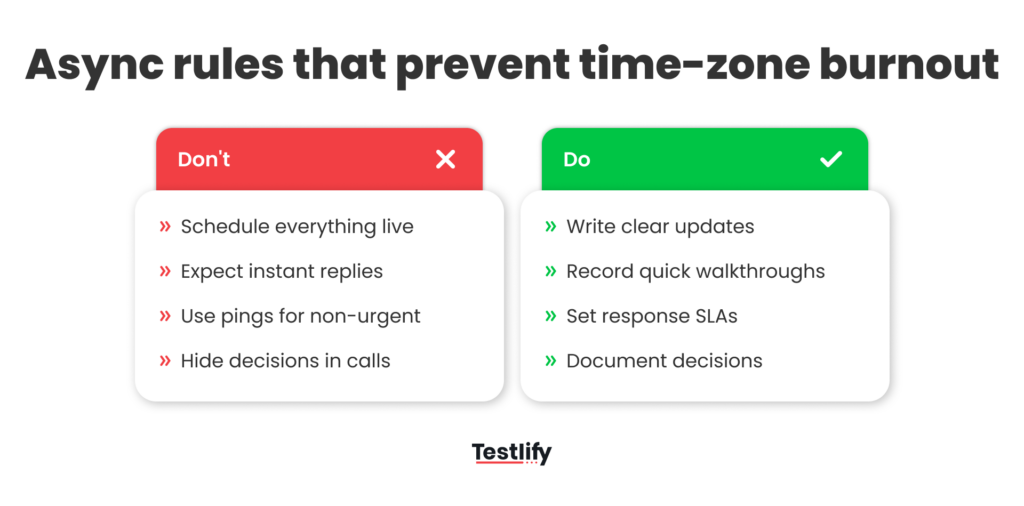
Stop trying to get everyone on a Zoom call at the same time. It’s impossible and leads to burnout.
Move toward “Asynchronous” (non-live) communication. Use tools like Slack, Notion, or recorded video messages (Loom) so people can update the team when they start their day.
Use standardized skills assessments
Don’t guess if a candidate is actually good at their job. Use a platform like Testlify to prove it before you even hop on an interview.
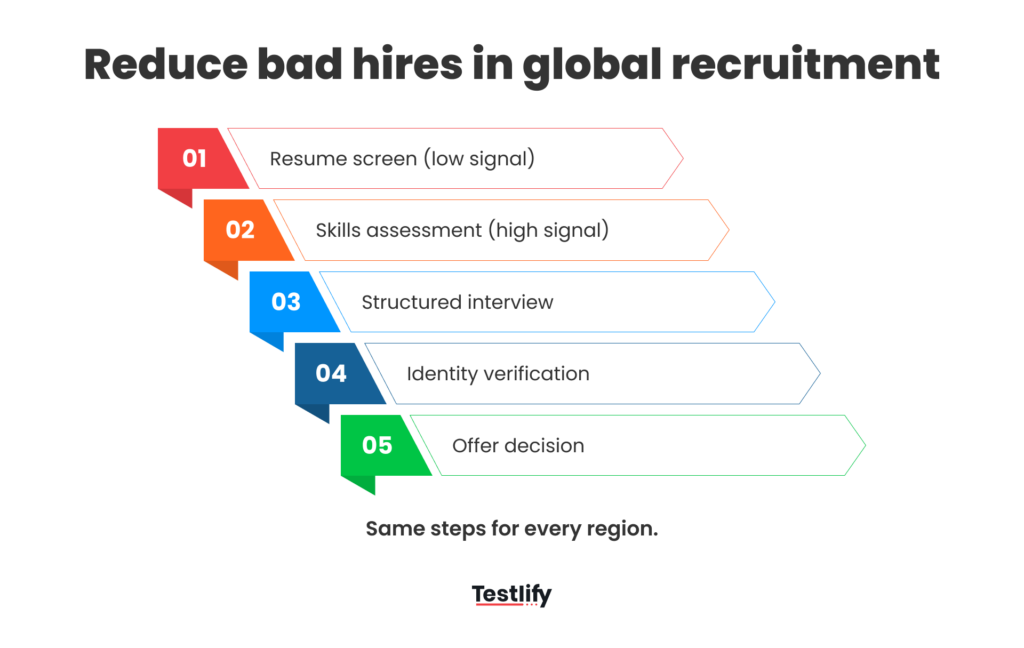
Instead of trusting a resume that might be written by AI, give candidates an online skills test. This step removes “bias” and ensures that the candidate you hire can actually do the work. You can save hours of time by only interviewing the top-performing candidates, reducing the risk of a bad hire.
Automate your payments
Avoid the high fees and slow speeds of traditional banks when paying your global team. Use modern global payroll software that handles multiple currencies automatically. These tools often use the real exchange rate and charge much lower fees than banks.
Your employees can get paid on time in their own currency, and you can save thousands of dollars in “hidden” banking costs every year.
Quick decision guide: Is global recruitment right for you?
Not every company needs to hire globally right away. To find out if it’s the right move for your team right now, follow the table below,
If your situation looks like this | then Global Recruitment is: | Why? |
|---|---|---|
You can’t find specific skills in your local city after 2–3 months of searching. | A Great Move | The world has millions of experts; your city only has a few. Don’t let a “local” search slow your growth. |
Your budget is tight, but you need high-quality, senior-level talent to scale quickly. | A Great Move | You can find top-tier talent in emerging tech hubs for a much lower cost than in major Western cities. |
You need to support customers in different countries at all hours of the day. | A Great Move | A global team covers all time zones naturally, so your business stays “open” 24/7 without overtime pay. |
Your business requires everyone to be physically present in one office to function. | Not Recommended | Global hiring relies on remote work. If “in-person” is a must-have, global hiring will cause more friction than benefit. |
You don’t have the tools to verify skills or handle international taxes yet. | Proceed with Caution | You need a plan. Use a tool like Testlify to check skills and an EOR to handle the legal paperwork first. |
Your current team is already struggling with clear communication and hitting deadlines. | Not Recommended | Adding different time zones and cultures will only make communication harder. Fix your internal process first. |
If you are comfortable using technology to manage work and you prioritize skill over location, global recruitment is your fastest path to scaling. If you aren’t ready to go fully remote or handle international paperwork, it is better to stay local until your systems are ready.
Conclusion
Global recruitment can unlock a larger talent pool, faster hiring, and better coverage, but only if your process is consistent. The real risks come from compliance gaps, time-zone friction, payroll complexity, and weak verification. Treat global hiring as a structured system, not an experiment.
Ready to scale global recruitment with confidence? Book a Demo
Frequently asked questions (FAQs)

B2B SaaS Content Writer
Rishav Kumar is a B2B SaaS content writer with 4 years of experience. He loves crafting engaging content. Always exploring fresh ideas, he's passionate about helping businesses grow through impactful writing.
LinkedInRelated resources
View all
Global Recruitment
How to create fair and objective hiring assessments for diverse candidates?

Global Recruitment
Employer of Record in the Netherlands: 5 Best EOR Services for 2026

Global Recruitment
How Testlify helps in skills assessment for global recruitment?

Global Recruitment
How to improve global recruitment ROI?

HR Statistics
Employer concerns survey 2026: What the data means for hiring

Talent Acquisition
Should job ads still list the years of experience qualified candidates need?
Get started.
Hire on proof, not resumes.
Run your first skills-based assessment free — no credit card required.