
How Testlify helps in skills assessment for global recruitment?
Scale your global team without the guesswork. Learn how to use automated assessments and proctoring to hire high-performers anywhere in the world.

Global recruitment should expand your talent pool, not your time to hire. Yet, most hiring managers find themselves drowning in a sea of international applications, struggling to identify who truly possesses the skills and knowledge required for the role.
The friction of manual screening is the silent killer of global growth. By integrating a standardized skills assessment for global recruitment, teams can automate the heavy lifting of the pre-hire phase, allowing recruiters to focus only on high-potential candidates.
But why exactly does global recruitment feel so much more chaotic than hiring locally? To fix the process, we first have to look at the specific hurdles that keep most international hiring drives stuck in the mud.
 ChatGPT
 Gemini
 Claude
 Grok
Grok Perplexity
TL;DR – Key takeaways
- Hiring across borders is exciting but usually comes with a massive trust gap and logistical headaches that slow everything down.
- Resume screening alone isn’t enough anymore; switching to a skills-first approach ensures you’re hiring people for what they can actually do, not just where they live.
- You can bridge the distance by using secure, proctored assessments and localized tests that make global candidates feel at home while protecting your hiring integrity.
- Automation is your best friend. Tools like video interviews and bulk invites handle the time-zone math so you can focus on the human side of the conversation.
- Ultimately, the goal is to stop guessing and start using clear, verified data to build a world-class team that scales as fast as your ambitions.

Why global recruitment feels harder than it should
Hiring across borders promises a big talent pool, but it often delivers administrative and cognitive load. There are three primary friction points that make global hiring feel difficult.
The credential & verification gap
When hiring locally, you usually have a mental map of which universities are top-tier and which former employers have high standards. But when you go global, that map disappears, often forcing recruiters to make safe choices. This creates a massive proximity bias, where great talent is ignored simply because their background is unfamiliar.
In fact, 2025 talent reports show a strange paradox: 63% of employers cite skills shortages as their biggest barrier, yet they still struggle to verify the actual skills and knowledge of international applicants.
Without a way to bridge this gap, you’re left with two bad options: spend weeks on exhausting background checks or hire based on a gut feeling. Neither is sustainable, and both frequently lead to expensive mis-hires that could have been avoided with a more objective approach.
Application overload
Most hiring managers are facing difficulty because they are still using manual screening for a global-scale pipeline.
Research shows that 60% of candidates drop out if a hiring process exceeds 14 days. When a recruiter is manually sifting through 1,000 global CVs, they cannot move fast enough to keep good candidates engaged.
The overall result you get here is that high-potential candidates get ghosted or snapped up by faster competitors while the recruiter is still on page 50 of the resume stack.
Cultural misalignment in soft skills
When you’re hiring across borders, technical talent is only half the battle. The real trick is measuring soft skills without letting cultural differences cloud your judgment. For instance, a recruiter might mistake a candidate’s natural humility for a lack of confidence, or view a respectful pause as a lack of knowledge.
These small cultural misunderstandings lead to a major problem: hiring someone who is a technical fit but a cultural miss. Even though most companies today are striving for more inclusive hiring, traditional interviews are still filled with these subconscious biases.
Without a standardized way to measure skills and abilities, you risk losing great people simply because of a communication style you aren’t used to.
How Testlify supports global recruitment end-to-end
For navigating global recruitment you need a shift from traditional resume-based screening to a skills-first approach. Testlify provides a unified platform to identify, verify, and interview top-tier talent regardless of their location.
Shortlisting with AI resume screener
Making manual review is nearly impossible since global recruitment often attracts high-volume applications.
Here, Testlify’s AI Resume Screener standardizes the screening process by providing an AI-driven job-fit score (High, Medium, or Low fit) for every applicant.
It reduces manual shortlisting efforts by up to 70%, allowing recruiters to prioritize high-signal candidates and automate the movement of qualified talent into the pre-hire assessment phase.
Standardized evaluation via a 3,500+ test library
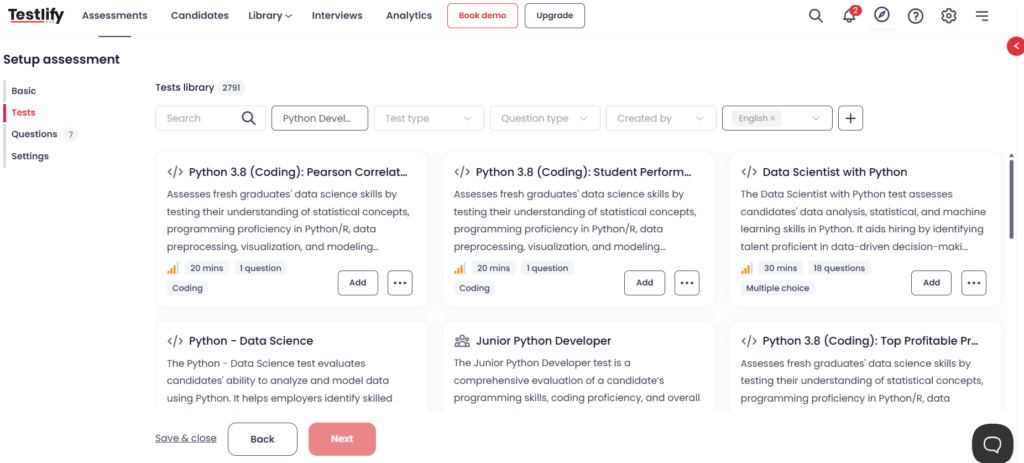
To combat the challenge of verifying international candidate’s credentials, Testlify shifts the focus from where they studied to what they can do on the job.
You can access over 3,500 validated tests mapped to 5,000+ job roles. These cover technical proficiency, cognitive ability, and situational judgment.
For technical roles, Testlify provides a real-time environment supporting 45+ programming languages, allowing you to evaluate a developer’s problem-solving and debugging skills.
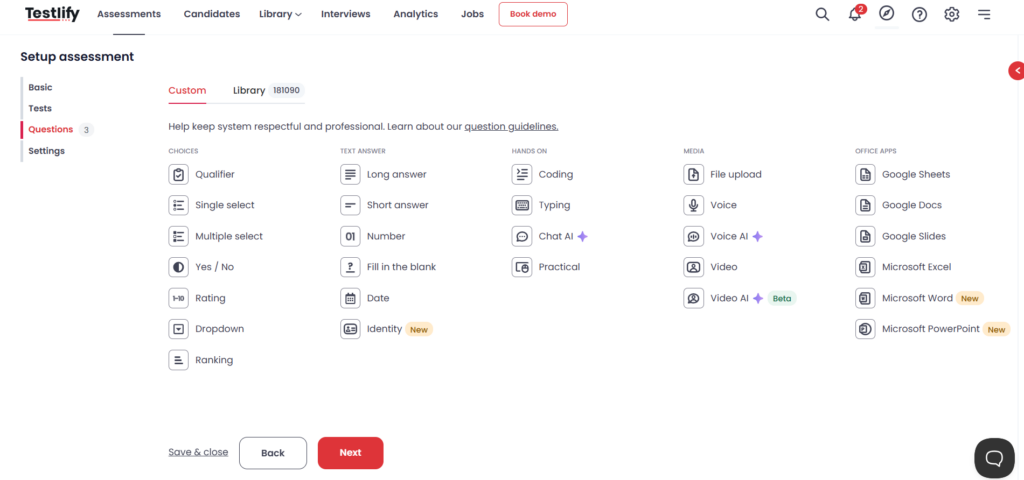
Beyond the library, you can create bespoke tests using custom question types, including Google Workspace simulations (Docs, Sheets, Slides) and file upload tasks.
Localization and inclusive global assessment
A global hiring strategy must account for linguistic diversity to avoid missing out on technically brilliant candidates due to language barriers.
To help execute it successfully, Testlify supports 16+s (including Arabic, Japanese, Portuguese, and Spanish). Through this offering, candidates can complete assessments in their native language.
Asynchronous evaluation and conversational AI
Scheduling live interviews across multiple time zones is often the biggest bottleneck in global recruitment.
- AI video & audio interviews: Candidates record responses to standardized prompts on their own schedule. AI auto-scoring then evaluates communication clarity and intent, allowing you to review dozens of “virtual interviews” in the time it would take for one live call.
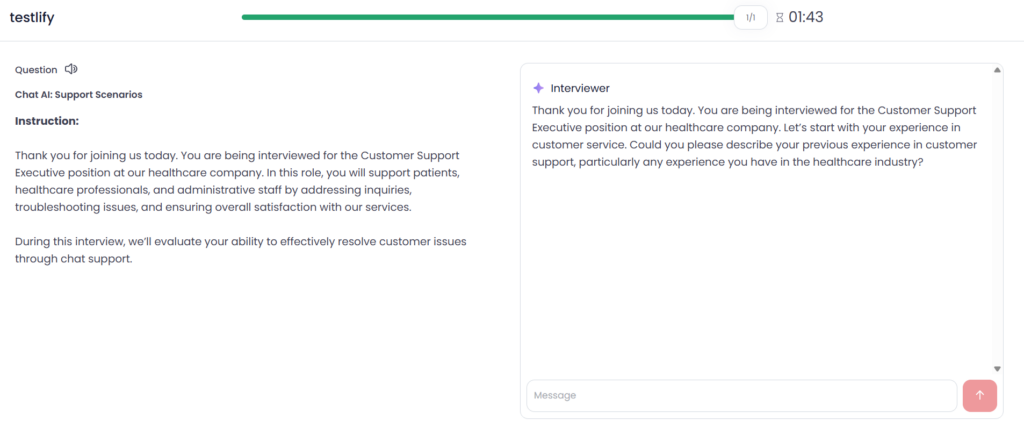
- AI chat simulations: This feature places candidates in role-specific, interactive chat scenarios (simulating tools like Slack or Zendesk) to measure real-time problem-solving and soft skills like empathy and de-escalation.
See how video AI works:
Multi-layered proctoring and assessment integrity
It’s important to maintain a fair and secure testing environment while hiring remote candidates. To prevent cheating, Testlify employs environment scan (webcam and mobile), AI-assistance detection (flagging ChatGPT or external help), and browser lockdown (preventing tab-switching and copy-pasting).
Recommended: Anti cheating and proctoring features
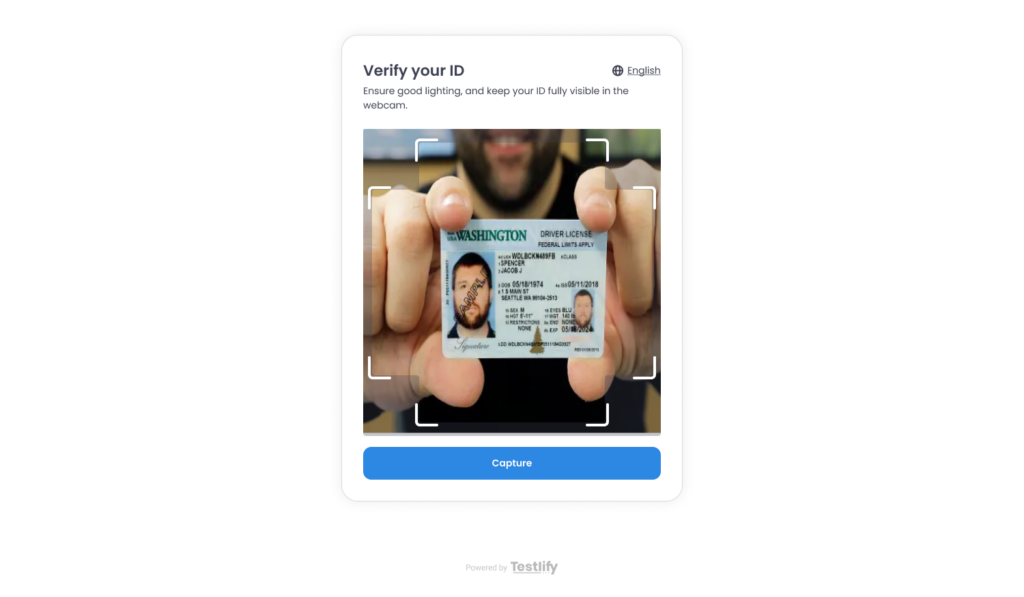
To tackle impersonation the platform also includes photo ID verification and face detection to verify that the person taking the assessment is the person being hired.
Seamless operations with 100+ ATS integrations
Global recruitment is a team sport that requires seamless coordination between distributed recruiters and hiring managers.
Testlify supports seamless ATS Integrations with over 100 platforms (e.g., Greenhouse, Lever, SAP SuccessFactors) ensure all candidate results sync directly back to your primary workflow.
Recruiters can share granular skill gap analysis reports via secure, shareable links, allowing stakeholders to review and benchmark candidates globally without extra logins.
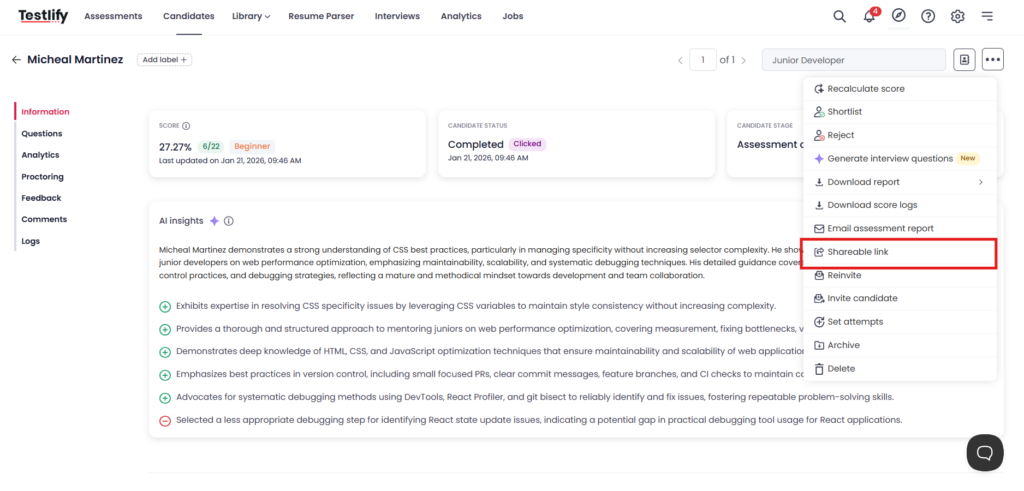
Additionally, you can fully brand the assessment experience with your company’s logo and colors, reinforcing your employer brand and building trust with international talent.
By centralizing pre-employment testing, AI resume screening, and video interviewing into one platform, Testlify allows global teams to reduce their time-to-hire by up to 55%. It offers a data-driven process that scales alongside your company’s global ambitions.
A simple global recruitment workflow using Testlify (step-by-step)
If you want to scale globally without losing your mind, you need a workflow that’s as rigorous as it is automated. Here is how you actually build a high-integrity global recruitment engine using Testlify.
Step 1: Architecting the assessment
In the Testlify dashboard, you have two distinct paths: you can Generate using AI by feeding in your job description, or hit “create assessment” to build a test from scratch.
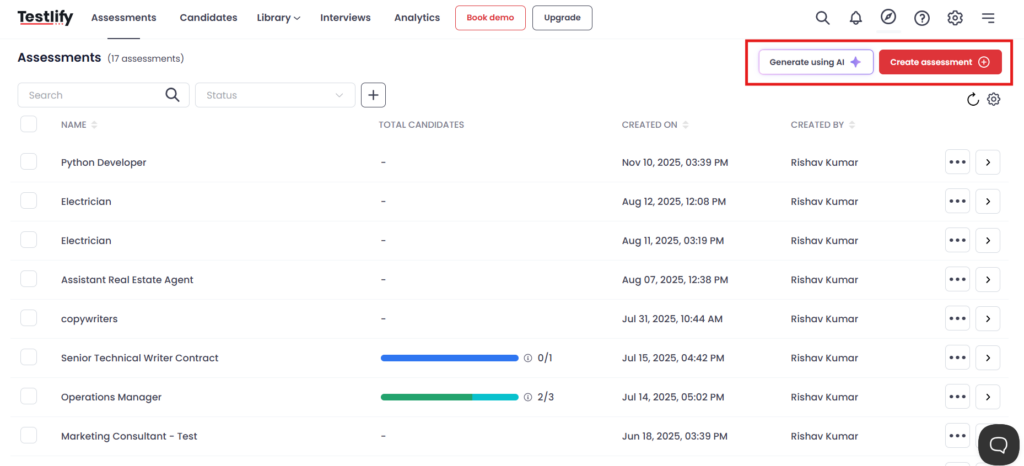
With access to 3,500+ ready-to-use assessments and 180,000+ validated questions, you can mix role-specific skill tests with Cognitive ability tests to ensure you’re measuring both raw talent and specific expertise.
Step 2: The invitation phase
When the applications start flooding in from LinkedIn or local job boards, manual entry is your enemy. For high-volume roles, use the Bulk invite feature to upload your entire shortlist at once.
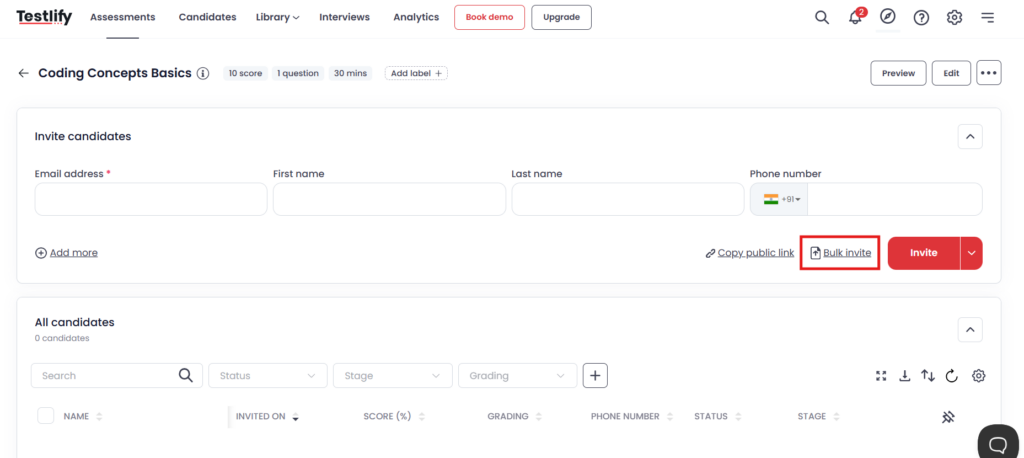
If you’re running a more open campaign, you can simply copy a public link and embed it directly into your job post. This keeps your pipeline moving 24/7, inviting candidates to prove their skills the moment they hit “apply.”
Step 3: Immersive testing with advanced simulations
The core of the evaluation happens through high-fidelity testing that mimics actual job tasks. Beyond standard questions, you can deploy Google Workspace simulations and Microsoft Office simulations to test productivity skills.
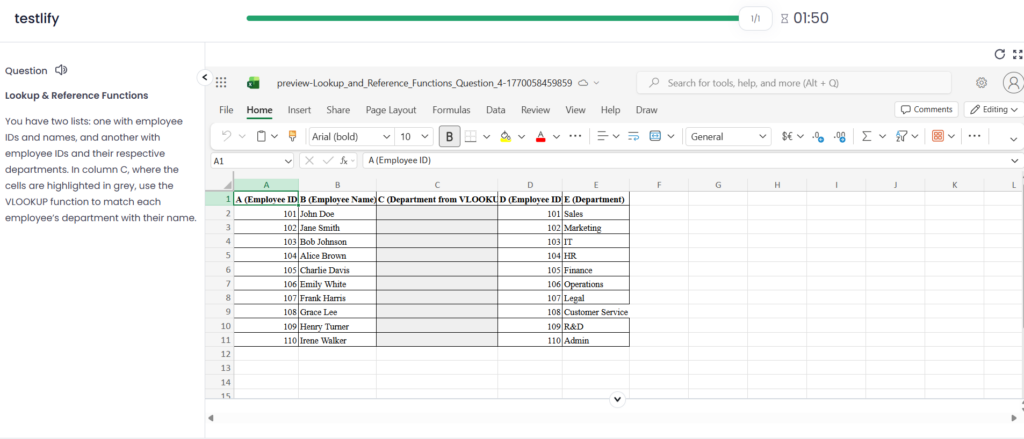
For technical hires, the single-file and multi-file coding environment supports 45+ coding languages and 4+ databases, allowing you to see exactly how a developer writes and executes code in a live setting. You can even include Typing and speed tests or 360° assessments for a more holistic view.
Step 4: Integrity with multi-layer proctoring
How do you know that the person in Brazil isn’t using ChatGPT or having a friend do the work? You go to the Proctoring tab. Here, you can choose between Standard or Strict modes. By enabling Face detection & photo ID verification, AI assistance detection, and mouse-out & tab-switch tracking, you create a secure lockdown environment.
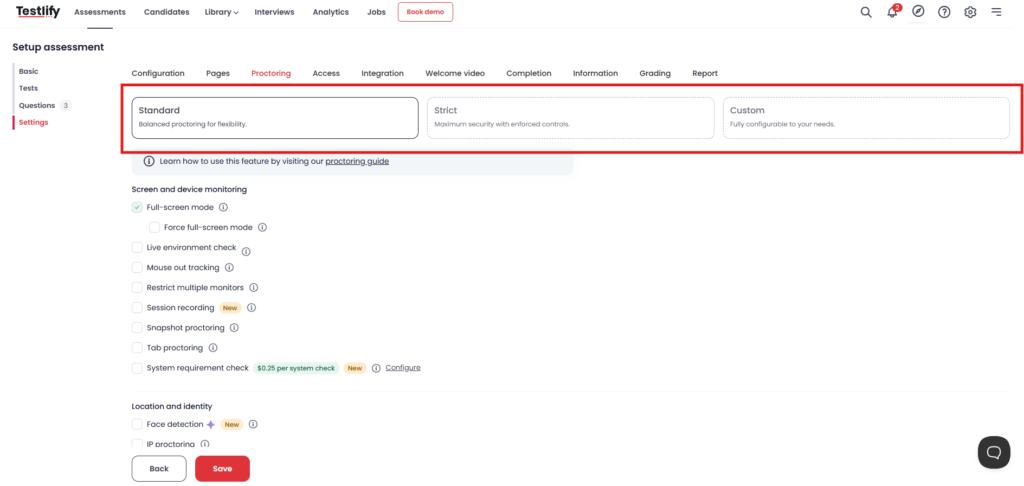
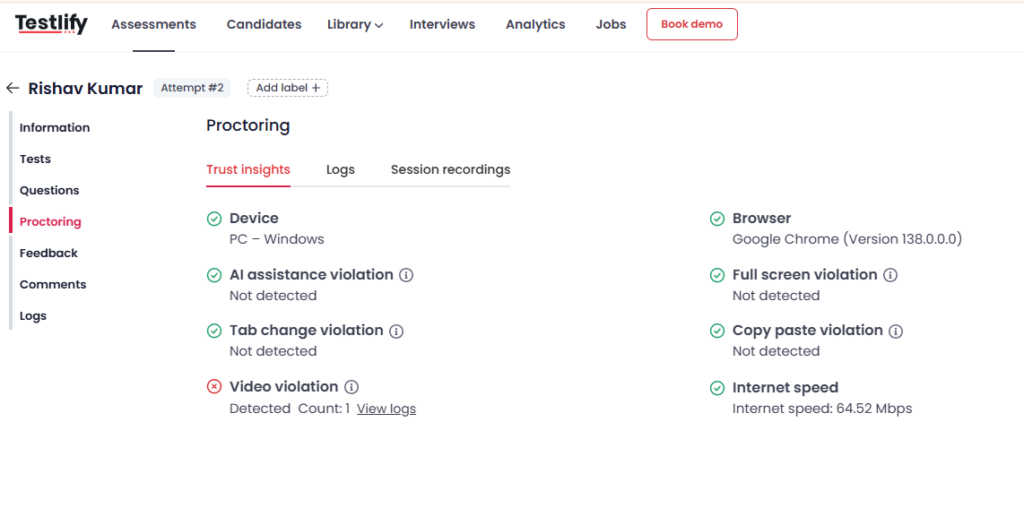
If a candidate tries to copy-paste or switch tabs, it’s flagged in the proctoring violation logs, giving you 100% confidence in the results.
Step 5: Qualitative assessment through conversational AI
Once the technical scores are in, you need to hear their voice. Use AI video/audio interviews to let candidates answer your culture-fit questions on their own time.
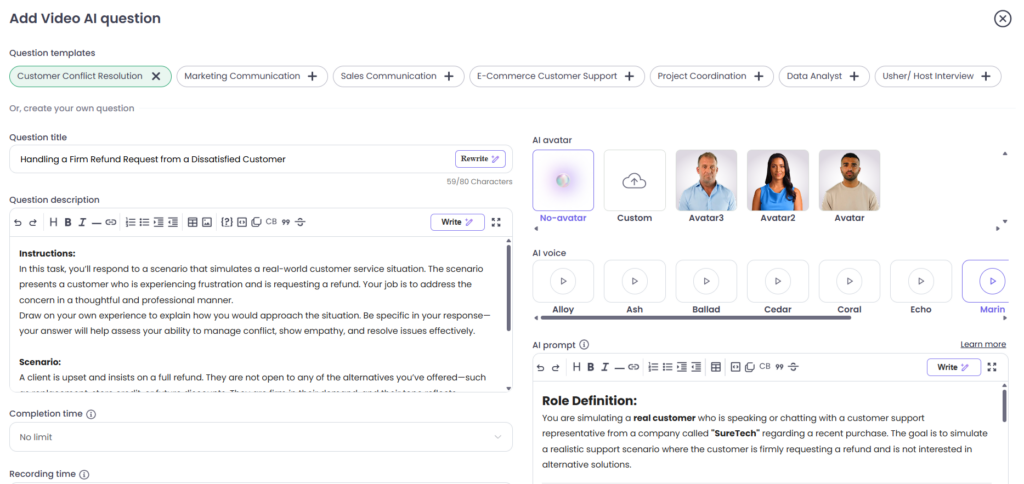
If you want something more interactive, conversational AI interviews can simulate a real-time dialogue. With 150+ ready-to-use interview templates, you don’t have to spend hours writing prompts; you just select the ones that match your role and let the system collect the “soft signal” data for you.
Best practices to get results (and avoid common mistakes)
To get the most out of your global hiring strategy, you need to balance high security with a great candidate experience. Here are the best practices to ensure you hire the right talent quickly and fairly:
- Mix your test types for a full picture: Don’t just test technical skills; use a combination of role-specific skill tests, cognitive ability tests, and personality & culture fit assessments to see how a candidate thinks and works.
- Match proctoring strictness to the job level: Use Strict proctoring with force full-screen mode for entry-level roles to prevent cheating, but consider standard settings for executive roles to maintain a high-trust experience..
- Use real-world simulations to prove skills: Move beyond multiple-choice by using Google Workspace simulations, Microsoft Office simulations, or Single-file and multi-file coding to see how candidates handle actual work tasks.
- Build trust with custom branding: Use Custom branding with white-label to add your logo and brand colors to the assessment, which helps international candidates feel secure that the job is legitimate.
- Speed up hiring with bulk actions: Instead of inviting people one by one, use the Bulk invite feature to send assessments to your entire shortlist at once and use 100+ ATS integrations to keep your data synced.
- Provide transparency through feedback: Use the feedback and comments section to rate candidates and provide internal notes to ensure that your global team is aligned and candidates aren’t left in the dark.
Conclusion
The future of work is undeniably global, and the most successful companies are those that prioritize ability over geography.
Testlify provides the infrastructure to make this transition seamless. Stop letting traditional boundaries limit your potential. Embrace a recruitment process that is as ambitious as your growth strategy. Book a demo today!
Frequently asked questions (FAQs)

B2B SaaS Content Writer
Rishav Kumar is a B2B SaaS content writer with 4 years of experience. He loves crafting engaging content. Always exploring fresh ideas, he's passionate about helping businesses grow through impactful writing.
LinkedInRelated resources
View all
Global Recruitment
How to improve global recruitment ROI?

Global Recruitment
Global recruitment: Advantages and disadvantages

Global Recruitment
How to create fair and objective hiring assessments for diverse candidates?

Global Recruitment
Employer of Record in the Netherlands: 5 Best EOR Services for 2026

Workplace culture
How to communicate with Gen Z workers: 9 tips for managers

Talent Acquisition
Hiring military veterans: a practical guide for employers in 2026
Get started.
Hire on proof, not resumes.
Run your first skills-based assessment free — no credit card required.