
Workforce Reduction: Steps, Alternatives, and Best Practices
Learn how to navigate workforce reduction with empathy, fairness, and transparency. Read our blog to plan and manage layoffs effectively.

In its March 2025 Current Events Pulse survey, SHRM found that more than one in seven HR professionals reported their organization ran a reduction in force inside a single 30-day window. Here is the part leaders miss: the cut rarely delivers the savings on the spreadsheet. Research from Leadership IQ, which surveyed 4,172 people who kept their jobs across 318 companies that had cut staff, found 74% said their own productivity dropped after the layoffs.
That gap is expensive. A rushed workforce reduction can strip out the wrong people, drag down the ones who stay, and expose you to a discrimination claim that costs more than the payroll you saved. Handled well, the same cut protects your best talent, holds output steady, and keeps the company legally clean. This guide gives you the full playbook: what a workforce reduction is, the alternatives to try first, the exact steps to run one, how to decide who stays without guesswork, and the legal checks you cannot skip.
A workforce reduction is a planned, evidence-based cut to headcount that removes roles an organization no longer needs, using objective criteria so the decisions are fair, defensible, and reversible only in the sense that you can prove why each one was made. Get the criteria right first, and everything after it gets easier.
 ChatGPT
 Gemini
 Claude
 Grok
Grok Perplexity
TL;DR
- Definition first. A workforce reduction permanently removes roles through layoffs, attrition, early retirement, or voluntary exits, usually to cut cost or match a new strategy.
- Try alternatives before you cut. Hiring freezes, natural attrition, internal redeployment, and reskilling often hit the same savings target with less damage.
- Run it in five steps. Plan and model, set selection criteria, communicate, execute the separations, then support the people who stay.
- Decide who stays on evidence, not tenure. Skills and competency data make retention choices objective and easier to defend.
- Stay legal. The WARN Act, the ADEA, and Title VII set hard rules; document your criteria and run an adverse-impact check before you act.

What is a workforce reduction?
A workforce reduction is the process of permanently cutting headcount by eliminating positions the business no longer needs. It happens through layoffs, a formal reduction in force, early retirement, or voluntary separation. Unlike a temporary layoff, a workforce reduction assumes the roles will not come back soon, so the goal is a leaner structure that still delivers the work.
It helps to separate the terms. A layoff can be short-term with a plan to recall workers. A reduction in force (RIF) removes positions for good. Downsizing is a cost-cutting cut; rightsizing is a capability cut that reshapes the team around the skills the business actually needs now.
Why do companies pursue a workforce reduction?
Most companies do not want to shrink their teams. Business pressure forces the call. In the same SHRM data, among HR teams that ran layoffs, the top driver was a workforce reorganization at 50%, followed by a change in business strategy at 37% and poor business performance at 36%. The reason behind the cut matters, because it changes how you frame the decision and how you support the people affected.
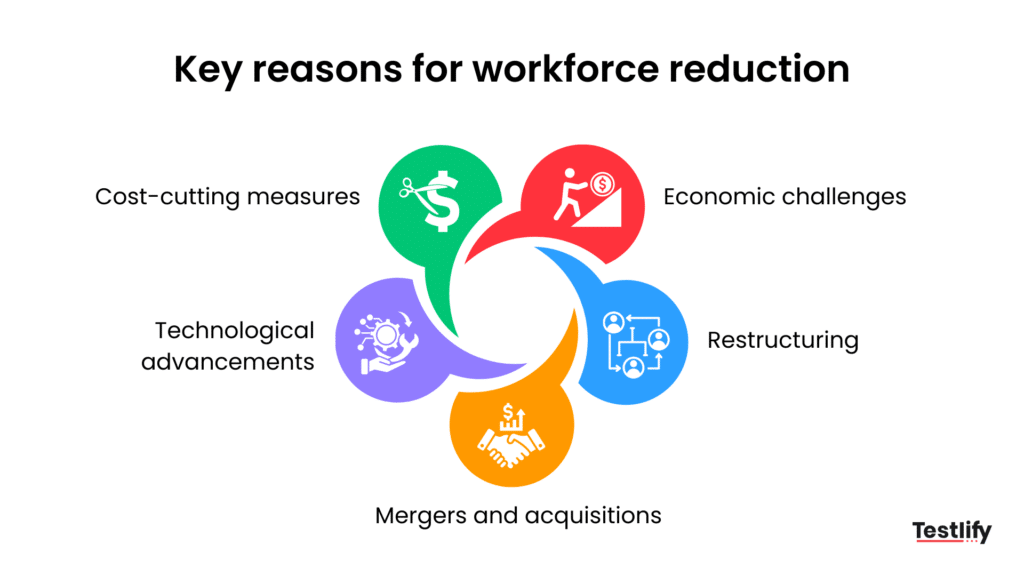
1. Economic pressure
When revenue falls or costs climb, headcount is often the largest line a company can move quickly. Recessions, industry slowdowns, and shrinking margins all push teams toward a reduction to protect the balance sheet.
2. Restructuring and reorganization
A new operating model can make some roles redundant. Merging two departments, flattening layers, or centralizing a function removes duplicate positions even when the business is healthy.
3. Mergers and acquisitions
When two companies combine, overlapping teams get consolidated. Finance, HR, and support functions are the usual places where duplicate roles are cut in the first year.
4. Technology and automation
New tools change what work needs a human. As tasks get automated, some roles shrink or disappear, and the skills the company needs shift toward judgment, oversight, and higher-value work.
5. Strategic cost control
Sometimes the cut is deliberate rather than forced. A company redirecting budget toward a new product or market may reduce headcount in one area to fund growth in another.
What are the alternatives to a workforce reduction?
Before you cut a single role, price out the alternatives to a workforce reduction. Several options reach a similar savings target with less disruption, lower legal risk, and no hit to morale. Many companies reach their number without a single involuntary exit.
Hiring freeze and natural attrition
Stop backfilling open roles and let normal turnover shrink the team over a quarter or two. If your annual attrition runs near 12 to 15%, a freeze on non-critical roles can deliver a meaningful reduction with zero forced departures.
Internal redeployment and reskilling
Move people from shrinking areas into open roles instead of releasing them and hiring outside. This is where a current view of employee skills pays off: you can see who is a short training course away from a role you still need to fill. Pair redeployment with targeted reskilling to close the gap.
Reduced hours, furloughs, and voluntary exits
Reduced schedules with proportional pay, short furloughs, and voluntary early retirement give you temporary or opt-in savings without a mandatory cut. They work best when the pressure is expected to ease.
How do you run a workforce reduction step by step?
A clean workforce reduction follows a repeatable process. Rushing it is where legal risk and reputation damage creep in. Work through these five workforce reduction steps in order.
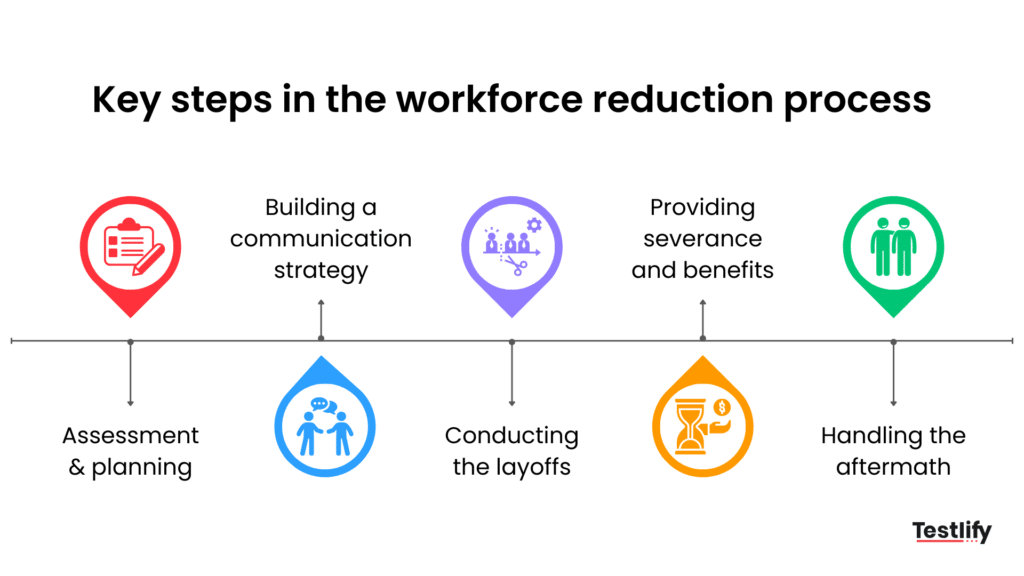
Step 1: Model the workforce reduction target
Start with the number, not the names. Define how much cost or headcount you need to remove and by when. Model two or three scenarios, including attrition-only and redeployment-heavy versions, so you know the smallest cut that still hits the goal.
Step 2: Set objective selection criteria
Write down how you will decide which roles and people are affected before you look at any individual. Base it on role relevance, verified skills, and documented performance. Fixed criteria set in advance are your best protection against bias and legal challenge.
Step 3: Build the communication plan
Decide who tells whom, in what order, and with what support. Managers need a script, a reason tied to the business, and clear answers on pay, benefits, and references. Send the logic behind the decision, not just the outcome.
Step 4: Conduct the separations with care
Hold the conversations privately and in person where possible. Cover severance, final pay, benefits continuation, and outplacement in one clear document. Treat departing employees with the respect the people who stay are watching for.
Step 5: Support and stabilize the team that remains
The people who stay are the ones who deliver next quarter. Redistribute work deliberately, not by dumping it on whoever is nearest. Re-clarify priorities and check in often, because survivor stress is real and it shows up as the productivity drop the Leadership IQ data measured.
Pro tip: Define your screening criteria before reviewing applications and apply the same standards to every candidate. Consistent, objective criteria help reduce bias, improve hiring decisions, and make the process easier to defend if questioned.
How do you decide who stays without bias?
This is the step every guide glosses over and every workforce reduction lives or dies on. Deciding who stays on gut feel, tenure, or a manager’s favorite invites both a weaker team and a discrimination claim. The fix is to base retention on measurable evidence of what each person can do in the role you still need.
Testlify gives you a structure for that. It maps every role that survives the cut to the competencies that matter, then connects each competency to measurable evidence: a skills assessment, a work simulation, a structured review, or documented performance. Instead of asking “who has been here longest,” you ask “who has the strongest evidence for the skills this role needs going forward.” Skills assessments supply that evidence in a form you can compare side by side and defend later.
Used this way, a skills gap analysis does double duty. It shows who to retain, and it flags who could be redeployed into an open role rather than released. A grounded job analysis for each surviving role tells you exactly which competencies to measure.
Selection basis | What it measures | Bias and legal risk | Defensibility |
|---|---|---|---|
Tenure or seniority | Length of service rather than current capability | May overlook current skills and create bias if used as the primary criterion | Low |
Manager evaluation alone | Individual opinion of performance | Subjective, difficult to standardize, and prone to inconsistency | Low |
Performance reviews | Historical performance against established goals | More reliable when reviews are recent, consistent, and evidence-based | Moderate |
Skills assessments and competency evidence | Current, role-relevant knowledge, skills, and abilities | Objective, standardized, and easier to compare across candidates | High |
Work samples or job simulations | Ability to perform real job tasks | Low when every candidate completes the same assessment under consistent conditions | High |
A worked example of a workforce reduction decision
A SaaS company restructures after shifting its product strategy and needs to reduce 40 positions across customer success and implementation teams.
Rather than relying on tenure or subjective manager ratings, HR evaluates employees using customer satisfaction scores, product knowledge assessments, recent performance data, and role-critical competencies. Employees whose skills match other open roles are redeployed before layoffs are considered.
The result: several high-performing employees are retained despite having less tenure, vacant roles are filled through internal mobility, and the organization has a clear, evidence-based record supporting every workforce decision.
What are the legal rules for a workforce reduction?
A workforce reduction is one of the most regulated actions HR runs. Get the compliance wrong, and a single workforce reduction can turn into class-action exposure. Three areas need your attention.
WARN Act notice
In the United States, the federal Worker Adjustment and Retraining Notification (WARN) Act requires employers with 100 or more employees to give at least 60 days of written notice before a plant closing or mass layoff. Several states set stricter mini-WARN thresholds, so check state law before you set a timeline.
Non-discrimination and adverse impact
Your selection cannot fall disproportionately on a protected group. Age is a common exposure, since tenure-based cuts can push out older workers and breach the ADEA. Before you finalize a list, run an adverse-impact analysis comparing the selected group against the workforce by age, gender, race, and other protected traits. Objective, skills-based criteria make this far easier to pass.
Severance, benefits, and documentation
Offer clear severance and benefits continuation, and keep a written record of the criteria and how each decision was made. Documentation is what turns a defensible process into a provable one if the reduction is later challenged.
How do you support employees after the cuts?
The workforce reduction is not finished when the last conversation ends. How you treat departing and remaining employees sets your reputation as an employer for years. Focus on two groups.
Support for people leaving
Practical help beats sympathy. Offer outplacement support, resume and interview coaching, and honest references. A departing employee who is treated well becomes a source of referrals and rehires, not a negative review.
Stabilizing the people who stay
Address survivor stress head on. Explain why the reduction happened, what changes now, and how new workloads will be handled. Use the moment to close skill gaps through a retention and development plan, so the leaner team is also a more capable one. A skills-based approach to backfilling any critical roles keeps the bar high as the team rebuilds.
Key takeaways
- Start with the number, not the names. Define the exact cost or headcount target and model attrition-only and redeployment-heavy scenarios first, because the smallest cut that hits the goal is almost always the right one.
- Alternatives are not a soft option. Hiring freezes, natural attrition near 12 to 15% a year, and internal redeployment often reach the same savings with far less damage to output and trust.
- Selection criteria decide everything. Set them in writing before you see a single name, and base them on verified skills and documented performance rather than tenure or one manager’s view.
- Evidence protects you twice. Skills and competency data build a stronger surviving team and give you the audit trail that defends each decision if a claim is filed.
- Compliance is not optional. The WARN Act 60-day rule, the ADEA, and an adverse-impact check are hard gates; document the process from the start, not after the fact.
- The people who stay carry next quarter. Survivor stress shows up as the 74% productivity drop the Leadership IQ study found, so redistribute work deliberately and communicate the reasons behind the cut.
Make your next workforce reduction defensible
The difference between a workforce reduction that weakens a company and one that sharpens it comes down to a single choice: whether the people you keep are chosen on evidence or on impression. Build your selection on verified skills, document the process, and support the team on both sides of the cut. That is what turns a painful decision into a defensible one.
Your next move is the selection criteria. Build a short, role-relevant skills assessment for every surviving role so retention and redeployment decisions rest on comparable, objective data instead of gut feel.
Frequently asked questions (FAQs)

Content Writer
Yashika Khandelwal is a Content Writer with 3+ years of experience creating research-backed content on hiring, talent assessment, and HR technology. She is a registered Organizational Psychologist and subject matter expert who combines behavioral science with practical recruitment insights to produce accurate, evidence-based content.
LinkedInRelated resources
View all
HR & recruitment
7 ways to start your talent search and sourcing strategy

HR & recruitment
HR Benchmarking: Types, benefits and challenges

HR & recruitment
Agile recruitment: Step-by-step process and benefits

HR & recruitment
Job Crafting: Types, Examples, and How to Do It (2026)

HR & recruitment
Best practices to ensure authenticity in candidates’ skills assessment tests
HR & recruitment
Purple squirrel in recruitment: Are they worth the hype?
Get started.
Hire on proof, not resumes.
Run your first skills-based assessment free — no credit card required.