
Testlify vs Drawmetrics: A detailed comparison
Discover the perfect solution for evaluating your candidates’ skills with Testlify. Dive into our comprehensive Testlify vs Drawmetrics…
 ChatGPT
 Gemini
 Claude
 Grok
Grok Perplexity
Searching for a Drawmetrics alternative?
Short answer: for most hiring teams, Drawmetrics is not the thing you replace with a skills assessment platform, because the two measure different things. Drawmetrics reads values and attitude from a set of drawings. Testlify measures whether a candidate can do the job. One tells you how someone is wired, the other tells you what they can deliver.
One more thing, and almost nobody covering this comparison has caught up with it. The standalone Drawmetrics website now redirects to AttituX, and Drawmetrics is the assessment method inside that HR platform rather than a product you buy on its own. If you are comparing vendors from a shortlist written last year, that shortlist is out of date.
TL;DR
- Drawmetrics is a projective assessment: candidates produce drawings, and an algorithm infers values, attitude and likely friction points from them. It is now delivered through the AttituX HR platform.
- Testlify is a pre-hire skills assessment platform with 3,500+ tests and 180k+ validated questions, built to measure demonstrated ability rather than inferred personality.
- These are complementary signals, not substitutes. Testlify lists Drawmetrics among its partner integrations, which is the clearest sign they solve different halves of a hiring decision.
- The published selection-science evidence is much stronger for structured, job-relevant assessment than for drawing-based projective measures, so treat attitude signal as a supporting input and never as the deciding one.
- Both categories count as high-risk AI under the EU AI Act's Annex III, and profiling systems cannot claim the Article 6(3) exceptions, so explainability to candidates belongs on the evaluation checklist rather than in the legal review afterwards.
- Testlify publishes its pricing (Standard at $139 a month, billed $1,668 a year). AttituX does not publish rates, so budget comparisons need a direct quote.

What is Drawmetrics and who owns it now?
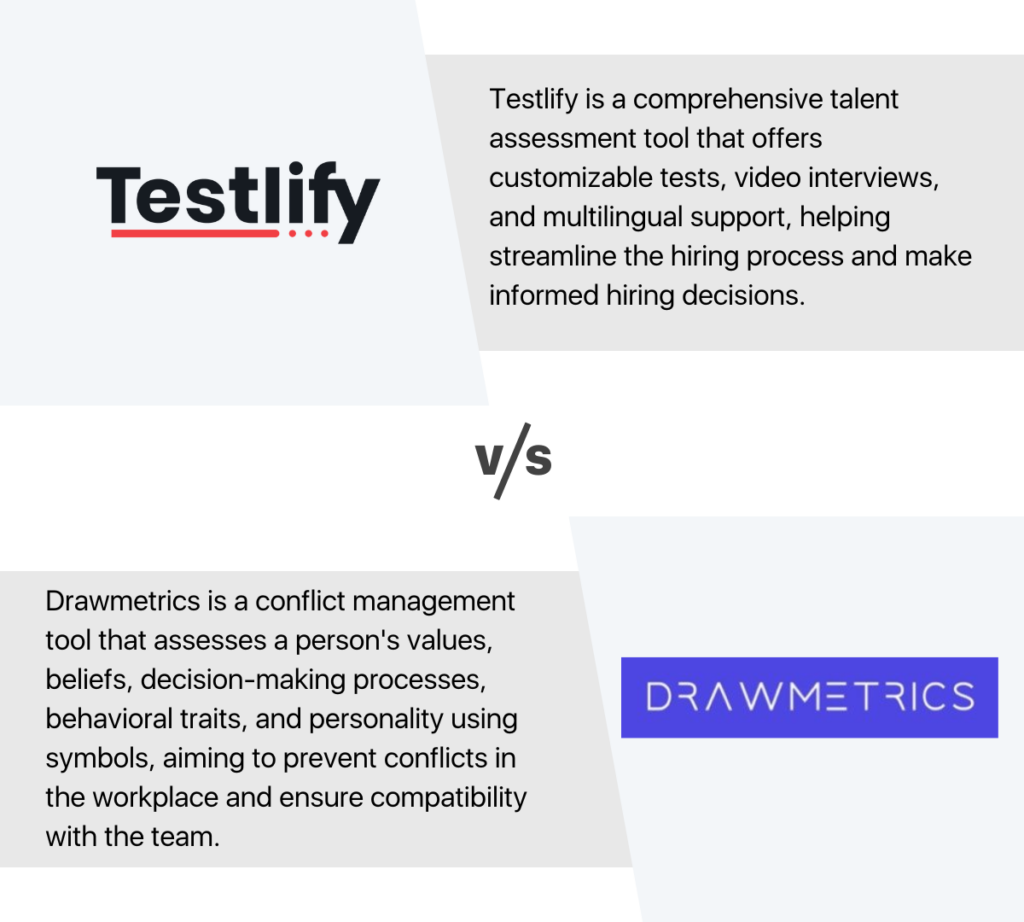
Drawmetrics is a projective psychometric method that analyzes a candidate's drawings to infer values, attitude and potential friction inside a team. It began as an in-house tool in 2003 and is now the core assessment technology inside AttituX, an HR platform for what the vendor calls attitude-driven recruitment. The standalone drawmetrics.com address redirects there.
That redirect matters more than it looks. Buyers still find comparison pages, directory listings and vendor roundups describing Drawmetrics as an independent product with its own roadmap and its own contract. What you are actually evaluating today is a module inside a broader HR system, which changes the procurement conversation, the integration questions and who you negotiate with.
Worth stating plainly, because it shapes how to read the rest of this page: Drawmetrics is listed among Testlify's partner integrations under conflict management. A buyer deserves to know that before reading a like-for-like feature grid anywhere on the web.
How does Drawmetrics actually work?
A candidate completes a set of ten drawings. An algorithm scores those drawings and returns a profile covering values, attitude and probable friction with a manager or team. AttituX says the assessment takes under three minutes, and the output maps candidates against attributes a hiring manager selects for the role, rated as a high, medium or low fit.
The appeal is obvious. Three minutes is nothing, candidates rarely feel tested, and there is no obvious way to game a drawing the way you can rehearse an interview answer. Projective methods also sidestep the self-report problem: a candidate filling in a personality questionnaire knows exactly which answers look good, and answers accordingly.
The catch sits in what happens after the drawing. Every projective instrument depends on the scoring model that turns an image into a trait score, and that model is where the evidence question lives. A fast, pleasant assessment that produces a number is not the same thing as a number that predicts anything.
What does Testlify measure instead?
Testlify measures demonstrated ability. Candidates take role-relevant tests drawn from a library of 3,500+ assessments built on 180k+ validated questions, covering job skills, coding, cognitive ability, language, software tools, psychometrics and situational judgment. The output is a score against the competencies the role actually requires.
The design principle is that hiring evidence should be observable. Rather than inferring whether someone is resourceful, a role-relevant assessment asks them to do something resourceful and scores the result. That is a narrower claim than reading character, and a much easier one to defend to a candidate, a hiring manager or a regulator.
Testlify also runs the surrounding machinery: cognitive ability testing, anti-cheating and proctoring controls, multiple reviewer scoring, and integrations that push results into the systems a talent team already lives in. The assessment is the part buyers compare; the workflow is usually what decides whether it survives contact with a real hiring cycle.
Drawmetrics vs Testlify: what each one measures
Comparison grids for this pairing tend to run to 70 or 80 rows and assert things no one has checked, including coding tests across 60+ programming languages. Nothing on the vendor's site supports a claim like that, and it is not a plausible capability for a drawing-based instrument. Unverifiable rows are worse than no rows, because they look like research.
What follows is built only on dimensions that can be checked against each vendor's own published material. Where a vendor simply does not document something, the cell says so instead of implying an absence.
Dimension | Testlify | Drawmetrics (AttituX) |
|---|---|---|
Primary construct measured | Demonstrated job skills and cognitive ability | Values, attitude and team friction |
Method | Role-relevant tests and work-style assessments | Projective analysis of ten drawings |
Evidence type | Observed performance on a task | Inferred traits from drawing features |
Assessment length | Typically 40 to 60 minutes | Under 3 minutes, per the vendor |
Test library size | 3,500+ tests, 180k+ questions | Single proprietary instrument |
Coding and technical testing | Yes, including live coding | Not published |
Custom assessment building | Yes | Not published |
Anti-cheating and proctoring | Yes, configurable by role | Not published |
Published pricing | Yes, from $139 per month | Not published |
Free trial | 7 days, no credit card | Beta access on request |
Money-back terms | 30-day guarantee | Not published |
Delivered as | Standalone assessment platform | Module inside the AttituX HR platform |
Origin of the method | Assessment library with reviewer and psychometric input | In-house tool developed from 2003 |
Relationship | Listed as partner integrations, not head-to-head rivals | |
Read the "Not published" cells as exactly that. They are not accusations that a capability is missing, they are a record that the vendor does not document it publicly, which is itself useful when you are building a procurement shortlist and need answers in writing.
Which signals actually predict job performance?
This is where a values-first and a skills-first approach genuinely diverge, and it is the part no ranking page on this query bothers to cite. The research on what predicts job performance has been revised substantially in the last few years, and the revision favors structured, job-relevant methods.
A large re-analysis of the personnel selection literature by Sackett and colleagues corrected a long-standing statistical overcorrection in earlier meta-analyzes. The revised operational validity estimates put structured interviews at .42, job knowledge tests at .40, work sample tests at .33 and cognitive ability tests at .31. The ordering matters: methods that observe job-relevant behavior sit at the top.
The same body of work prompted a wider rethink of how selection systems should be designed, rather than a simple reshuffle of a league table. The practical reading for a hiring team is that no single instrument carries a process, and the strongest predictors are the ones tied most tightly to the work itself.
Drawing-based projective measurement has a harder evidence record. A 2020 study in Child Psychiatry and Human Development evaluated the Draw a Person: Quantitative Scoring System and concluded that practitioners should not rely on human figure drawing tests as a projective measure of intelligence, citing weak validity evidence and poor correlation with academic performance.
Be precise about what that does and does not establish. It examined a specific clinical instrument used to estimate children's intelligence, not AttituX and not workplace attitude screening, and it would be sloppy to stretch it further. What it fairly supports is a posture: the burden of proof for any drawing-based inference sits with the vendor, and a buyer is entitled to ask for validation data on the specific population they hire from.
Where attitude and values screening earns its place
None of that makes attitude signal useless. It makes it a supporting input rather than a gate, and there are real situations where it pulls its weight.
Team friction is the strongest case. A candidate can clear every skills test and still be a poor fit for one specific manager, and that mismatch is expensive in a way a skills score never surfaces. Turnover data gives the shape of the risk: median employee tenure in the United States was 3.9 years as of January 2024, and just 2.7 years for workers aged 25 to 34, so the window in which a bad fit shows up and costs you a rehire is short.
Values screening also has a candidate-experience argument. A three-minute drawing exercise is a light touch at the very top of a funnel, and for high-volume roles where a full assessment battery would be disproportionate, a short signal that flags nothing more than "worth a conversation" is defensible.
The failure mode is using it as a filter. The moment an inferred values profile screens someone out before anyone has looked at whether they can do the job, you have made an irreversible decision on your weakest evidence. Rank your signals by how directly they observe the work, and let the strongest one carry the decision.
Pro Tip: if you run any attitude or values instrument, run it after a job-relevant assessment and never before. Use it to shape interview questions and manager pairing, not to reject. That ordering keeps the fast signal useful while keeping the defensible signal in charge of the outcome.
How much do Testlify and Drawmetrics cost?
Testlify publishes its pricing. The Standard plan is $139 a month billed annually at $1,668, additional user seats are $15 per seat per month, and extra credits are $21 each. Base plan pricing is locked for 24 months, there is a 7-day free trial with no credit card, and a 30-day money-back guarantee. Organizations assessing more than 25,000 candidates a year move to custom pricing.
AttituX does not publish rates anywhere on its own site. Access is offered through a beta signup rather than a published plan. Any figure quoted for Drawmetrics on a third-party comparison page is unverifiable against the vendor, so treat a confident-looking rupee or dollar plan elsewhere as unsourced.
Recommended: Testlify vs. Coderbyte: Which Skills Assessment Platform is Best for HR Teams?
Related Read: Testlify vs. Codility: Which Platform is Best for HR Teams?
Also Read: Testlify vs. Cangrade: Which Skills Assessment Platform is Best for HR Teams?
For a procurement comparison, the practical difference is not the headline number, it is predictability. A published rate card with a fixed term lets a talent team model cost per hire before signing. A quote-only vendor cannot be modelled until you are already in a sales cycle, which is worth factoring into a shortlist when you are comparing on total cost rather than sticker price.
How does each one fit your existing stack?
This is the question that decides most enterprise shortlists, and a feature grid never asks it. The two products do not occupy the same slot in a hiring stack, so the integration conversation is different in kind rather than in degree.
Testlify is a point solution. It handles assessment, then pushes scores and candidate reports into the systems a talent team already runs, so the applicant tracking system stays the record of truth and the assessment layer plugs into it. Nothing about the surrounding process has to move.
AttituX is an HR platform with assessment inside it, including job lists, hiring managers and campaign workflows. If your organization already runs an HRIS and an applicant tracking system, adopting it means deciding which system owns the candidate record and how much overlap you are willing to carry. That is a larger program than adding an assessment step, and it belongs on the evaluation from the start rather than surfacing during implementation.
Practical questions to settle early: does candidate data flow back into your existing systems automatically or does someone re-key it, who owns the record if the two disagree, what single sign-on is supported, and where the data is stored for teams with residency requirements. The vendor does not publish answers to these, so get them in writing. For a team hiring across multiple regions, data residency alone can decide the shortlist before anyone compares a feature.
How should you choose between them?
Stop treating it as a choice. The useful question is which signals a role needs and in what order, which is what the Testlify Multi-Signal Talent Evaluation Model is built to answer. The model's premise is that one signal is fragile and multiple signals create confidence: a candidate should advance when several role-relevant signals point the same way, not because one test scored well.
Applied here, that gives a clear ordering. Job-relevant capability is the load-bearing signal, because it is the one that observes the actual work. Cognitive and psychometric measures add context on how someone approaches problems. Attitude and values signal, including a projective instrument, sits alongside structured interview feedback as context that shapes how you interview and who you pair someone with.
Consider a hypothetical: a 900-person logistics operator hiring 40 warehouse supervisors in a quarter, where the real problem is not capability screening but supervisors leaving within eight months after clashing with site managers. Skills testing from the assessment library establishes the shortlist can do the job. A short values instrument then flags which candidates may struggle with a particular site manager's style, and that flag becomes an interview topic and a pairing decision, not a rejection. Both signals do work neither could do alone.
The wider hiring context supports building the process this way rather than betting on one instrument. World Economic Forum research found that nearly 40% of skills required on the job are set to change, with 63% of employers already citing the skills gap as the key barrier they face. When the skills a role needs keep moving, a process anchored to a single fixed trait profile ages badly, while one that measures current, role-relevant capability can be re-pointed as the role changes.
Is an AI drawing assessment high-risk under EU rules?
Yes, and so is most candidate-facing assessment technology. The European Commission's AI Act guidance classifies AI systems used for recruitment or selection under point 4(a) of Annex III, covering systems that analyze and filter applications or evaluate a candidate's suitability. Any tool scoring candidates for a hiring decision sits inside that category.
One detail deserves attention from anyone buying an inferred-trait product. Systems that perform profiling cannot benefit from the exceptions in Article 6(3), so a vendor cannot argue its way out of the high-risk classification on the grounds that the tool is only a light preliminary filter. Building a picture of a person from data points in order to evaluate them is exactly the activity the rule is aimed at.
This cuts across vendors rather than at one of them. Testlify's AI-assisted features fall inside the same regime, which is why the platform is built so that AI supports the evaluation and a human makes the decision. The point is not that one approach is regulated and another is not. It is that the compliance burden is easier to carry when the evidence behind a score is something you can point at.
That is where projective methods get uncomfortable. High-risk classification brings expectations around transparency and human oversight, and those are hard to satisfy when the underlying evidence is a drawing. If a candidate asks why they were rated a low fit, "the algorithm read your drawing that way" is a difficult answer to give, and a harder one to defend if the decision is ever challenged. A score tied to a task the candidate performed is far easier to explain, because the evidence is legible to everyone involved.
Obligations also land on the employer deploying the system, not only the vendor selling it. A talent team that adopts an AI scoring tool inherits duties around oversight and documentation, so "our vendor handles compliance" is not a position that survives scrutiny. Ask where the vendor's responsibility ends and yours begins, in writing, before the contract is signed.
What to ask any projective assessment vendor
None of this means walking away from attitude signal. It means running the same diligence you would run on any tool that influences who gets hired. Six questions separate a vendor with evidence from a vendor with a good demo.
- Where is the validation study, and who was in the sample? A validity claim is only meaningful for populations resembling the one studied. Ask for the sample size, the roles, the regions and the outcome measure the scores were tested against. "Validated" with no study attached is marketing.
- What does the score actually predict, and how strongly? Ask for a coefficient, not an adjective. Revised selection research puts the strongest job-relevant methods in the .31 to .42 range, so any number offered can be placed against a real benchmark rather than accepted on its own terms.
- Has adverse impact been tested across protected groups? Any scoring system can produce different pass rates across demographic groups, and an inferred-trait model is no exception. Ask what testing has been done and how often it is repeated.
- How is a low score explained to the candidate? Draft the actual sentence you would send. If it cannot be written in a way a rejected candidate would find reasonable, that is a signal about how the tool should sit in your process.
- What accommodations exist? A drawing exercise raises real accessibility questions for candidates with motor, visual or certain cognitive differences. Ask what the alternative pathway is and whether it produces a comparable score, because "most candidates manage fine" is not an accommodation policy.
- How stable is the result over time? If the same person takes the assessment twice a month apart, how close are the two profiles? Test-retest reliability sets the ceiling on how much any instrument can predict, and a vendor confident in its model will have the number.
Run those six past a skills assessment vendor too, including Testlify. A buyer who applies the same standard to every tool ends up with a process they can defend, which is the whole point of assessing rather than guessing.
Key Takeaways
- Drawmetrics is now part of AttituX, not a standalone purchase. The old domain redirects and the method ships inside an HR platform. That changes who you contract with and what integration questions matter, so any shortlist written before this shift needs rechecking before you sit down with procurement.
- The two tools measure different constructs. Testlify measures demonstrated ability, Drawmetrics infers values and attitude. Treating them as substitutes produces a comparison that cannot be resolved, because neither one answers the question the other is built for.
- Evidence quality should decide which signal leads. Revised selection research puts structured, job-relevant methods at the top, with structured interviews at .42 and job knowledge tests at .40. Anchor the decision to the signal that observes the work and let softer signals inform, not filter.
- Ask any projective vendor for validation data on your population. The published record for drawing-based measurement is thin, so the burden of proof sits with the vendor. A short, pleasant assessment that returns a confident score is not evidence that the score predicts performance in your roles.
- Published pricing is itself a procurement signal. Testlify lists rates and terms openly, from $139 a month with a 30-day guarantee. A quote-only vendor cannot be modelled for cost per hire until you are already in a sales cycle, which belongs in the comparison alongside features.
- Sequence matters more than selection. Run capability assessment first and values signal second, using the latter to shape interviews and manager pairing. Reversing that order spends your weakest evidence on your most irreversible decision.
Hire on evidence you can defend
If the roles you are filling turn on whether someone can actually do the work, start with a role-relevant assessment and build the rest of the evidence around it. Testlify offers a 7-day free trial with no credit card, or you can book a demo and walk through how the assessment plan would look for one specific role on your req list.
FAQs
Related resources
View all
Competitor Comparisons
Testlify vs EVA: A detailed comparison
Competitor Comparisons
Testlify vs Pulsifi: A detailed comparison
Competitor Comparisons
Testlify vs Prevue: A detailed comparison
Competitor Comparisons
Testlify vs Ducknowl: A detailed comparison
Competitor Comparisons
Testlify vs letsremotify: A detailed comparison
Competitor Comparisons
Testlify vs Topgrading: A detailed comparison
Get started.
Hire on proof, not resumes.
Run your first skills-based assessment free — no credit card required.