
Testlify vs EVA: A detailed comparison
Discover the perfect solution for evaluating your candidates’ skills with Testlify. Dive into our comprehensive Testlify vs EVA comparison…
 ChatGPT
 Gemini
 Claude
 Grok
Grok Perplexity
Testlify vs EVA: which platform fits your hiring?
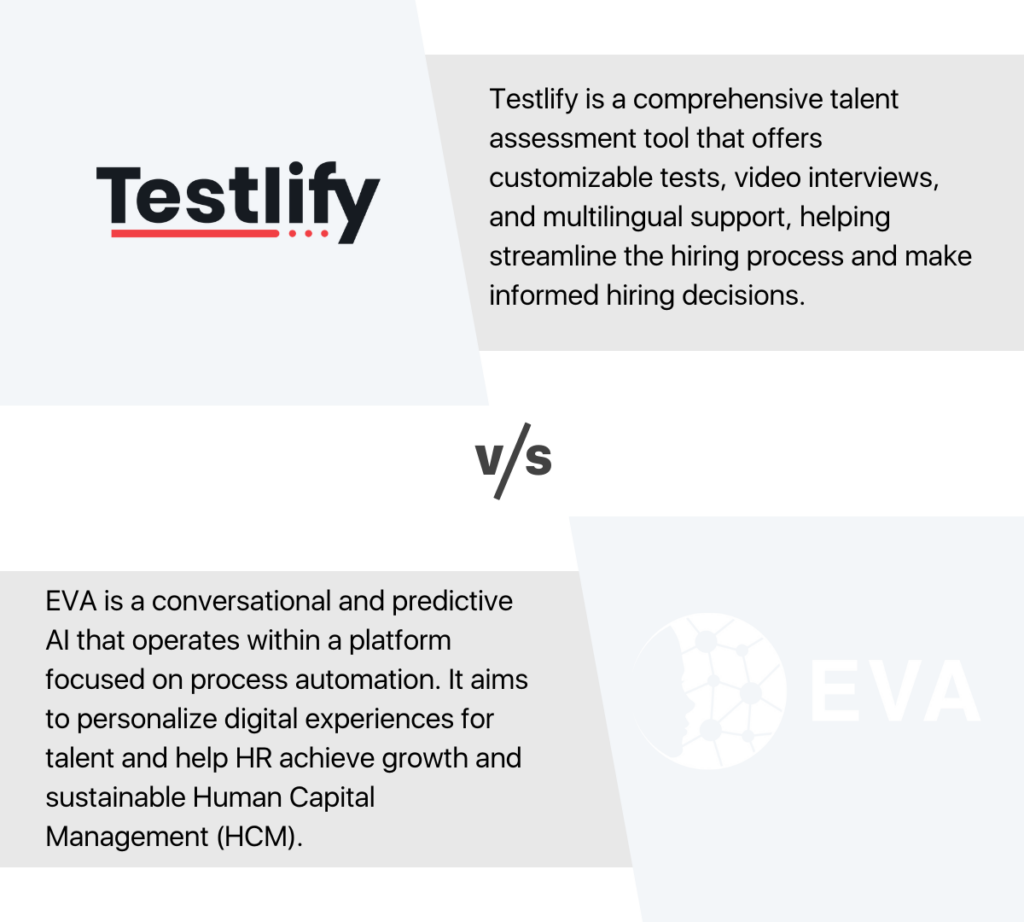
Testlify and EVA solve two different problems. Testlify is a pre-hire assessment platform that measures whether a candidate can actually do the job. EVA is a workforce decision intelligence platform that automates the recruiting process around that decision. Buy Testlify to measure skills. Buy EVA to automate workflow.
TL;DR
- These are not rival products in the same category. EVA automates the hiring process. Testlify measures the candidate inside it.
- EVA publishes real prices now, starting at $12,000 a year and running past $350,000 for its full workforce tier. That is enterprise procurement, not a card-swipe purchase.
- Testlify starts at $139 a month, or $1,668 a year for 100 candidate credits, with a 7-day free trial and a 30-day money-back guarantee.
- If the pain is "we cannot tell who is good," that is an assessment problem. If it is "we cannot move 8,000 applicants through a funnel," that is an automation problem.
- Plenty of teams end up running both, because an automated funnel that moves the wrong people faster just produces bad hires sooner.
One note on the numbers below: both vendors changed their public pricing during 2026, so every figure here carries the date it was checked. Anything that cannot be checked on a public page is called out as unverified rather than presented as fact.

What is the difference between Testlify and EVA?
Testlify tests skills before a hire. It runs role-based, cognitive, coding, personality and language assessments, then scores candidates against the role. EVA runs the machinery around hiring: applicant tracking, conversational screening, scheduling, workflow automation and people analytics. One answers "can this person do the work," the other answers "how do we process everyone."
That distinction matters because the two get shortlisted against each other for the wrong reason. A talent team drowning in applicants often assumes it needs better measurement, when what it actually needs is throughput. The reverse happens too, and it is the more expensive mistake: a team automates a funnel end to end, hits its time-to-hire target, and still ships weak hires, because nothing in the pipeline ever measured skill.
The market pressure behind both is real. Employers expect 39% of workers' core skills to change by 2030, according to the World Economic Forum's Future of Jobs Report 2025, down from 44% in its 2023 edition. When the skills attached to a job title move that fast, a resume describes a job that no longer exists. Something has to measure the current skill directly.
Feature-wise comparison for Testlify vs EVA
The table below compares the two platforms feature by feature. Read it as a starting point, not a verdict. The EVA column was built from EVA's public product pages and third-party software directories, and vendors ship features faster than comparison tables get updated, so confirm anything that will decide the purchase directly with the vendor. Where EVA does not publish a clear answer, the cell says so instead of guessing.
Features | Testlify | EVA |
|---|---|---|
Test Library | ||
Role-specific tests | ✓ | ✓ |
Cognitive ability tests | ✓ | ✓ |
Programming Tests | ✓ | ✗ |
No. of programming languages supported | 45+ | ✗ |
Situational judgment tests | ✓ | ✓ |
Typing test | ✓ | ✗ |
Software skills tests | ✓ | ✗ |
Non-technical tests | ✓ | ✓ |
Psychometric tests | ✓ | ✓ |
Personality tests | ✓ | ✓ |
Motivation test | ✓ | ✓ |
Assessment templates | ✓ | ✓ |
Custom assessments creation | ✓ | ✗ |
Test recommendations for different job roles | ✓ | ✓ |
Coding tests | ✓ | ✗ |
Assessments | ||
Custom assessment builder | ✓ | ✗ |
Custom coding questions | ✓ | ✗ |
Multiple-choice questions | ✓ | ✓ |
Descriptive questions | ✓ | ✗ |
Video interview questions | ✓ | ✓ |
Assessments curated by I/O psychologists | ✓ | Not stated |
Google doc | ✓ | ✗ |
Google sheets | ✓ | ✗ |
Google slides | ✓ | ✗ |
Audio questions | ✓ | ✗ |
Qualifier questions | ✓ | ✓ |
File upload questions | ✓ | ✗ |
Quality check | Extensive process incl. peer reviews, sample testing, review by psychometrician & more | Not stated |
Video interview questions | ||
One-way video interview | ✓ | ✓ |
Custom video questions creation | ✓ | ✗ |
Candidate's recording attempts per question | ✓ | ✗ |
Live video interview | ✗ | ✗ |
Candidate experience | ||
Fully customizable email templates | ✓ | ✗ |
Custom invitation and rejection email | ✓ | ✓ |
Mobile-friendly | ✓ | ✓ |
Candidate support | ✓ | ✗ |
Instructions before assessment | ✓ | ✓ |
Average assessment length | 40-60 minutes | ✗ |
Anti-cheating features | ||
Session recording | ✓ | ✗ |
Snapshot capturing | ✓ | ✗ |
Mouse tracking | ✓ | ✗ |
Copy-paste disabled | ✓ | ✗ |
Microphone and camera access | ✓ | ✗ |
Location access | ✓ | ✗ |
IP address tracking | ✓ | ✗ |
Randomization of question sequence | ✓ | ✗ |
Time limit on tests | Yes, typically 10 minutes | ✗ |
Reporting and analytics | ||
Detailed reports | ✓ | Not stated |
Easy to share reports and scorecards | ✓ | ✗ |
Exportable/downloadable reports | ✓ | Not stated |
Recruiting analytics | ✓ | ✗ |
Candidate benchmarking | ✓ | ✗ |
Completion rate and response insights | ✓ | ✗ |
Enterprise friendly | ||
White label feature | ✓ | ✗ |
Custom branding | ✓ | ✓ |
ATS integration | ✓ | ✗ |
User, role, and access management | ✓ | ✓ |
Bulk candidate invite | ✓ | ✗ |
Share public link invite to candidates | ✓ | ✗ |
Candidate pipeline management | ✓ | ✓ |
Internationalization | ✓ | ✓ |
Campus hiring support | ✓ | ✗ |
Dedicated account manager | ✓ | ✗ |
GDPR compliant | ✓ | Not stated |
Multilingual abilities | ✓ | ✗ |
Customer support | ||
24/7 support | ✓ | ✗ |
On-call support | ✓ | ✓ |
Email support | ✓ | ✓ |
Product demo | ✓ | ✓ |
Training & onboarding tour | ✓ | Not stated |
One correction worth making plainly, because it cuts against the table: EVA's own site now markets skills-related decisioning, and several software directories list skills assessment among its features. Treat the assessment rows as "narrower than a dedicated assessment platform," not as "absent."
How does EVA work?
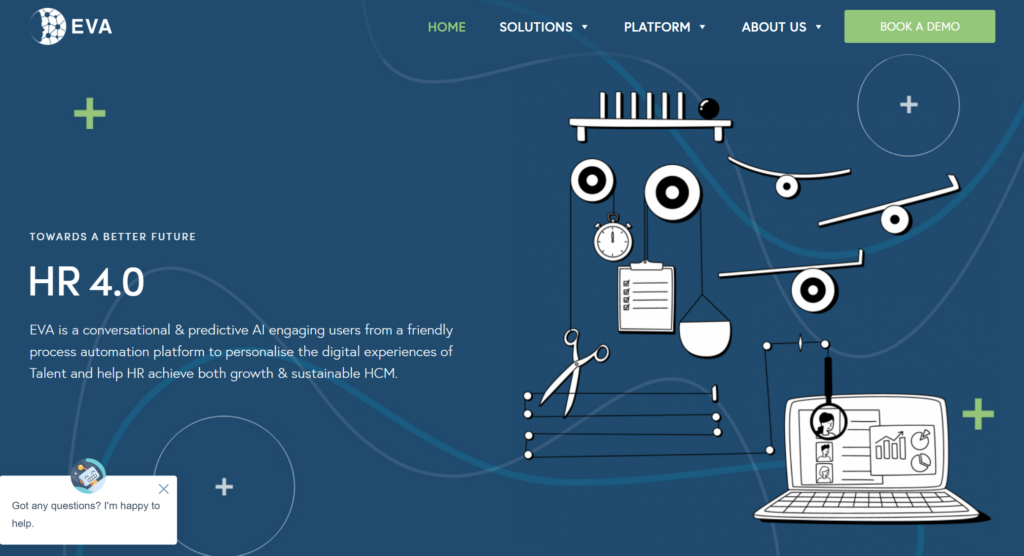
EVA describes itself as a workforce decision intelligence platform, built to make hiring, mobility and skills decisions faster, fairer and auditable at scale. It sells to enterprises, operates across 170+ countries, and combines what used to be two separate purchases, an applicant tracking system and a candidate relationship manager, into one automation layer.
The product breaks into six pieces: personalized portals for each type of user, a conversational AI assistant that screens and schedules, machine learning and predictive models that rank and recommend, robotic process automation for repetitive admin, people analytics dashboards, and connectors that pull legacy HR systems together. EVA is explicit that a human stays in the loop, with the system explaining why it recommended something rather than deciding on its own.
That design tells you who it is for. EVA is built for organizations hiring or managing thousands of people a year, where the cost is administrative drag across a huge funnel. A company hiring 40 people a year will not get its money back on that. A company processing 40,000 applications might. For a sense of the volume involved, US employers made 5.2 million hires against 7.6 million open jobs in May 2026, per the Bureau of Labor Statistics, with 3.1 million people quitting in the same month. Backfilling at that rate is an operations problem before it is a judgment problem.
What does Testlify measure that EVA does not?
Testlify's job starts where a resume stops. It runs validated assessments across role skills, coding, cognitive ability, personality and language, adds proctoring so the score means something, then hands hiring teams a scored comparison instead of a stack of CVs. The role-specific test library covers 3,500+ tests across 5,000+ roles and 50+ industries.
Depth on the assessment side is the trade. Testlify is not an applicant tracking system, not a CRM, not an HRIS, and it does not run payroll or onboarding. It plugs into those instead, with 100+ ATS and HR integrations covering Workday, SAP SuccessFactors, Greenhouse, Lever, BambooHR and SmartRecruiters, among others. Teams that want one vendor for everything will find that annoying. Teams that already own an ATS they do not intend to replace will find it the whole point.
This is the Testlify Multi-Signal Talent Evaluation Model in practice: combine several role-relevant signals rather than trusting one. A skills test, a coding exercise, a structured interview, reference input and reviewer scores each carry different noise, and they rarely fail in the same direction at once. One signal is fragile. Several pointing the same way is a decision a hiring manager can defend six months later when someone asks why this candidate got the offer.
The hiring market rewards that kind of discipline right now, because volume is not doing the work for anyone. Indeed's Hiring Lab put its Job Postings Index at 101.8 as of 14 August 2026, only 1.8% above where it sat in February 2020, with year-over-year change still negative at -2.9%. Openings are flat. The lever left is picking better from the applicants already arriving.
Testlify vs EVA: Pricing
This is where the comparison changed most in 2026, and where the old version of this page was simply out of date. Both vendors now publish numbers, so a buyer can size the two without booking a sales call first.
EVA pricing
EVA publishes tiered annual pricing on its pricing page, checked on 25 August 2026. A Starter Pilot runs $12,000 a year. The Modular plan is $50,000 a year, Core Talent $145,000 a year, and Total Workforce $245,000 a year. The top HCM Auto-Pilot tier starts from $350,000 a year and is tailored per customer. Add-ons are priced separately, at around $5,000 a year per module plus roughly $1 per shortlisted applicant.
Read those as enterprise software prices, because that is what they are. The entry tier alone is a budget line that needs a business case, a procurement cycle and an internal owner.
Testlify pricing
Testlify's published pricing, checked the same day, works on candidate credits rather than seats. The Standard plan is $139 a month, or $1,668 a year, and includes 100 candidate credits, which works out to $16.68 per candidate assessed. Three user seats are included, with extra seats at $15 a month and extra credits at $21 each. A Custom plan covers organizations assessing 25,000+ candidates a year.
Some capabilities are priced as add-ons rather than bundled: white labelling and ATS integrations are $2,388 a year each on the Standard plan, live video proctoring is $5 per attempt, and photo ID verification is $0.50 per attempt. Worth modelling those before comparing headline prices, since heavy proctoring changes the real per-candidate cost. Testlify includes a 7-day free trial with no credit card and a 30-day money-back guarantee.
How do you choose between Testlify and EVA?
Start with the failure you are actually having, not the feature list. Write down the last ten hires that went wrong and sort them into two piles: ones where the process was too slow or too manual, and ones where the person simply could not do the job. The bigger pile picks the vendor.
If the pain is administrative, thousands of applicants, scheduling chaos, recruiters retyping data between systems, that is EVA's territory, and an assessment tool will not fix it. If the pain is judgment, strong interviewers disagreeing, hires that interview well and perform badly, screening that leans on where someone worked before, that is an assessment problem, and more automation will only move the wrong candidates through faster.
Budget usually settles the rest. There is a real gap between a $139 monthly subscription and a $12,000 annual entry tier, and that gap is not a discount, it is a difference in what is being bought. A mid-market team can run Testlify on a corporate card this week. EVA is a procurement project.
Pro Tip: run one live role through whichever tool you are leaning toward before signing anything longer than a month. Take a role you are hiring for right now, put ten real candidates through it, and check whether the output changed a decision anyone would have made anyway. If the shortlist comes out the same as it would have without the tool, the tool is not earning its price, however good the demo looked.
The honest answer for a lot of teams is that these are not either-or. An automation layer that moves people through a funnel and an assessment layer that decides who deserves to move are complementary, and organizations at the volume EVA targets typically run something in both roles already. Skills upkeep is now normal rather than exceptional: 50% of the workforce completed training or reskilling in 2025, up from 41% two years earlier, per the same World Economic Forum research cited above. Measuring what people can do has become a repeating task, not a one-off gate.
Ready to compare on real skills?
The fastest way to settle a platform comparison is to run a real role through it. Testlify's 7-day free trial needs no credit card, and the 30-day money-back guarantee covers the first paid month if it does not hold up. Teams weighing several vendors at once can compare other assessment tools side by side, or book a demo and walk through a live role with someone who has set this up before. Hiring for a specialist seat, such as hiring a customer success manager, is a good first test, because the skills are easy to describe and notoriously hard to read off a resume.
Key Takeaways
- They are different categories, so a feature scoreboard misleads. EVA automates recruiting workflow; Testlify measures candidate skill. Comparing check marks across two categories rewards whichever vendor lists more rows, which is why the buying decision should start from the problem being solved rather than the table.
- Price difference reflects scope, not a discount. EVA's entry tier is $12,000 a year against Testlify's $139 a month. A team that only needs to measure skills would be buying a workforce automation suite to get an assessment, and paying for the rest of it every year.
- Check the per-candidate cost, not the sticker. Testlify's credit model works out at $16.68 per candidate on the Standard plan, but live proctoring at $5 per attempt and ID verification at $0.50 per attempt change that number for high-integrity roles. Model the real volume before comparing.
- Automation without measurement scales the wrong outcome. Moving candidates faster only helps if the shortlist is right. Teams that fix throughput first often find their bad-hire rate unchanged, because nothing in the funnel ever tested skill.
- Skills move faster than job titles. With 39% of core skills expected to change by 2030, credentials age quickly. Whichever platform is chosen, the process needs a step that measures current ability rather than inferring it from history.
- Verify vendor feature claims before signing. Comparison tables, including this one, lag product releases. Anything that decides the purchase should be confirmed against the vendor's own current documentation or a live trial.
FAQs
Related resources
View all
Competitor Comparisons
Testlify vs Pulsifi: A detailed comparison
Competitor Comparisons
Testlify vs Prevue: A detailed comparison
Competitor Comparisons
Testlify vs Ducknowl: A detailed comparison
Competitor Comparisons
Testlify vs letsremotify: A detailed comparison
Competitor Comparisons
Testlify vs Topgrading: A detailed comparison
Competitor Comparisons
Testlify vs Recruiter: A detailed comparison
Get started.
Hire on proof, not resumes.
Run your first skills-based assessment free — no credit card required.