
Testlify vs Pulsifi: features, pricing and proctoring compared for 2026
Testlify and Pulsifi compared for 2026: test libraries, AI video interviews, proctoring, ATS fit, compliance and published pricing.
Testlify vs Pulsifi is a choice between a skills-first assessment platform and a talent intelligence platform. Testlify tests what a candidate can do, with 3,500+ tests, coding, simulations, AI interviews and proctoring on every test. Pulsifi predicts role fit and culture fit from personality, reasoning and resume data, and adds a built-in ATS, talent mapping and published credit pricing. This comparison uses each vendor's public pages, checked on 23 October 2026.
TL;DR / Key Takeaways
- Pick Testlify if most of your roles have a testable skill. Pick Pulsifi if the decision is mostly about role fit, culture fit and potential.
- Proctoring scope is the biggest gap. Pulsifi proctors cognitive tests only, while Testlify applies 20+ checks to every test, coding task and AI interview.
- Pulsifi Lite costs USD 2,800 a year for 2,800 credits and Pro costs USD 8,000 for 9,000 credits, with a 12-month minimum.
- A Pulsifi candidate doing personality, reasoning and video uses 28 credits. A Testlify candidate uses one credit to start an assessment.
- Pulsifi includes a built-in ATS plus talent mapping and succession tools. Testlify connects to 100+ ATS and HRIS tools instead.
- Pulsifi does not list coding tests. Testlify runs coding tasks in a live IDE with 45+ programming languages.
- Both score candidates with AI, so hiring in New York City needs a current Local Law 144 bias audit from either vendor.
 ChatGPT
 Gemini
 Claude
 Grok
 Perplexity
Testlify vs Pulsifi: what is the difference?
Testlify and Pulsifi differ in the question each answers first. Testlify answers "can this person do the job?" with skills tests, work simulations and structured AI interviews. Pulsifi answers "will this person fit the role and the company?" with psychometric profiles, fit scores and talent analytics, and it reaches past hiring into succession and internal mobility.
The table below is the short version. Every Pulsifi row comes from pulsifi.me product and pricing pages as of 23 October 2026; "Not listed" means we could not find it in Pulsifi's public material, so ask for it on a demo.
Area | Testlify | Pulsifi |
|---|---|---|
Core job | Skills-based assessment and AI interviewing | Talent intelligence: fit prediction for hiring and talent management |
Test library | 3,500+ tests: role skills, coding, cognitive, SJT, language, typing, personality | Personality, work interest, work culture, reasoning, plus 2,600+ functional tests |
Custom questions | 25+ question types, AI test builder from a job description | Custom interview and pre-screening questions on Enterprise |
Coding tests | Yes, live IDE with 45+ programming languages | Not listed |
Video interviews | One-way video and audio, two-way AI interviews by video, voice or chat, live coding interviews | Pre-recorded video interviews with AI transcript scoring |
Proctoring | 20+ checks on every test type and interview | Basic and premium proctoring on cognitive tests |
ATS | Integrates with 100+ ATS and HRIS tools | Built-in ATS, integrates with 30+ HR systems |
Talent management | 360 feedback | Talent mapping, succession, 180/360 feedback, development plans |
Data residency | Customer picks the region | Singapore or EU data centre |
Pricing | Published, credit per candidate, monthly or annual, 7-day free trial | Published: Lite and Pro yearly plans, Enterprise on request |

What is Pulsifi and who is it built for?
Pulsifi is a talent intelligence platform that turns personality, cognitive, skills and resume data into role fit and organizational fit scores. Pulsifi sells three solutions: Predictive Hiring, Talent Mapping, and AI Impact and Readiness. Its buyers are enterprise HR teams, with a strong Southeast Asian customer base, that want one people-data platform for hiring and talent decisions.
Pulsifi's roots are in psychometrics, and culture fit is still the center of the product. The Role Fit score combines soft traits from psychometric assessments with hard skills drawn from resume analysis, then compares the candidate against a job success profile. The Organizational Fit score maps the same psychometric results to a culture framework, either your own or one of Pulsifi's (high potential, entrepreneurial leadership, work agility, customer success, crisis recovery).
Three newer parts of the product matter for this comparison:
- Predictive Hiring with a built-in ATS: Pulsifi now runs applicant tracking, resume screening, automated invites, pre-recorded video interviews and a hiring manager interview widget with suggested questions.
- Talent Mapping: The same profiles feed succession planning, high-potential identification, 180/360 feedback and individual development plans.
- AI Impact and Readiness: Pulsifi scores roles for automation impact and plots them on a 3 by 3 matrix for workforce planning.
Customer quotes on Pulsifi's site come from teams at Nestlé, the National University of Singapore and Kraft Heinz Indonesia, which fits its campus and early-career strength.
What is Testlify and who is it built for?
Testlify is an AI-native skills assessment and interviewing platform for talent teams that want to hire on proof of skill rather than resumes. Testlify turns a job description into a role-specific assessment, runs structured AI interviews, scores every response and ranks candidates, with a person making the final call. More than 1,500 talent teams use it across 50+ industries.
The Testlify test library covers role-specific skills, software skills, coding, cognitive ability tests, situational judgment, language (CEFR A1 to C2), typing and psychometric tests such as Big Five and DISC. Hiring teams can add their own questions in 25+ formats, including video, audio, file upload, Google Sheets and Excel tasks, and Chat AI or Voice AI items.
Testlify is built for mid-market and enterprise teams hiring across many roles at once: tech, contact centers, finance, healthcare and blue-collar work. One platform covers the coding test for an engineer and the typing and chat simulation for a support agent, which is why volume and multi-role teams pick it.
How do the test libraries compare?
The test libraries compare on breadth and on depth of skills evidence. Testlify offers 3,500+ tests with coding, Office and Google Workspace simulations, language and situational judgment tests. Pulsifi offers three psychometric assessments, three reasoning tests and a functional skills catalog of 2,600+ technical tests, with each assessment taking 5 to 15 minutes.
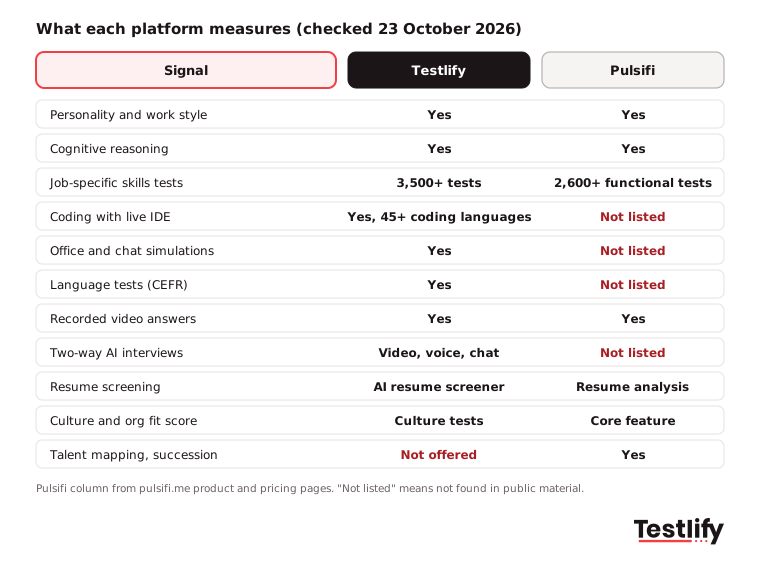
The gap between the two has narrowed. When this comparison was first written in 2023, Pulsifi had no skills tests; its pricing page now lists functional assessments of up to five tests per candidate. The difference that remains is in how the evidence is used and how deep it goes:
- How skills feed the decision: At Pulsifi, the Role Fit score takes hard skills from resume analysis and combines them with psychometric traits. At Testlify, skills come from what the candidate actually does in the test, scored per skill.
- Coding and simulations: Testlify runs coding tasks in a live IDE with 45+ programming languages, plus MS Office, Google Workspace, typing and chat simulations. Pulsifi does not list coding tests or simulations.
- Building a test: Testlify's AI test builder drafts an assessment from a job description in under a minute, and subject experts build custom tests on request. Pulsifi customizes job success profiles and, on Enterprise, its predictive models.
- Personality: Both cover personality. Pulsifi goes deeper on work interests and culture, which is its core product.
Bottom line: if your hiring risk is "can they do it?", Testlify gives more direct evidence. If it is "will they stay and fit?", Pulsifi's fit model is the more developed tool.
How do video interviews and AI scoring compare?
Video interviews compare on format and on how answers are scored. Pulsifi runs pre-recorded video interviews and scores the transcript with AI, weighting response quality at 40% and response effectiveness at 60%. Testlify runs one-way video and audio questions, two-way AI interviews by video, voice or chat, and live coding interviews, all scored against the same structured rubric.
Pulsifi's AI video interview analysis is a sensible design. Pulsifi states that it scores what candidates say, not how they look or sound, so camera setup and accent play no part in the rating, and each score links back to quotes from the transcript. Logistics questions such as notice period or salary are kept for the recruiter but left out of the competency score. Pulsifi also lists an integration with the Willo video interviewing tool.
Testlify's AI interviews for candidate screening go a step further. An AI interviewer asks structured questions and follow-ups, every candidate gets the same path, and answers are scored on the skills the role needs. AI candidate insights add a per-skill breakdown, pros and cons, and suggested follow-up questions for the next round. Speech authenticity detection runs on Voice AI and Video AI answers.
How to write video interview questions that hold up
Whichever platform you use, structure is what makes a video answer useful:
- Ask every candidate the same questions in the same order.
- Tie each question to one skill or behavior from the job description.
- Write what a strong, average and weak answer looks like before the first candidate records.
- Score each answer before watching the next one, and keep logistics questions out of the score.
Pro tip: add one task-based question ("walk me through how you would fix this ticket") next to the behavioral ones. Rehearsed answers about teamwork are easy to polish; a worked task is not.
How do Testlify and Pulsifi handle cheating and AI misuse?
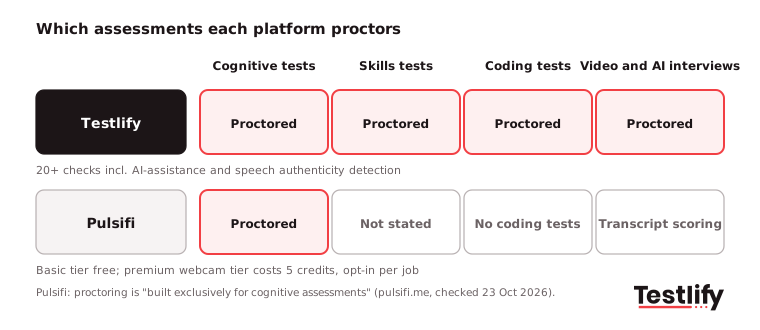
Cheating controls differ mainly in scope. Pulsifi's browser-based proctoring is "built exclusively for cognitive assessments": a free basic tier checks response timing, answer patterns, tab switches and copy attempts, and a premium tier adds webcam snapshots, gaze and phone detection. Testlify applies 20+ anti-cheating and proctoring checks to every test type, coding task and AI interview.
Scope matters because fraud is now a planning assumption, not an edge case. Gartner predicts that 1 in 4 candidate profiles worldwide could be fake by 2028, and in its survey of 3,000 job candidates 6% admitted to interview fraud, according to HR Dive's coverage of the Gartner report. TA leaders in GoodTime's 2026 hiring report ranked fraudulent or AI-assisted candidates as their top hiring challenge of the year, as Recruiting News Network reported in June 2026.
What each platform does about it:
- Pulsifi: Processing runs on the candidate's device, so raw video and audio never leave it. Each attempt gets a 0 to 100 proctoring score with an event timeline, and the premium tier costs 5 credits and is switched on per job. Results carry forward for one year across new applications.
- Testlify: Checks include full-screen enforcement, webcam snapshots and camera recording, tab and mouse-out tracking, face and talking detection, AI-assistance detection, copy-paste blocking, IP and location limits, Focus Guard mode and question randomization. Photo ID verification with face match and live video proctoring are available as paid per-use options.
A one-year-old, cognitive-only integrity check is fine for a graduate personality screen. It is thin for a remote developer, analyst or finance role, where the skills test and the interview are the parts most worth faking.
Which platform fits your ATS and HR stack?
The answer depends on whether you already run an ATS. Pulsifi includes its own applicant tracking system and lists integrations with more than 30 HR systems, with API access and SSO on its Enterprise plan. Testlify does not replace your ATS; it connects to 100+ ATS and HRIS tools with two-way sync, so scores land in the pipeline your recruiters already use.
Testlify's integrations include Workday, SAP SuccessFactors, Oracle HCM, Greenhouse, Lever, SmartRecruiters, BambooHR, Workable, UKG Pro Recruiting and Ashby, with a REST API and webhooks for anything else. Most connect in under five minutes. Integrations are an add-on on smaller plans and included on Custom plans.
If your company has no ATS, Pulsifi's built-in one is a real advantage. If you run Workday or Greenhouse and do not want a second candidate record, check that Pulsifi's connector covers your system before you sign.
How do security and AI compliance compare?
Both platforms cover the data privacy basics, and Testlify carries more third-party certifications. Testlify holds ISO 27001 and SOC 2 Type II, supports GDPR and CCPA, lets customers pick a data region and offers SAML SSO. Pulsifi lists GDPR and PDPA compliance, a choice of Singapore or EU data centre, and SSO and HIPAA compliance on its Enterprise plan.
AI scoring raises a second question: is the tool audited for bias? Both platforms use AI to score or rank candidates. In New York City, Local Law 144 bars employers from using an automated employment decision tool unless it has had a bias audit within one year of use, the results are public and candidates get notice.
Testlify publishes a third-party bias audit of its matching model; we could not find a published audit on Pulsifi's site. If you hire in New York City, ask each vendor for the date of its latest audit, since the law counts from the date of use. Testlify's wider controls are on its security page.
Testlify vs Pulsifi pricing: what does each cost in 2026?
Both vendors now publish prices. Pulsifi lists a Lite plan at USD 2,800 a year with 2,800 credits and a Pro plan at USD 8,000 a year with 9,000 credits, with Enterprise on request and a 12-month minimum on core plans. Testlify uses a simpler model: one credit per candidate who starts an assessment, monthly or annual billing, and a 7-day free trial.
The two credit systems count differently, which is where buyers get caught out. Pulsifi charges per assessment type, as listed on its pricing page on 23 October 2026:
Pulsifi item | Credits |
|---|---|
Personality, work interest and culture assessments | 10 per candidate |
Logical, numerical and verbal reasoning | 10 per candidate |
Functional assessment (up to five tests) | 10 per candidate |
Video interview | 5 per candidate |
AI video interview analysis | 3 per interview |
Resume analysis and screening questions | 0.5 per candidate |
Premium proctoring | 5, opt-in per job |
A worked cost example
Take a graduate intake where each applicant does the personality set, the reasoning set and a recorded video interview with AI analysis. On Pulsifi that is 10 + 10 + 5 + 3 = 28 credits per candidate. On Lite, where a credit costs USD 1, that is about USD 28 per candidate and roughly 100 candidates a year before the plan runs out. Add a functional skills test and it rises to 38 credits.
On Testlify, the same candidate uses one credit for the assessment, which can combine several tests, custom questions and a video question, with standard proctoring included. Credits are only spent when a candidate starts, and there is a 30-day money-back guarantee. See current plans on the Testlify pricing page and run your own screened-candidate count through both models before you compare totals.
Want to see your real numbers? Book a Testlify demo and bring last year's applicant volume.
When is Pulsifi the better pick?
Pulsifi is the better pick when the decision is mostly about fit and potential rather than a testable skill, or when you want one platform for hiring and talent management. Large graduate intakes with similar resumes, succession and high-potential programs, and teams without an ATS all play to Pulsifi's strengths, especially in Southeast Asia.
- Graduate and early-career hiring: With hundreds of applicants and no work history, personality, work interests and reasoning are the main signals, and Pulsifi's fit model is built for that.
- Talent mapping and succession: If the project is finding future leaders among current staff, Pulsifi's talent mapping, 360 feedback and development plans go well past what a hiring tool offers.
- No ATS yet: Pulsifi's built-in ATS means one less system to buy.
- Repeat applicants: Results stay valid for a year, so a candidate who applies to three roles does the assessments once.
When is Testlify the better pick?
Testlify is the better pick when most of your roles have a skill you can test, when you hire across many job families at once, or when cheating controls must cover skills tests and interviews, not just reasoning tests. Teams that want to pilot without a 12-month commitment, or that already run an ATS, also tend to choose Testlify.
- Skills-heavy roles: Developers, analysts, finance, support and sales roles where a work sample shows more than a profile.
- High-volume and multi-role hiring: One assessment can mix coding, simulations, a video answer and a personality test, scored and ranked automatically.
- Remote and high-stakes roles: 20+ proctoring checks, AI-assistance detection and ID verification options apply to every test.
- AI skills hiring: Gartner expects 75% of hiring processes to include tests for workplace AI proficiency by 2027, which needs a library you can extend with custom tasks.
Still weighing options? See why talent teams pick Testlify for how customers set up skills-based screening.
How should you choose between Testlify and Pulsifi?
Choose by matching each open role to the evidence it needs, then checking which platform supplies it. Skills need a work sample or knowledge test, traits need a psychometric profile, and integrity needs proctoring on the parts that matter. With nearly 70% of HR professionals struggling to fill full-time roles in SHRM's 2026 Talent Trends research, the cost of a wrong pick is a slower search, not just a wasted license.
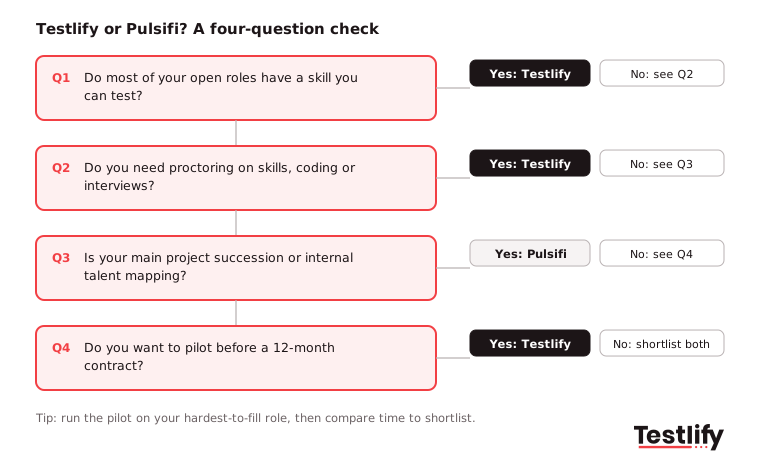
- List 4 to 6 must-haves per role: Mark each one "skill" or "trait".
- Match each to a signal: If more than half are skills, a fit-first platform leaves the biggest risk unmeasured.
- Set the integrity bar: Remote, regulated or high-pay roles need proctoring on skills tests and interviews.
- Price your real volume: Use last year's screened-candidate count and the credit math above.
- Pilot one hard role for 30 days: Judge it on time to shortlist and hiring manager confidence.
Across the teams we work with, assessment programs fail on adoption, not on the test itself. We have seen hiring managers stop reading reports they do not trust, so agree who scores what, with which rubric, before the first candidate lands. That decision matters more than any feature on this page.
Try Testlify on one real role
If most of your open roles are skills-heavy, start a free 7-day Testlify trial (no credit card) and run one live role through a proctored assessment with a video question attached. Or book a demo and bring your Pulsifi credit estimate, and the team will price the same volume on Testlify.
Key takeaways
- Testlify and Pulsifi start from different questions: Testlify measures what candidates can do; Pulsifi predicts fit to the role and the culture. Classify your roles before you compare features.
- Pulsifi has caught up in places: It now publishes prices, sells 2,600+ functional tests, scores video transcripts with AI and proctors cognitive tests.
- Proctoring scope is the biggest gap: Pulsifi proctors cognitive tests only; Testlify applies 20+ checks to every test, coding task and AI interview.
- Credits count differently: A Pulsifi candidate doing personality, reasoning and video uses 28 credits; a Testlify candidate uses one credit to start an assessment.
- Ask about bias audits: Both tools score candidates with AI, so New York City hiring needs a current Local Law 144 audit.
- Pulsifi wins on talent management: Succession, high-potential mapping and development plans are outside Testlify's scope.
FAQs
Related resources
View all
Competitor Comparisons
Testlify vs Prevue: A detailed comparison
Competitor Comparisons
Testlify vs Ducknowl: A detailed comparison
Competitor Comparisons
Testlify vs letsremotify: A detailed comparison
Competitor Comparisons
Testlify vs Topgrading: A detailed comparison
Competitor Comparisons
Testlify vs Recruiter: A detailed comparison
Competitor Comparisons
Testlify vs Otomeyt: A detailed comparison
Get started.
Hire on proof, not resumes.
Run your first skills-based assessment free — no credit card required.