
Testlify vs Searchlight: A detailed comparison
Discover the perfect solution for evaluating your candidates’ skills with Testlify. Dive into our comprehensive Testlify vs Searchlight…
Testlify and Searchlight both promise better hiring decisions, but they measure different things at different moments. Testlify scores what a candidate can actually do before you interview them. Searchlight gathers structured reference feedback and ties it to quality-of-hire analytics once a shortlist already exists. Pick by the evidence gap you have.
That framing matters more than any feature checklist, because the two are not straight substitutes. Swap one for the other and you do not get a cheaper version of the same product. You get a different kind of evidence, at a different point in the hiring timeline.
Trusted by 1,500+ hiring teams from fast-scaling startups to enterprise TA functions
 ChatGPT
 Gemini
 Claude
 Grok
Grok Perplexity
TL;DR: Testlify vs Searchlight in 60 seconds
- Testlify is a pre-hire assessment platform: role-based skills tests, coding tests, cognitive and personality assessments, one-way video questions, and proctoring.
- Searchlight is a reference-checking and quality-of-hire platform. It collects structured feedback from a candidate's former managers and peers, then connects that to how the hire performs later.
- The feature table below is lopsided, and not because one product is lazy. Searchlight was never built to run a coding test, and Testlify was never built to survey a former manager.
- Too many unqualified candidates reaching your interview panel is a screening problem. Assessment is the cheaper fix.
- Hiring people who interview well and then underperform in month four is a signal-quality problem after the shortlist. References plus outcome tracking help more there.
- Nothing stops you running both, and the sequencing section below covers how to do it without charging your candidates twice for their time.

What is the difference between Testlify and Searchlight?
Testlify measures a candidate's job-relevant skills before you interview them, through role-based tests, coding exercises, cognitive assessments and proctoring. Searchlight measures what people who already worked with that candidate say about them, through structured reference checks, then links those inputs to how the hire turns out. One is pre-hire evidence. The other corroborates.
Selection science has a settled view on which of those signals carries more weight. A 2022 reanalysis of decades of validity research by Sackett and colleagues puts structured evaluation among the strongest predictors of job performance, and puts years of education and general years of experience near the bottom. The exact revised coefficients are still argued over in print. The ranking is not.
Reference checking sits lower on that ladder than most hiring teams assume. The 1998 Schmidt and Hunter meta-analysis, the ranking those later reanalyses were built on, placed reference checks well below work samples and structured evaluation as a predictor of performance. That does not make references worthless. It makes them a confirming signal rather than a screening one, which is exactly how the strongest hiring processes use them.
How does Searchlight work?
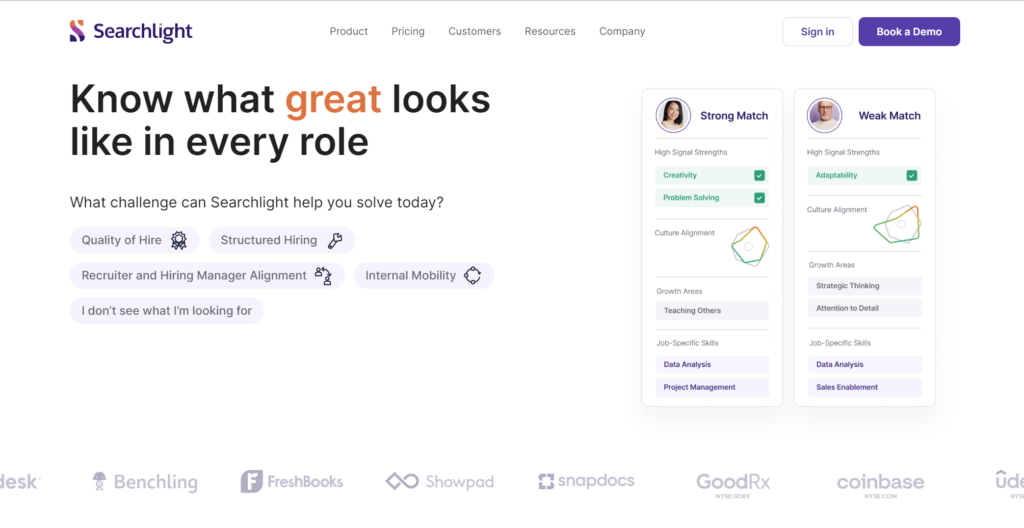
Searchlight sits after the shortlist. A recruiter sends a request, the candidate nominates former managers and peers, and those people answer a structured questionnaire instead of taking a freeform phone call. The output is a profile of observed strengths and risks, plus analytics that tie what referees said to how the hire actually worked out.
The structure is the part worth paying for. An unstructured reference call is close to useless as a prediction tool, because the referee chooses what to talk about and the recruiter hears what they already expected. A structured, job-related process is a real improvement on that, though the honest description of the lift is modest rather than transformative.
Searchlight's own positioning covers faster hiring, hiring effectiveness, internal mobility, recruiter and hiring manager alignment, DEIB, quality of hire, and top-talent retention. Read that list slowly. Every item on it happens at or after the offer stage. None of it happens while you are still deciding who deserves an interview slot in the first place.
What does Testlify measure that Searchlight does not?
Testlify runs before the interview. The test library covers role-specific skills, coding across 45+ programming languages, cognitive ability, personality, situational judgment, typing and software skills, with one-way video questions and a proctoring layer over the top. A candidate sits a 40 to 60 minute assessment, and the shortlist arrives already scored.
So the difference fits in one sentence. Testlify tells you who deserves an interview. Searchlight tells you more about the people who already got one.
The pre-hire slice keeps getting more valuable, and there is data behind that. The World Economic Forum's Future of Jobs Report 2025 found employers expect 39% of workers' core skills to change by 2030. When the skill mix under a job title moves that fast, a resume ages badly, and a reference describing work someone did three years ago describes a job that no longer has the same shape. Testing the skill you need now is the one signal that keeps pace.
Honest scope, since you are comparing: Testlify is an assessment platform. It is not an applicant tracking system, not a sourcing tool, not an HRIS, and it does not run background checks. It plugs into that stack. It does not replace it. If someone tells you an assessment tool covers your whole hiring workflow, check what they are counting.
How do Testlify and Searchlight compare feature by feature?
Below is the side-by-side hiring teams ask for, with one warning attached. A row where Searchlight shows a cross is usually not a gap in Searchlight. It is a category the product was never designed to enter. Read the table as a scope map, not a scoreboard.
Features | Testlify | Searchlight |
|---|---|---|
Test Library | ||
Role-specific tests | ✓ | ✓ |
Cognitive ability tests | ✓ | ✗ |
Programming Tests | ✓ | ✗ |
No. of programming languages supported | 45+ | ✗ |
Situational judgment tests | ✓ | ✗ |
Typing test | ✓ | ✗ |
Software skills tests | ✓ | ✗ |
Non-technical tests | ✓ | ✓ |
Psychometric tests | ✓ | ✗ |
Personality tests | ✓ | ✗ |
Motivation test | ✓ | ✗ |
Assessment templates | ✓ | Not stated |
Custom assessments creation | ✓ | Not stated |
Test recommendations for different job roles | ✓ | ✗ |
Coding tests | ✓ | ✗ |
Assessments | ||
Custom assessment builder | ✓ | ✗ |
Custom coding questions | ✓ | ✗ |
Multiple-choice questions | ✓ | Not stated |
Descriptive questions | ✓ | Not stated |
Video interview questions | ✓ | ✗ |
Assessments curated by I/O psychologists | ✓ | Not stated |
Google doc | ✓ | ✗ |
Google sheets | ✓ | ✗ |
Google slides | ✓ | ✗ |
Audio questions | ✓ | ✗ |
Qualifier questions | ✓ | ✗ |
File upload questions | ✓ | ✗ |
Quality check | Extensive process incl. peer reviews, sample testing, review by psychometrician & more | Not stated |
Video interview questions | ||
One-way video interview | ✓ | ✗ |
Custom video questions creation | ✓ | ✗ |
Candidate's recording attempts per question | ✓ | ✗ |
Live video interview | ✗ | ✗ |
Candidate experience | ||
Fully customizable email templates | ✓ | ✗ |
Custom invitation and rejection email | ✓ | ✓ |
Mobile-friendly | ✓ | ✗ |
Candidate support | ✓ | ✗ |
Instructions before assessment | ✓ | ✓ |
Average assessment length | 40-60 minutes | ✗ |
Anti-cheating features | ||
Session recording | ✓ | ✗ |
Snapshot capturing | ✓ | ✗ |
Mouse tracking | ✓ | ✗ |
Copy-paste disabled | ✓ | ✗ |
Microphone and camera access | ✓ | ✗ |
Location access | ✓ | ✗ |
IP address tracking | ✓ | ✗ |
Randomization of question sequence | ✓ | ✗ |
Time limit on tests | Yes, typically 10 minutes | Not stated |
Reporting and analytics | ||
Detailed reports | ✓ | ✓ |
Easy to share reports and scorecards | ✓ | ✗ |
Exportable/downloadable reports | ✓ | Not stated |
Recruiting analytics | ✓ | ✗ |
Candidate benchmarking | ✓ | ✗ |
Completion rate and response insights | ✓ | ✗ |
Enterprise friendly | ||
White label feature | ✓ | ✗ |
Custom branding | ✓ | ✗ |
ATS integration | ✓ | ✗ |
User, role, and access management | ✓ | Not stated |
Bulk candidate invite | ✓ | ✗ |
Share public link invite to candidates | ✓ | ✗ |
Candidate pipeline management | ✓ | ✗ |
Internationalization | ✓ | ✗ |
Campus hiring support | ✓ | ✗ |
Dedicated account manager | ✓ | ✓ |
GDPR compliant | ✓ | ✓ |
Multilingual abilities | ✓ | ✗ |
Customer support | ||
24/7 support | ✓ | ✗ |
On-call support | ✓ | ✓ |
Email support | ✓ | ✓ |
Product demo | ✓ | ✗ |
Training & onboarding tour | ✓ | Not stated |
Testlify vs Searchlight: pricing
Testlify pricing
Testlify's plans bill monthly or annually, and the plan tiers are visible before you speak to anyone. That matters more than the headline number when you are comparing tools, because you can model a full hiring cycle at your own candidate volume instead of waiting on a quote.
Searchlight pricing
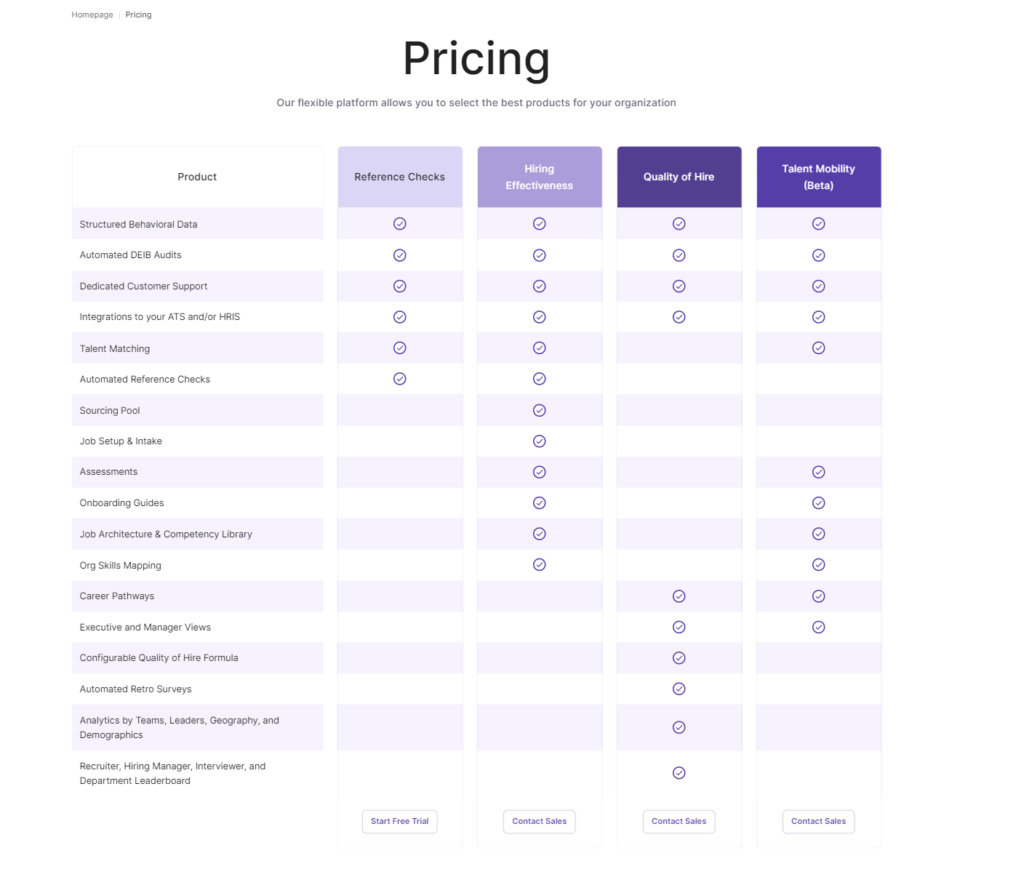
Searchlight does not publish pricing. You contact them for a quote. In practice that means a sales conversation before you can put a cost per hire next to a tool that shows its numbers up front, so build that delay into your evaluation timeline.
Whatever either platform costs, anchor it against the thing you are trying to avoid. Gallup's 2019 estimate is that replacing one employee costs one-half to two times their annual salary, and it calls that conservative. On a $90,000 role, that is $45,000 to $180,000 sitting behind a single hiring decision. Priced against that, the interesting question is not which tool is cheaper. It is which one stops the wrong hire earlier.
Which platform should you choose?
Start from the failure you are actually seeing, not from the feature list.
Assessment first, if this sounds familiar:
- Your interview panels are burning hours on candidates who cannot do the work.
- You hire technical, operational or high-volume roles where skill is genuinely testable.
- You need a consistent, defensible score across every candidate for the same role.
- Your funnel is wide and the bottleneck sits at the top of it.
References and outcome tracking first, if this sounds more like you:
- Your shortlist quality is fine and your month-four performance is not.
- You hire senior or specialist roles where observed past behaviour is the best signal available.
- You already run assessments and now want to close the loop on quality of hire.
Then there is the uncomfortable case. If you have neither, do not buy both at once. Fix the screening end first. A better reference process running on a shortlist that was assembled badly does not save you. It just documents the wrong people more thoroughly, and it does it three weeks later in the process, when swapping course costs the most.
How do you run both without duplicating work?
The Testlify Multi-Signal Talent Evaluation Model rests on a simple claim: one signal is fragile, and several signals create confidence. A candidate should not move forward because of one strong resume, one polished interview or one good test score. They should move forward when several role-relevant signals point the same way.
Running assessment and references together is that model in practice. Sequence it so nothing gets collected twice:
- Define what the role actually requires, written as competencies you can measure rather than years you can count.
- Assess those competencies before the first interview, and let the score decide the shortlist.
- Interview that shortlist against the gaps the assessment surfaced, not against the resume.
- Run structured references on finalists only, asking about the specific risks the earlier stages flagged.
- Track how the hire performs, then feed that back into which signals you weight next cycle.
Pro tip: do not run references on everyone who reaches the interview stage. It is slow, it spends your candidates' professional goodwill on people you were probably never going to hire, and at that point in the funnel it buys you very little. Finalists only.
Worth knowing before you commit to either: neither tool fixes a badly written role definition. If your hiring managers cannot agree what good looks like for the job, an assessment measures the wrong competencies precisely and a reference check asks the wrong questions politely. That work comes first, and no vendor does it for you.
Hire on proof, not resumes
Testlify covers the role-specific, cognitive and coding assessments most hiring teams need, and you can score a shortlist before anyone books an interview slot. Browse the test library to see what maps to the role you are hiring for, or book a walkthrough and bring the role you are struggling to fill. If you are still mapping the market, there is a wider view of Searchlight alternatives, another head-to-head worth reading, and a full roundup of assessment platforms.
Key takeaways
- These products sit at different points in the hiring timeline, so a feature-by-feature score misleads you. Testlify generates evidence before the interview; Searchlight generates evidence around and after the offer. Decide which of those two gaps is costing you more this quarter, and buy for that one.
- Structured evaluation outranks reference checking as a predictor of job performance in the selection literature, and that gap has survived every reanalysis. Use references to confirm a decision you have already reasoned your way to, never to make it.
- Searchlight's crosses in the comparison table are mostly scope, not weakness. Judging a reference platform on whether it runs coding tests tells you nothing useful about whether it is good at the job it was built for.
- With 39% of core skills expected to shift by 2030, evidence from a role someone held three years ago describes work that has already changed. That erosion hits reference data harder than it hits a test of the skill you need today.
- Published pricing is worth real money at evaluation time. One vendor lets you model cost per hire this afternoon; the other requires a sales cycle before you can compare anything, and that delay is a cost even if the eventual quote is lower.
- If you run both, run assessment on the whole funnel and references on finalists only. Reversing that order is the common and expensive mistake, because it spends the slow, goodwill-heavy step on candidates the fast step would have filtered out.
FAQs
Related resources
View all
Competitor Comparisons
Testlify vs SalesDrive: A detailed comparison
Competitor Comparisons
Testlify vs Paradox: A detailed comparison
Competitor Comparisons
Testlify vs Drawmetrics: A detailed comparison
Competitor Comparisons
Testlify vs EVA: A detailed comparison
Competitor Comparisons
Testlify vs Pulsifi: A detailed comparison
Competitor Comparisons
Testlify vs Prevue: A detailed comparison
Get started.
Hire on proof, not resumes.
Run your first skills-based assessment free — no credit card required.