
Predictive Index alternatives: 10 tools to compare in 2026
Ten Predictive Index alternatives compared on what they measure, pricing model and fit, plus a checklist for switching away from PI.
The Predictive Index (PI) is a talent optimization platform built around a short behavioral assessment and a cognitive assessment, sold as an annual subscription priced by headcount. Predictive Index alternatives are tools that cover the same hiring job in a different way: most add skills tests, AI interviews and proctoring, and many charge per candidate instead of per employee.
TL;DR:
- A behavioral and cognitive assessment platform, sold as an annual subscription from $10,000 a year, priced by headcount.
- Behavior is not proof of skill, pricing follows headcount instead of hiring volume, and technical or high-volume roles need a second tool.
- Testlify, TestGorilla, Criteria, Culture Index, Vervoe, Mercer Mettl, iMocha, HireVue, TestDome and eSkill, on what they test, how they price and who they suit.
- Decide what to measure, match pricing to hiring volume, then check ATS fit, compliance, candidate experience and integrity controls.
- If managers use it company-wide for coaching and team design, add a skills test instead of replacing it.
- Export your data, map job targets to skills, pilot on one or two roles, connect your ATS, then train managers and roll out.
 ChatGPT
 Gemini
 Claude
 Grok
 Perplexity
What is the Predictive Index and what does it cost?
The Predictive Index is a behavioral assessment and talent optimization platform. Its two core tools are the PI Behavioral Assessment, which describes workplace behaviors and motivations, and the PI Cognitive Assessment, which measures learning ability and problem solving. PI says the behavioral assessment takes about six minutes.
PI's assessments page positions both tests inside a wider platform for hiring, manager coaching and team building. Hiring features include job targets, candidate-to-job match scoring and interview guides.
On cost, the Predictive Index pricing page states that plans start at $10,000 per year and that the price is based on headcount (checked October 21, 2026). The plan is an annual subscription with unlimited users, unlimited behavioral assessments and 97+ integrations. PI Professional Certification and expert-led workshops are sold as add-ons, and a free trial is not a standard offer.

Why do hiring teams look for Predictive Index alternatives?
Hiring teams look for Predictive Index alternatives when they need proof that a candidate can do the work, not only a read on how that person tends to behave. The other common triggers are price, contract shape and the effort needed to read results well.
- Behavior is not the same as skill: A behavioral profile says how someone prefers to work. It does not show whether a sales rep can handle an objection or an analyst can build a pivot table. Most teams add a skills test anyway, then pay for two tools.
- Annual, headcount-based pricing: PI's price follows your employee count, not your hiring volume. A 600-person company that hires 40 people a year pays for the whole company.
- Training to interpret results: PI sells a certification program for HR leaders. Teams that want hiring managers to read a report without training often prefer plain skill scores.
- Volume and technical hiring: PI has no coding tests, job simulations or proctoring for high-volume screening, so engineering and contact center teams need a second tool.
- Pressure to prove quality of hire: LinkedIn's Future of Recruiting 2025 found that 93% of TA professionals say accurately assessing skills is crucial to quality of hire, yet only 25% feel highly confident they can measure quality of hire. Skill scores give that measurement a starting point.
Recruiting is still hard, which makes wasted assessment spend more painful. SHRM's 2025 Talent Trends reports that nearly 70% of organizations still face challenges recruiting for full-time roles.
How do the top Predictive Index alternatives compare?
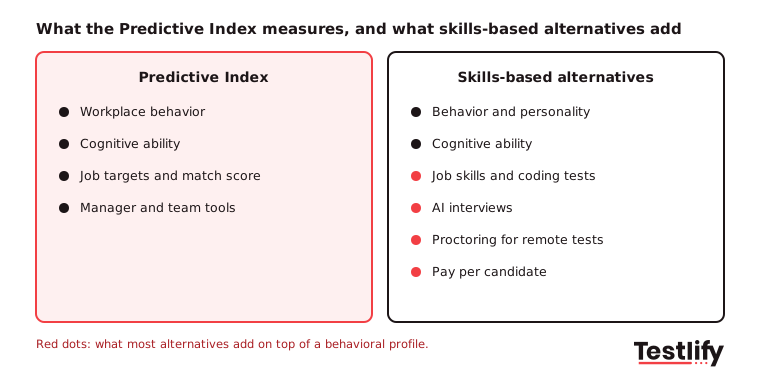
The top Predictive Index alternatives split into two groups: behavioral peers that measure traits like PI does (Criteria, Culture Index) and skills-based platforms that test job skills, often with personality and cognitive tests included (Testlify, TestGorilla, Vervoe, Mercer Mettl, iMocha, HireVue, TestDome, eSkill). Vendor pricing and features below were checked on October 21, 2026.
Tool | Best for | What it measures | Pricing model | Free option |
|---|---|---|---|---|
Testlify | Mid-market and enterprise teams replacing PI with one platform | Skills, cognitive, personality (Big Five, DISC), AI interviews | Credits, pay only when a candidate starts | 7-day free trial, no credit card |
Predictive Index (baseline) | Behavior-led hiring plus manager and team tools | Behavior, cognitive ability | Annual, by headcount, from $10,000/yr | No standard trial |
TestGorilla | Small teams that want a free starting point | Skills, cognitive, personality | Per account, Core from $215/mo billed annually | Free plan, 10 credits a month |
Criteria | Teams that want aptitude plus personality | Cognitive, personality, emotional intelligence, risk, skills | Quote-based | Not published |
Culture Index | Leaders who want a behavioral survey with advisory support | Behavior against a benchmark | Quote-based | Free diagnostic via sales |
Vervoe | Work-sample tests graded by AI | Job skills through realistic tasks | Request pricing | Not published |
Mercer Mettl | Campus and large-scale proctored testing | Aptitude, domain, technical, psychometric | Quote-based | Not published |
iMocha | Enterprises linking hiring to skills intelligence | Technical and role skills, AI interviews | Demo-led | Not published |
HireVue | Enterprise video interviewing at volume | Interviews, assessments | Demo-led | Not published |
TestDome | Pay-as-you-go work-sample tests | Coding and job skills | Per candidate, from $7 | No subscription needed |
eSkill | Broad test catalog with simulations | Skills, cognitive, behavioral, personality | Sales-led | Not published |
What are the 10 best Predictive Index alternatives in 2026?
The 10 best Predictive Index alternatives in 2026 are Testlify, TestGorilla, Criteria, Culture Index, Vervoe, Mercer Mettl, iMocha, HireVue, TestDome and eSkill. Each entry below covers what the tool does, who it suits, and the trade-offs compared with PI.
1. Testlify
Testlify is an AI-native skills assessment and interviewing platform. It turns a job description into a role-specific assessment, runs structured AI interviews, scores every response and ranks candidates, with explainable results and a human making the final call. For a team leaving PI, the main difference is that behavior, cognitive ability and job skills sit in one test link.
What you get:
- 3,500+ validated tests, including role-specific, coding, cognitive ability, situational judgment, language and personality tests such as the Big Five inventory and DISC assessment.
- An AI test builder that drafts an assessment from a job description in under a minute, plus 25+ question types.
- AI interviews by video, voice and chat, and one-way video interviews.
- 20+ proctoring and anti-cheating checks, such as full-screen enforcement, tab tracking, webcam snapshots and AI assistance detection.
- 100+ ATS and HRIS integrations, including Workday, Greenhouse, Lever and SAP SuccessFactors, and tests in 15+ languages.
- A third-party NYC Local Law 144 bias audit of its Matching Model, completed June 16, 2023, plus ISO 27001 and SOC 2 Type II.
Pros: one platform for tech and non-tech roles; credit pricing that follows hiring volume; G2 rating of 4.7 with Leader badges in Talent Assessment; 1,500+ companies use it.
Cons: no manager coaching or team-dynamics module like PI's Develop and Build tools; white label and some integrations are add-ons on lower plans; unused credits expire at the end of the billing cycle.
Pricing: credit-based, where one credit is one candidate who starts an assessment, with a 7-day free trial and no credit card. See Testlify pricing for current plans.
Pro tip: If you already have PI behavioral profiles for your top performers, rebuild those roles in Testlify with a skills test plus the Big Five or DISC test, then run both tools side by side on one open role before your renewal date.
Want to see it on one of your own roles? Book a Testlify demo or start the free trial.
2. TestGorilla
TestGorilla is a skills testing platform that now sells two products: Gorilla Sourcing for finding candidates and Gorilla Assessments for testing them. Its free assessment plan gives 10 credits a month and includes essential tests such as Big 5 (OCEAN), with 350+ premium tests on paid plans.
Pros: free plan to start; personality, cognitive and skills tests in one place; AI interviews and resume scoring on paid plans.
Cons: paid assessment plans start at Core from $215 a month billed annually, with Plus from $520 a month; sourcing seats are priced separately.
Pricing: per account, checked on TestGorilla's pricing page on October 21, 2026. Read our TestGorilla alternatives guide for a closer look.
3. Criteria
Criteria (Criteria Corp) is the closest like-for-like swap for PI. It offers cognitive aptitude tests, including the well-known CCAT, along with personality, emotional intelligence, risk and skills tests, game-based assessments, AI proctoring, and both async and real-time video interviewing, according to Criteria's website.
Pros: strong aptitude and personality range; video interviewing built in; development tools for current employees.
Cons: narrower job-skill and coding coverage than skills-first platforms; no public price list was found on the site on October 21, 2026.
Pricing: quote-based. Compare it further in our Criteria Corp alternatives guide.
4. Culture Index
Culture Index is a behavioral assessment company, which makes it the alternative most similar to PI in approach. Culture Index's site describes scoring every hire against a behavioral benchmark and pairs the data with expert advisory support.
Pros: behavior-first like PI, with consulting support for leadership teams.
Cons: no skills tests, coding tests or proctoring; pricing is not published, and the site routes buyers to a free diagnostic with sales.
Pricing: quote-based.
5. Vervoe
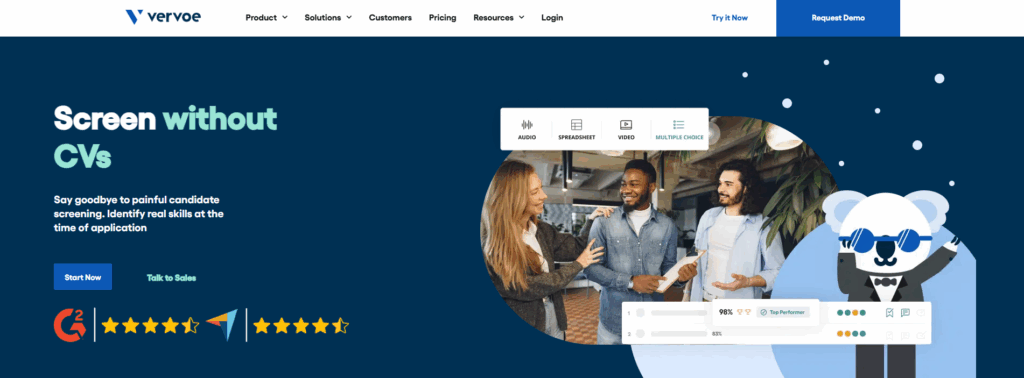
Vervoe tests candidates on realistic job tasks and uses machine learning to grade and rank responses. The platform includes an AI assessment builder, chat and voice screening, and interview scheduling with prepared panels.
Pros: work samples show how a candidate performs real tasks; automated grading saves reviewer time.
Cons: less focus on behavioral profiling; pricing is not listed.
Pricing: Vervoe's pricing page asks buyers to request pricing (checked October 21, 2026). See our Vervoe alternatives guide.
6. Mercer Mettl
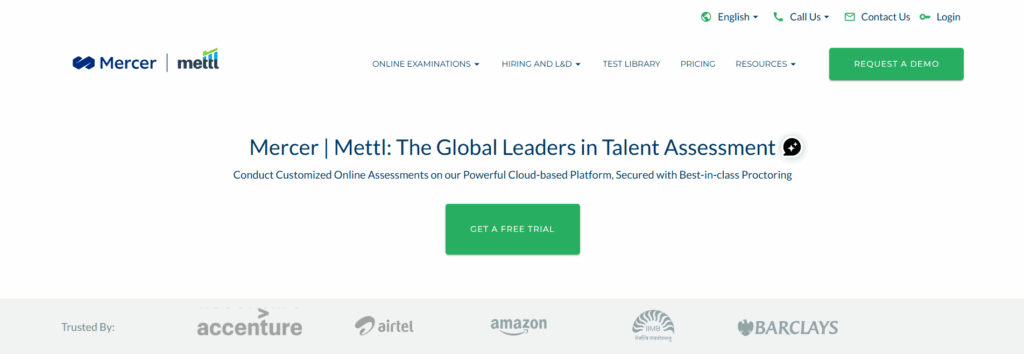
Mercer Mettl offers pre-hiring assessments for campus, lateral, technical and sales hiring, backed by AI-assisted proctoring. Its psychometric and aptitude range makes it a common choice for large campus programs.
Pros: wide test range including psychometric tests; proctoring built for exam-scale volume.
Cons: quote-based pricing; setup is heavier than self-serve tools.
Pricing: quote-based per Mercer Mettl. Compare options in our Mettl alternatives guide.
7. iMocha
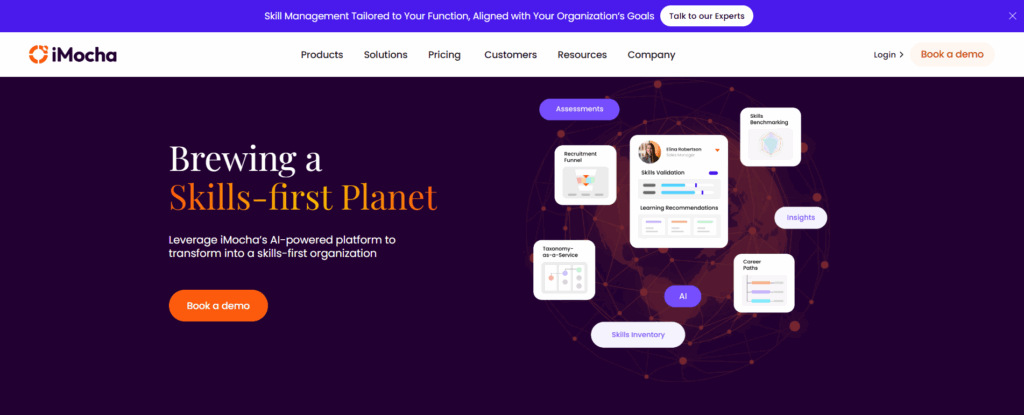
iMocha combines skills-based hiring with a wider skills intelligence suite for current employees. For hiring, it offers role-based assessments, AI interviews, coding evaluations, communication tests and proctoring.
Pros: connects hiring data with internal skills mapping; strong technical coverage.
Cons: no published pricing; the platform is broader than teams that only need pre-hire screening may want.
Pricing: demo-led via iMocha. See our iMocha alternatives guide.
8. HireVue
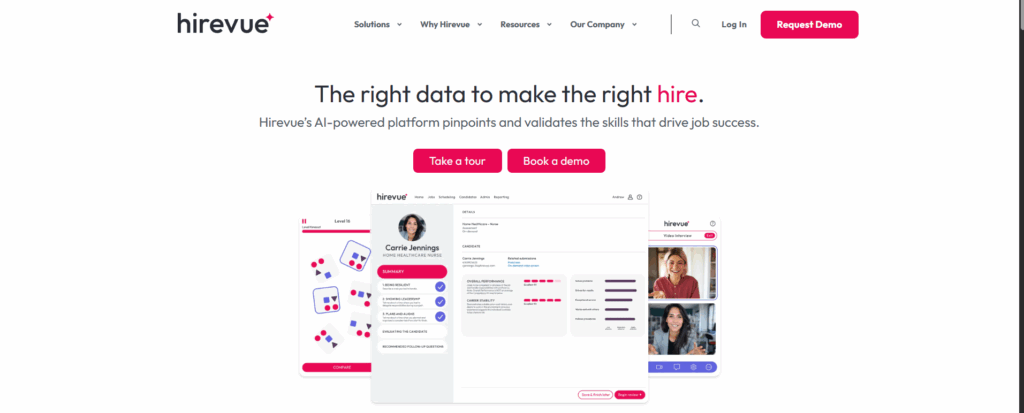
HireVue is an enterprise hiring platform known for video interviewing. It now includes an AI interviewer, assessments with an assessment builder, scheduling automation and cheating and fraud mitigation, and it targets mid-market and enterprise employers.
Pros: mature video interviewing for high-volume programs; strong scheduling automation.
Cons: pricing only through a demo; a large platform to roll out if you only need assessments.
Pricing: demo-led per HireVue's pricing page. See our HireVue alternatives guide.
9. TestDome
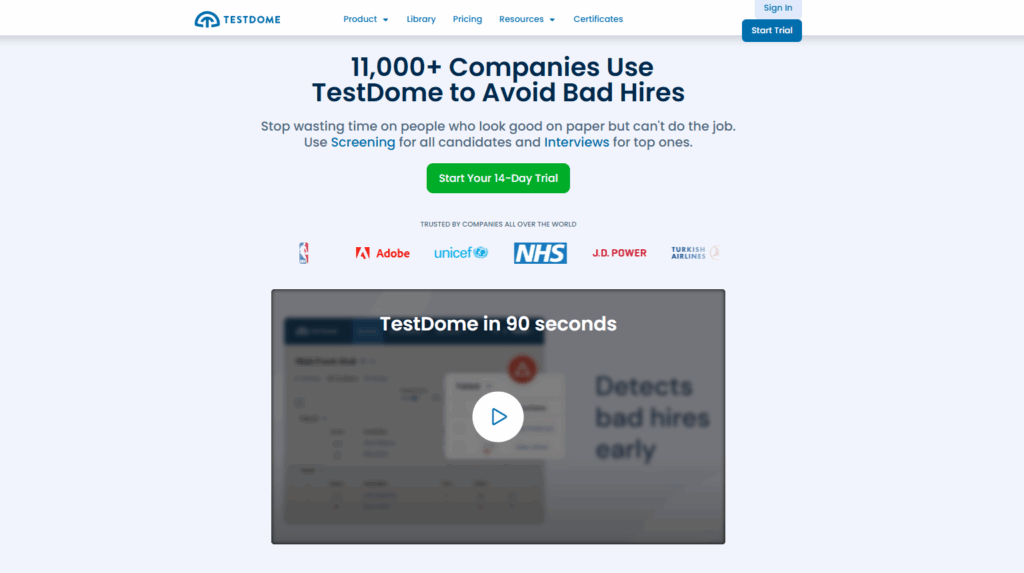
TestDome sells work-sample tests for programming and other job skills with no subscription. You pay when you test or interview someone.
Pros: clear public pricing; low commitment for occasional hiring.
Cons: no behavioral or personality profiling to replace PI's core report; per-candidate costs add up at volume.
Pricing: from $7 per candidate, with a Starter pack at $20 per candidate for five candidates, per TestDome's pricing page (checked October 21, 2026).
10. eSkill
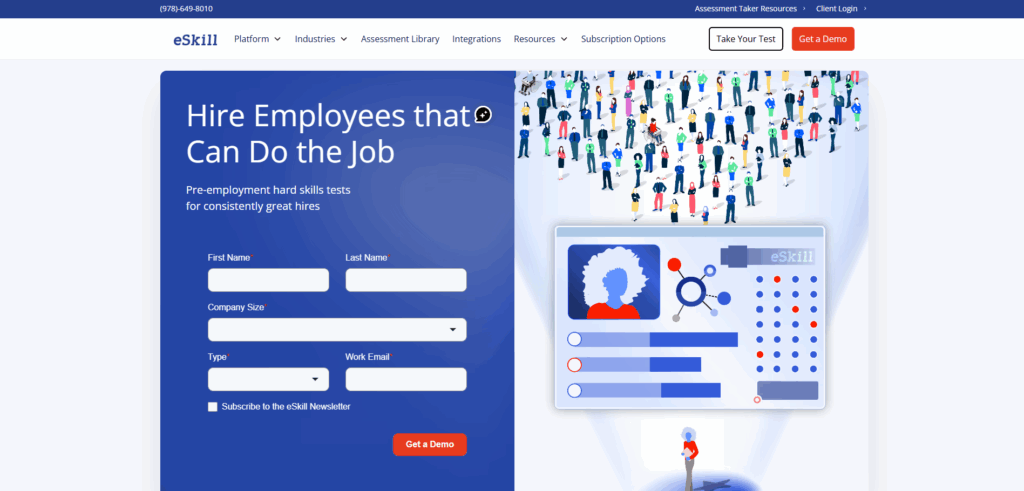
eSkill offers skills, cognitive, behavioral, personality and aptitude tests along with job simulations, one-way interviews and AI-powered proctoring. That mix covers both what PI measures and the skills PI leaves out.
Pros: broad catalog across hard skills, soft skills and behavior; simulations for practical roles.
Cons: pricing is sales-led; the catalog breadth means more setup to pick the right tests.
Pricing: contact sales via eSkill.
How do you choose the right Predictive Index alternative?
The right Predictive Index alternative depends on what you need to measure, how many people you hire, and which systems the tool must fit into. Start with the decision you are trying to improve, then check pricing model, integrations and compliance.
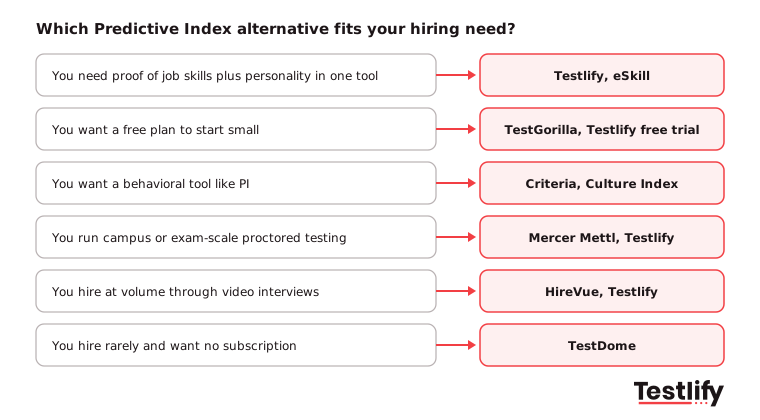
- Decide what you need to measure: If behavior is enough, a behavioral peer like Criteria or Culture Index keeps the change small. If you need proof of skill, choose a platform that tests skills and still offers personality and cognitive ability tests.
- Match the pricing model to your hiring volume: Headcount pricing suits companies that use PI across the whole workforce. Per-candidate or credit pricing suits teams whose spend should follow hiring volume.
- Check the ATS fit: Ask for two-way sync with your ATS and test it on a live requisition before you sign.
- Check compliance: If you hire in New York City, Local Law 144 requires a bias audit of an automated employment decision tool within one year of use, public audit information and candidate notices. Ask every vendor for its audit.
- Look at the candidate experience: Run the assessment yourself on a phone. Long, unrelated tests raise drop-off.
- Check integrity controls: For remote and volume hiring, look for proctoring such as webcam snapshots, tab tracking and copy-paste blocking.
Key takeaway: Pick the tool that measures what predicts success in your roles. For most teams that means skills first, with behavior and cognitive ability as supporting signals.
When should you stay with the Predictive Index?
The Predictive Index is still a good fit when you use it beyond hiring. If managers rely on PI profiles for coaching, team design and day-to-day communication, and the whole company has taken the assessment, switching away removes a shared language people use every day.
Stay with PI if most of these are true:
- PI is used across the company, not only by recruiters.
- Your roles are mostly ones where behavior predicts success better than a skill test would.
- Your hiring volume is low enough that a second tool for skills is not worth it.
If PI fits those points but you still need skill evidence, add a skills test alongside it instead of replacing it. Our detailed head-to-head comparison shows where each tool is stronger.
How do you switch from the Predictive Index without losing data?
Switching from the Predictive Index works best when you plan around the renewal date and keep your data. PI's pricing FAQ says customers can download their data before it is anonymized after cancellation, so export first.
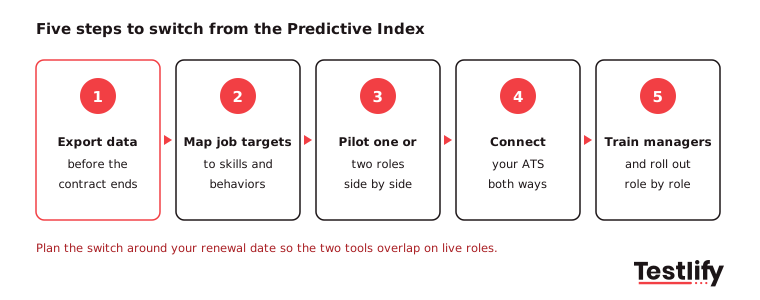
- Export your data: Download candidate and employee profiles and job targets before the contract ends.
- Map job targets to skills: For each PI job target, list the skills and behaviors the role needs, then pick tests that cover them.
- Pilot on one or two roles: Run the new assessment next to PI on live candidates and compare shortlists with hiring managers.
- Connect your ATS: Set up the integration so invites and scores flow both ways.
- Train hiring managers and roll out: Show managers how to read skill scores and interview with AI-suggested follow-up questions, then expand role by role.
Why does Testlify lead this list of Predictive Index alternatives?
Testlify leads this list because it replaces the hiring half of the Predictive Index and adds what PI leaves out: proof of skill. Teams get personality and cognitive tests, 3,500+ skills tests, AI interviews and 20+ proctoring checks in one platform, with credit pricing that follows hiring volume instead of headcount.
Testlify's own customer figures show 55% faster time-to-hire and 94% candidate satisfaction. Browse the Testlify test library to see the tests for your roles, then book a demo or start a 7-day free trial with no credit card.
Frequently asked questions

Content Writer
Yashika Khandelwal is a Content Writer with 3+ years of experience creating research-backed content on hiring, talent assessment, and HR technology. She is a registered Organizational Psychologist and subject matter expert who combines behavioral science with practical recruitment insights to produce accurate, evidence-based content.
LinkedInRelated resources
View all
Alternatives
Top 15 Sova Alternatives and Competitors
Alternatives
Top 15 Glider AI Alternatives and Competitors
Alternatives
Top 15 Criteria Corp Alternatives and Competitors
Alternatives
Top 15 WeCP Alternatives and Competitors
Alternatives
Top 15 Xobin Alternatives and Competitors
Alternatives
Top 15 Saville Alternatives and Competitors
Get started.
Hire on proof, not resumes.
Run your first skills-based assessment free — no credit card required.