
Top 15 Saville Alternatives and Competitors
Discover 15 powerful Saville alternatives to streamline your hiring process and assess candidates with confidence.
The best Saville Assessment alternatives are platforms that keep the measurement rigour Saville is known for, but add work-sample testing, AI interviewing and proctoring in one place, and publish their prices. Testlify, Canditech and eSkill are the closest fits for most teams. Saville itself remains a strong choice for regulated, high-volume graduate programmes.
Saville Assessment is a psychometric publisher founded in 2004 by occupational psychologists. Its Wave questionnaires and Swift aptitude tests are well built and genuinely predictive, and its reports are the kind that a trained assessor can defend in a tribunal. That is the point of it. It is also why it can feel like a lot of machinery for a company hiring twelve people a year.
So the honest question is not "what is better than Saville". It is "what does a team actually need, and how much of Saville's apparatus is it really using?" A 40-minute personality inventory scored against occupational norms is worth it for a graduate intake of 800. For a 60-person agency filling a client-services role, it mostly buys delay.
 ChatGPT
 Gemini
 Claude
 Grok
Grok Perplexity
TL;DR
- Saville is strongest where volume, norm groups and legal defensibility matter most. Below roughly 200 employees, most teams pay for rigour they never use.
- The main reasons teams switch are opaque pricing, accreditation requirements before anyone can read a report, and no built-in interviewing or anti-cheating layer.
- Work-sample and job simulation testing is the biggest practical upgrade over a pure personality-plus-aptitude battery, because candidates do the job rather than describe themselves.
- Ask any replacement three things: can a non-psychologist read the report, is the price on the website, and what stops a candidate using an AI tool mid-test.
- Testlify covers all three, with 3,500+ tests, AI video and voice interviewing, and dual-device proctoring. Pricing starts at $139 a month billed annually.

Why do teams look for Saville alternatives?
Four reasons come up again and again, and only one of them is about test quality.
The first is cost visibility. Saville quotes per assessment through a consultant. That is normal for the psychometric publishing world, and it is also why a hiring lead cannot answer "what will screening 200 applicants cost us" without a call.
The second is accreditation. Interpreting Wave properly expects trained users. That is a genuine safeguard, not a flaw, but it means the report lands with someone who then has to explain it to the hiring manager. One more step, one more week.
The third is scope. Saville measures. It does not run your interviews, it does not watch for a candidate pasting answers from a chatbot, and it does not move people through stages. Teams end up buying two or three tools.
The fourth is fit with how work now changes. The World Economic Forum's Future of Jobs Report 2025 found employers expect 39% of workers' core skills to change by 2030, down from 44% in 2023. A stable trait profile still tells you something real about how a person works. It tells you less about whether they can do a job whose content is being rewritten every couple of years.
Worth keeping in perspective: U.S. Bureau of Labor Statistics figures put median employee tenure at 3.9 years in January 2024, the lowest since 2002, and just 2.7 years for workers aged 25 to 34. If you are re-running the same hire every three years, the per-candidate cost and the time the process takes stop being small details.
How we evaluated these Saville alternatives
Every platform below was assessed against the same five criteria, weighted towards what actually changes a hiring decision rather than what looks good on a feature grid.
- Measurement depth: does it test ability and behaviour, or only one of them? Does it publish anything about how its scores are built?
- Work-sample coverage: can a candidate perform a realistic task, not just answer questions about themselves?
- Assessment integrity: what stops impersonation, tab-switching, or a candidate routing questions through an AI tool?
- Time to a decision: how long from invite to a report a hiring manager can read without training?
- Price transparency: is a starting price on the website, or does every answer start with a sales call?
Ratings and prices below are the vendors' published figures at the time of writing. Vendor pricing moves, so check the current page before you budget against it.
Quick comparison of Saville alternatives
Platform | Best for | Entry price | G2 rating |
|---|---|---|---|
Testlify | Skills plus AI interviewing in one tool | $139/mo billed annually | 4.7 |
TestGorilla | Simple, fast multi-test screening | $83/mo billed annually | 4.5 |
Adaface | Conversational, candidate-friendly tests | $180/yr | 4.6 |
Vervoe | AI-graded task performance | $300/yr for 10 candidates | 4.6 |
Codility | Engineering hiring at scale | $1,200/yr | 4.6 |
Mercer Mettl | Psychometrics with live invigilation | Custom quote | 4.4 |
iMocha | Large skills taxonomy and upskilling | $999/yr | 4.4 |
Maki People | Candidate experience and AI agents | Custom quote | 4.7 |
TestDome | Short work-sample screening | $199/mo | 4.5 |
Coderbyte | Developer tests on a flat subscription | $199/mo | 4.4 |
The Talent Games | Gamified graduate and volume hiring | Custom quote | 4.1 |
TalentMetrix | Psychometric reports with narrative | Custom quote | Not listed |
TalentLens | BPS and EFPA aligned psychometrics | Custom quote | 4.6 |
Canditech | Job simulations across roles | $150/mo for 100 candidates | 5.0 |
eSkill | Clerical, software and call-centre roles | Custom quote | 4.5 |
What is a job simulation assessment?
A job simulation assessment is a test where the candidate performs a realistic slice of the actual role instead of answering questions about it. They handle a support ticket, clean a spreadsheet, debug a function, or reply to an awkward client email. Scoring is against what a competent person in that role would produce.
This is the single biggest practical difference between a psychometric battery and a modern assessment platform, and it is the gap most teams are trying to close when they look past Saville. A personality inventory tells you a candidate reports themselves as detail-oriented. A job simulation assessment shows you whether they caught the error in row 47.
The research supports taking the distinction seriously. Roth and colleagues' meta-analysis of work-sample tests found meaningful predictive validity, while cautioning that classic estimates had probably been overstated, and that a work sample only earns its keep when it is genuinely job-relevant, standardised and consistently scored. A badly built simulation is not automatically better than a well-built questionnaire.
The wider selection literature points the same way on structure. Sackett and colleagues' 2022 reanalysis of selection-method validity revised many long-quoted coefficients downward, but structured methods still came out among the strongest predictors, and general years of experience among the weakest. Structure is the thing that survives every reanalysis. Whether you get it from a Wave questionnaire or a scored work sample matters less than getting it at all.
1. Testlify
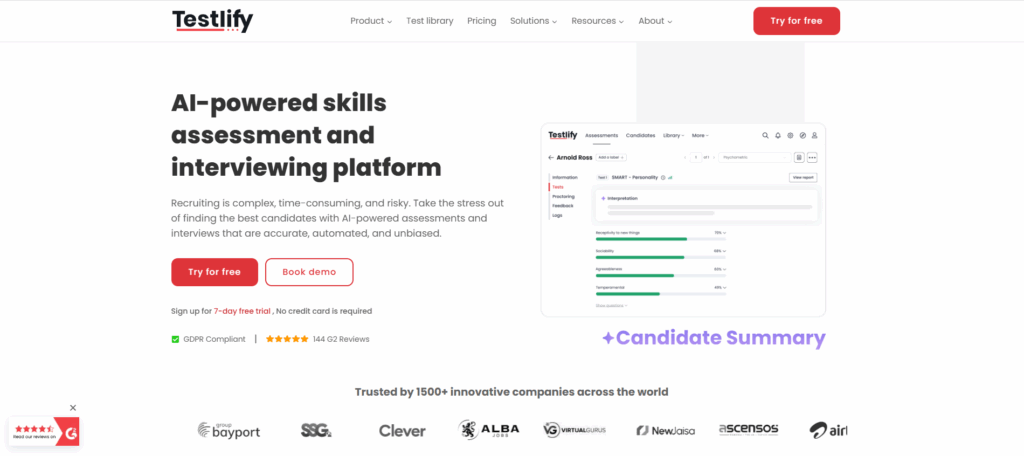
Testlify is an AI-assisted skills assessment and interviewing platform. It covers the two things a psychometric publisher usually leaves to someone else: the interview and the integrity layer. Candidates take role-relevant tests, then a conversational AI interview over chat, voice or video, and the whole session is proctored.
Key features
- Test library: 3,500+ tests and 180,000+ validated questions across 4,500+ roles and 50+ industries, spanning cognitive ability, personality and culture, situational judgement, coding, software skills and simulation.
- Question depth: 25+ question types, including work-sample formats bound to the real applications people use at work, such as Google Sheets, Microsoft Excel and PowerPoint, plus coding in an embedded VS Code editor with up to 20 test cases per question.
- AI interviewing: one-way async video, two-way conversational AI video, voice questions and outbound AI phone interviews, with selectable avatars and voices, custom prompts, attempt and recording-time limits, and automatic multilingual transcripts.
- Human-led scoring: AI auto-scores open-ended answers and produces per-candidate insights, but the product ships with the disclaimer that AI scores are for guidance only. Including the AI score in the final average is a toggle, and any question can be routed to a named human reviewer.
- Item-level psychometrics: difficulty index, discrimination index, quality-risk flags, answer distributions and percentile benchmarking, surfaced to recruiters rather than kept in a publisher's back office.
- Dual-device proctoring: the candidate's phone acts as a second camera showing both them and their screen. The assessment will not start until it is active. Alongside it: photo ID verification with face match, tab-switch detection, multi-monitor restriction and AI-tool detection.
- Integrations: 100+ ATS integrations, including Greenhouse, Lever and Workable, so an existing applicant tracking system stays the system of record. Teams with no ATS can use Testlify's own simple job requisitions, application form and applied-to-shortlisted pipeline instead.
Reviewers see a three-tier integrity flag rather than an automatic verdict. Green means the session was clean, yellow means a quick manual review is recommended, red means cheating was confirmed. Auto-termination exists but is opt-in with a threshold the recruiter sets, which is a meaningfully different posture from a platform that silently rejects on a flag.
G2 rating: 4.7
Testlify pricing
Testlify publishes its pricing as a credit-volume selector crossed with a monthly or annual toggle. One credit covers one started assessment by a qualified candidate. Annual billing, headline figures:
- Starter: $139/month, billed $1,668/year, for 100 credits at $16.68 each, with 3 seats.
- Basic: $279/month, billed $3,348/year, for 300 credits at $11.16 each, with 5 seats.
- Business: $699/month, billed $8,388/year, for 1,000 credits at $8.39 each, with 10 seats.
- Premium, Enterprise and Custom: 3,000, 10,000 and 25,000+ credits respectively, priced through sales.
A 7-day free trial runs without a card, there is a 30-day money-back guarantee, and the price is locked for 24 months. Non-profits get 25% off. Worth knowing before you budget: white labeling, SAML SSO and the 100+ ATS integrations are $2,388/year add-ons on the self-serve tiers rather than included, and AI phone interviews are metered at $0.18 a minute.
Limitations
Testlify runs on Chromium desktop browsers, so Chrome or Edge, and several proctoring features are desktop-only. The mobile app is a fallback for recording audio and video, not a way to sit a full assessment on a phone. It also does not schedule live human interview panels, so calendar coordination for a final-round panel stays wherever it lives today. AI resume scoring is currently limited to Greenhouse.
2. TestGorilla
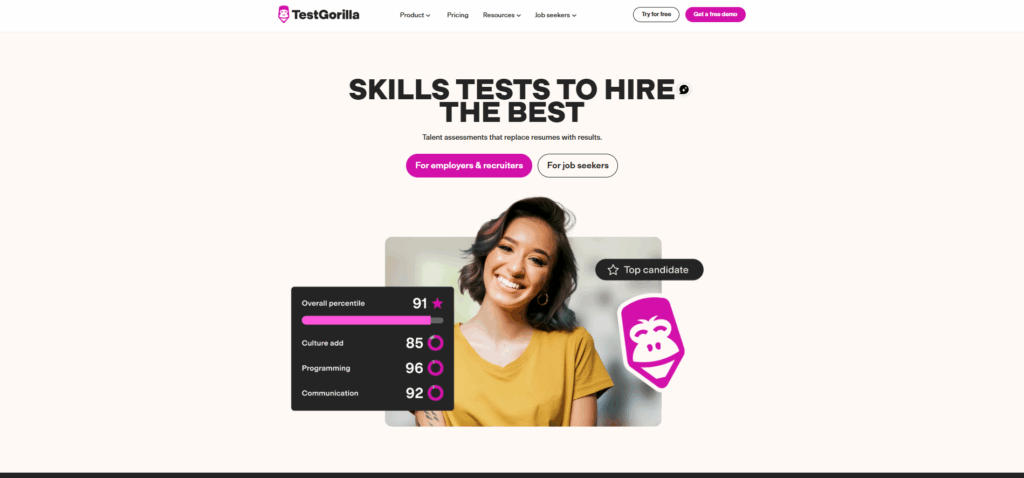
TestGorilla is built for teams that want structured multi-test screening without much setup. It suits speed and simplicity more than depth of psychometric reporting.
Key features
- Pre-built assessments: 300+ tests covering coding, numerical reasoning, cognitive ability, personality and culture fit, mapped to job requirements.
- One-way video interviews: open-ended video prompts for soft skills such as communication and customer empathy.
- Bias reduction: anonymous results and standardised scoring formats.
- Customisation: your logo, brand colours and intro videos, with control over test order, difficulty and timing.
G2 rating: 4.5/5
Pricing: a free plan with essential tests and unlimited candidate invites. Starter and Pro plans start at $83/month and $127/month billed annually, varying by company size.
3. Adaface
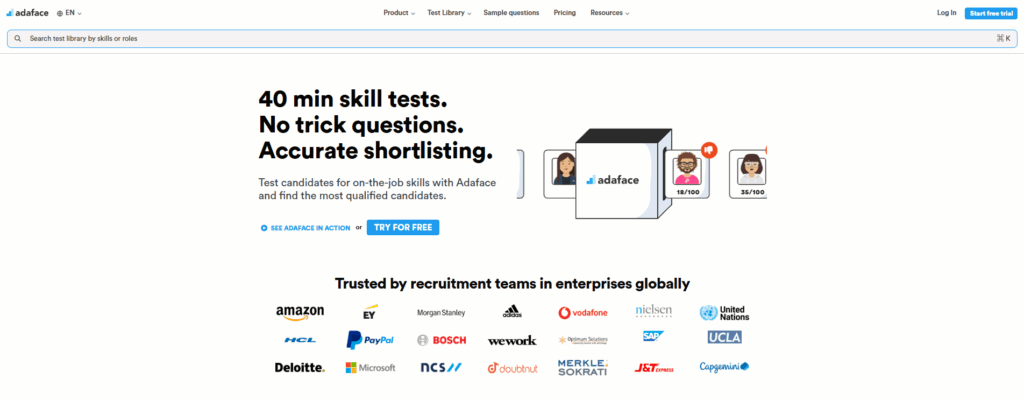
Adaface takes a conversational approach instead of multiple choice. Its chatbot-driven assessments test job-specific knowledge in a format candidates tend to rate well.
Key features
- Conversational assessments: recruiter-style dialogue that tests job-specific knowledge rather than trivia.
- Test library: 150+ pre-built tests for engineering, finance, support and operations roles.
- Real-time scoring: candidates sort into pass, borderline or fail groups, cutting manual review.
- Anti-cheating: questions are written in-house and kept private, and the team re-checks monthly whether public AI tools can solve them.
G2 rating: 4.6/5
Pricing: free trial available. Plans start at $180/year for an individual plan and scale for larger teams.
4. Vervoe
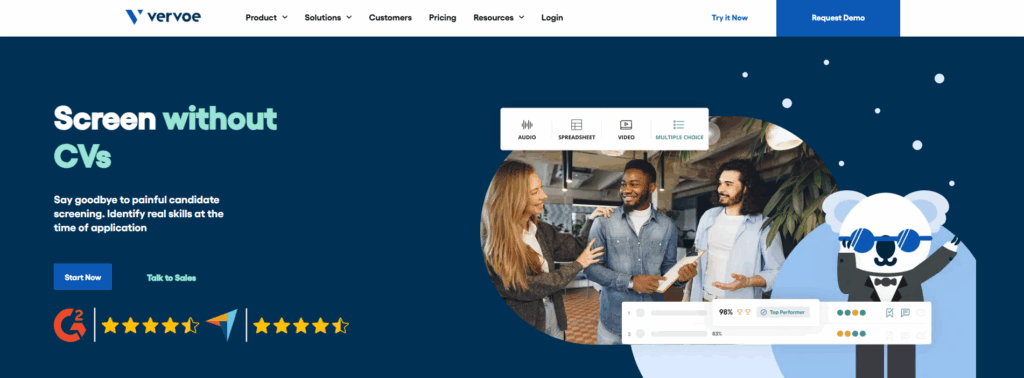
Vervoe grades candidates on job-related tasks rather than resumes, with AI ranking the responses. It covers technical and soft skills through practical exercises.
Key features
- Job simulations: 300+ pre-built tests across customer support, sales, marketing, technology and operations.
- Multi-format testing: text, video, file uploads and spreadsheets.
- AI grading: automatic scoring and ranking on accuracy, effort and relevance.
- Team review: several reviewers can score and comment in one dashboard.
G2 rating: 4.6/5
Pricing: a pay-as-you-go model suited to uneven hiring cycles. The entry plan starts at $300 per year for 10 candidates and rises with volume.
5. Codility
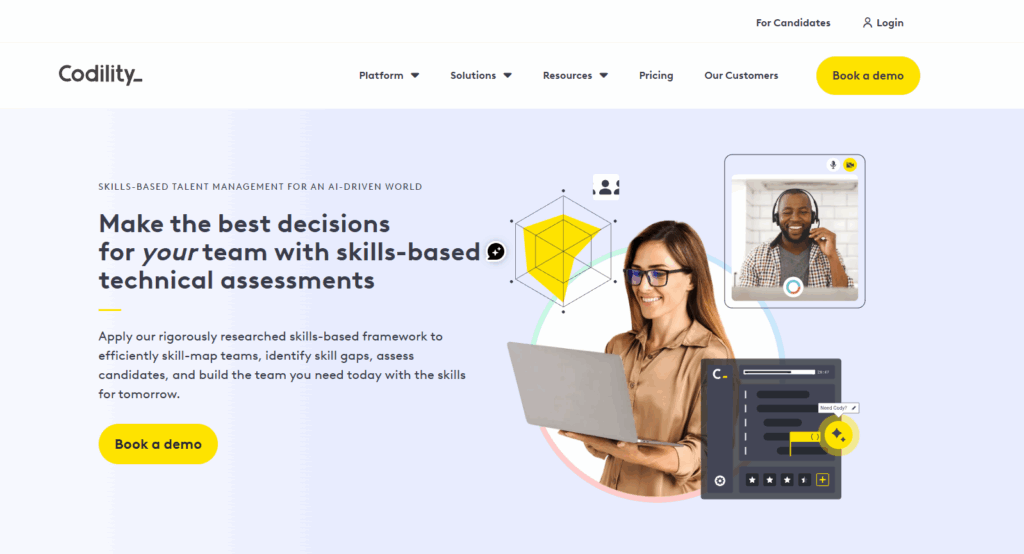
Codility is aimed squarely at engineering recruitment at scale, with real-world coding challenges and collaborative technical interviews. It is not a general psychometric replacement.
Key features
- Coding test bank: 1,100+ challenges across 45+ programming languages, from basic algorithms to system design.
- Live interviews: collaborative coding in Codility's IDE with syntax highlighting, a compiler and a test runner.
- Automated scoring: submissions are evaluated for logic, correctness, efficiency and readability.
- Reporting: task breakdowns, test-case results and code-quality scores.
G2 rating: 4.6/5
Pricing: three tiers. Starter at $1,200 per year, Scale at $6,000 per year, and a custom enterprise plan.
6. Mercer Mettl
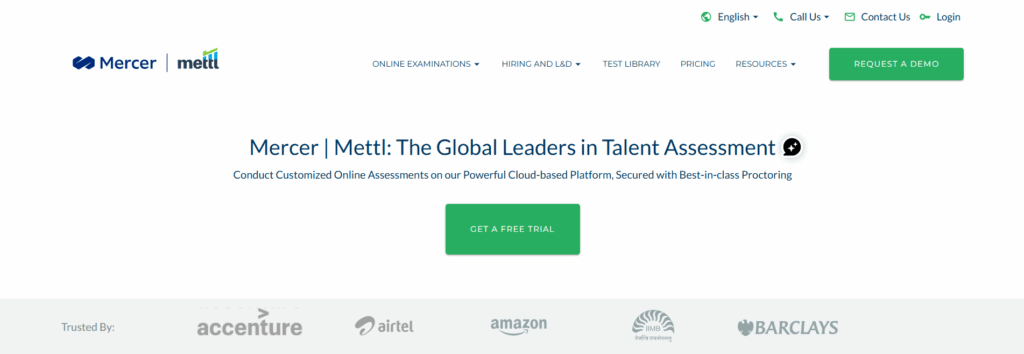
Mercer Mettl is the closest like-for-like to Saville on this list: research-based behavioural and psychometric evaluation, with heavy proctoring. It is widely used in campus recruitment and certification.
Key features
- Test coverage: 200+ job-specific assessments across technical, cognitive, behavioural and psychometric domains, all customisable.
- Enterprise proctoring: AI face recognition, browser lockdown and live human invigilation.
- Brand personalisation: your branding, logos and a dedicated test domain.
- Reporting: competency-based scoring, percentile comparisons and hiring recommendations.
G2 rating: 4.4/5
Pricing: customised. Costs depend on the number of tests, candidates and features, so expect a quote rather than a published price.
7. iMocha
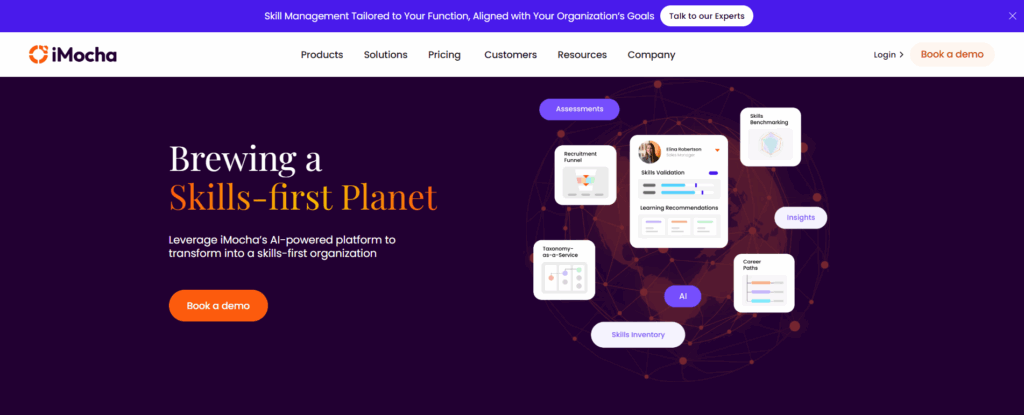
iMocha pairs pre-employment testing with workforce skills intelligence, so it appeals to teams thinking about internal mobility as much as hiring.
Key features
- Test library: 3,000+ ready-to-use assessments and 30,000+ skills mapped to job roles, including SAP, cybersecurity and financial services.
- Custom test builder: combine existing questions or write new ones, with customisable scoring logic.
- AI interviewer: a virtual interviewer running chat-based, adaptive conversations.
- Reporting: performance detail across domains and skill groups.
G2 rating: 4.4/5
Pricing: 14-day free trial. Plans start at $999/year and scale for larger teams.
8. Maki People
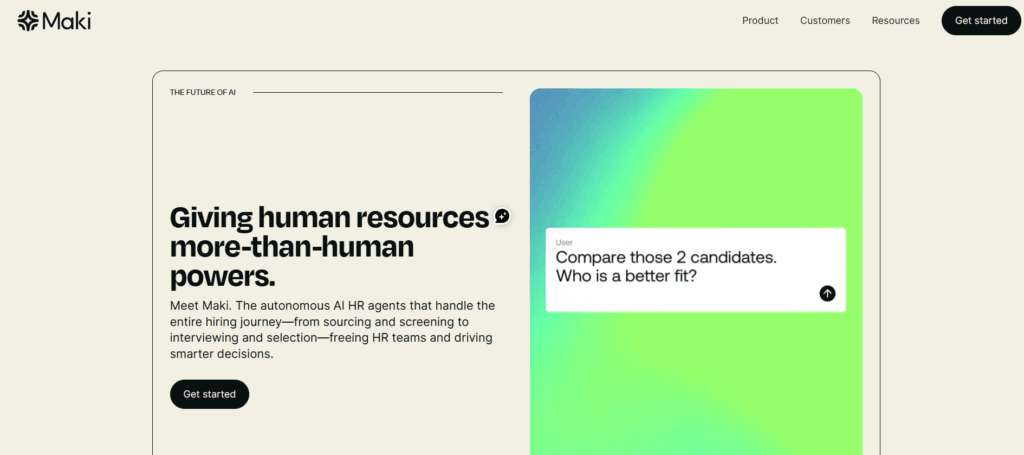
Maki People focuses on candidate experience and bias-free evaluation, with 200+ ready-made tests and an emphasis on judging people by evidence rather than impression.
Key features
- AI hiring agents: configurable agents that handle sourcing, screening, interviewing and selection steps in your brand voice.
- Skills assessment: 300+ skills covering cognitive ability, soft skills, language and technical expertise, using models grounded in psychometrics.
- Integrations: 30+ ATS and HR systems including Workday, SAP, SmartRecruiters, Phenom and Eightfold.
G2 rating: 4.7/5
Pricing: not published. Pricing comes via the sales team and varies by assessment type and hiring scale.
9. TestDome
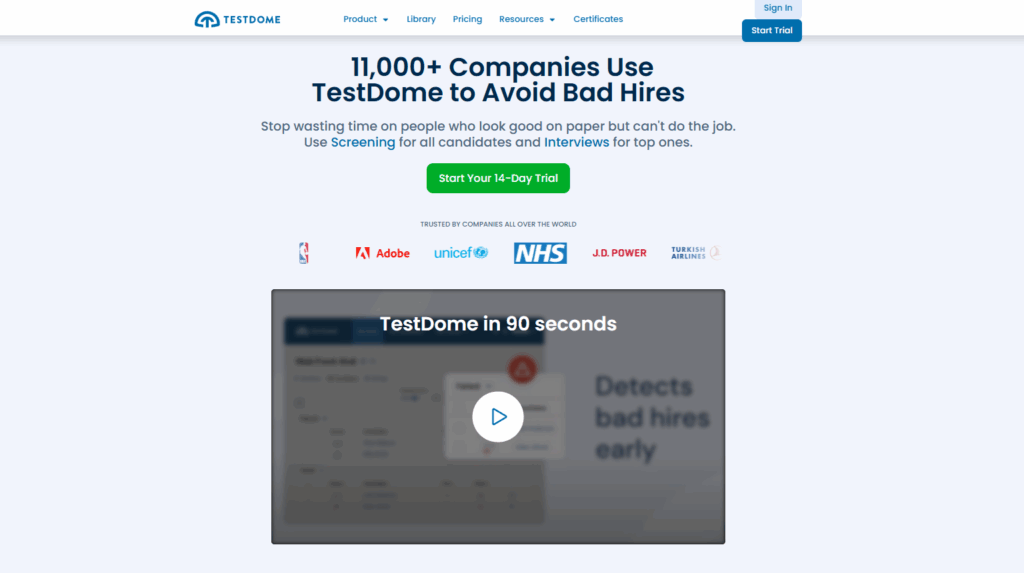
TestDome is a work-sample specialist. Its 150+ pre-made tests simulate on-the-job tasks rather than testing theory, across programming, IT, accounting and customer service.
Key features
- Work-sample testing: realistic tasks that mirror actual job responsibilities.
- 150+ pre-built tests: software development, accounting, customer service and data entry, kept short to filter quickly.
- Custom questions: build your own tasks or mix them with the library.
- Benchmarking: visual scorecards, percentile rankings and clear pass/fail indicators.
G2 rating: 4.5/5
Pricing: subscription-based, starting around $199/month for unlimited candidates and tests, with discounted annual billing available.
10. Coderbyte
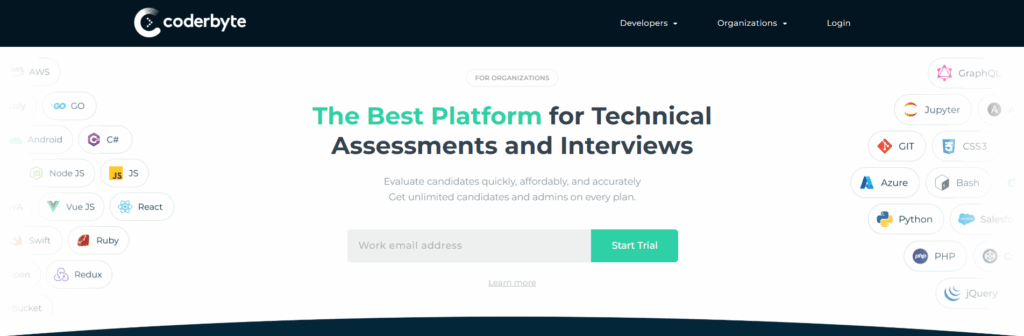
Coderbyte is a technical assessment platform for startups and mid-sized companies hiring developers and data scientists, sold as a flat subscription rather than per candidate.
Key features
- Coding challenges: 1,000+ challenges across 30+ programming languages and 100+ technical skills, plus take-home projects.
- Multiple question types: coding tasks, multiple choice, open written responses and SQL queries.
- Interview tools: live technical interviews with video, a collaborative code editor, Jupyter notebooks and a whiteboard.
- Reporting: code submissions, replayable session recordings, automated scorecards and benchmarking charts.
G2 rating: 4.4/5
Pricing: subscription-based at roughly $199/month for unlimited candidates and tests, with discounted annual plans.
11. The Talent Games
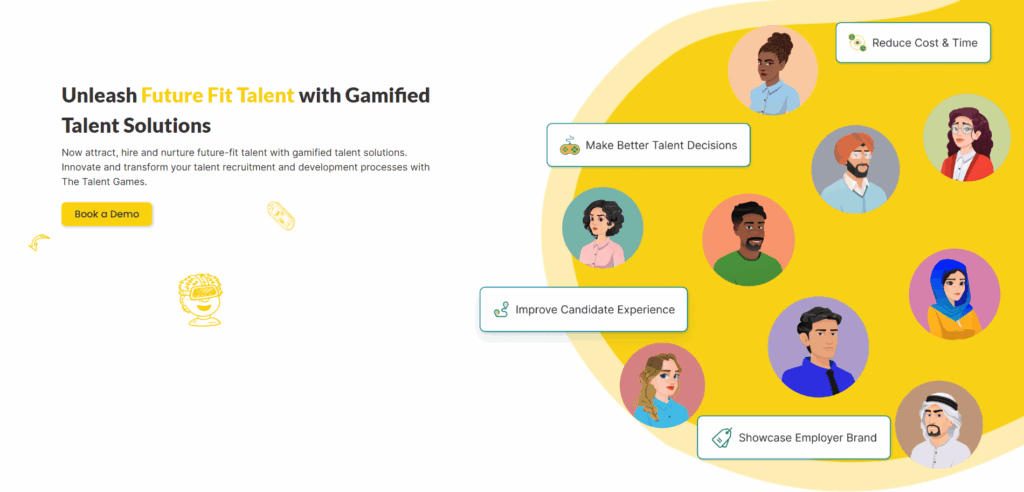
The Talent Games runs gamified assessment for high-volume and graduate hiring, which is the segment where Saville is strongest, so it is a direct swap for that use case.
Key features
- Gamified assessments: interactive games testing decision-making, teamwork and adaptability.
- Competitive challenges: timed scenarios that show how candidates perform under pressure.
- Job simulations: game-based simulations replicating real job tasks, which double as a role preview.
G2 rating: 4.1/5
Pricing: not published. Contact sales for a quote based on assessment type and hiring scale.
12. TalentMetrix
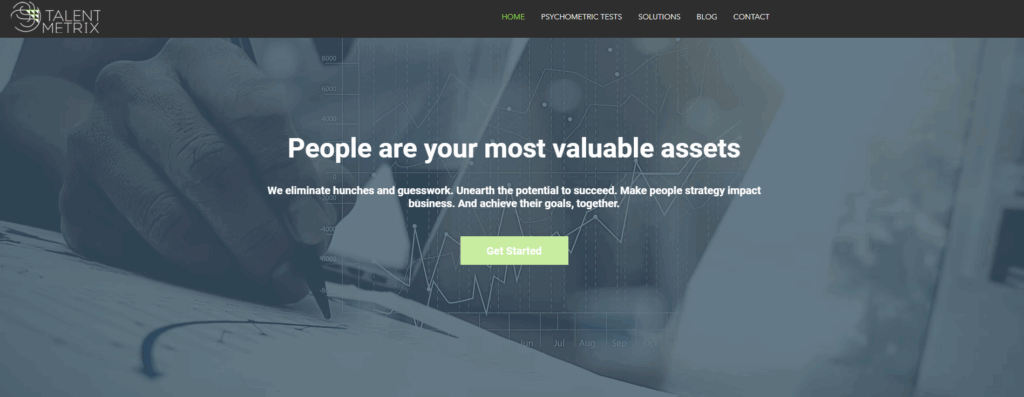
TalentMetrix provides psychometric testing aimed at the traits an interview rarely surfaces, with narrative reporting alongside the scores.
Key features
- Psychometric assessments: personality, cognitive ability, emotional intelligence and job-specific competencies.
- Diagnostic reports: quantitative scoring paired with qualitative interpretation.
- Straightforward platform: a plain interface for administering assessments to candidates.
G2 rating: not listed
Pricing: not published. Contact sales for a custom quote.
13. TalentLens
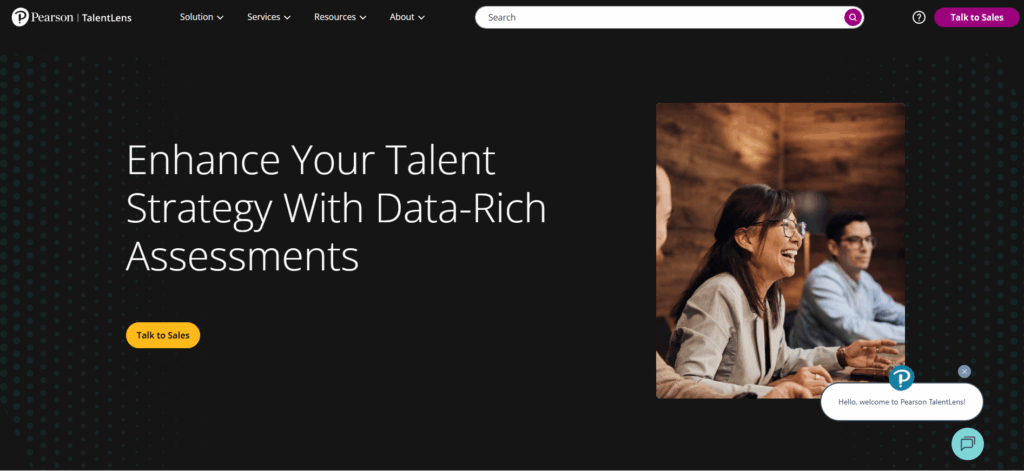
TalentLens is Pearson's assessment division, and the closest match on this list for a team that specifically wants a publisher-grade psychometric with recognised standards behind it.
Key features
- Psychometric assessments: cognitive ability, personality and motivation instruments.
- Motivation assessments: what drives a candidate, used to anticipate engagement and retention.
- Scientific standards: instruments developed to British Psychological Society and European Federation of Psychological Associations best-practice standards.
G2 rating: 4.6/5
Pricing: not published. Contact sales for a quote.
14. Canditech
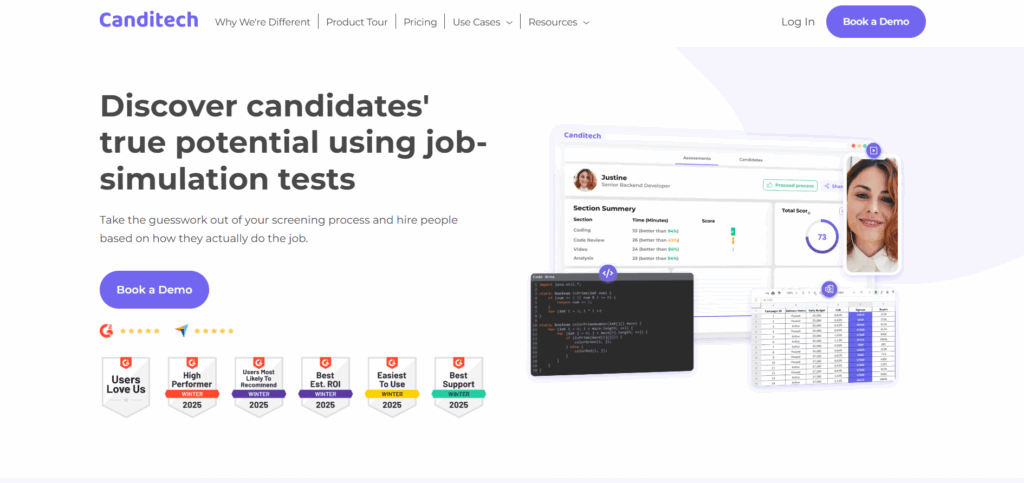
Canditech is a job simulation and skills assessment platform built around realistic work scenarios. It is a newer entrant that has picked up strong review scores quickly.
Key features
- Custom test creation: multiple choice, essays, coding challenges and video responses, with your own scoring logic and timing.
- Job simulations: coding tasks, Excel exercises and open-text responses that mirror the role.
- Automatic scoring: candidates ranked on performance, reducing the pull of first impressions.
- Benchmarking analytics: performance compared against job-specific benchmarks.
G2 rating: 5/5
Pricing: team plan starts at $150/month for 100 candidates.
15. eSkill
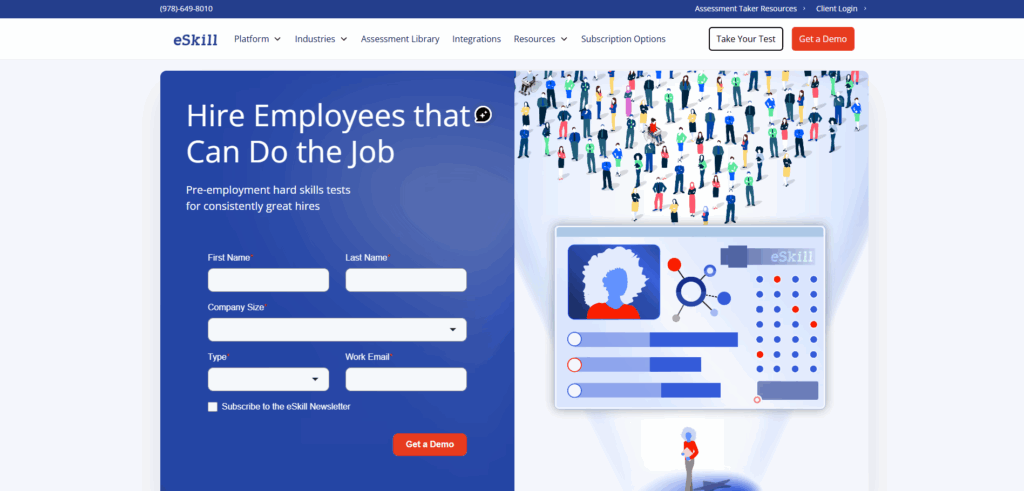
eSkill covers the operational middle of a business well: clerical, software proficiency, literacy and numeracy, accounting and call-centre roles, with heavy customisation.
Key features
- Test library: 600+ ready-to-use tests, plus custom assessments built from thousands of questions across topics and software tools.
- Job simulations: interactive scenarios such as customer service calls, data entry and IT troubleshooting.
- Proctoring: monitors copy-pasting, excessive tab switching and irregular response patterns, flagging suspicious activity in real time.
- Analytics: overall scores with breakdowns by subject area and question type.
G2 rating: 4.5/5
Pricing: not published. Contact sales for a custom quote.
When should you keep Saville instead?
Plenty of switching advice pretends the incumbent has no case. Saville has one, and it is worth stating plainly before you run a migration.
Keep it if you hire graduates at volume against published norm groups, and those norms are load-bearing in how you sit candidates against each other. Keep it if you have trained, accredited users in-house already, because the accreditation cost is sunk and the interpretation quality is real. Keep it if your process has ever been challenged and the defensibility of the instrument was the thing that held.
The Wave questionnaires are substantial pieces of work. Professional Styles runs 216 items in about 40 minutes, Focus Styles 72 items in about 13 minutes, and the dual-response format exists specifically to catch candidates presenting themselves too favourably. That is not machinery you should throw away casually.
The honest read is that most teams under 200 employees are not using any of that. They are using Saville as a general screening step, paying publisher prices and consultant lead times for it, and then running a separate interview process anyway.
Which Saville alternative should you choose?
Match the tool to the constraint that is actually hurting.
- Cost and speed are the problem: Testlify, TestGorilla or Canditech. All three publish prices and get you to a readable report without accreditation.
- You want measurement rigour, just cheaper to run: TalentLens or Mercer Mettl. Both keep the psychometric publishing tradition.
- You are hiring engineers: Codility or Coderbyte. Neither replaces a behavioural assessment, so pair accordingly.
- Candidate drop-off is your issue: Adaface or Maki People, both built around the experience rather than the report.
- You need one tool for testing, interviewing and integrity: Testlify is the only option here that does all three natively.
This is where the Testlify Multi-Signal Talent Evaluation Model is useful as a way to think about it. Rather than treating any single instrument as the decision, it combines several role-relevant signals, an assessment, a structured interview, a work sample, reference input and reviewer feedback, and treats confidence as something that grows as the signals agree. One test is a data point. Three that point the same way is a decision you can defend.
There is evidence behind combining signals mechanically rather than re-interpreting them by instinct at the end. Kuncel and colleagues' meta-analysis of mechanical versus clinical data combination found that combining assessment information by formula predicts outcomes at least as well as experts recombining the same information holistically. Read narrowly, that is an argument against letting a gut feeling in the debrief overwrite the scores. It is not an argument for removing humans from the decision, and it should not be read as one.
Pro tip: before you migrate anything, run the new platform in parallel on one live role. Send the same shortlist through both, then compare who each process would have advanced. Two weeks of overlap will tell you more than any feature comparison, and it gives you something concrete to show whoever signs off the switch.
Try Testlify on your next open role
If your Saville renewal is coming up and you want to see what a combined assessment, AI interview and proctoring workflow looks like on a role you are actually hiring for, start a free trial with no card required, or book a demo and walk through it with someone. Related reading: how aptitude tests work in hiring, the tradeoffs of aptitude testing, and a wider roundup of talent assessment tools. For the deeper head-to-head, read the Testlify vs Saville Assessment comparison.
Key takeaways
- Saville is not the wrong tool, it is often the wrong size. Its rigour is built for volume graduate hiring with norm groups and accredited interpreters. If you are not using those, you are paying for infrastructure you never touch, and the switch is a sizing decision rather than a quality complaint.
- Price transparency is the fastest filter. Platforms that publish a starting price let a hiring lead model the cost of screening 200 applicants in a minute. Ones that do not add a sales cycle to every budget question, which matters most for the small teams that have no procurement function to absorb it.
- Work samples change what you learn. A questionnaire tells you how a candidate describes themselves, a job simulation assessment shows what they produce. The research is encouraging but conditional: a work sample only pays off when it is genuinely job-relevant, standardised and scored consistently.
- Structure beats the specific instrument. Modern reanalyses of selection validity keep landing on the same finding, that structured methods predict better than unstructured judgement while years of experience predicts poorly. Whichever platform you pick, the gain comes from asking every candidate the same things and scoring them the same way.
- Integrity is now part of measurement. A test a candidate can route through an AI tool is not measuring them. Anti-cheating capability belongs on the evaluation checklist next to test quality, not treated as an optional extra you add later.
- Combine signals, keep the human decision. Multiple role-relevant signals scored consistently give you more confidence than any single instrument. Combining them by formula is well supported, but the final call should still sit with the hiring team rather than with a score.
- Run a parallel pilot before migrating. One live role through both processes, comparing who each would advance, surfaces problems that no feature grid predicts and gives you real evidence for the decision.
FAQs

Director of Marketing
Akash Patange is the Director of Marketing at Testlify, where he works closely with HR leaders and recruiters to help organizations improve hiring outcomes. He writes about talent assessment, recruitment technology, and data-driven hiring practices.
LinkedInRelated resources
View all
Alternatives
Top 15 Talogy Alternatives and Competitors
Alternatives
Top 15 Hire Success Alternatives and Competitors
Alternatives
Top 15 Testgrid Alternatives and Competitors
Alternatives
Top 15 Testello Alternatives and Competitors
Alternatives
Top 15 TalentLyft Alternatives and Competitors
Alternatives
Top 15 Skillmeter Alternatives and Competitors
Get started.
Hire on proof, not resumes.
Run your first skills-based assessment free — no credit card required.