
Testlify vs. TalentMesh: Which Skills Assessment Platform is Best for HR Teams?
Testlify vs. TalentMesh: Discover which skills assessment platform best suits your hiring needs
Testlify and TalentMesh both sit in front of a hiring decision, but they do opposite jobs. TalentMesh finds and contacts people for you, using AI agents that search a candidate database and rank profiles. Testlify measures what a shortlisted person can actually do, using tests, AI interviews and proctoring. If your problem is an empty pipeline, TalentMesh is the closer fit. If your problem is that the pipeline is full and you cannot tell who is good, Testlify is.
That distinction matters more in 2026 than it did a year ago, because TalentMesh relaunched itself as an agentic recruiter rather than an assessment tool. The comparison below reflects what both platforms actually publish as of September 2026, including current pricing on both sides.
 ChatGPT
 Gemini
 Claude
 Grok
Grok Perplexity
TL;DR: Testlify vs TalentMesh at a glance
- TalentMesh is sourcing-led. Its agents search a curated database of 500M+ profiles plus the open web, rank matches, run outreach, and attach four test families (skills, personality, aptitude, emotional intelligence).
- Testlify is evaluation-led. It has 3,500+ ready tests across 4,500+ roles, 25+ question types, AI video, voice and phone interviews, and 20+ proctoring measures.
- Pricing works differently. TalentMesh charges $250 or $625 a month for platform access plus $175 per recruitment, with unlimited seats. Testlify charges per candidate credit, from $139 a month for 100 credits a year.
- Neither replaces the other cleanly. Testlify does not source candidates. TalentMesh does not publish proctoring, video interviewing or work-sample testing.
- The tiebreaker is usually your bottleneck, not the feature grid. Count how many good candidates reached your last shortlist. If it was too few, buy sourcing. If it was too many and you guessed, buy evidence.

What is TalentMesh?
TalentMesh is an AI recruitment platform that describes itself as an end-to-end agentic recruiter. Rather than one product, it sells a set of AI agents that split the recruiting job between them: sourcing agents search for candidates, ranking agents score them against an ideal profile, outreach agents contact them across email and other channels, and selection agents produce a recommendation.
The company positions this for hiring teams, HR leaders, founders and recruiters filling specialised or business-critical roles. Its stated reach is 500M+ curated profiles and more than a billion professionals visible on the open web. The pitch is speed: a shortlist in minutes rather than days.
This is a real change from how TalentMesh was described even a year ago, when it read as an applicant tracking system with tests bolted on. Any comparison written before 2026 is now describing a product that no longer exists in that form.
What do TalentMesh solutions include?
TalentMesh solutions cover four areas: finding candidates, contacting them, ranking them, and testing them. The testing half is the narrowest part. TalentMesh publishes four assessment families: a pre-employment skills test aimed at roles like accounting, administrative, retail and customer service; a personality test it describes as an improved Big 5; an aptitude test covering numerical, logical and verbal reasoning; and an emotional intelligence test.
It also sells a permanent recruitment service and executive search alongside the software, which is unusual for a platform in this category and genuinely useful if you would rather hand the whole search over.
What TalentMesh does not publish anywhere on its site is proctoring, anti-cheating, coding or work-sample testing, or video interviewing. That is worth stating carefully: absence from a marketing site is not proof a feature does not exist, so ask them directly if any of those are decision criteria for you.
What is Testlify?
Testlify is an AI-powered talent assessment and interviewing platform. It covers the stage after a candidate is in front of you: what can this person do, and how do you prove it consistently across every applicant?
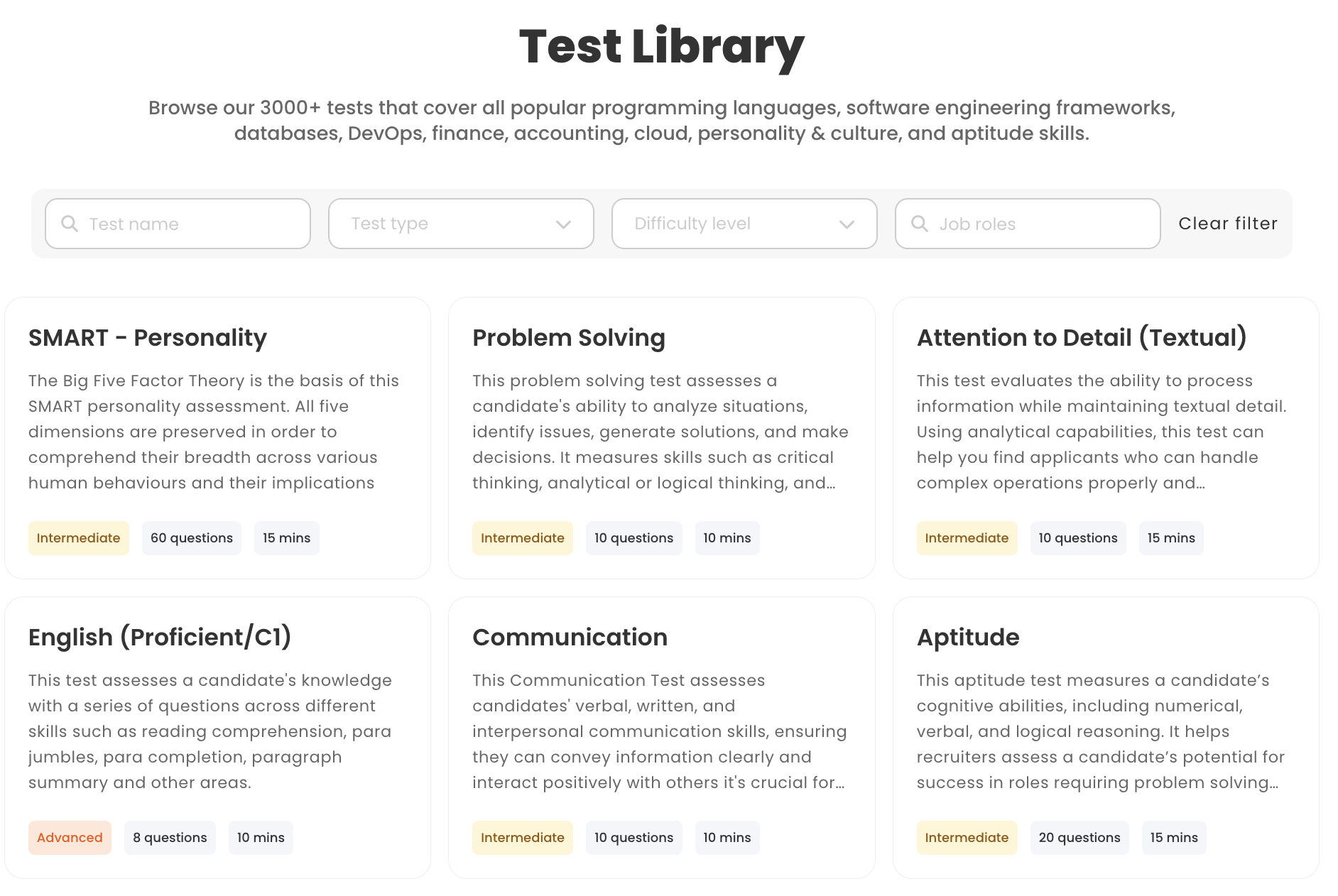
The test library runs to 3,500+ tests and 180,000+ validated questions across 4,500+ roles and 50+ industries, with 45+ programming languages covered on the technical side. Categories include coding assessments, cognitive ability, psychometric profiling, situational judgement, language proficiency, software skills, blue-collar roles, simulation and gamified formats.
Most teams that buy Testlify already run an applicant tracking system, so the normal setup is one of the 100+ integrations: Testlify becomes the screening and interviewing layer and Greenhouse, Workday or Lever stays the record of truth. For teams that have no such system, Testlify also ships a simple built-in pipeline (job requisitions, an application form, publishing to job boards, and an applied to reviewed to shortlisted to rejected flow). That pipeline is deliberately basic, and it is meant for a small team that does not want to buy two products.
How do Testlify and TalentMesh compare?
The table below is the short version. The sections after it explain where the differences actually bite.
Area | Testlify | TalentMesh |
|---|---|---|
Primary job | Evaluate and interview shortlisted candidates | Find, contact and rank candidates |
Test library | 3,500+ tests, 4,500+ roles, 25+ question types | 4 families: skills, personality, aptitude, emotional intelligence |
Coding and work samples | Yes, including a browser VS Code editor and multi-file projects | Not published |
Interviewing | AI video, voice and phone interviews, one-way and conversational | Not published |
Proctoring | 20+ measures including dual-device monitoring | Not published |
Sourcing | No, Testlify is not a sourcing tool | Yes, agent-based across 500M+ profiles |
Hiring pipeline | Simple built-in pipeline, plus 100+ ATS integrations | Yes, full recruitment workflow |
Seats | 3 to 40 by tier, extra seats $15 a month | Unlimited on paid tiers |
Entry price | $139 a month, annual billing, 100 credits a year | $250 a month plus $175 per recruitment |
Free trial | 7 days, no card required | 14 days, no card required |
Test library and question types
This is the widest gap. TalentMesh gives you four test families. Testlify gives you 25+ question types, and several of them are hard to find anywhere: Google Docs, Sheets and Slides tasks and Microsoft Word, Excel and PowerPoint tasks bound to the real applications, file-upload and URL-submitted practical work, typing tests scored on 60% accuracy plus 40% speed, and programming questions that run in an embedded VS Code editor with up to 20 test cases, hidden or visible, including SQLite database cases.
One question type is worth singling out. Vibe coding lets a candidate direct AI tools to reach a working solution instead of writing every line by hand. For a 2026 engineering hire, that is closer to the actual job than a syntax exam, and almost nobody else offers an answer to it.
Pro tip: If you are hiring for an operations or finance role, run the Office-app question types before anything else. A candidate who can genuinely build a pivot table tells you more in 15 minutes than a personality profile will in an hour.
Interviewing: video, voice and phone
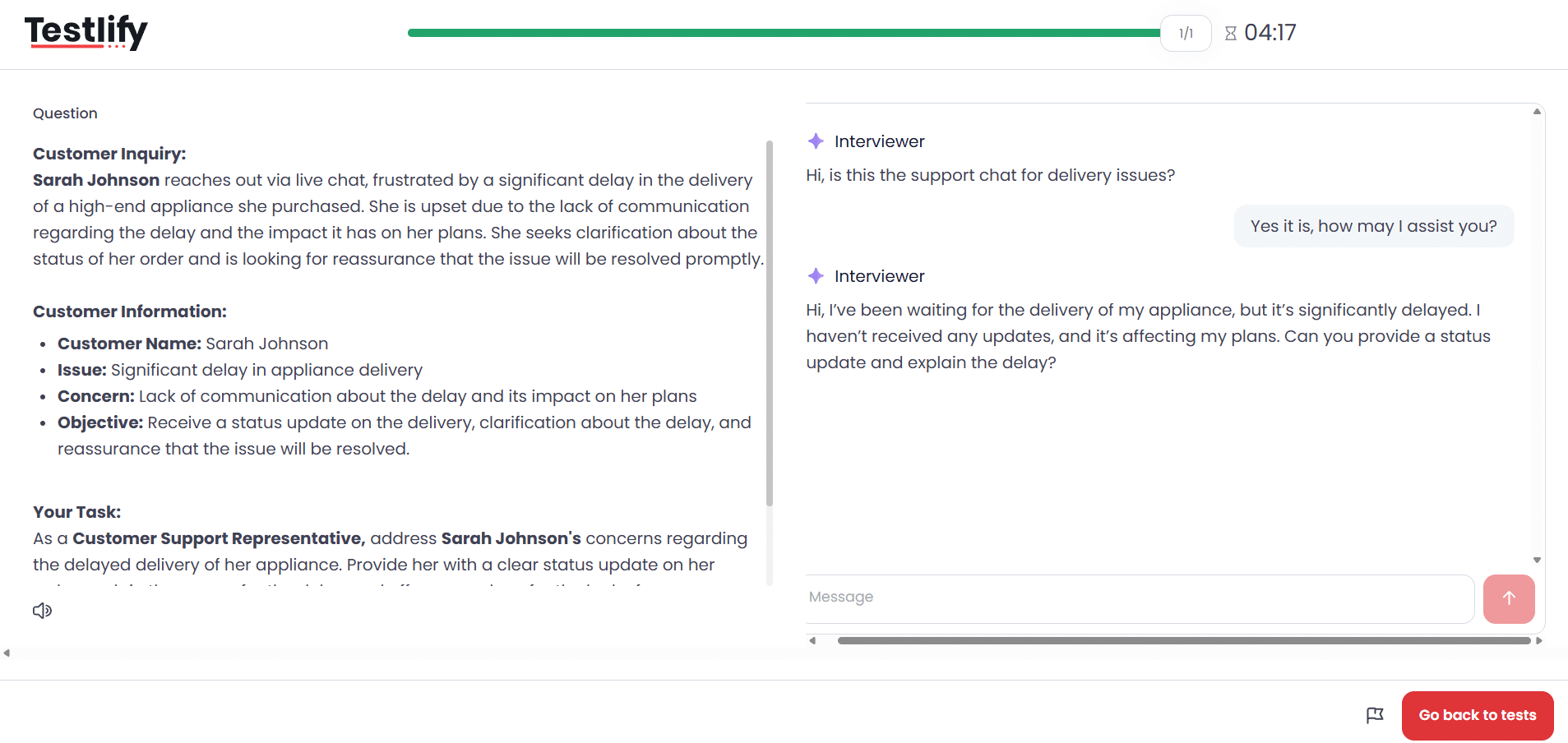
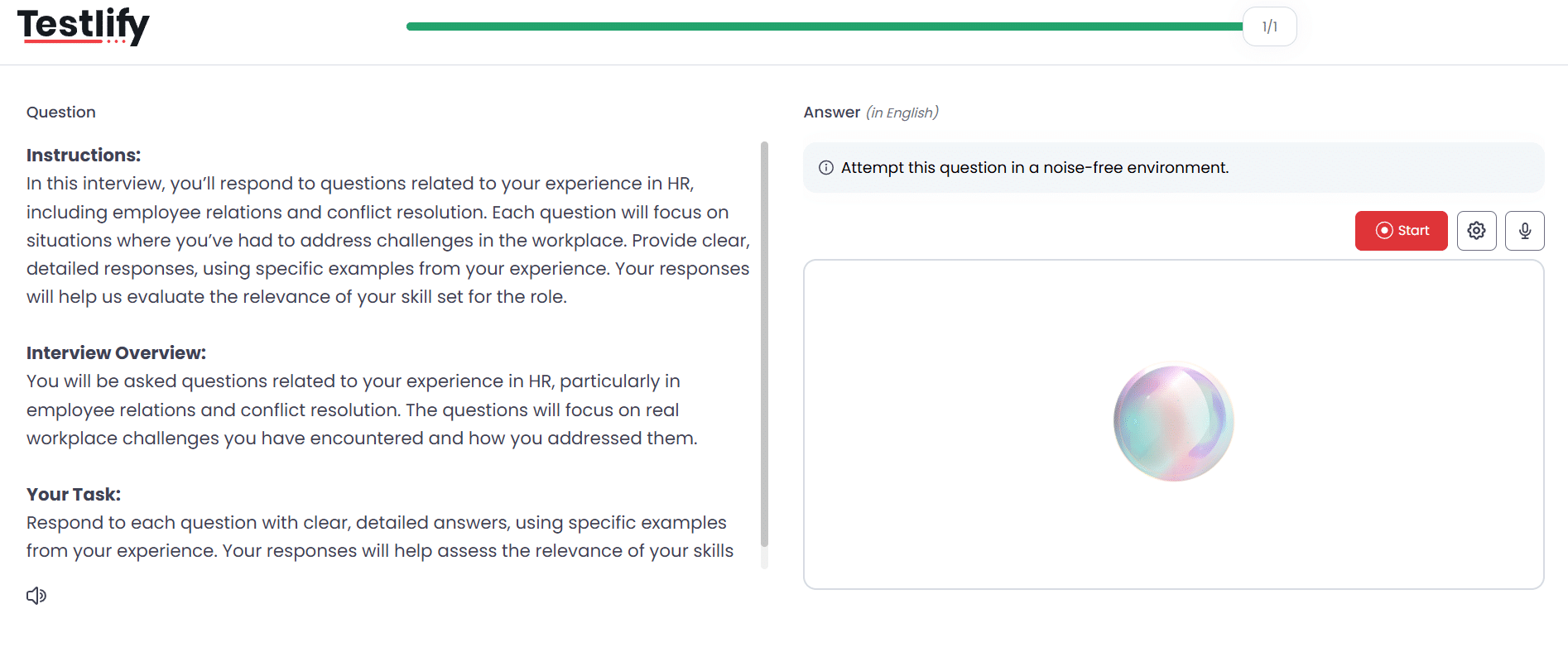
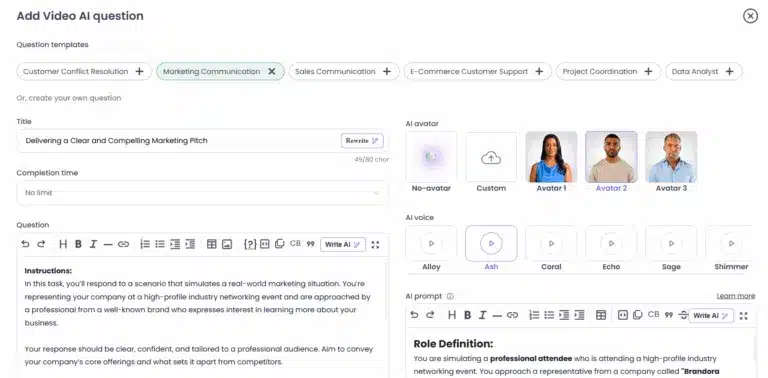
Testlify runs one-way asynchronous video, two-way conversational AI video, audio and voice questions, and outbound AI phone interviews billed at $0.18 a minute. You can pick the AI avatar and voice, write custom prompts, set a persona, cap attempts and recording time, and start recording automatically after a preparation window. There are 150+ interview templates, transcripts are generated automatically in the candidate's spoken language for recordings of at least 30 seconds, and AI scoring can be switched to advisory so it never enters the final average.
The honest limit: Testlify does not schedule live human interview panels. If you need calendar coordination for a four-person loop, that stays with your ATS or scheduling tool.
Proctoring and assessment integrity
Testlify ships 20+ integrity and proctoring measures across three presets (Standard, Strict and Custom): full-screen enforcement, tab-switch detection, photo ID verification with face match, periodic webcam snapshots, multi-monitor restriction, copy-paste tracking, AI-tool and browser-extension detection, and IP and location checks.
The one worth knowing about is dual-device proctoring. The candidate's phone becomes a second camera positioned to capture both them and their screen, and the assessment will not start until that feed is live. It is the single hardest integrity control in this category to fake around.
The framing matters as much as the feature list. Flags are green, yellow or red, and yellow reads "a quick manual review is recommended" rather than triggering anything. Auto-termination is a separate setting a recruiter has to turn on with their own violation threshold. Face verification data is deleted after 30 days and candidates can withdraw consent at any time.
Sourcing and the hiring pipeline
TalentMesh wins this outright, and it is not close. Testlify does not source candidates, does not run outreach and is not a CRM. If nobody is applying, Testlify cannot fix that.
Where Testlify pushes back is on what happens to a ranked list once you have one. A 2022 reanalysis of selection research by Sackett and colleagues places structured interviews among the strongest predictors of job performance, and places years of education and general years of experience among the weaker ones. A profile is mostly made of the weaker signals, because that is what a profile contains. The point is not that ranking is useless. It is that a ranked list is a starting order, not a hiring decision. (The exact validity coefficients are still argued over in the literature; the ranking of structured evaluation above credential history is the part that survives every reanalysis.)
Reporting, analytics and AI evaluation
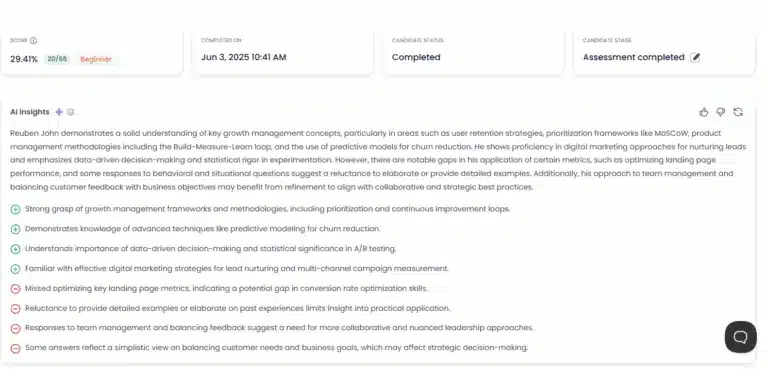
Both platforms produce candidate scorecards and skill breakdowns. Testlify's reporting and analytics go further into territory usually reserved for test publishers: per-question difficulty index, discrimination index, and a quality-risk flag that tells you when a question has very low accuracy or high skip rates. That means you can find out your own test is broken, which most tools will never tell you.
Report types run to development, DISC, CEFR, cultural fit, conflict management, 16 personality traits, enneagram, interview reports, compliance reports, 360 feedback and reviewer score reports. Exports cover PDF, ZIP, CSV, transcripts and score logs, and shareable reports have granular show and hide controls for AI insights, proctoring detail and answer explanations.
Compliance and AI governance
This is where an agentic recruiter and an assessment platform diverge most, and where buyers get caught out. The EU classifies AI systems used to recruit, screen, filter or evaluate job candidates as high-risk under the AI Act, Regulation (EU) 2024/1689. In New York City, Local Law 144 has required since July 5, 2023 that an automated employment decision tool passes a bias audit within one year of use, that a summary of that audit is published, and that candidates get notice 10 business days before it is used. NIST's AI Risk Management Framework, released January 26, 2023, is the voluntary structure most legal teams now ask vendors to map against.
Agent-driven sourcing and ranking sit squarely inside those rules. So ask any vendor whose software ranks people two questions before you sign: how is the ranking audited, and what exactly is the candidate told? A tool that scores applicants and cannot answer either one is a liability you have bought, not a shortcut.
Testlify's answer is human-in-the-loop by default. The product ships the line "AI scores and insights are for guidance only. Use human judgment for final decisions." Showing AI scores to a reviewer is a toggle. Including the AI score in the final average is a separate toggle. Any question can be routed to a named human for manual review. On the certification side, Testlify holds SOC 2 Type II, ISO 27001, GDPR, CCPA, FERPA, ISO 23988 and NYC Local Law 144 alignment.
Integrations, white label and enterprise controls
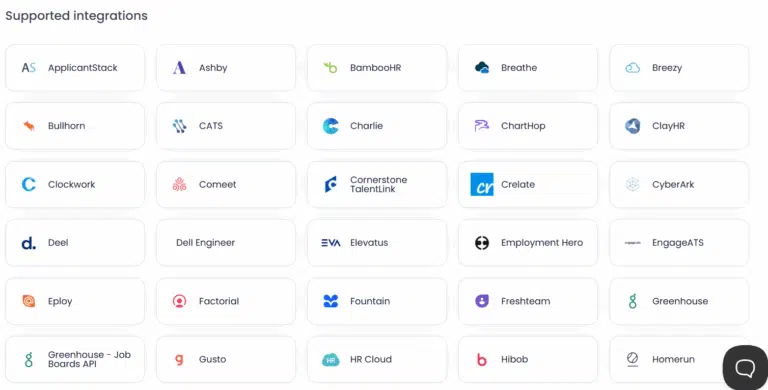
Testlify integrates with 100+ ATS and HRIS platforms, plus Zapier and webhooks covering assessment, candidate, score and interview events. Enterprise controls include SAML SSO with group-to-role mapping, SCIM provisioning, 2FA, custom roles with granular permissions, audit logs from the Enterprise plan up, and real-time audit streaming to a SIEM. White labelling covers hidden Testlify branding, a custom domain and custom SMTP, and there is a reseller option.
Read the pricing before you assume any of that is bundled. White labelling, the 100+ ATS integrations, and SAML SSO with 2FA are each paid add-ons on the self-serve tiers at $2,388 a year, and are included only on the Custom plan.
Pricing compared
The two pricing models are not directly comparable, which is the whole difficulty. TalentMesh charges for the platform and then per search. Testlify charges for the number of candidates you assess.
TalentMesh publishes two paid tiers: Silver at $250 a month for platform access plus $175 per recruitment, and Gold at $625 a month plus the same $175 per recruitment, with a Custom tier for high volume or combined executive search. Both paid tiers include unlimited users and seats, and there is a 14-day free trial with no credit card.
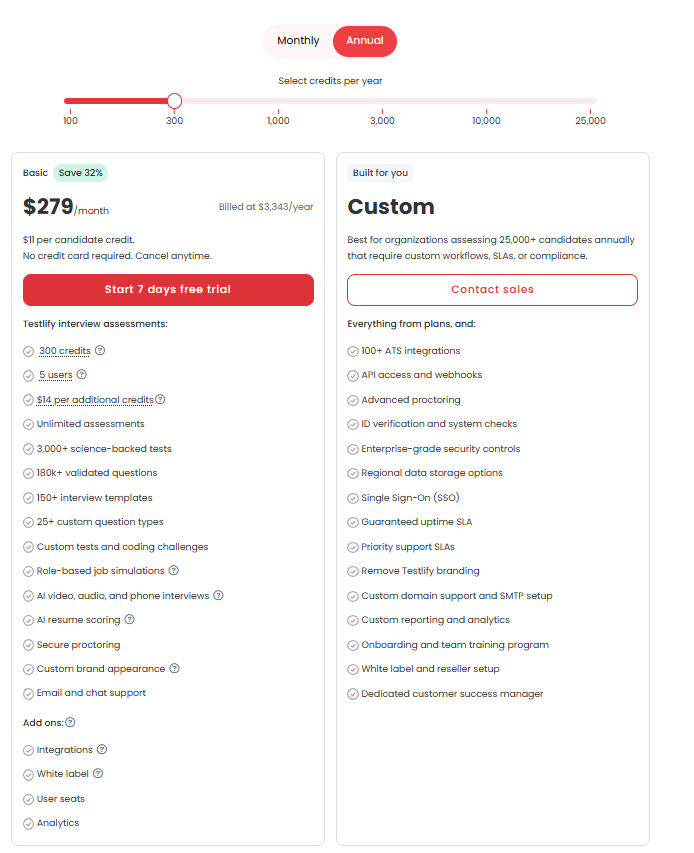
Testlify prices by credit volume, with one credit consumed per started assessment. On annual billing the published tiers are:
Tier | Credits a year | Price | Per credit | Seats |
|---|---|---|---|---|
Starter | 100 | $139 a month, billed $1,668 | $16.68 | 3 |
Basic | 300 | $279 a month, billed $3,348 | $11.16 | 5 |
Business | 1,000 | $699 a month, billed $8,388 | $8.39 | 10 |
Premium | 3,000 | Contact sales | Volume-based | 20 |
Enterprise | 10,000 | Contact sales | Volume-based | 30 |
Custom | 25,000+ | Contact sales | Volume-based | 40 |
Monthly billing is a different set of numbers for the same tier names: Starter is $198 a month for 10 credits, Basic $398 for 30, Business $998 for 100. Extra seats are $15 a month on every tier. Credits do not roll over. There is a 7-day free trial with no card, a 30-day money-back guarantee, a 24-month price lock, and a 25% non-profit discount. AI phone interviews are metered separately at $0.18 a minute. Full current figures are on the Testlify pricing page.
A worked comparison, hypothetical but arithmetically real. Say a 60-person marketing agency runs eight searches a year and assesses roughly 25 candidates in each, so 200 assessments. On TalentMesh Silver that is $3,000 of platform access plus $1,400 in per-recruitment fees, about $4,400. On Testlify the closest fit is Basic at $3,348 for 300 credits, with 100 credits spare. Similar money, completely different purchase: one buys you candidate discovery, the other buys you 300 pieces of scored evidence.
Which one should you choose?
Choose TalentMesh if you cannot fill the top of the funnel. Specialised, niche or hard-to-find roles, a small team with no sourcing capacity, or a search you would honestly rather outsource. Unlimited seats also make it easier to give a whole hiring committee access without a per-user conversation.
Choose Testlify if candidates are arriving and the decision is the hard part. High-volume roles, technical or operations hiring where the work is testable, regulated environments where you have to show your reasoning, or remote hiring where you need integrity controls that survive an audit. The role-specific test range is the fastest way to see whether your open vacancies are already covered.
This is the Testlify Multi-Signal Talent Evaluation Model in practice. It says a candidate should not advance on one strong resume, one polished interview or one test score, but when several relevant signals point the same way: skills evidence, a work sample, an interview response, a reference, a second reviewer. Not every role needs every signal, and the signals should not be weighted equally. A sourcing agent produces one signal, and it happens to be the one built out of the weakest inputs.
The caveat nobody mentions on either side: Testlify assessments run on Chromium desktop browsers (Chrome or Edge), and the mobile app is a capture fallback for recording audio and video, not a way to sit a whole assessment on a phone. If you hire hourly staff who only have a phone, test that flow before you commit.
What are the best TalentMesh alternatives?
If neither of these is the fit, the category splits three ways, and knowing which you are shopping in saves a fortnight of demos. Sourcing and outreach platforms find candidates. Applicant tracking systems organise them. Assessment and interviewing platforms, which is where Testlify sits, tell you which of them can do the work.
A longer breakdown, including where each type of tool overlaps and where it does not, is in the TalentMesh alternatives guide. Broader options across the assessment category are on the Testlify alternatives page.
Before you shortlist anything, write down the one thing that went wrong in your last hire. Almost every tool in this space is good at exactly one of the three jobs above, and buying the wrong one is how teams end up paying for software that solves a problem they did not have.
Ready to see Testlify in action?
The fastest way to settle this is to run one real role through both. Take a live vacancy, build the assessment in Testlify, and see what the scored shortlist tells you that the resumes did not. The trial runs 7 days with no card required, and you can bring the results to your existing ATS through one of the 100+ integrations. If you would rather be walked through it against your own hiring process, book a demo with the Testlify team or start with the skills assessment platform overview.
FAQs

Director of Marketing
Akash Patange is the Director of Marketing at Testlify, where he works closely with HR leaders and recruiters to help organizations improve hiring outcomes. He writes about talent assessment, recruitment technology, and data-driven hiring practices.
LinkedInRelated resources
View all
Competitor Comparisons
Testlify vs. Maki People: Which Skills Assessment Platform is Best for HR Teams?
Competitor Comparisons
Testlify vs. TestGenius: Which Skills Assessment Platform is Best for HR Teams?
Competitor Comparisons
Testlify vs. Thrive: Which Skills Assessment Platform is Best for HR Teams?
Competitor Comparisons
Testlify vs The Talent Games: Which Is Best for HR Teams?
Competitor Comparisons
Testlify vs. TalentMetrix: Which Skills Assessment Platform is Best for HR Teams?
Competitor Comparisons
Testlify vs. Total Testing: Which Skills Assessment Platform is Best for HR Teams?
Get started.
Hire on proof, not resumes.
Run your first skills-based assessment free — no credit card required.