
Testlify vs. Thrive: Which Skills Assessment Platform is Best for HR Teams?
Testlify vs. Thrive: Discover which skills assessment platform best suits your hiring needs
Testlify and Thrive both score candidates before you interview them, but they are not the same kind of product. Thrive is a psychometric instrument: personality and cognitive ability, with Aon's selection science behind it. Testlify is an evidence platform: 25+ question types, live coding, AI interviews, dual-device proctoring and item-level test analytics. Pick Thrive when a validated personality profile is the answer. Pick Testlify when you need to see the work.
That distinction matters more than any feature grid, so this comparison starts there and then gets specific about libraries, test security, interviewing, integrations and what each one actually costs in 2026.
 ChatGPT
 Gemini
 Claude
 Grok
Grok Perplexity
TL;DR
- Thrive is a UK psychometric assessment platform whose tests are powered by Aon and accredited by international psychology bodies. It measures Big Five personality plus numerical, verbal and logical reasoning.
- Testlify is a pre-hire assessment and interviewing platform: a large test library, 25+ question types, coding and work-sample tasks, AI video and phone interviews, and proctoring built for remote hiring.
- Thrive publishes no anti-cheating or proctoring capability on its product pages. Testlify ships three proctoring presets and dual-device monitoring, where the candidate's phone becomes a second camera.
- Pricing works differently. Thrive is free to search and shortlist and charges from GBP 8 (USD 12) per person tested. Testlify sells annual credit bundles, from $139 a month for 100 candidate credits up to $699 a month for 1,000.
- Thrive is not ThriveMap. Two different companies, two different products, and the SERP confuses them constantly.

What is Testlify?
Testlify is a talent assessment platform that scores candidates on what they can do, then hands your team the evidence to decide. It covers skills tests, cognitive ability, psychometrics, coding, language, typing and situational judgment, plus AI-led video, voice and phone interviews. The test library spans blue collar, engineering, software, role-specific and gamified categories at three difficulty levels.
How Testlify works
1. Build the assessment
Pick tests from the library, add custom questions, or point the AI builder at a job description and let it draft up to 20 questions from a PDF or text file. You can nest sub-skills, set per-question time limits, shuffle options, and pull a variable question set from a larger bank so no two candidates see quite the same paper.
2. Invite and assess
Candidates get a link, an email OTP, a requirements check and a section-by-section run. Reminders fire on a cadence you set, and real-time translation renders the test in the candidate's preferred language. Question types run from single-select and ranking through fill-in-the-blank to live coding tasks in an embedded VS Code editor, with up to 20 test cases and SQLite database questions.
3. Score and review
Scoring happens at question, test and assessment level. You can weight any test from x0 to x5, switch on negative marking in either of two modes, and mark a question non-scorable. AI auto-scores open text, code, spreadsheets, presentations, images and design files, and an AI insights summary flags strengths and gaps. The product's own disclaimer is the important part: AI scores and insights are for guidance only, and a toggle decides whether the AI score even enters the final average.
4. Keep the results trustworthy
Three proctoring presets, photo ID verification with a face match, webcam snapshots, multi-monitor restriction, copy-paste tracking and AI-tool detection. Results come back as a green, yellow or red flag, and yellow says a quick manual review is recommended rather than rejecting anyone automatically.
5. Push results where hiring already happens
100+ ATS integrations, webhooks, Zapier, SAML SSO, SCIM provisioning and audit logs with real-time SIEM streaming on Enterprise plans. Notifications go out by email, SMS or WhatsApp.
6. Handle the compliance side
Face verification data is deleted after 30 days and consent can be withdrawn at any time. Video and audio responses are removed after six months. Candidates can request an accommodation through a structured form that routes to a human administrator, and optional DEI questions are anonymous and never shared with the employer. Testlify is GDPR compliant and holds SOC 2 Type II and ISO 27001.
What is Thrive?
Thrive is a UK talent assessment company that describes itself as an all-in-one platform for elevating a workforce through data and personalised insights. Its assessments are powered by Aon, whose selection science has served recruitment and talent development at more than 500 enterprise businesses, and Thrive says its tests are accredited by international psychology bodies. Its own numbers: more than 200,000 job-specific assessments, 30 million candidates tested, 90 countries, 500+ client companies.
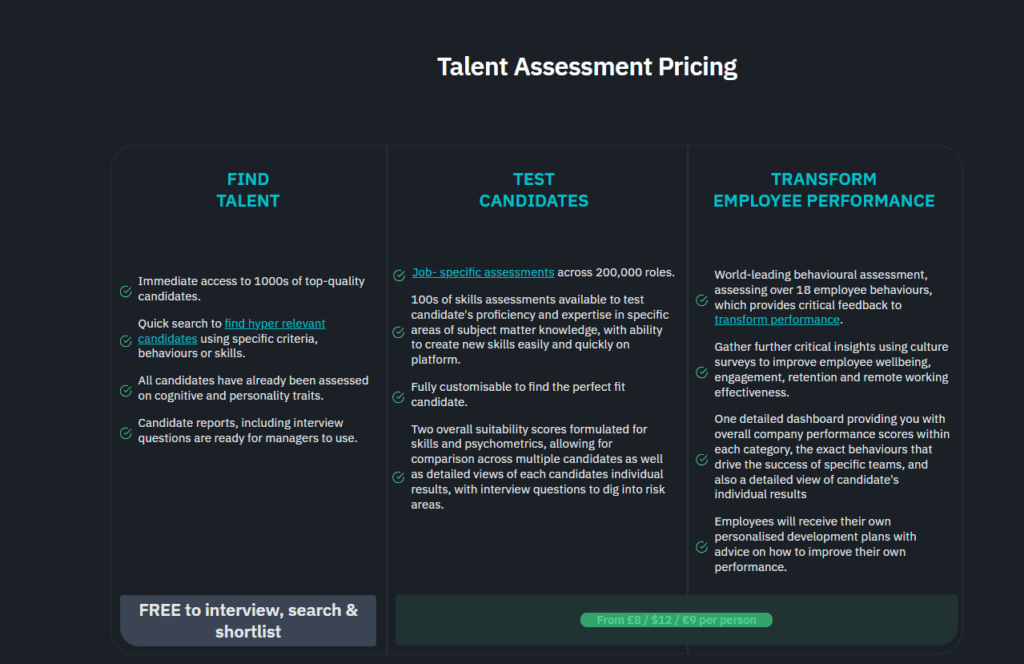
The product splits into three parts, and the split explains the pricing. Find Talent lets you search and interview candidates who have already completed Thrive's personality and cognitive assessments, free. Test Candidates is the pre-hire assessment product. Transform Employee Performance is a post-hire tool covering 18 employee behaviours, culture surveys and development plans. That third pillar is real product surface Testlify does not have, and any honest comparison should say so.
One caution before you shortlist. Thrive is not ThriveMap, a separate company selling realistic job simulations for frontline and high-volume roles. The two get mixed up in search results constantly. If job simulations are what you are after, the Testlify and ThriveMap comparison is the one you want.
How does Thrive psychometric testing work?
Thrive psychometric testing combines a Big Five personality questionnaire with cognitive ability tests covering numerical, verbal and logical reasoning. Candidates take it in one sitting. The cognitive sections are deliberately over-length, so nobody finishes: Thrive's own guidance says it is humanly impossible to answer every question in the time allowed, which is standard practice for speeded ability tests.
Results come back as two overall suitability scores, one for skills and one for psychometrics, plus a breakdown by individual ability and personality trait. Candidates can be benchmarked against thousands of others. Where the profile shows a risk area, Thrive's psychologists supply interview questions aimed at it, which is a genuinely useful touch that most assessment vendors leave to the recruiter.
What it does not do is watch the session. Nothing on Thrive's product, skills or psychometrics pages describes proctoring, identity verification or AI-assistance detection. For an office-based assessment centre that is fine. For an unsupervised remote test where the score decides who reaches an interview, it is the gap to think hardest about.
The science question underneath all of this is worth being precise about. A 2022 reanalysis of selection validity by Sackett and colleagues revised many long-quoted validity coefficients downward after challenging how earlier work corrected for range restriction. Structured interviews stayed near the top of the ranking. Years of education and general years of experience sat near the bottom. So the case for testing over resume-reading survives the correction, but any vendor quoting a single tidy validity number at you, in either direction, is quoting a contested figure.
Testlify vs Thrive: feature comparison
Capability | Testlify | Thrive |
|---|---|---|
Core approach | Skills, work samples and interviews, with psychometrics alongside | Psychometrics first: Big Five personality plus cognitive ability |
Question types | 25+, including coding, typing, file upload, Office app tasks and video | Not published; assessments are configured from Thrive's own battery |
Library size | 3,500+ tests across 13 categories | 200,000+ job-specific assessments; 100+ pre-built skills tests listed |
Coding assessment | VS Code editor, multi-file projects, 20 test cases, SQLite, vibe coding | Programming skills tests listed (Python, Java, React) |
Video and AI interviews | One-way, two-way conversational AI video, and outbound AI phone calls | Free candidate interviewing in the Find Talent tier |
Proctoring | 3 presets, dual-device monitoring, ID face match, AI-tool detection | Not published |
Item-level analytics | Difficulty index, discrimination index, quality-risk flags per question | Trait and ability breakdowns, benchmarking against thousands |
ATS integrations | 100+, sold as a $2,388/year add-on on self-serve tiers | Eploy and Greenhouse documented |
Post-hire tooling | 360 feedback and reference assessments | 18 behaviours, culture surveys, development plans |
Entry pricing | $139/month for 100 annual credits | Free to search and shortlist; from GBP 8 per person tested |
Which platform has the bigger test library?
On the raw claim, Thrive. On what you can actually pick from, Testlify. Those two sentences are not a contradiction, and the difference is the single most misread thing in this category.
Thrive's 200,000 figure counts job-specific assessment configurations, generated by matching roles to the traits and abilities its occupational psychologists judge relevant. Its skills-assessment page lists something closer to 100 pre-built tests: Excel, Python, Java, React, product management, sales strategy, HR, financial modelling. Both numbers are true. They count different things.
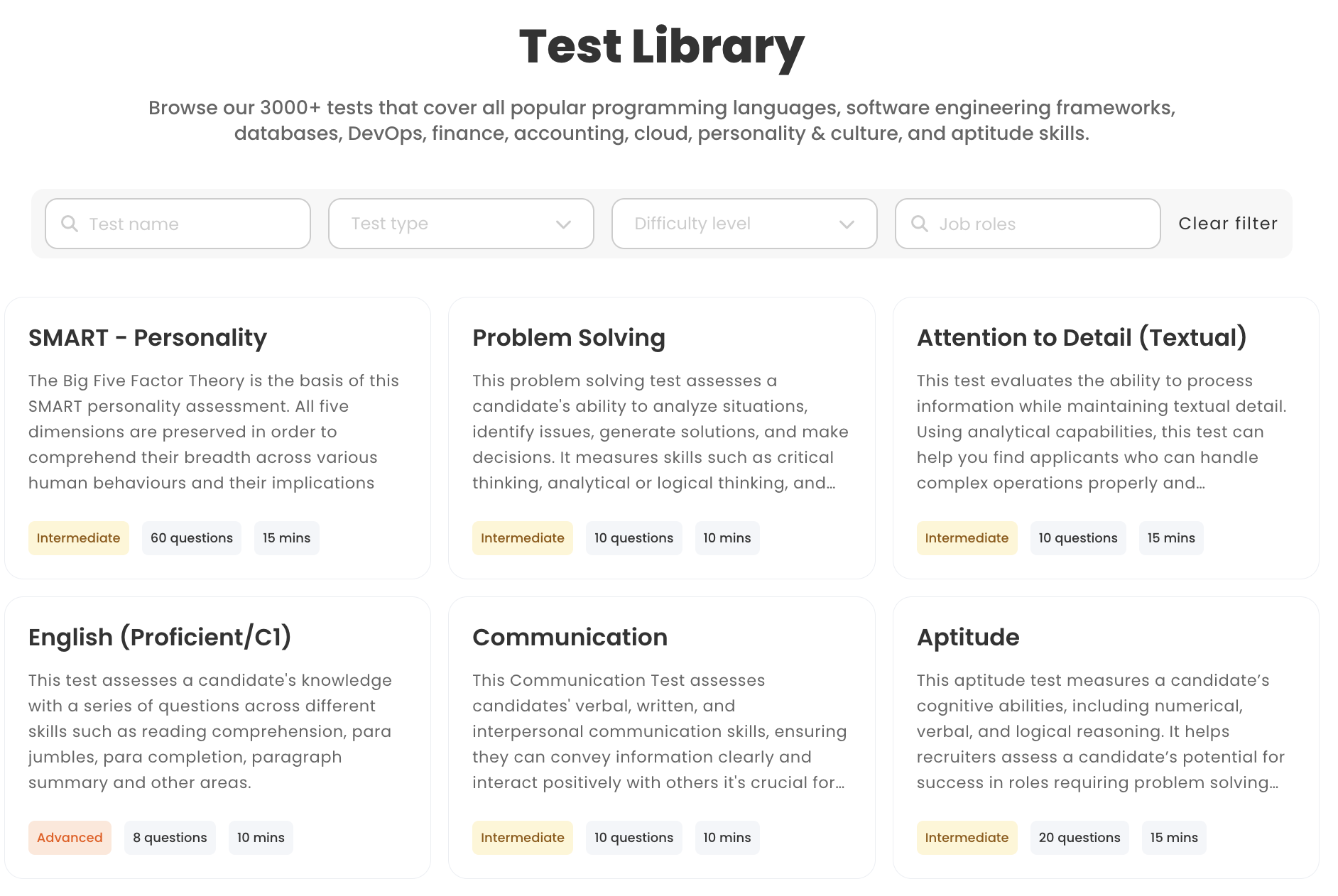
Testlify's library holds 3,500+ tests across blue collar, coding, cognitive ability, engineering, language, personality and culture, programming, psychometric, role-specific, situational judgment, software skills, simulation and gamified categories, each at easy, medium or hard. On top of that sits the question-type range: single and multi select, ranking, range, dropdown, fill-in-the-blank with free-text or dropdown blanks, practical tasks submitted by file or URL, typing tests scored 60% on accuracy and 40% on speed, and live tasks inside Google Docs, Sheets, Slides, Word, Excel and PowerPoint.
The coding surface is where the gap opens widest. Multi-file projects in a browser VS Code editor, up to 20 visible or hidden test cases with per-case scoring, SQLite database questions, and vibe coding, which lets a candidate direct AI tools toward a working solution instead of typing syntax from memory. Given that employers expect 39% of workers' core skills to change by 2030, testing whether someone can work with AI tools rather than around them is not a novelty feature. It is the thing the job will need.
Pro Tip: library size is a vanity metric. Shortlist three roles you hire repeatedly, build the assessment for each on both platforms during the trial, and count how many questions you had to write yourself. That number predicts your real setup cost far better than any catalogue figure.
How do the two handle cheating and proctoring?
This is the widest gap in the comparison, and it is not close.
Testlify runs test security as a configurable layer with three presets: Standard for balance, Strict for maximum control, Custom for everything in between. The measures include full-screen enforcement, tab-switch detection, face detection and single-presence checks, photo ID verification with a face match against the ID, periodic webcam snapshots, session recording of clicks and navigation, copy-paste tracking, multi-monitor restriction, IP proctoring, browser-extension detection and AI-assistance detection.
The standout is dual-device proctoring. The candidate's phone becomes a second camera positioned to capture both them and their laptop screen, and it is a hard gate: the assessment will not start until mobile monitoring is active. Disconnect it mid-test and the session stops, with the event reported to the administrator.
What the recruiter sees is deliberately evidence-shaped rather than verdict-shaped. Green means the session followed the rules. Yellow means something was not ideal and a quick manual review is recommended. Red means cheating was confirmed. Automatic termination exists but is opt-in, with a violation threshold you set, so a flag never rejects anyone on its own. There is also an AI checker that classifies a written answer as human, AI-generated or mixed.
Thrive publishes none of this. Its psychometrics FAQ argues that well-built assessments resist dishonesty through validated design, which is a fair argument for a supervised setting and a weak one for an unsupervised remote test. If your candidates sit the test at home and the score gates the interview, that difference decides the comparison on its own.
Which one does video and AI interviews?
Both, but for different jobs.
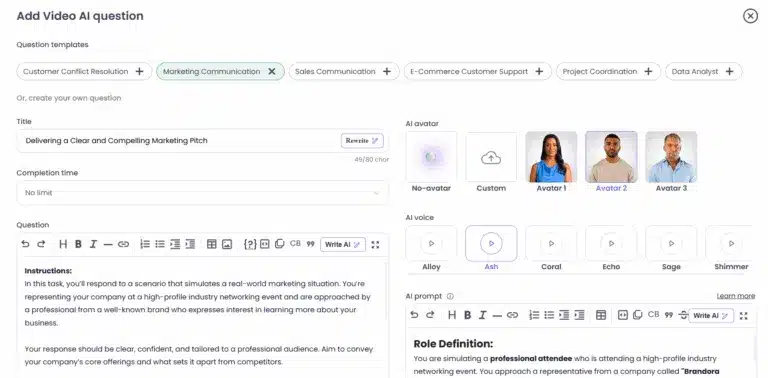
Testlify runs four interview formats in one product: one-way asynchronous video, two-way conversational AI interviews, audio and voice questions, and outbound AI phone interviews billed at $0.18 a minute. The AI interviewer is configurable down to the avatar, the voice, the persona, the context it is given and the prompts it asks from, with 150+ interview templates to start from. You set the number of attempts, the recording time, the preparation time before recording auto-starts, and a five-minute ceiling per video answer.
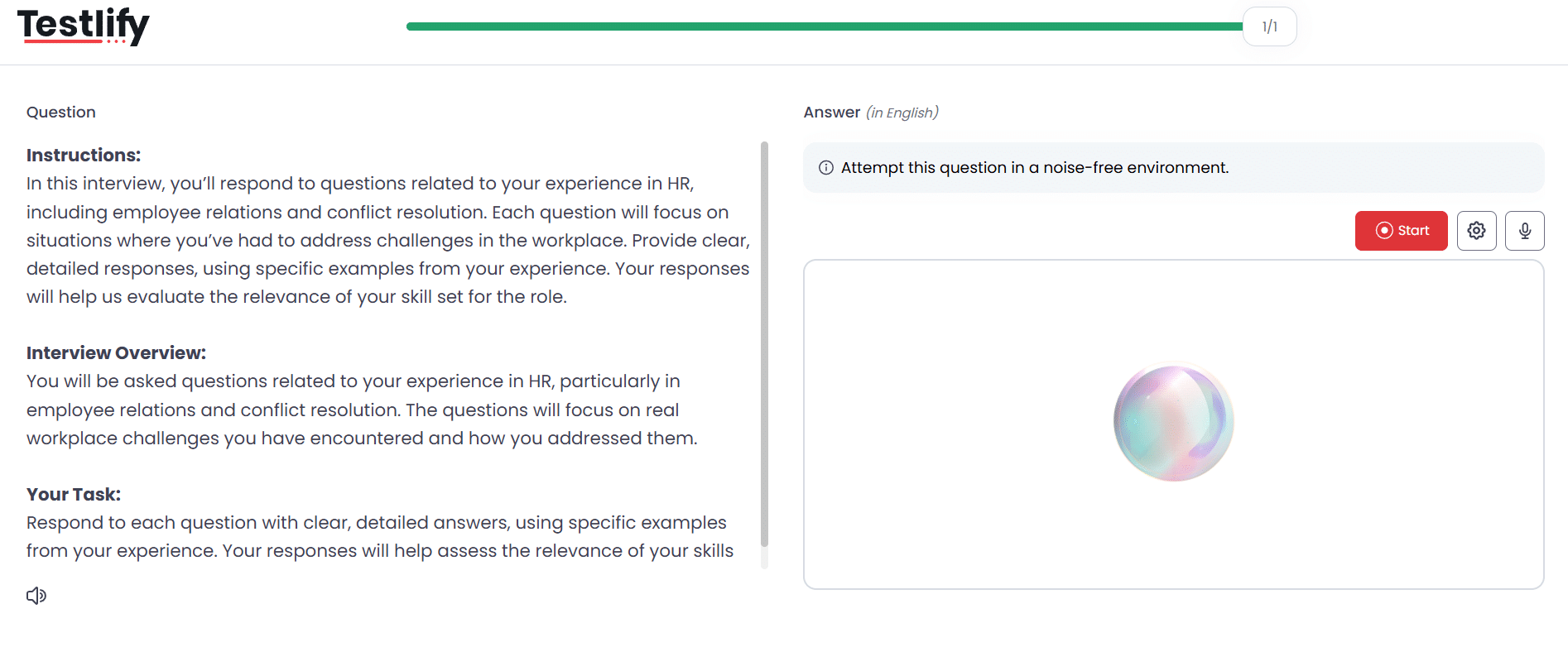
Transcripts are automatic and multilingual, with the language auto-detected for any recording over 30 seconds. Reviewers get the video, the audio, a downloadable transcript, an interview report they can regenerate, and screen replay. Video violation detection runs alongside, catching a webcam that goes dark, no face in frame, or more than one face appearing.
Thrive's interviewing sits in its free Find Talent tier, aimed at searching and shortlisting candidates who already carry a completed Thrive profile. That is a different proposition: less an interviewing toolkit, more a pre-assessed talent pool you can browse without paying until you test.
Neither product schedules live human interview panels. If calendar coordination for a four-person panel is the thing you need solved, that is an ATS or a scheduling tool, not either of these.
How do Testlify and Thrive integrate with an ATS?
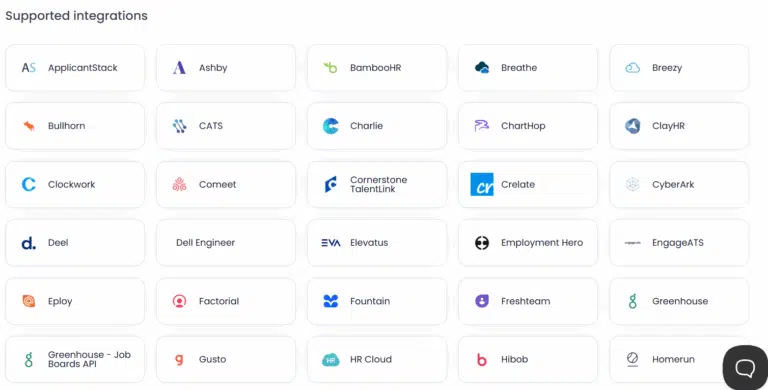
Testlify integrates with 100+ applicant tracking systems and leaves your ATS as the system of record. Results sync back, candidates auto-advance to the next ATS stage when they clear a cut-off score, and rejections stay inside Testlify rather than writing back. Be aware of the commercial detail: ATS integrations are a $2,388/year add-on on the self-serve tiers and are included on Custom plans. Zapier, webhooks and a REST API cover anything without a native connector, and AI resume screening is free with a Greenhouse integration while it remains in beta.
For teams with no ATS at all, Testlify also ships a simple built-in hiring pipeline: job requisitions, an application form, publishing to job boards, a public listing, and applied to reviewed to shortlisted to rejected stages. It is deliberately basic, and it exists so a ten-person company does not have to buy two systems to make one hire.
Thrive documents an Eploy ATS integration, which needs an Eploy API subscription, and a Greenhouse integration. Beyond those two, its published integration surface is thin, so check the connector you depend on before you commit.
What does each platform cost in 2026?
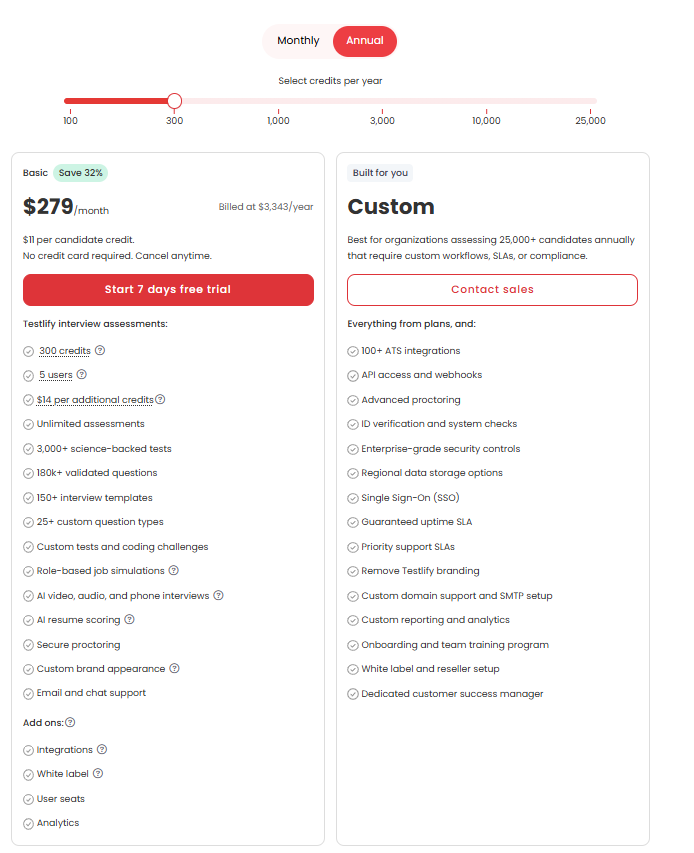
Testlify sells candidate credits, and one credit is consumed when a qualified candidate starts an assessment. Credits do not roll over. These are the annual, billed-yearly tiers from the pricing plans:
Plan | Credits per year | Price | Per credit | Seats |
|---|---|---|---|---|
Starter | 100 | $139/month, billed $1,668/year | $16.68 | 3 |
Basic | 300 | $279/month, billed $3,348/year | $11.16 | 5 |
Business | 1,000 | $699/month, billed $8,388/year | $8.39 | 10 |
Premium | 3,000 | Contact sales | Volume-based | 20 |
Enterprise | 10,000 | Contact sales | Volume-based | 30 |
Custom | 25,000+ | Contact sales | Volume-based | 40 |
Monthly billing is a different set of numbers for the same tier names: $198 for 10 credits, $398 for 30, $998 for 100. Extra seats are $15 each per month, the trial runs seven days with no card, there is a 30-day money-back guarantee, pricing is locked for 24 months, and non-profits get 25% off. Some things meter separately: AI phone interviews at $0.18 a minute, face verification at $0.50 an attempt, the highest proctoring tier at $5 an attempt. White labelling and ATS integrations are $2,388/year add-ons on self-serve plans.
Thrive prices per person. Searching, shortlisting and interviewing from its candidate pool is free. Testing starts from GBP 8 / USD 12 / EUR 9 per person, and the post-hire performance product starts from GBP 5 / USD 6 / EUR 6 per month.
Work an example. Assess 300 candidates a year and Testlify's Basic plan costs $3,348, or $11.16 a head, with five seats, proctoring, interviews and reporting included. The same 300 on Thrive's published entry rate lands near $3,600, with no seat limit stated and no charge for the searching and shortlisting around it. At 1,000 candidates the picture flips harder: $8,388 on Testlify, about $8.39 a head, against roughly $12,000 at Thrive's entry rate. Volume favours the credit model. Occasional, low-volume hiring favours pay-per-person.
Which platform fits your hiring situation?
Choose Thrive if a validated personality and cognitive profile is genuinely the decision you are making: graduate schemes, structured assessment centres, or post-hire development where the 18-behaviour model and culture surveys earn their keep. Its free search-and-shortlist tier is also the cheapest way to look at pre-assessed candidates before you spend anything.
Choose Testlify if you need to see work product, if candidates test unsupervised, if you hire technical roles, or if one platform covering screening through interview beats stitching two together. This is the Testlify Multi-Signal Talent Evaluation Model in practice: combine several role-relevant signals, including assessments, interviews, simulations, references and reviewer feedback, rather than advancing anyone on a single score. One signal is fragile. Several pointing the same way is a decision you can defend.
Defensibility is not a rhetorical flourish here. Under the US Uniform Guidelines on Employee Selection Procedures, any selection procedure with adverse impact has to be validated for the job. New York City goes further: its automated employment decision tool rules require an independent bias audit within a year of use, a published summary of the results, and at least 10 business days' notice to candidates. Whichever platform you pick, ask who owns that audit and where the results are published, and keep a human in the scoring loop rather than letting a model decide alone.
The context is worth holding onto too: 63% of employers name the skills gap as the main barrier to transforming their business, according to the Future of Jobs Report 2025, which surveyed more than 1,000 employers representing 14 million workers. Both of these products are answers to that problem. They just measure different halves of it.
Still weighing options? There are other Thrive alternatives worth a look, and reporting and analytics or white-labelling may swing the decision if either matters to your team.
Hire on evidence, not on a single score
Run both against a role you are hiring for right now, with the same three candidates, and compare what each report tells you the day before an offer. Testlify's trial runs seven days with no card. Book a demo and bring the job description you are stuck on.
Key takeaways
- The two products answer different questions. Thrive tells you what a candidate is like; Testlify tells you what they can do. Teams that treat them as substitutes end up disappointed by whichever one they picked, because the gap they felt was never a feature gap.
- Test security is the sharpest divide. Testlify ships three proctoring presets and dual-device monitoring; Thrive publishes no proctoring capability at all. If your assessment is unsupervised and the score gates an interview, treat this as the deciding factor rather than a nice-to-have.
- Library numbers are not comparable. Thrive's 200,000 counts role-matched configurations of its own battery; Testlify's 3,500+ counts distinct tests you select from. Compare the assessments you would actually build, not the catalogue headline.
- Volume decides the pricing argument. Per-person pricing wins for occasional hiring; credit bundles win once you pass a few hundred candidates a year, where Testlify drops to $8.39 a credit against roughly $12 a head.
- Compliance follows the tool you pick. Bias-audit rules and validation requirements apply to whatever scores your candidates, so confirm who runs the audit, where the summary lives and how a human overrides a machine score before you sign anything.
- Do not confuse Thrive with ThriveMap. Different companies, different products. Check the domain on any comparison you read, including the ones that rank above this page.
FAQs

Director of Marketing
Akash Patange is the Director of Marketing at Testlify, where he works closely with HR leaders and recruiters to help organizations improve hiring outcomes. He writes about talent assessment, recruitment technology, and data-driven hiring practices.
LinkedInRelated resources
View all
Competitor Comparisons
Testlify vs The Talent Games: Which Is Best for HR Teams?
Competitor Comparisons
Testlify vs. TalentMetrix: Which Skills Assessment Platform is Best for HR Teams?
Competitor Comparisons
Testlify vs. Total Testing: Which Skills Assessment Platform is Best for HR Teams?
Competitor Comparisons
Testlify vs. ThriveMap: Which Skills Assessment Platform is Best for HR Teams?
Competitor Comparisons
Testlify vs. UbiAptitude: Which Skills Assessment Platform is Best for HR Teams?
Competitor Comparisons
Testlify vs. Zapilio: Which Skills Assessment Platform is Best for HR Teams?
Get started.
Hire on proof, not resumes.
Run your first skills-based assessment free — no credit card required.