
Testlify vs The Talent Games: Which Is Best for HR Teams?
Testlify vs. The Talent Games: Discover which skills assessment platform best suits your hiring needs
Choosing between Testlify and The Talent Games comes down to one question: do you want gamified assessments built to engage high-volume, early-career candidates, or a broad, evidence-based platform that measures role-specific skills across technical and non-technical hiring? Testlify is the better fit for most HR teams that hire across many roles, because it pairs 3,500+ ready-to-use assessments with AI interviews, proctoring, and 100+ ATS integrations in one platform. The Talent Games is a strong pick when candidate engagement in a graduate or campus funnel matters more than test breadth.
Hiring the wrong person is expensive, and it happens more than most teams admit. Gallup found that companies pick the wrong person for a management role 82% of the time, usually because the decision leans on resumes and gut feel instead of evidence. That is the real job of an assessment platform: replace guesswork with signal. Below is how these two tools actually stack up, and how to tell which one your team should run.
 ChatGPT
 Gemini
 Claude
 Grok
Grok Perplexity
TL;DR: Testlify vs The Talent Games
- Best overall for most HR teams: Testlify, thanks to test breadth (3,500+ assessments), AI interviews, proctoring, and 100+ ATS integrations in a single platform.
- Best for candidate engagement in high-volume early-career funnels: The Talent Games, which turns cognitive and behavioral assessment into branded, game-based experiences.
- Assessment style: Testlify runs role-based skills, cognitive, personality, coding, and language tests; The Talent Games runs neuroscience-based games measuring cognitive ability and soft skills.
- Where Testlify pulls ahead: depth of role-specific and technical testing, structured AI interviews, anti-cheating controls, and enterprise security (SOC 2 Type II, ISO 27001, GDPR).
- Where The Talent Games pulls ahead: gamified candidate experience for graduate, campus, and volume hiring where drop-off is the main problem.
- Bottom line: if you hire across many roles and want one system for testing, interviewing, and scoring, Testlify wins. If your bottleneck is engaging thousands of junior applicants, The Talent Games earns a look.

Testlify vs The Talent Games: quick comparison
Here is the at-a-glance view before we get into the details. Both platforms assess candidates before the interview stage, but they solve slightly different problems.
Test library | ||
Features | Testlify | The Talent Games |
Role-specific tests | ✓ | ✗ |
Coding tests | ✓ | ✗ |
Cognitive ability tests | ✓ | ✓ |
Programming tests | ✓ | ✗ |
Number of programming languages supported | 45+ | ✗ |
Situational judgment tests | ✓ | ✓ |
Typing test | ✓ | ✗ |
Software skills tests | ✓ | ✗ |
Non-technical tests | ✓ | ✗ |
Psychometric tests | ✓ | ✗ |
Personality tests | ✓ | ✓ |
Motivation test | ✓ | ✗ |
Assessment templates | ✓ | ✓ |
Custom assessments creation | ✓ | ✗ |
Assessments | ||
Features | Testlify | The Talent Games |
Custom assessment builder | ✓ | ✗ |
Custom coding questions | ✓ | ✗ |
Multiple-choice questions | ✓ | ✗ |
Short answer questions | ✓ | ✗ |
Long answer questions | ✓ | ✗ |
Rating questions | ✓ | ✗ |
Date questions | ✓ | ✗ |
Fill in the blanks | ✓ | ✗ |
Microsoft Word/Excel/PowerPoint questions | ✓ | ✗ |
Google Docs/Slides/Sheets questions | ✓ | ✗ |
Qualifier questions | ✓ | ✗ |
File upload questions | ✓ | ✗ |
Assessments curated by I/O psychologists | ✓ | ✓ |
Quality check | ✓ | ✓ |
Interview | ||
Features | Testlify | The Talent Games |
Audio interviewing (Voice AI) | ✓ | ✗ |
One-way audio interview | ✓ | ✗ |
Video interviewing (Video AI) | ✓ | ✗ |
One-way video interview | ✓ | ✗ |
Chat simulation (Chat AI) | ✓ | ✗ |
Custom interview questions creation | ✓ | ✗ |
Candidate experience | ||
Features | Testlify | The Talent Games |
Customizable email templates | ✓ | ✗ |
Mobile-friendly | ✓ | ✓ |
Candidate support | ✓ | ✓ |
Welcome video | ✓ | ✓ |
Average assessment length | 40-60 minutes | - |
Assessment attempts | Customizable | - |
Anti-cheating features | ||
Features | Testlify | The Talent Games |
Session recording | ✓ | ✗ |
Snapshot capturing | ✓ | ✗ |
Mouse tracking | ✓ | ✗ |
Disabled copy-paste | ✓ | ✗ |
Microphone and camera access | ✓ | - |
Location access | ✓ | ✗ |
IP address tracking | ✓ | ✗ |
Question-level activity logs | ✓ | ✗ |
Full-screen mode | ✓ | ✗ |
Force full-screen mode | ✓ | ✗ |
Tab proctoring | ✓ | ✗ |
AI assistance detection | ✓ | ✗ |
Restrict multiple monitors | ✓ | ✗ |
Randomization of question sequence | ✓ | ✗ |
Time limit on tests | ✓ | ✓ |
Screen sharing | ✓ | ✗ |
Dual camera proctoring | ✓ | ✗ |
Honesty Agreement | ✓ | ✗ |
Reporting and analytics | ||
Features | Testlify | The Talent Games |
Detailed reports | ✓ | ✓ |
Public link to share reports and scorecards | ✓ | ✓ |
Exportable/downloadable reports | ✓ | ✓ |
Recruiting analytics | ✓ | ✓ |
Candidate benchmarking | ✓ | ✓ |
Completion rate and response insights | ✓ | ✓ |
Enterprise friendly | ||
Features | Testlify | The Talent Games |
White label | ✓ | ✓ |
Custom branding | ✓ | ✓ |
ATS integrations | 100+ | - |
User, role, and access management | ✓ | ✓ |
Bulk candidate invite | ✓ | ✓ |
Share the public link invite with candidates | ✓ | ✓ |
Candidate pipeline management | ✓ | ✓ |
Internationalization | ✓ | ✓ |
Campus hiring support | ✓ | ✓ |
Dedicated account manager | ✓ | ✓ |
Security and compliance | ||
Features | Testlify | The Talent Games |
GDPR | ✓ | ✓ |
CCPA | ✓ | ✗ |
SOC2 | ✓ | ✗ |
ISO 27001 | ✓ | ✗ |
Customer support | ||
Features | Testlify | The Talent Games |
24/7 support | ✓ | ✓ |
On-call support | ✓ | ✗ |
Email support | ✓ | ✓ |
Product demo | ✓ | ✓ |
Training & onboarding tour | ✓ | ✓ |
What is Testlify?
Testlify is an AI-powered skills assessment platform designed to help organizations identify top candidates worldwide & make informed hiring decisions. With a focus on scalability and flexibility, it offers a vast library of tests, advanced proctoring capabilities and conversational AI powered interviews, making it ideal for diverse hiring needs across industries.
How does Testlify work?
Our conversational AI-powered interview & talent assessment platform enables recruiters to assess candidates' skills with precision, empowering you to make well-informed decisions. Here's how Testlify works:
1. Create personalized assessments
Recruiters can choose from a library of over 3,000 tests covering 4,500+ job roles or use AI to generate custom questions, including multiple-choice, open-ended, and coding challenges. The platform also supports conversational AI-powered interviews in chat, voice, and video formats to simulate real-world job scenarios.
2. Send candidate invitations
Once an assessment is created, recruiters can invite candidates via email to attempt it. Candidates can access the assessment directly through the invitation link without needing to create an account, ensuring a seamless experience.
3. Advanced anti-cheating and proctoring measures
To ensure the integrity of the skills assessment process, Testlify uses advanced proctoring features such as webcam monitoring, browser lockdown, screen recording and location tracking. These measures help verify that assessments are completed honestly and promote a fair testing environment.
4. AI-Powered scoring and analytics
Testlify leverages AI to automatically score assessments, giving recruiters detailed insights into each candidate’s performance. Its comprehensive reports break down results by skill, question type, and overall performance, facilitating informed decision making.
5. Integration with applicant tracking systems (ATS)
To simplify the hiring process, Testlify offers seamless integration with over 100 ATS platforms, including Greenhouse, Lever, and Recruitee. This makes it easy to import candidate profiles, compare assessment results, and make informed hiring decisions.
6. Data compliance
Testlify is GDPR compliant and places a strong emphasis on the security of recruitment data. It offers advanced admin controls, strong security integrations, strict data governance, comprehensive audit trails, and robust privacy protections, all supported by SOC 2 Type II, AICPA, and ISO 27001 certifications.
What is The Talent Games?
The Talent Games is a world leader in gamified recruitment assessments, offering a unique approach to candidate evaluation and development. It helps organizations attract and shortlist top talent especially graduates using online game-based assessments
The platform (flagship product “C-Factor”) combines AI, neuroscience, and behavioral science to create immersive hiring games that measure cognitive abilities, soft skills, and personality traits in a fun, engaging format
How does The Talent Games work?
The Talent Games takes a different approach by turning assessments into engaging games. Here’s how The Talent Games works to help companies hire at scale:
1. Create custom assessments
Employers begin by selecting or designing a recruitment game aligned with their hiring goals. The Talent Games offers a library of around 60+ ready-to-play gamified tests covering cognitive, situational, and aptitude evaluations. For large projects, the platform also provides fully tailor-made games customized to the employer’s specific role, brand, and competencies. This ensures the assessment game reflects real job scenarios and company values.
2. Invite candidates
Once the game is ready, companies invite candidates to participate – often as part of campus drives, graduate hiring programs, or other high-volume recruitment campaigns. Invitations can be sent via email or shared as a link. Because the assessments feel like interactive games, they tend to generate strong candidate engagement
3. Candidates attempt the assessment
Candidates complete the gamified assessment online, tackling a series of challenges or scenarios. These games measure a mix of abilities in a less intimidating way than traditional tests
For example, The Talent Games provides neuroscience-based puzzles to assess cognitive skills (memory, logical reasoning, pattern recognition), situational judgment simulations to evaluate decision-making and soft skills, and other mini-games for aptitude.
The gameplay is timed and scored automatically by the platform’s AI-driven analytics, and unbiased algorithms ensure every player is evaluated purely on merit.
4. Analyze results & shortlist
After the game, recruiters gain access to a reporting portal to monitor each candidate’s performance. The platform provides scores for various competencies measured in the game, and even generates leaderboards ranking participants by their results
This makes it easy to identify the top performers out of a large talent pool. Recruiters can drill into individual profiles to see detailed results (e.g. cognitive scores, decision-making style, etc.) and compare candidates’ strengths at a glance.
5. Data compliance
The Talent Games adheres to enterprise-grade standards (the company has been recognized for meeting ISO 27001 information security and EU GDPR requirements) to protect candidate information and privacy during these assessments.
Testlify vs. The Talent Games comparison
Testlify vs. The Talent Games: Test library & test types
Testlify offers advanced conversational AI-powered interviews across chat, voice, and video formats alongside a comprehensive library of over 3,000 tests tailored to 4,500+ job roles spanning 50+ industries. The platform also supports a wide range of test types, including:
- Cognitive tests (e.g., critical thinking, pattern recognition, analytical reasoning)
- Role-specific tests (e.g., custom-built tests aligned to job responsibilities)
- Blue-collar hiring tests (e.g., practical skill assessments for blue-collar roles)
- Programming tests (e.g., coding, algorithm design, technical proficiency)
- Software skills tests (e.g., Microsoft Office, CRM systems, other software tools)
- Psychometric tests (e.g., personality profiling, adaptability, teamwork orientation)
- Situational judgment tests (e.g., conflict resolution, ethical decision-making, client handling)
- Live coding tests (e.g., coding challenges and assessments)
- Typing tests (e.g., speed, accuracy, typing proficiency)
- Language tests (e.g., proficiency in speaking and writing certain languages)
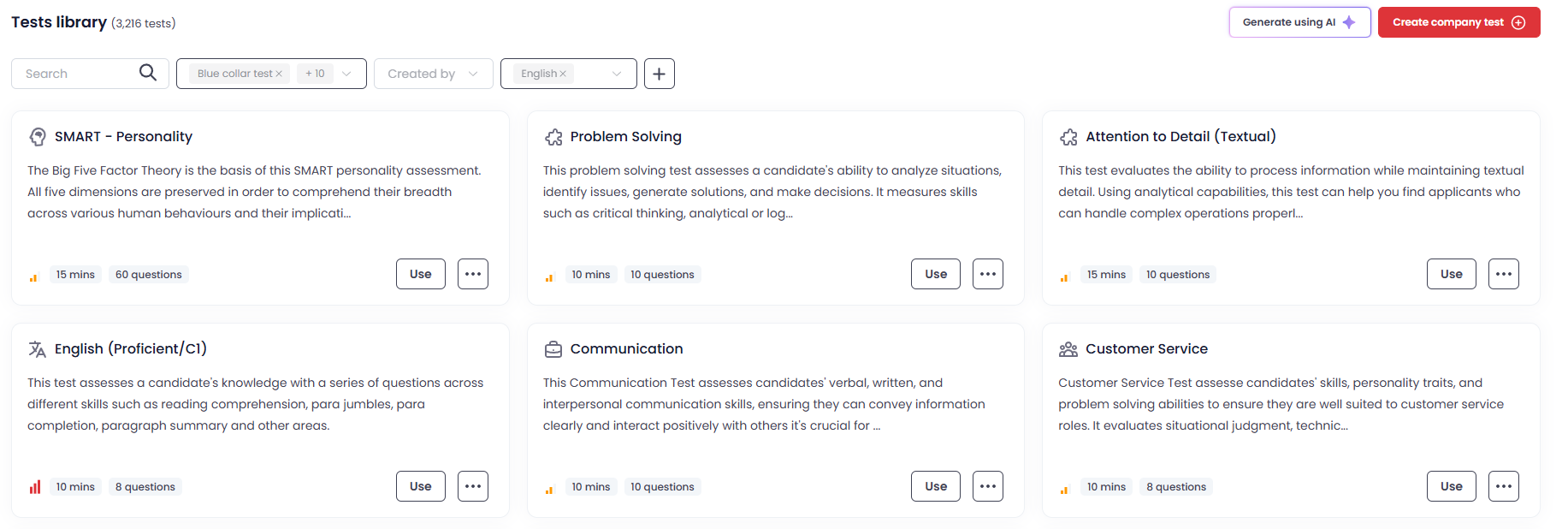
The Talent Games boasts a more focused library of around 60+ gamified assessments. These are not traditional question banks but rather interactive games. They primarily cover:
- Situational Judgment simulations: Immersive story-based scenarios where candidates’ choices reveal their competencies (e.g. how a candidate handles a customer complaint scenario
- Cognitive ability games: Neuroscience-based puzzles testing memory, pattern recognition, problem-solving, etc., in a game format
- Aptitude and reasoning games: Mini-games to evaluate verbal and logical reasoning and general mental agility
- Behavioral and personality assessments: Embedded in gameplay, assessing traits like risk-taking, persistence, teamwork, and other soft skills through how candidates play the game
Verdict: Both Testlify and The Talent Games offer extensive assessment libraries, but their focus differs significantly. Testlify stands out with its sheer breadth of content – covering thousands of job-specific tests and technical skills that can be deployed instantly. This makes Testlify ideal if you need assessments for a wide variety of roles (especially technical or niche positions) or prefer traditional question formats along with AI-driven interviews.
Meanwhile, The Talent Games takes a gamified, candidate-centric approach, which excels in engagement and employer branding. Its library, though smaller in number, is highly specialized for measuring cognitive and soft skills in an enjoyable way.
This makes it perfect for graduate recruitment or large-scale hiring where you want to attract candidates and evaluate general competencies. However, if your hiring requires specific hard-skill tests (e.g. coding, accounting, software knowledge), The Talent Games’ library is relatively limited.
In summary, Testlify offers far broader test coverage, whereas The Talent Games focuses on a narrower range of skills delivered via gamification.
Testlify vs. The Talent Games: Custom question types
Testlify empowers recruiters to create personalized skills assessment tests with 15+ custom question types:
- Multiple Choice Questions (MCQs)
- Open-ended and descriptive questions
- Fill in the blanks
- Conversational AI-powered chat interview
- Conversational AI-powered video interview
- Conversational AI-powered audio interview
- Pre-made and custom coding questions
- File upload questions
- Google Docs, Sheets, and Slides questions
- Microsoft Office questions
- Rating, date, and number questions
- Qualifier questions
The Talent Games, on the other hand, approaches customization at the game level. Rather than letting recruiters write individual questions, The Talent Games team works with clients to build fully customized recruitment games for their needs.
Companies can request bespoke game scenarios that incorporate their branding, values, and specific competencies. For example, a bank could have a custom game for assessing financial acumen and customer service via a virtual banking scenario. The platform’s customization feature is essentially “white-glove service” delivering tailor-made assessment games for large-volume screening.
Verdict: Verdict: Both platforms recognize that one size doesn’t fit all in skills testing, but they offer customization at different scales.
Testlify provides granular control you can craft or tweak questions and sections yourself, on the fly. This is a major advantage if you want to quickly develop new assessments or incorporate unique questions that target very specific skills.
Also Read: Testlify vs. eSkill: Which Skills Assessment Platform is Best for HR Teams?
Related Read: Testlify vs. HackerEarth: Which Skills Assessment Platform is Best for HR Teams?
Recommended: Testlify vs. Evalgator: Which Skills Assessment Platform is Best for HR Teams?
Testlify’s AI-assisted test builder further streamlines this process, making custom test creation faster and more self-service.
The Talent Games in contrast, offers customization as a service for high-volume projects. If you have the resources and need to deliver a completely unique gamified experience the platform can deliver a bespoke gamified assessment that stands out.
Testlify vs. The Talent Games: White-labeling capabilities
Testlify delivers a solid candidate experience by offering custom branding options for pre-employment assessments, allowing companies to showcase their logo, brand colors, and messaging.
A standout feature is the ability to personalize invitation and rejection emails. Instead of sending generic messages, companies can craft communications that reflect their brand’s tone and values, leaving candidates with a more thoughtful, professional, and lasting impression.
Assessments are designed to be efficient, typically ranging from 10 to 30 minutes, helping maintain candidate engagement without compromising on evaluation quality.
Candidates have access to email support and detailed help documentation to address any questions or technical issues during the assessment process.
The Talent Games also provides robust white-labeling, taking it a step further by embedding branding into the game experience. Employers can have a custom company URL/domain for the game portal, and of course add their logos and brand visuals to the game interface.
Because games can be customized, organizations often incorporate their company scenarios or products into the game narrative itself, effectively turning the assessment into a branded story. Additionally, just like Testlify, The Talent Games supports customizing emails sent to candidates and any web pages associated with the game
Verdict: Both Testlify and The Talent Games offer extensive white-labeling capabilities, enabling you to deliver assessments under your own brand umbrella. You really can’t go wrong with either here as both platforms let you customize logos, colors, and candidate communications to fit your company identity
Testlify’s branding is best suitable for a conventional test environment, whereas The Talent Games embeds your brand into an interactive game. If providing an innovative, gamified branded experience is a priority (for example, appealing to campus hires), The Talent Games has an edge due to its unique format. Otherwise, for standard assessment branding, Testlify covers all the bases.
Testlify vs. The Talent Games: Conversational interviews
Testlify features conversational AI to simulate real job scenarios across chat, voice, and video formats, bringing practical context into the hiring process.
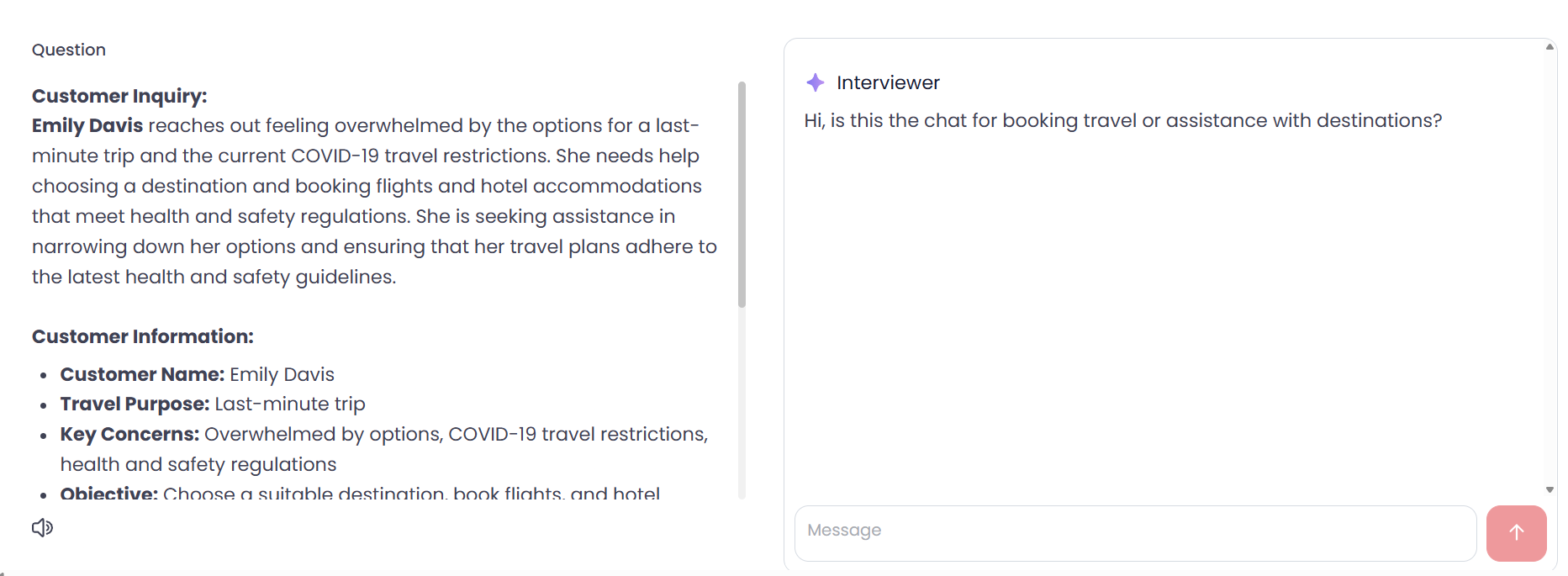
- Chat AI: Assess problem-solving, written communication, and critical thinking by engaging candidates in realistic text-based scenarios such as responding to a client inquiry about a delayed shipment or resolving a technical issue through live chat.
- Voice AI: Assess verbal fluency, tone, and persuasive ability by having candidates respond to role-specific voice prompts such as pitching a product to a potential client or handling a customer complaint over the phone.
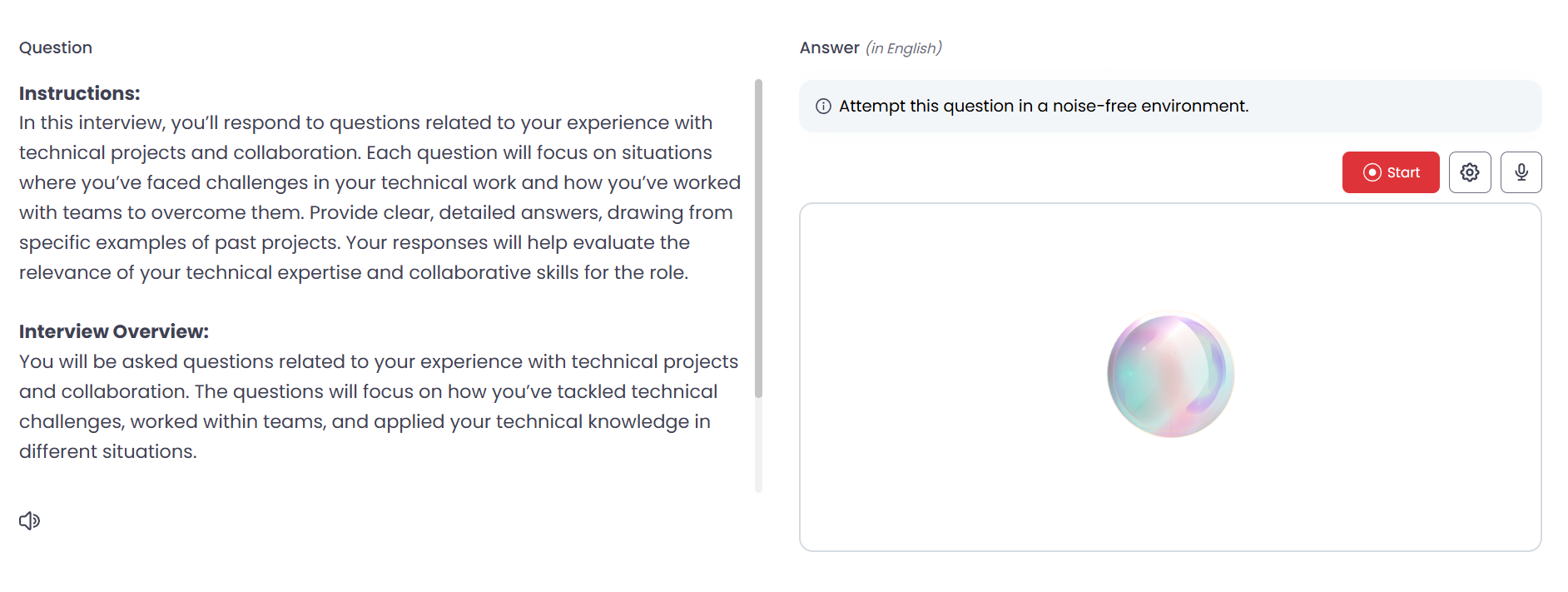
- Video AI: AI avatars guide candidates through complex job-specific scenarios in asynchronous video interviews, enabling employers to assess non-verbal cues, confidence, and emotional intelligence more effectively.
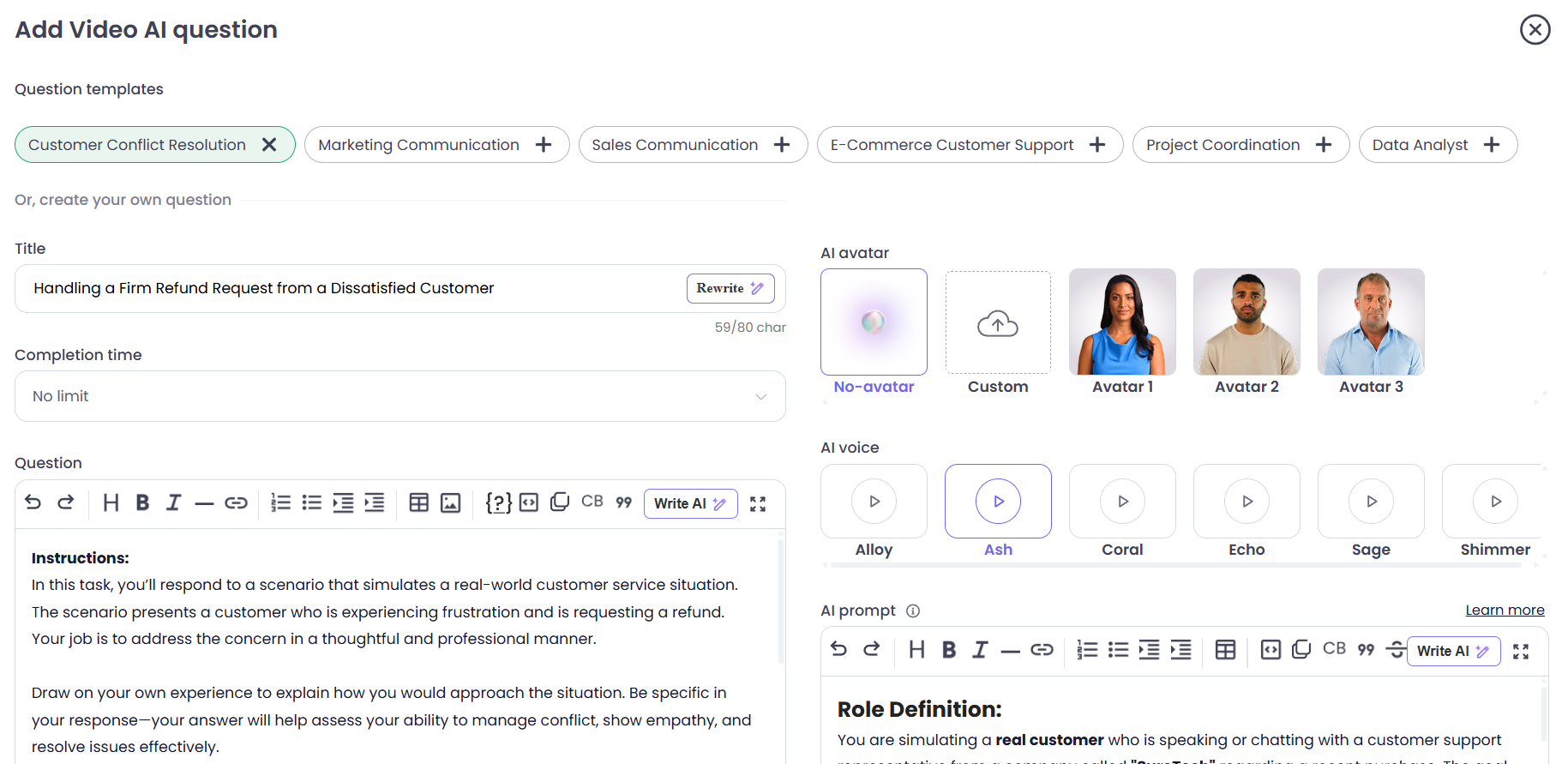
The Talent Games does not offer a feature analogous to AI-driven interviews. Its focus is on gamified tests rather than interview Q&A. However, The Talent Games’ assessments do incorporate some “conversational” elements in a gamified sense. For example, a game scenario may involve a dialogue with a virtual customer or teammate, where the candidate chooses how to respond (simulating a conversation).
Verdict: Testlify is the stronger option for conversational interviews. It uses advanced conversational AI to deliver realistic job simulations across chat, voice, and video formats. This approach is especially effective for evaluating candidates’ skills and competencies in roles that demand strong communication and problem-solving abilities.
The Talent Games, for all its strengths in gamification, does not include a true interview module. If your hiring process demands an interview stage that can be automated or scaled (for example, an AI screening interview before an in-person round), Testlify clearly has the advantage. The Talent Games offers an engaging alternative for screening, but you would still need to conduct separate interviews through other means.
Testlify vs. The Talent Games: Anti-cheating & proctoring features
Testlify comes with advanced anti-cheating measures and remote proctoring features designed to maintain the integrity of every assessment by ensuring that results truly reflect each candidate’s skills and effort. Key features include:
- Face detection
- Dual-camera proctoring (Tablet + Phone)
- Webcam snapshots
- IP-based proctoring
- Full-screen detection
- Mouse-out tracking
- Screen recording
- Copy/paste tracking
- Question-level activity logs
- Question randomization
- Live video monitoring
- AI assistance detection
- Honesty agreements
The Talent Games uses a gamified approach, eliminating the need for proctoring measures. Its assessments, often deployed for early-stage or bulk hiring, are designed to naturally discourage cheating. The puzzles and scenarios are not easily solved through quick online searches, and candidates understand that the evaluation emphasizes how they play as much as what they know.
Verdict: Testlify provides a far more comprehensive proctoring system suitable for high-stakes testing or remote environments where cheating must be minimized. Features like dual-webacam monitoring and AI-based fraud detection give Testlify an edge for roles or industries where assessment security is paramount.
The Talent Games, on the other hand, offers a more honor-system approach baked into an engaging experience which may be sufficient for preliminary screening or situations where the incentive to cheat is low.
Testlify vs. The Talent Games: Integrations
Testlify supports integration with 100+ ATS, communication and email tools, making it easy to import candidate profiles, review and compare assessment results, and make clear, data-driven hiring decisions.
The Talent Games supports integration as well, though on a more limited scale. According to the company, the gamified assessment platform “can be integrated with all leading ATS and LMS” systems.
In practice, this likely includes major ATS players (possibly via API or custom integration) and Learning Management Systems for the talent development use-case. However, The Talent Games does not publicly list dozens of integrations like Testlify does.
Verdict: Testlify is built with integration in mind, offering seamless connectivity with over 100 Applicant Tracking Systems (ATS) and third-party tools. This extensive compatibility makes it highly adaptable to diverse recruitment workflows.
Testlify vs. The Talent Games: AI overviews
Testlify supports AI overviews, which provide a concise summary of a candidate's overall performance in an assessment. These insights highlight key strengths and areas for improvement, enabling recruiters to quickly assess suitability and make informed decisions with greater efficiency.
The Talent Games uses AI primarily within its gamified assessments (to power unbiased scoring and adaptivity), but it does not explicitly offer a feature that writes out summary evaluations of each candidate. Recruiters using The Talent Games will see scores and competency breakdowns, but any narrative interpretation would be up to the recruiter to make
Verdict: : Both Testlify and The Talent Games leverage AI, but Testlify is more explicit in using AI to generate recruiter-facing summaries. If you value an automatic “executive summary” of each candidate, something you can quickly share with a hiring manager, Testlify is the clear winner here.
Testlify vs. The Talent Games: Reporting & insights
Testlify delivers comprehensive analytics with deep candidate behavior insights, question-level performance breakdowns, and benchmarking capabilities. Recruiters can visualize how individual candidates stack up against both organizational and global benchmarks.
Furthermore, candidate assessment reports can be easily shared with key decision-makers in PDF, Excel, or CSV formats, making it easier for them to make informed hiring decisions.
The Talent Games ikewise provides comprehensive metrics, but in a format suited to gamified hiring. Key analytics features include:
- Leaderboards: For each gamified assessment, recruiters see a ranked list of participants by score. This is extremely useful for high-volume hiring enabling recruiters to quickly identify the top 10% performers.
- Internal Benchmarks: The platform can benchmark a candidate against others within the same campaign or organization. For instance, you can compare an individual’s cognitive game score to the average of all your candidates in that hiring round (or your past hires, if data is retained).
- Competency Reports: Because each game is tied to certain competencies, The Talent Games provides insight into each candidate’s strengths and weaknesses. For example, you might see that Candidate A scored high on analytical thinking but low on risk-taking relative to the pool, which can inform what roles they fit best.
Verdict: Both Testlify and The Talent Games deliver strong reporting and analytics capabilities that turn raw assessment data into meaningful insights for hiring decisions
Common strengths include: comprehensive performance breakdowns, easy identification of top candidates, and the ability to share results with stakeholders in a digestible format.
Testlify offers more in terms of analytics depth and visualization. The platform’s reports incorporate AI insights and benchmarking charts that can be very compelling when making the case for a candidate or for refining your tests.
Testlify vs. The Talent Games: Customer support
Testlify is known for its responsive and personalized customer support, provided by real human agents across multiple channels. The platform offers dedicated onboarding for new customers and priority support for enterprise clients, ensuring a smooth and well-supported user experience.
The Talent Games provides a more hands-on support model, especially since their clients often engage in big hiring campaigns. As mentioned earlier, during a campaign deployment, The Talent Games offers comprehensive support to the HR team and even candidates.
Their support typically includes a dedicated account manager who works with the client through planning, launch, and post-campaign analysis. Given that The Talent Games’ solution can be custom-tailored, the support team also plays an advisory role helping employers design the right game mechanics for their goals.
Verdict: Both Testlify and The Talent Games offer robust, multi-channel customer support with priority assistance for enterprise clients. Each platform ensures a smooth user experience through responsive communication and helpful onboarding resources, making them equally reliable when it comes to customer support.
Testlify vs. The Talent Games: Pricing plans
Testlify offers scalable pricing plans designed to grow with your business, providing everything from basic assessments for startups to advanced features for enterprise-level hiring.
- Starter Plan: Ideal for early-stage startups, this plan offers access to a limited number of candidate credits per year and supports up to three user accounts. It’s designed to help small teams get started with skills-based hiring in a cost-effective way.
- Basic Plan: This plan provides additional candidate credits, more user accounts, and expanded flexibility with a broader range of assessments, making it a great fit for growing businesses.
- Business & Premium Plans: These plans are tailored for scaling and enterprise-level organizations. They include thousands of candidate credits annually, support for multiple users, and access to advanced features such as unlimited assessments, white-label branding, and priority support.
- Custom Plan: For companies seeking unrestricted access, Testlify offers a Custom Plan. This plan includes unlimited candidate credits and full platform functionality, ideal for large enterprises with ongoing, high-volume hiring needs.
The Talent Games does not disclose its pricing on its website. Recruiters and employers must contact the sales team directly to discuss requirements and obtain a custom quote, which may vary based on factors such as assessment type, scale of hiring, and additional services. This approach allows for tailored solutions but makes cost comparisons less transparent for potential customers.
Verdict: In terms of pricing flexibility, Testlify’s transparent tiered plans make it straightforward to choose a subscription that matches your hiring volume and feature needs. The existence of a clear unlimited option at a known price point is also a plus for planning budgets. With Testlify, you can start small and scale up as your usage grows, without unexpected costs – you pay more as you need more features or higher candidate volumes.
Which platform is best for your HR team?
Pick The Talent Games if your main problem is engaging thousands of junior or campus applicants and you want a branded, game-based experience that keeps them from dropping out. Pick Testlify if you hire across varied roles, need technical and non-technical depth, want interviews and proctoring in the same tool, and care about routing scores into your ATS. For most HR teams, that second description is the everyday reality.
Pro Tip: Before you sign with either vendor, run one currently open role through both platforms with 10 to 15 live candidates. A branded game demo looks impressive in a sales call; what actually matters is whether the scores sort your shortlist the way your hiring manager would. Pilot on a real req, not a canned sample.
The stakes are why this matters. SHRM puts the average cost per hire at $4,129, and that is before the cost of a hire who does not work out. The World Economic Forum reports that employers expect 39% of workers’ core skills to change by 2030, so the skills you test for keep shifting. A platform such as Testlify that covers many roles and updates its library lasts the test of time better than one built around a fixed set of games.
Key takeaways
- Match the tool to your hiring mix. The Talent Games is built for high-volume early-career funnels; Testlify is built for hiring across many roles. Picking the wrong one means paying for engagement you do not need, or missing the role-specific depth you do.
- Breadth compounds. With 3,500+ assessments versus 60+ games, Testlify covers technical and non-technical roles a game format cannot, so one platform serves more of your reqs and you renew fewer point tools.
- One workflow beats stitched tools. Testlify keeps assessment, AI interviews, and scoring in one profile, which cuts the handoffs that slow a shortlist down and lose candidate context between systems.
- Integrity is a cost decision. For senior or regulated roles, Testlify’s identity checks, browser controls, and AI-assistance detection reduce the risk of a disputed result that forces you to re-run a hire.
- Test before you commit. Both vendors quote enterprise deals directly, so run a live role through each against your real volume rather than trusting a list price or a feature grid.
Frequently asked questions

Director of Marketing
Akash Patange is the Director of Marketing at Testlify, where he works closely with HR leaders and recruiters to help organizations improve hiring outcomes. He writes about talent assessment, recruitment technology, and data-driven hiring practices.
LinkedInRelated resources
View all
Competitor Comparisons
Testlify vs. TalentMetrix: Which Skills Assessment Platform is Best for HR Teams?
Competitor Comparisons
Testlify vs. Total Testing: Which Skills Assessment Platform is Best for HR Teams?
Competitor Comparisons
Testlify vs. ThriveMap: Which Skills Assessment Platform is Best for HR Teams?
Competitor Comparisons
Testlify vs. UbiAptitude: Which Skills Assessment Platform is Best for HR Teams?
Competitor Comparisons
Testlify vs. Zapilio: Which Skills Assessment Platform is Best for HR Teams?
Competitor Comparisons
Testlify vs. TalentClick: Which Skills Assessment Platform is Best for HR Teams?
Get started.
Hire on proof, not resumes.
Run your first skills-based assessment free — no credit card required.