
Testlify vs. TalentMetrix: Which Skills Assessment Platform is Best for HR Teams?
Testlify vs. TalentMetrix: Discover which skills assessment platform best suits your hiring needs
Testlify and TalentMetrix both test candidates before you hire them, but they are not really the same kind of tool. TalentMetrix is a psychometric specialist: it tells you how someone is wired. Testlify is a skills assessment and AI interviewing platform: it tells you what someone can actually do, and it covers personality too. Which one wins depends entirely on whether you are screening applicants or developing people you already employ.
TL;DR
- TalentMetrix is a psychometric and behavioural assessment provider based in India, with more than 20 years behind it and seven named test families built around personality, motivation, emotional intelligence and stress.
- Testlify is a broader pre-hire platform: 3,500+ tests, 25+ question types, coding and Office-app work samples, AI video and voice interviews, and 20+ proctoring measures.
- If you need to decide who to interview next week, Testlify covers more of that job. If you need a deep behavioural read on a shortlist of internal leadership candidates, TalentMetrix is genuinely good at that and Testlify is not a consultancy.
- TalentMetrix does not publish pricing. Testlify does: $139, $279 and $699 a month on annual billing, for 100, 300 and 1,000 candidate credits a year.
- Neither tool should decide a hire on its own. The research on selection methods is fairly blunt about single-signal decisions, and both vendors are better used as one input among several.
 ChatGPT
 Gemini
 Claude
 Grok
Grok Perplexity
What is TalentMetrix?
TalentMetrix is a psychometric testing and HR consulting firm that measures personality, motivation and behaviour rather than job skills. It sells seven test families, including a DISC-based behavioural test, an Emotional Quotient test, a Stress Quotient test and a Sales Skills Index, and applies them to recruitment, promotion, high-potential identification and succession planning.
The company describes itself as offering the best psychometric tests and assessments in India, and it has been doing this work for more than 20 years. Its client wall is heavy with large enterprises. Alongside the tests it sells four solution lines: HR analytics, high potential development, employee engagement and inter-personal effectiveness. That mix matters, because it tells you what kind of company this is. TalentMetrix is a diagnostics and consulting business that happens to deliver its instruments online, not a self-serve screening product you sign up for on a Tuesday afternoon.
It does not document pricing, proctoring controls or software integrations publicly. That is not a knock on the product. It is what you would expect from a firm that sells through a conversation with a consultant.

What is Testlify?
Testlify is a pre-hire assessment and interviewing platform. It combines a library of 3,500+ tests across 4,500+ roles with 25+ question types, AI video, voice and phone interviews, 20+ proctoring measures, multi-reviewer scoring and candidate reporting, all in one product with published per-credit pricing.
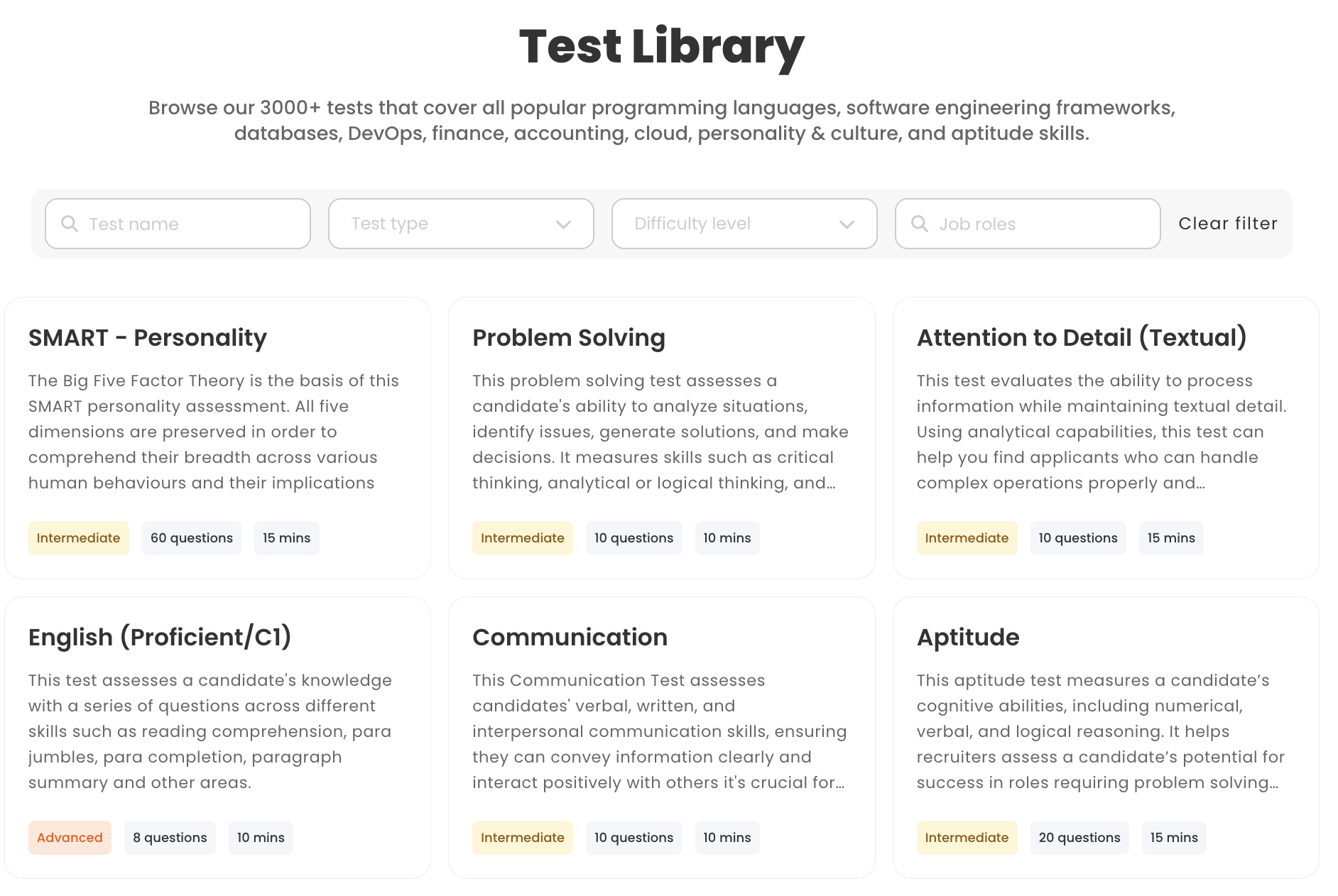
The library spans thirteen categories: blue collar, coding, cognitive ability, engineering skills, language, personality and culture, programming skills, psychometric, role specific skills, situational judgement, software skills, simulation and gamified. So the personality and psychometric side is covered here too, which is worth saying plainly because an older version of this page claimed otherwise.
Question types go well past multiple choice. Candidates can be asked to write code in an embedded VS Code editor across multiple files, complete a real task in Google Sheets or Microsoft Excel, take a typing test scored on 60% accuracy and 40% speed, record a video answer, or take a call from an AI interviewer. There is also a vibe coding format, where the product's own description is that it "lets candidates direct AI tools to reach a working solution, instead of writing syntax manually". For anyone hiring engineers in 2026, that is a more honest test of the job than a whiteboard puzzle.
Testlify vs TalentMetrix: feature comparison
Rows marked "Not published" mean exactly that: TalentMetrix does not state it on its site, so it is recorded as unknown rather than guessed at.
Dimension | Testlify | TalentMetrix |
|---|---|---|
Core focus | Skills, cognitive, coding and personality testing plus AI interviewing | Psychometric and behavioural diagnostics |
Test coverage | 3,500+ tests across 13 categories and 4,500+ roles | Seven named psychometric test families |
Question types | 25+, including coding, typing, Office-app tasks, video and voice | Not published |
Coding assessment | Embedded VS Code editor, up to 20 test cases, multi-file projects, 45+ languages | Not offered |
Personality and behavioural | Personality and culture, psychometric and situational judgement categories | Core strength: DISC behavioural, motivators, EQ, stress quotient |
Interviewing | One-way video, two-way conversational AI video, voice, outbound AI phone | Not published |
Proctoring | 20+ measures, three presets, dual-device monitoring | Not published |
Scoring | Weighted or score-based, negative marking, item-level psychometrics, AI checker | Quantitative scores with qualitative narrative reports |
Integrations | 100+ ATS integrations, a paid add-on on the self-serve tiers | Not published |
Pricing | Published tiers from $139 a month on annual billing | Quote only, on request |
Free trial | 7-day trial, no card required | Not published |
Which platform has stronger test coverage?
Testlify, by a wide margin on breadth. TalentMetrix, by a clear margin on depth in one place. Seven well-built psychometric instruments refined over two decades will read a candidate's motivations better than a general personality module inside a broader platform. Breadth and depth are different products, and pretending otherwise is how comparison pages lose credibility.
The practical question is what you are screening for. A behavioural profile does not tell you whether a finance hire can build a working model in Excel, whether a support hire can defuse an angry customer in writing, or whether a developer can debug someone else's code. Testlify's answer is a work sample: give the candidate the actual task. TalentMetrix's answer is a trait profile that predicts how they will approach the task.
There is also a scale difference that shows up in practice. Testlify carries 180,000+ validated questions and supports variable question banks, which draw a different set for each candidate from a larger pool. The product is honest about the trade-off in its own interface: smaller question banks raise the chance that two candidates see overlapping questions. That is the kind of caveat you want a vendor to volunteer.
Pro tip: if you already run a psychometric battery you trust, do not rip it out. Put a work-sample test in front of it instead. Screening on job skills first and personality second cuts the number of expensive psychometric reports you pay for, because fewer candidates reach that stage.
How do the two compare on interviewing?
This is the widest gap between the two. Testlify runs interviews inside the platform in four formats: one-way asynchronous video, two-way conversational AI video, voice and audio questions, and outbound AI phone interviews billed at $0.18 a minute. TalentMetrix does not publish an interviewing product.
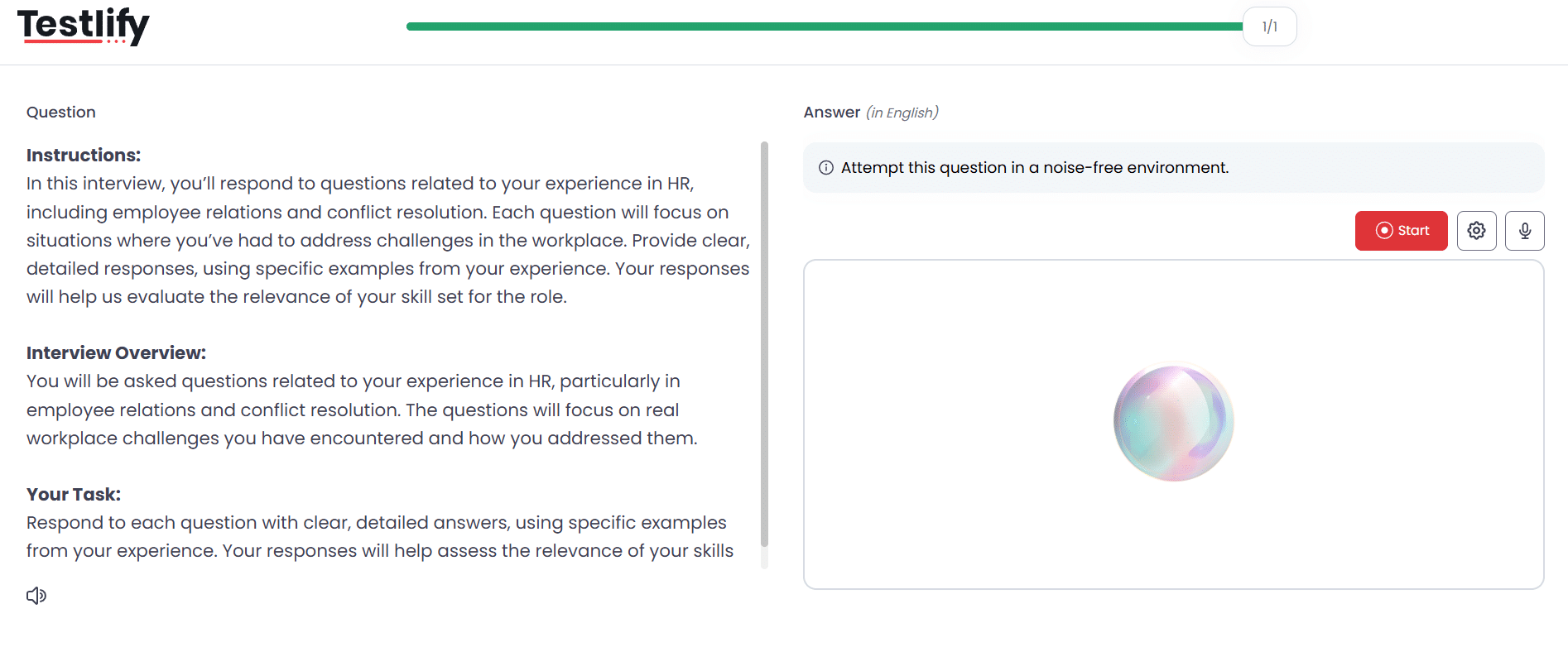
The configurability is the part that matters once you actually run a cycle. You pick the AI avatar, the AI voice, the persona and the context, and you can write custom prompts or pull from 150+ interview templates. You set how many attempts a candidate gets (including no limit), how long the recording can run, how much preparation time they get before recording auto-starts, and the recording language. Reattempting deletes the previous take, and candidates are told so before they commit.
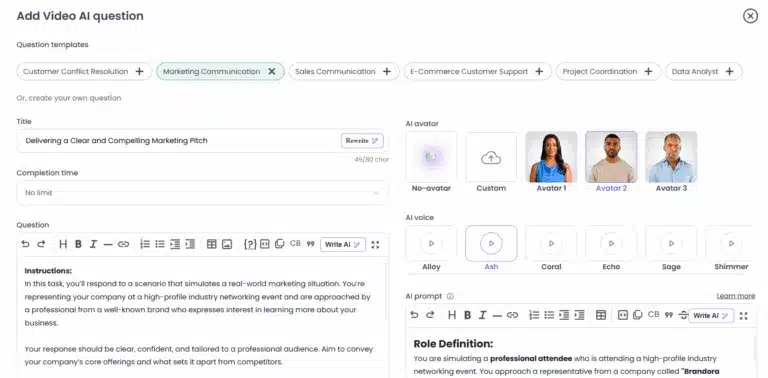
Transcripts generate automatically and the AI detects the spoken language itself, for any recording of at least 30 seconds. Reviewers get the video, the audio, the transcript, an interview report they can regenerate, and a screen replay. During a live AI voice interview the candidate sees a "You're muted while the AI is speaking" prompt, which is a small detail that tells you it is genuine turn-taking rather than a recorded prompt playing at them.
The honest boundary: Testlify does not schedule live human interview panels. If your bottleneck is coordinating four calendars for a final round, neither of these tools solves it.
How do proctoring and test integrity compare?
Testlify ships 20+ integrity measures and three presets (Standard, Strict and Custom). TalentMetrix does not publish proctoring detail, and its own description of the tests as online and computer based suggests an unproctored delivery model. For a development or engagement programme, that is fine. For a hiring decision you have to defend, it is a gap.
The standout is dual-device proctoring, and almost nobody else does it. The candidate's phone becomes a second camera positioned to capture both them and their laptop screen. It is a hard gate, not a suggestion: the product states that "You will not be able to start the assessment until mobile monitoring is active", and ending the mobile session is logged and reported to the administrator.
What matters more than the measure count is what the recruiter is shown. Integrity signals arrive as evidence, not as a verdict, in three tiers. Green means the session followed the rules. Yellow means something was off and "A quick manual review is recommended". Red means cheating was confirmed. Auto-termination exists but is a separate opt-in setting with a threshold you choose, so a flag never rejects anyone on its own.
That distinction is not decoration. Any tool used to decide who gets a job is a selection procedure, and the Uniform Guidelines on Employee Selection Procedures (29 C.F.R. Part 1607) expect selection procedures to be job related and validated. A process where a machine silently rejects people on a webcam flag is much harder to explain than one where a human reviewed the evidence and wrote down why.
How do Testlify and TalentMetrix score candidates?
TalentMetrix returns quantitative scores wrapped in a qualitative narrative report, which is the classic psychometric consulting output and is genuinely useful for a development conversation. Testlify scores at three levels (question, test and overall assessment) and exposes the machinery so you can tune it.
You choose between score-based weighting, where each test's impact follows its total score, and weights-based, where you set a multiplier from x0 to x5 per test. Negative marking has two distinct modes, and the difference is spelled out in the interface rather than buried in a manual. Any question can be marked non-scorable. Personality and cultural tests carry no total score at all, which the product says out loud instead of inventing one.
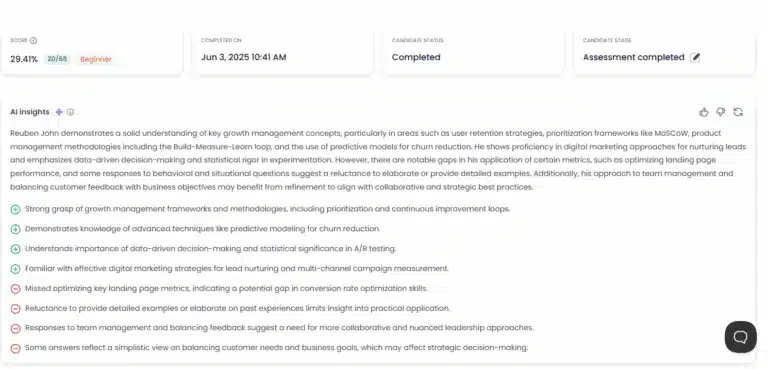
Then there is the layer most assessment tools do not surface: item-level psychometrics, shown to recruiters rather than kept for the test publisher. Difficulty index, discrimination index, a quality-risk flag for questions with very low accuracy or high skip rates, answer distributions, median and average time. If you are the person defending a cut-off score to a hiring manager, that is the data you want.
The AI layer stays advisory by design. An AI checker classifies an open answer as human, AI generated or mixed. AI insights summarise strengths and gaps. But the product ships the disclaimer "AI scores and insights are for guidance only. Use human judgment for final decisions", and whether AI scores are shown to reviewers or counted in the final average are both toggles. That is the Testlify Multi-Signal Talent Evaluation Model in practice: one signal is fragile, several independent signals create confidence. A candidate should move forward when a work sample, an interview and a behavioural read point the same way, not because one score looked good.
The selection science backs the caution rather than the marketing. Sackett and colleagues' 2022 reanalysis of selection-method validity revised many long-quoted estimates downward, while structured interviews held their place among the stronger predictors. It updates the ranking that Schmidt and Hunter set out in 1998, and the exact coefficients are still being argued over in print. The shape that survives every reanalysis is the useful part: structure beats intuition, and no single instrument is strong enough to carry a decision alone.
How well does each fit your hiring stack?
Testlify connects to 100+ applicant tracking systems, sold as a $2,388 a year add-on on the self-serve tiers and included on the Custom plan. TalentMetrix does not document integrations publicly, so results most likely arrive as reports rather than as data flowing into your pipeline.
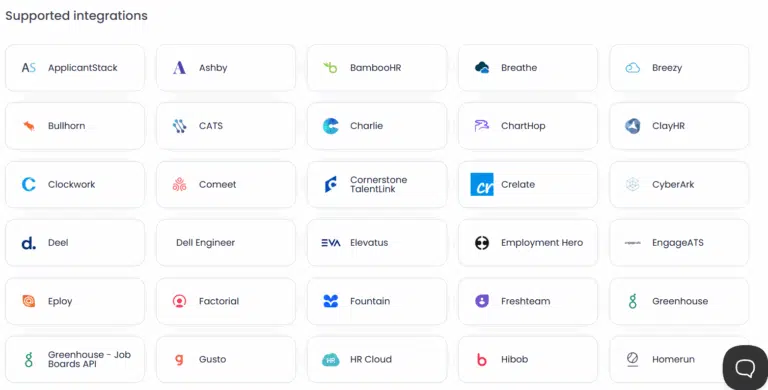
If you already run Greenhouse, Workday or Lever, Testlify sits in front of them as the screening and interviewing layer and leaves your system of record where it is. Resume parsing reads candidates from the connected system and can auto-advance them to the next stage when they clear a cut-off score. Worth knowing before you plan a workflow: rejections happen inside Testlify and do not write back.
If you have no applicant tracking system at all, Testlify also ships a simple built-in one. Job requisitions, an application form, publishing to job boards, a public listing, and an applied to reviewed to shortlisted to rejected pipeline. It is deliberately basic, and it is aimed at a team that does not want to buy two products. It is not a substitute for a system of record at a company that already has one.
What do Testlify and TalentMetrix cost?
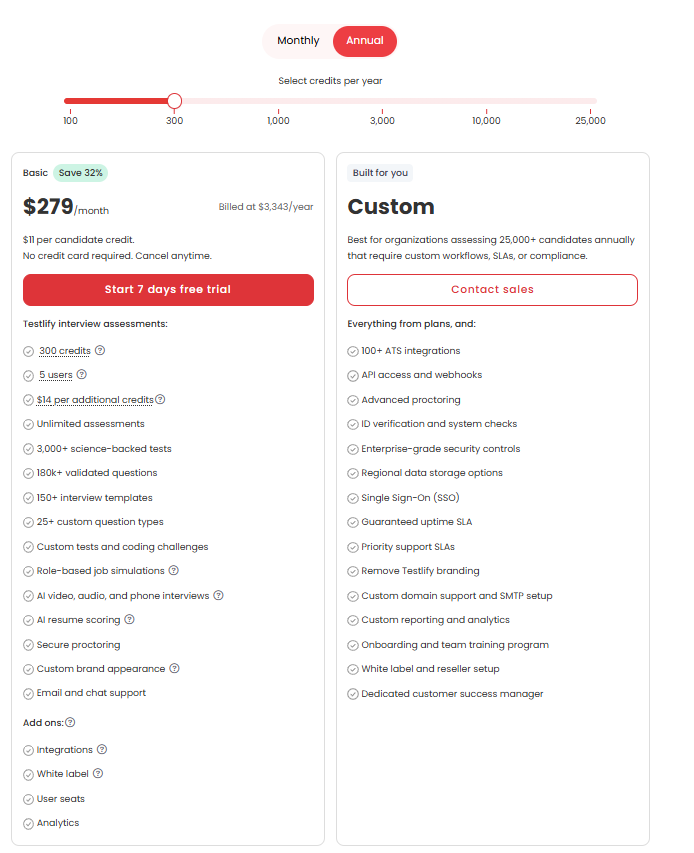
Testlify publishes its prices. TalentMetrix does not, so every comparison ends in a phone call. On annual billing, Testlify runs three self-serve tiers plus three quote-based ones, priced on how many candidates you assess a year.
Tier | Credits a year | Price | Per credit | Seats |
|---|---|---|---|---|
Starter | 100 | $139 a month, billed $1,668 a year | $16.68 | 3 |
Basic | 300 | $279 a month, billed $3,348 a year | $11.16 | 5 |
Business | 1,000 | $699 a month, billed $8,388 a year | $8.39 | 10 |
Premium | 3,000 | Contact sales | Volume based | 20 |
Enterprise | 10,000 | Contact sales | Volume based | 30 |
Custom | 25,000+ | Contact sales | Volume based | 40 |
Monthly billing is a different set of numbers for the same tier names, with far fewer credits, so annual is where the per-credit maths works. One credit is consumed per started assessment by a qualified candidate, and credits do not roll over. Extra seats are $15 each a month on every tier. There is a 7-day free trial with no card, a 30-day money-back guarantee, prices locked for 24 months, and a 25% non-profit discount.
Read the add-ons before you budget. White labelling, the 100+ ATS integrations and SAML SSO with 2FA are each $2,388 a year on the self-serve tiers, and included only on Custom. A few metered items sit outside the credit model too: AI phone interviews at $0.18 a minute, face verification at $0.50 an attempt. Current plan details are on the pricing page.
TalentMetrix quotes per engagement, which is normal for consulting-led assessment and has a real upside: you can buy exactly the diagnostic you need. The downside is that you cannot compare cost per candidate without a sales conversation, and you cannot start on a Friday.
Which platform should you choose?
Pick TalentMetrix when the job is understanding people you already employ. Succession planning, leadership pipelines, engagement diagnostics, a behavioural read on a small shortlist where a consultant's interpretation adds more than a dashboard would. Twenty years of instrument refinement is not nothing, and a narrative report from a consultant who knows the model beats an auto-generated summary for that use case.
Pick Testlify when the job is deciding who to interview. High applicant volume, technical or role-specific skills that need proving, remote candidates where integrity matters, or a team that wants assessment and interviewing in one place with pricing they can read on a web page.
The trap is treating either as a complete answer. Employers expect 39% of workers' core skills to change by 2030, and 63% of them name skill gaps as the biggest barrier to transforming their business, in the World Economic Forum's Future of Jobs Report 2025. A personality profile does not tell you whether the skill is there today, and a skills test does not tell you whether someone will still be learning in three years. The same research puts 78 million net new jobs on the table by 2030, which is a lot of hiring to do on one signal.
For most teams under 200 people, and especially the ones where the founder is still in the loop on hiring, the practical stack is a work sample plus a structured interview, with a behavioural instrument reserved for final-round or internal-mobility decisions. Score reporting is what makes that defensible later.
Key Takeaways
- These tools answer different questions. TalentMetrix measures traits and motivation; Testlify measures demonstrated skill and adds interviewing on top. Deciding which you need starts with whether you are screening applicants or developing employees, not with a feature count.
- Breadth is not depth, and the reverse is also true. Testlify carries 3,500+ tests across 13 categories; TalentMetrix carries seven instruments refined over more than 20 years. If your entire need is a behavioural read on eight leadership candidates, the specialist is the better buy and no amount of library size changes that.
- Interviewing and proctoring are where the gap is widest. Testlify runs video, voice and AI phone interviews with configurable avatars, attempts and recording limits, plus dual-device proctoring that blocks the session until a second camera is live. TalentMetrix publishes neither, so remote high-stakes hiring is not what it was built for.
- Published pricing changes how you buy. Testlify's tiers ($139, $279 and $699 a month on annual billing) let you model cost per candidate before you talk to anyone. TalentMetrix quotes per engagement, which fits consulting work but makes budgeting slower. Check the $2,388 a year add-ons before you commit.
- Do not let one score decide a hire. Modern reanalyses of selection-method validity have pulled many estimates down, and structure is what holds up. Combine a work sample, a structured interview and a behavioural signal, and keep a human accountable for the call.
- Document why you chose the tool. Anything used to make an employment decision is a selection procedure and should be job related. Whichever platform you pick, write down the link between the role's competencies and what you are measuring, before the first candidate takes it.
Hire on evidence, not on one signal
Build an assessment that mirrors the actual job, run it before the first call, and let the shortlist arrive already scored. Book a Testlify demo and bring a role you are struggling to fill, or compare the field first on the wider list of TalentMetrix alternatives.
FAQs

Director of Marketing
Akash Patange is the Director of Marketing at Testlify, where he works closely with HR leaders and recruiters to help organizations improve hiring outcomes. He writes about talent assessment, recruitment technology, and data-driven hiring practices.
LinkedInRelated resources
View all
Competitor Comparisons
Testlify vs. Total Testing: Which Skills Assessment Platform is Best for HR Teams?
Competitor Comparisons
Testlify vs. ThriveMap: Which Skills Assessment Platform is Best for HR Teams?
Competitor Comparisons
Testlify vs. UbiAptitude: Which Skills Assessment Platform is Best for HR Teams?
Competitor Comparisons
Testlify vs. Zapilio: Which Skills Assessment Platform is Best for HR Teams?
Competitor Comparisons
Testlify vs. TalentClick: Which Skills Assessment Platform is Best for HR Teams?
Competitor Comparisons
Testlify vs. ASC Smarter Assessment: Which Skills Assessment Platform is Best for HR Teams?
Get started.
Hire on proof, not resumes.
Run your first skills-based assessment free — no credit card required.