
Testlify vs Talently.ai: Detailed Comparison
Testlify vs Talently.ai: Explore how these AI interviewing platforms compare in interview experience, assessments, analytics, integrations, and pricing.
Hiring has changed dramatically in the last few years. Manual resume screening and unstructured interviews are rapidly being replaced by AI-powered interviewing platforms that promise speed, objectivity, and scalability.
For growing companies and enterprises alike, choosing the right AI hiring solution can directly impact the quality of talent you bring in. Two platforms that are gaining attention in this space are Testlify and Talently.ai.
In this detailed comparison, we will evaluate Testlify vs Talently.ai across key decision-making areas, including AI interviewing experience, test library depth, anti-cheating mechanisms, ideal use cases and more. By the end, you’ll have a clear understanding of which platform aligns best with your hiring goals.
 ChatGPT
 Gemini
 Claude
 Grok
Grok Perplexity
What is Testlify?
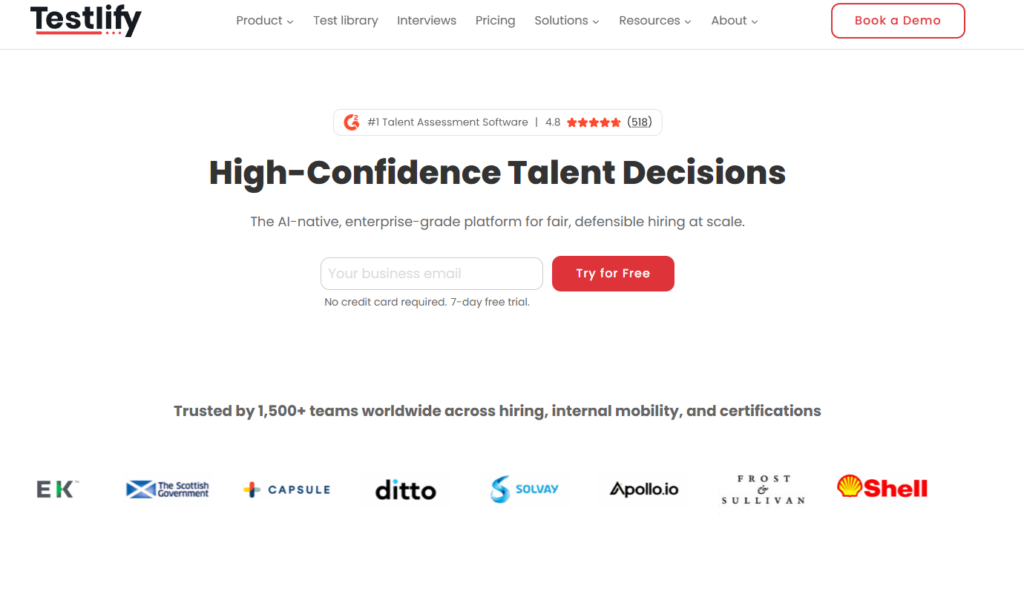
Testlify is a leading AI-native skills assessment and interviewing platform designed to evaluate candidates across the entire recruitment funnel and shortlist top talent. It combines conversational AI interviews with 3,500+ validated skill tests to help organizations measure real skills and make better hiring decisions.
What truly differentiates Testlify is its enterprise-grade architecture. The platform includes:
- AI resume screener with explainable job-fit scores
- Support for 100+ ATS integrations
- Advanced proctoring and anti-cheating features (dual camera, screen recording, AI assistance detection, focus guard, IP tracking, and more)
- Benchmarking analytics against industry standards
- White-label customization for branding control
- GDPR compliance with SOC 2 Type II and ISO 27001 certifications
Testlify is purpose-built for volume hiring, technical recruitment, and campus hiring drives, making it an ideal choice for campus recruitment teams and enterprise recruiters.

What is Talently.ai?
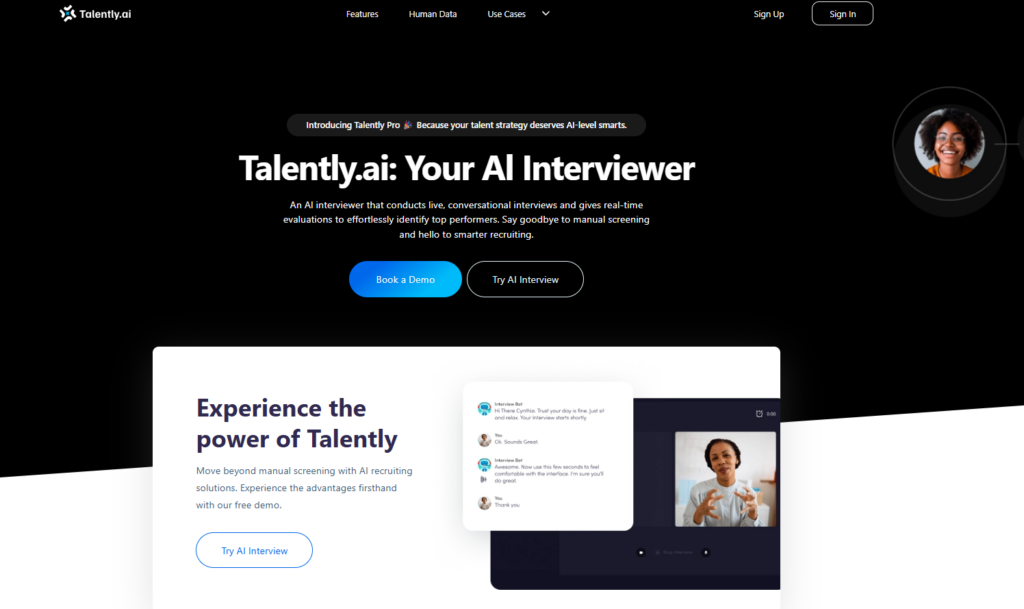
Talently.ai positions itself primarily as an AI interviewer that conducts live, conversational interviews with real-time evaluations. The platform focuses on simulating human-like interview interactions while providing automated candidate scoring.
Talently.ai emphasizes:
- Live AI conversational interviews
- Real-time candidate evaluations
- Role-specific questioning
- Live coding assessments for developers
- Multi-language interview capabilities
- Bias-reduction in technical hiring
The platform is particularly geared toward organizations looking to streamline early-stage interviews, especially in software development hiring. However, Talently.ai appears to be more interview-centric rather than offering a broader, end-to-end assessment infrastructure.
Testlify vs Talently.ai: AI interviewing experience
AI interviews are no longer just about asking automated questions. The real differentiator lies in depth of evaluation, realism of interaction, behavioral intelligence, and the ability to generate structured, measurable insights from every candidate interaction. This is where the contrast between Testlify and Talently.ai becomes more visible.
Testlify AI interviewing experience
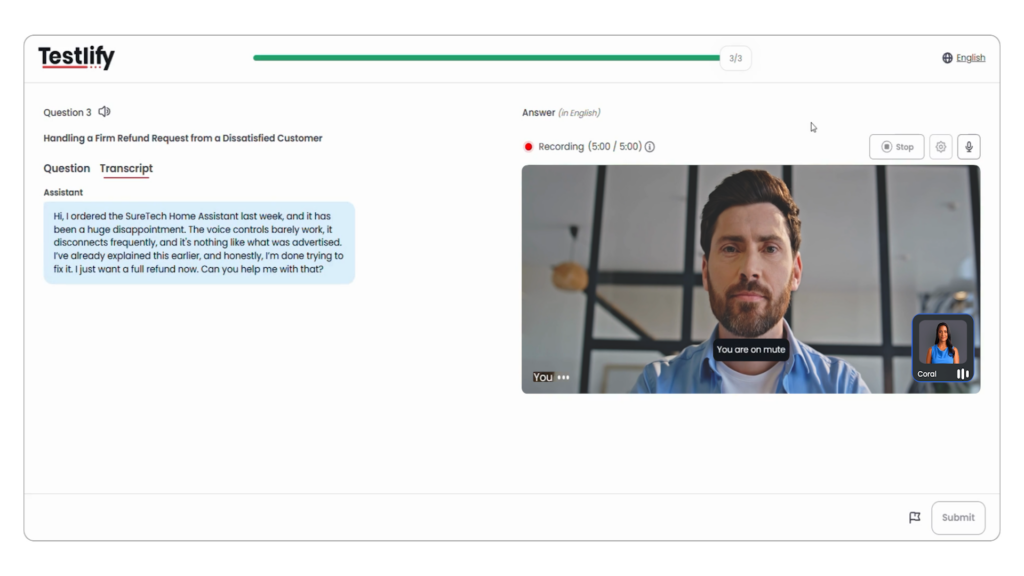
Testlify delivers multi-format conversational AI interviews designed to simulate real-world job scenarios while extracting structured behavioral and skill-based insights.
Testlify supports three distinct AI interview formats:
- Chat AI interviews: Text-based simulations that assess written communication, logical reasoning, and problem-solving through realistic workplace scenarios.
- Voice AI interviews: Evaluates verbal fluency, persuasion, clarity of thought, and tonal intelligence for roles such as sales, customer support, and leadership.
- Video AI interviews: AI avatars guide candidates through asynchronous video interviews while analyzing verbal and non-verbal cues such as confidence, emotional intelligence, and behavioral indicators.
Unlike platforms that focus only on conversational flow, Testlify layers its interviews with behavioral intelligence. The system evaluates:
- Answer relevance and contextual accuracy
- Communication clarity and structure
- Emotional intelligence markers
- Verbal and non-verbal signals
- Behavioral patterns linked to job success
Recruiters can also combine AI interviews with role-specific skill tests, psychometric tests, and cognitive ability tests, ensuring interviews are not isolated events but part of a broader, data-backed hiring strategy.
Additionally, Testlify allows:
- Custom question flows
- Weighted scoring
- Global benchmarking analytics
- Manual score override options for recruiters
- Detailed, shareable performance reports (pdf and csv formats)
Talently.ai interviewing experience
Talently.ai is particularly appealing for organizations that want an AI interviewer to conduct early-stage screening conversations without recruiter involvement. Its real-time evaluation approach enables quick decision-making and reduces manual interview workload.
Key strengths include:
- Human-like conversational interface
- Real-time scoring during interviews
- Role-specific tailored questioning
- Live coding sessions for developer roles
- Multi-language interview support
However, its primary focus remains the conversational layer of interviewing. There is limited evidence of deeper behavioral modeling frameworks, integrated psychometric analysis, and weighted scoring flexibility in comparison to Testlify
Verdict
Talently.ai performs well as a live AI interviewer, especially for organizations seeking immediate, conversational screening with coding capabilities.
However, Testlify is the stronger choice as it delivers a more comprehensive, layered AI interviewing experience. The platform combines conversational AI interviews with role-specific tests, assigns weighted scoring rules, and provides detailed analytics.
This turns AI interviews from simple automation tools into accurate, reliable systems for evaluating talent.
Testlify vs Talently.ai: Test library and test types
A strong AI interview is only one part of effective hiring. What truly determines long-term hiring accuracy is the depth, diversity, and scientific structure of the assessment library behind the platform. This is where the difference between Testlify and Talently.ai becomes even more pronounced.
Testlify test library
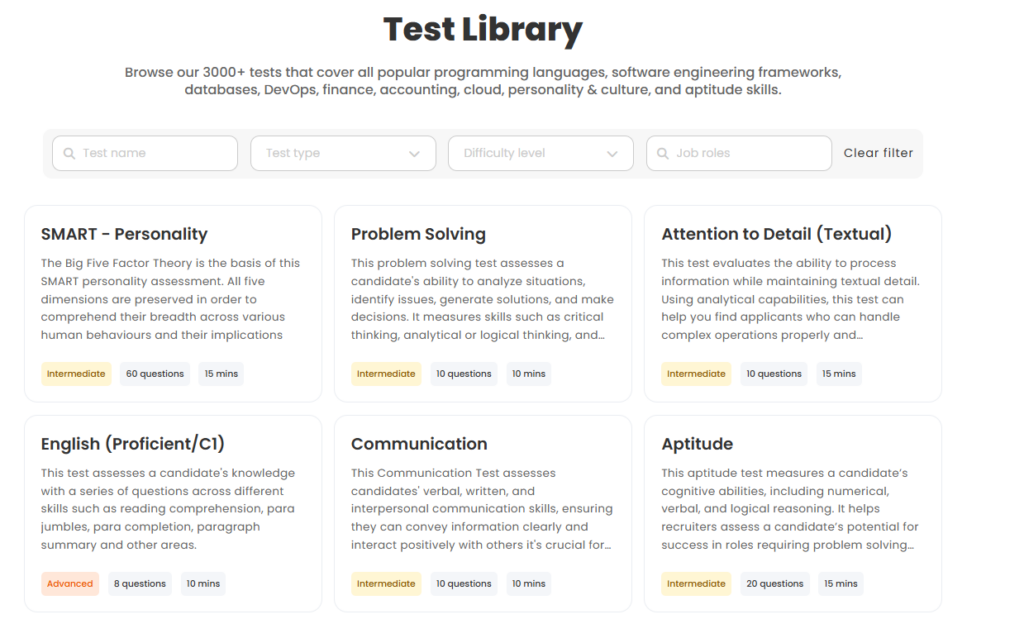
Testlify offers an extensive test library comprising of 3,500+ tests covering 4,500+ job roles across 50+ industries. It also offers 150+ interviewing templates for fast, consistent, and effective candidate evaluation.
Instead of limiting evaluation to interviews alone, Testlify enables recruiters to assess candidates across multiple dimensions using these skill tests:
- Cognitive ability tests (problem-solving, logical reasoning, attention to detail)
- Psychometric and personality tests
- Situational judgment tests
- Role-specific job simulations
- Programming and live coding tests
- Software skills tests (CRM, Microsoft Office, tools)
- Blue-collar practical skill assessments
- Typing and data-entry tests
- Language proficiency tests
In addition to pre-built assessments, Testlify allows hiring teams to create fully customized tests using 15+ question formats, including:
- AI-powered chat, video, and audio interviews
- Scenario-based MCQs
- Open-ended descriptive responses
- File upload questions
- Coding challenges
- Google Docs, Sheets, Slides tasks
- Microsoft Office simulations
- Qualifier and weighted scoring questions
What further strengthens Testlify’s ecosystem is its weighted scoring flexibility. Recruiters can assign different importance levels to skills, adjust AI-generated scores, and prioritize core competencies based on the role.
Talently.ai assessment capabilities
Talently.ai primarily centers its evaluation process around AI-led interviews and live coding tests. The platform supports:
- Role-specific question tailoring
- Live coding assessments
- Technical and non-technical skill screening through AI interviews
Talently.ai does a solid job in customizing interviews based on job descriptions and assessing candidates during live sessions. Its live coding functionality is particularly relevant for software development hiring.
However, the platform appears to focus more on interview-driven assessment rather than offering a large standardized test library spanning multiple industries and skill categories.
Verdict
Talently.ai is effective for companies that primarily want AI-driven interviews with live coding functionality, particularly for technical hiring.
However, Testlify provides a far more comprehensive assessment infrastructure. Its extensive test library, multi-industry role-specific tests, customizable question formats, and weighted scoring framework make it easier for recruiters to identify top talent.
Testlify vs Talently.ai: Anti-cheating and proctoring features
As AI interviews and remote assessments become more common, maintaining test integrity is critical. Without strong proctoring and anti-cheating safeguards, hiring decisions can quickly lose credibility. This is an area where the gap between the two platforms becomes particularly clear.
Testlify anti-cheating and proctoring features
Testlify offers one of the most advanced remote proctoring and anti-cheating features in the remote hiring space. The platform is built to ensure that every assessment reflects genuine skill and authentic candidate effort.
Testlify includes a wide range of anti-cheating and remote proctoring features, including:
- Face detection and photo ID verification
- Webcam snapshots and dual camera proctoring
- Full-screen enforcement
- Screen recording
- Copy/paste tracking
- Mouse-out tracking
- IP address monitoring
- Live video monitoring
- Question randomization
- AI assistance detection (to identify external AI tool usage)
- Focus guard (anti-cheat mode)
- Talking prohibition controls
- Internet speed and system requirement checks
- Question-level activity logs
- Honesty agreements
These layered safeguards create a controlled remote testing environment comparable to in-person proctored exams. This is especially valuable for:
- High-volume hiring
- Technical assessments
- Campus recruitment drives
- Compliance-heavy industries
- Enterprise-level hiring programs
By combining AI interviews with strict proctoring, Testlify ensures that insights are not only intelligent but trustworthy.
Talently.ai integrity approach
Talently.ai emphasizes reducing bias and using AI to objectively evaluate candidates during interviews. Its real-time conversational evaluation provides structured scoring based on candidate responses.
However, based on available information, Talently.ai does not highlight an extensive anti-cheating or remote proctoring infrastructure comparable to advanced assessment platforms.
For organizations conducting high-stakes technical assessments or large-scale remote hiring, this may present limitations in ensuring full assessment integrity.
Verdict
Talently.ai delivers AI-driven interview evaluations with a focus on reducing bias. However, it appears to rely primarily on the interview format itself rather than a comprehensive remote proctoring system.
Testlify, on the other hand, provides enterprise-grade anti-cheating controls that safeguard both interviews and structured assessments. For companies that prioritize hiring accuracy, compliance, and test integrity, especially at scale, Testlify offers a significantly stronger and more reliable proctoring framework.
Testlify vs Talently.ai: Resume screening and workflow automation
Modern hiring is no longer just about conducting better interviews. It is about building a streamlined, automated workflow that reduces manual effort while improving decision accuracy. Resume screening, shortlisting, and ATS synchronization play a critical role in this process — especially for high-volume hiring teams.
This is another area where the structural difference between the two platforms becomes evident.
Testlify resume screening and automation
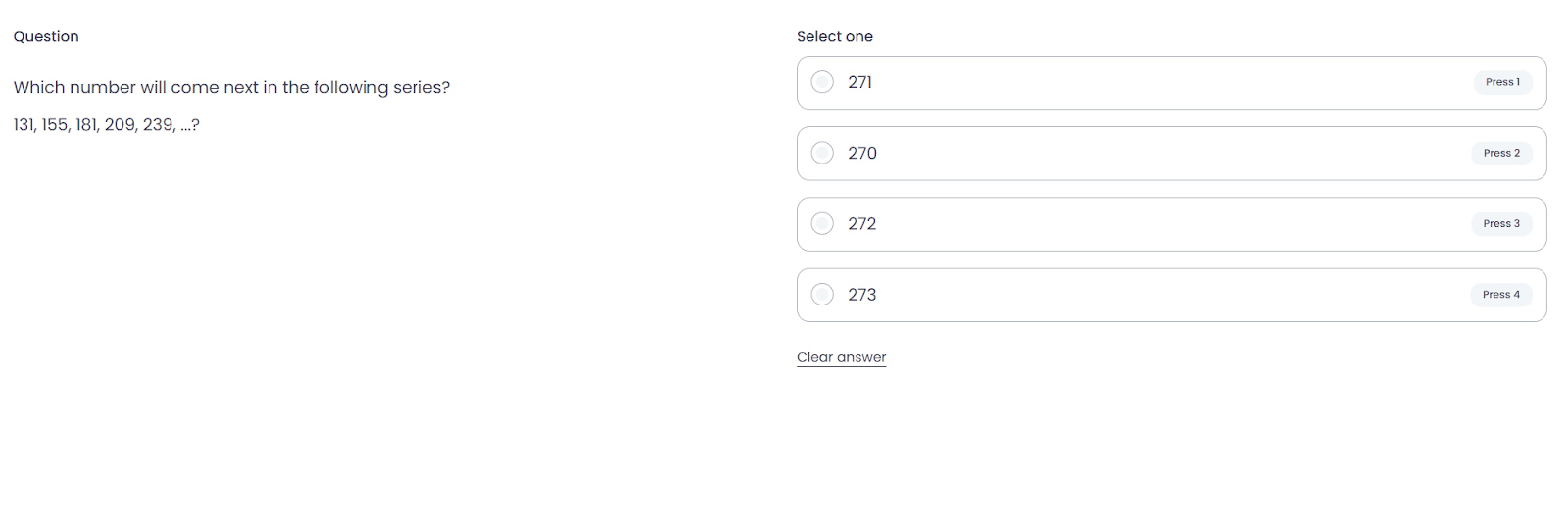
Testlify extends beyond interviews and assessments by offering AI-powered resume screening that integrates directly into the hiring workflow.
Instead of manually reviewing hundreds of resumes, recruiters can:
- Automatically pull resumes from their ATS
- Evaluate candidates against role-specific criteria
- Receive explainable job-fit match scores
- Label candidates as High, Medium, or Low fit
- Auto-shortlist qualified candidates
- Automatically reject non-matching profiles
- Sync all results back into the ATS
This creates a seamless end-to-end pipeline:
Resume screening → Assessment → AI interview → Final evaluation → ATS sync
Testlify’s automation reduces hours of repetitive screening work while maintaining consistency and objectivity. Because resume scores and assessment results are centralized, hiring managers get a unified view of candidate fit in one place.
Additionally, Testlify integrates with 100+ ATS platforms, enabling smooth collaboration across recruiters, hiring managers, and HR teams. Automated reminders, candidate notifications, and report sharing further reduce administrative overhead.
This workflow-level automation makes Testlify particularly powerful for:
- Enterprise recruitment teams
- Distributed hiring teams
- Campus recruitment programs
- Agencies managing multiple client roles
- High-volume technical hiring
Talently.ai screening workflow
Talently.ai primarily focuses on AI-led interviews as the core screening mechanism. Its strength lies in replacing manual first-round interviews with AI conversations and live coding sessions.
Candidates are evaluated during the interview process, and recruiters receive structured performance insights. This reduces manual interview time and accelerates early-stage screening.
However, there is limited indication of:
- AI-powered resume scoring
- Automated shortlisting logic
- Full ATS ecosystem integrations at scale
- End-to-end workflow automation across hiring stages
Talently.ai appears to operate more as an AI interviewing layer rather than a complete hiring workflow engine.
Verdict
Talently.ai improves efficiency by automating interviews, but its automation appears concentrated at the interview stage.
Testlify, in contrast, automates the entire candidate journey from resume screening to assessments, interviews, reporting, and ATS synchronization. This integrated workflow approach reduces manual effort, increases hiring consistency, and provides a structured, scalable recruitment system.
For organizations looking to optimize not just interviews but the full hiring pipeline, Testlify is clearly the winner.
Testlify vs Talently.ai: Reporting and analytics
Data-driven hiring is what separates modern recruitment teams from traditional ones. AI tools are only as powerful as the insights they generate. The depth, clarity, and usability of reporting directly influence hiring confidence and decision accuracy. This is where advanced analytics can significantly elevate a platform’s value.
Testlify reporting and benchmarking intelligence
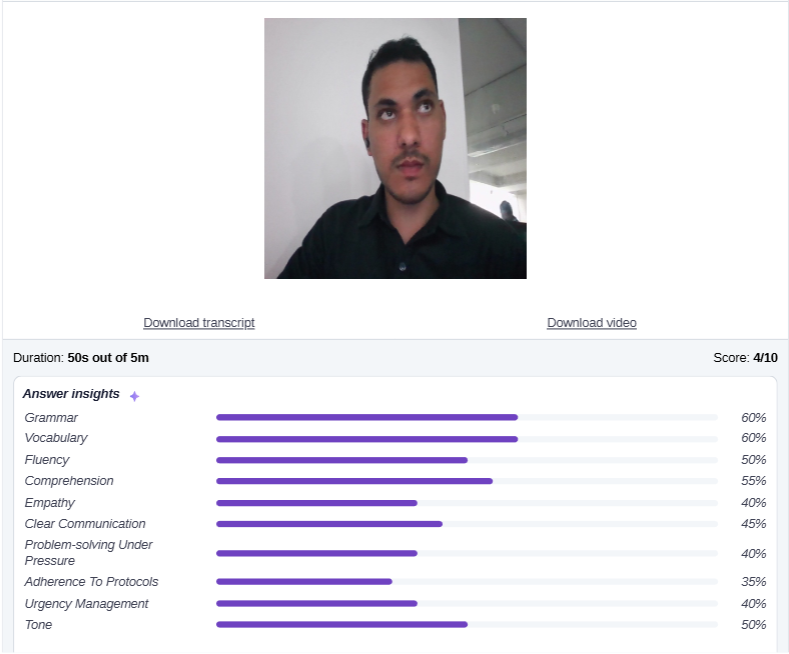
Testlify provides structured, multi-layered reporting that goes far beyond simple interview scores. Its analytics framework is designed to help recruiters, hiring managers, and leadership teams make evidence-based decisions.
Testlify delivers:
- Skill-by-skill performance breakdowns
- Question-level insights
- Behavioral and communication analysis
- Cognitive and psychometric score summaries
- AI-generated candidate performance overviews
- Global benchmarking against industry standards
- Weighted scoring insights
- Exportable reports in PDF, Excel, and CSV formats
One of Testlify’s strongest advantages is benchmarking analytics. Recruiters can compare candidates against industry averages or internal performance baselines. This makes it easier to identify top performers, detect skill gaps, and maintain consistent hiring standards across departments or geographies.
Additionally, reports are structured for collaboration. Hiring managers can quickly understand:
- Where a candidate excels
- Where potential weaknesses lie
- How do they compare to other applicants
- Whether they meet predefined job-fit thresholds
This level of structured reporting is especially valuable for:
- Enterprise hiring programs
- Campus recruitment drives
- Technical role screening
- Compliance-heavy industries requiring audit trails
- Multi-stakeholder hiring decisions
Testlify transforms raw interview data into strategic hiring intelligence.
Talently.ai reporting capabilities
Talently.ai provides real-time evaluation reports generated during AI interviews. Recruiters receive insights into candidate strengths, weaknesses, and overall performance.
Key highlights include:
- Real-time scoring
- Technical skill evaluation summaries
- Cultural fit observations
- Immediate interview feedback
Talently.ai’s reporting is effective for quick decision-making during early-stage screening. However, based on available information, it does not emphasize:
- Industry benchmarking frameworks
- Extensive question-level analytics
- Cross-role comparative analytics
- Advanced weighted scoring visualization
Verdict
Talently.ai offers solid real-time evaluation reports for interview-based screening, making it useful for quick hiring decisions.
However, Testlify provides a more comprehensive and enterprise-ready analytics system. Its benchmarking capabilities, structured skill breakdowns, behavioral analysis, and exportable reporting formats ensure hiring transparency and easy identification of top talent at scale
Testlify vs Talently.ai: Integrations and enterprise readiness
For modern hiring teams, a recruitment tool cannot operate in isolation. Seamless integrations with existing HR systems, strong data governance, and enterprise-grade compliance standards are critical for scalability and long-term adoption.
This is where platform maturity becomes especially important.
Testlify integrations and compliance framework
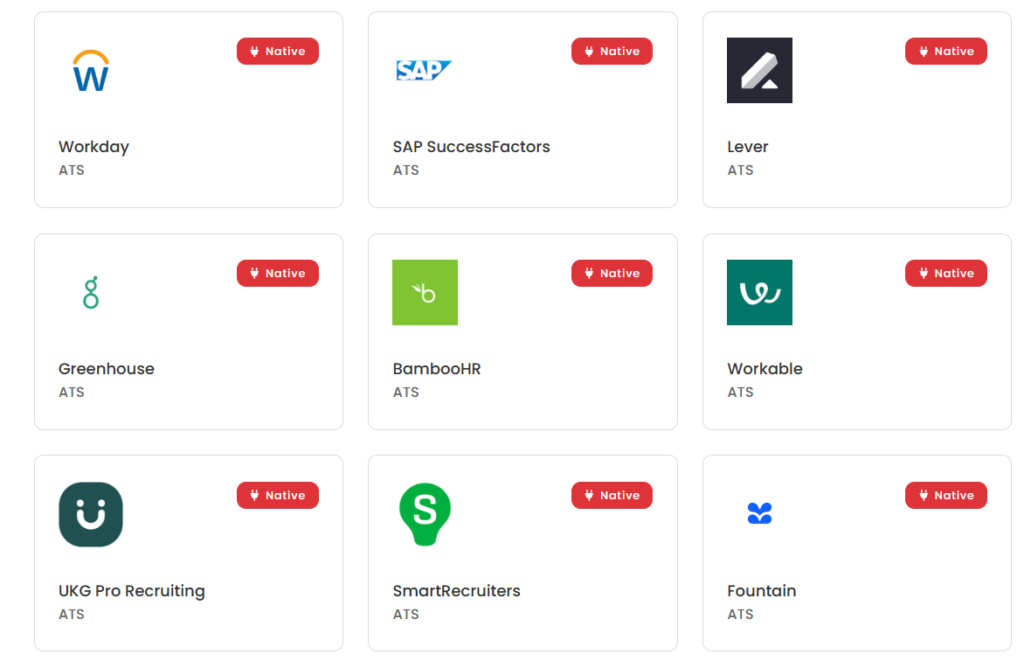
Testlify is built with enterprise scalability in mind. The platform integrates seamlessly with 100+ applicant tracking systems (ATS) and HRMS platforms, ensuring smooth data synchronization across every stage of hiring.
Candidate profiles, resume match scores, interview results, and assessment analytics are automatically pushed into existing recruitment systems. This eliminates manual data entry, reduces workflow friction, and improves collaboration between recruiters and hiring managers.
Beyond integrations, Testlify demonstrates strong enterprise readiness through its compliance and security infrastructure:
- GDPR compliance
- SOC 2 Type II certification
- ISO 27001 certification
- AICPA standards adherence
- Advanced admin controls and data governance
These certifications and controls are particularly critical for:
- Global enterprises
- Regulated industries
- Organizations handling large volumes of candidate data
- Companies prioritizing data privacy and security
Testlify is designed to fit into complex recruitment ecosystems without compromising security, compliance, or operational efficiency.
Talently.ai integrations
Talently.ai focuses primarily on AI-driven interviews and real-time evaluation capabilities. While the platform supports structured interview workflows, there is limited publicly available information highlighting the platform’s integration capabilities.
In fact, Talently.ai appears optimized for interview automation rather than deep infrastructure integration across enterprise HR systems.
Verdict
Talently.ai delivers efficient AI interviews, but its enterprise infrastructure and integration depth appear limited in comparison.
Testlify, on the other hand, offers a mature integration ecosystem backed by globally recognized compliance certifications and strong data governance standards. Its ability to embed seamlessly into existing HR workflows makes it a more scalable and enterprise-ready solution
Testlify vs Talently.ai: Customization and branding
The ability to customize assessments, control scoring logic, and align the interface with your company’s brand can significantly impact both hiring accuracy and employer perception. This is another area where flexibility and platform depth matter.
Testlify customization and white-label branding
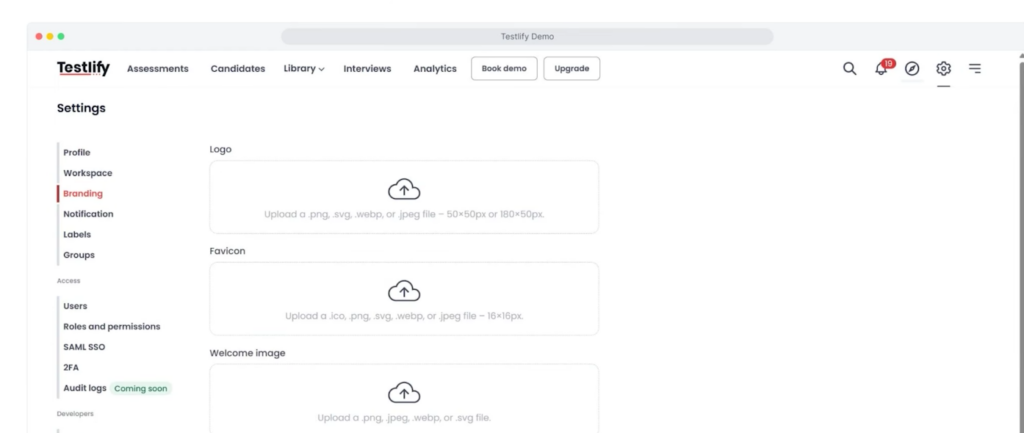
Testlify offers extensive customization options designed to give hiring teams full control over both evaluation structure and candidate experience.
On the assessment side, Testlify allows recruiters to:
- Create fully customized AI interviews
- Build role-specific assessments from scratch
- Choose from 15+ question formats
- Combine interviews with cognitive, psychometric, technical, and situational tests
- Assign weighted scoring to prioritize key competencies
- Manually review and adjust AI-generated scores
This scoring flexibility ensures that hiring decisions reflect the organization’s priorities rather than relying solely on automated outputs.
On the branding side, Testlify provides white-label capabilities, enabling companies to:
- Add their own logos
- Customize platform appearance
- Personalize invitation and rejection emails
- Align communication tone with brand voice
This ensures candidates experience a seamless, branded recruitment journey rather than interacting with a generic third-party tool.
Such customization is particularly valuable for:
- Enterprise employers protecting brand reputation
- Recruitment agencies representing multiple clients
- High-growth startups building strong employer branding
- Organizations running large campus recruitment programs
Testlify gives hiring teams both analytical control and brand ownership.
Talently.ai customization approach
Talently.ai allows customization primarily at the interview level. Recruiters can:
- Tailor questions based on job descriptions
- Adjust interview flows to match role requirements
- Customize live coding scenarios
T Based on available information, Talently.ai customization strength appears focused mainly on tailoring interview conversations rather than offering a fully configurable hiring ecosystem.
Verdict
Testlify provides deeper structural flexibility across interviews, assessments, scoring logic, and branding. Its weighted scoring system, multi-format test creation, and white-label capabilities give organizations greater control over both hiring accuracy and candidate perception.
For companies that want a platform that adapts to their processes rather than forcing them into predefined workflows, Testlify offers a significantly more flexible and brand-aligned solution.
Testlify vs Talently.ai: Customer support and onboarding
Even the most advanced hiring platform requires proper onboarding, guidance, and ongoing support. For busy recruitment teams, responsive assistance and structured onboarding can make the difference between underutilizing a tool and fully unlocking its value.
This is an often-overlooked but important factor when choosing a long-term hiring partner.
Testlify customer support and onboarding experience
Testlify is known for offering hands-on, human-centered customer support designed to help teams maximize platform capabilities quickly.
Key support features include:
- Dedicated onboarding assistance for new customers
- Personalized implementation guidance
- Responsive multi-channel support (live chat, phone, and email)
- Priority support for enterprise clients
- Comprehensive help center with documentation and best-practice guides
- Continuous product improvements based on customer feedback
Rather than leaving users to navigate the system independently, Testlify actively works with hiring teams to:
- Set up structured assessments
- Configure AI interviews effectively
- Optimize scoring frameworks
- Align integrations with existing ATS workflows
- Customize branding and candidate communication
This proactive support model is especially valuable for:
- Enterprises implementing structured hiring frameworks
- Teams transitioning from manual recruitment processes
- Organizations running high-volume or campus hiring programs
- Companies adopting AI-based hiring for the first time
Testlify positions itself not just as a software provider, but as a long-term hiring partner.
Talently.ai customer support
Talently.ai focuses primarily on delivering AI-driven interview automation. While users can expect standard platform assistance, there is limited publicly available information on the overall support offered.
For organizations seeking a straightforward AI interview tool, this may be sufficient. However, companies implementing AI hiring at scale often require more structured onboarding and ongoing strategic guidance.
Verdict
Talently.ai appears to offer functional support around its AI interview capabilities. However, its support structure is less prominently positioned as a strategic onboarding partnership.
Testlify, on the other hand, provides hands-on onboarding and responsive customer service 24/7. For recruitment teams managing complex hiring needs, this level of support can significantly accelerate adoption and ensure full platform utilization.
For organizations that value strong implementation guidance and long-term collaboration, Testlify provides a more dependable and support-driven experience.
Testlify vs Talently.ai: Pricing and scalability
Pricing transparency and scalability are crucial when evaluating an AI interviewing platform. Organizations need a solution that not only fits their current hiring volume but can also scale predictably as recruitment demands grow.
This is where structured pricing models and flexibility play an important role.
Testlify pricing
Testlify offers flexible pricing plans that scale with your business, providing everything from basic assessments for startups to advanced features for enterprise-level hiring.
- Starter plan: Ideal for small teams and startups, this plan starts at $139/month (billed at $1,663/year) and includes 100 candidate credits at $17 per credit with support for 3 users.
- Starter: Designed for growing businesses, the Starter starts at $279/month (billed at $3,343/year) and includes 300 credits at $11 per credit with support for 5 users.
- Starter: Built for scaling teams, this plan costs $699/month (billed at $4,192/year) and includes 1,000 credits at $8 per credit with 10 users.
- Premium plan: Suited for high-growth organizations, the Premium plan includes 3,000 credits and supports 20 users, with pricing available upon contacting the sales team.
- Enterprise plan: Designed for large enterprises, this plan includes 10,000 credits and supports 30 users, with pricing available upon contacting the sales team.
- Enterprise plus plan: Designed for large-scale hiring programs, this plan includes 25,000 credits and supports up to 40 users, with pricing details available upon contacting the sales team.
- Unlimited plan: For companies seeking unrestricted access, Testlify offers an unlimited plan that includes unlimited candidate credits and full platform functionality, with pricing available on request from the sales team.
Because Testlify integrates resume screening, assessments, AI interviews, proctoring, analytics, and ATS synchronization within one ecosystem, organizations avoid paying for multiple disconnected tools. This makes it cost-efficient in the long run, especially for enterprises managing high applicant volumes.
The availability of multiple plans also makes it easier for companies to start small and scale up without switching platforms.
Talently.ai pricing approach
Talently.ai positions itself primarily around AI-led interviews. However, detailed public pricing tiers and transparent scaling structures are not strongly emphasized.
Organizations interested in Talently.ai may need to engage directly with sales to understand pricing specifics. While this may work for teams seeking a focused AI interview tool, the lack of clearly structured scaling tiers may make long-term budget planning less straightforward.
Additionally, if organizations require extended features beyond conversational interviews — such as large assessment libraries, proctoring controls, or resume automation — they may need supplementary tools, potentially increasing overall hiring costs.
Verdict
Talently.ai may work for organizations primarily seeking AI interview automation. However, limited visibility into structured pricing tiers may require deeper inquiry before long-term budgeting decisions can be made.
Testlify, in contrast, offers transparent, scalable pricing across multiple business sizes. Its credit-based model, enterprise tiers, and unlimited option make it adaptable for startups, scaling teams, and global enterprises alike.
For organizations looking for predictable growth, cost efficiency, and an all-in-one hiring ecosystem that scales seamlessly, Testlify provides a clearer and more flexible pricing structure.
Testlify vs Talently.ai: Ideal use cases
While both platforms leverage AI to improve hiring efficiency, they are built with slightly different priorities. Understanding where each platform fits best helps organizations align technology with their recruitment strategy.
When to choose Testlify
Testlify is ideal for organizations that need a structured, scalable, and data-driven hiring ecosystem rather than just interview automation.
Testlify is particularly well-suited for:
- High-volume hiring programs where resume screening, assessments, and interviews must work together seamlessly
- Technical hiring at scale, combining coding tests, cognitive assessments, and AI interviews
- Campus recruitment drives that require standardized evaluation across large candidate pools
- Global hiring initiatives with multilingual interview capabilities
- Blue-collar and non-technical hiring, supported by diverse assessment types
- Organizations prioritizing anti-cheating safeguards and assessment integrity
- Companies seeking full ATS integration and workflow automation
Because Testlify covers resume screening, assessments, AI interviews, proctoring, analytics, and integrations within one ecosystem, it is ideal for teams that want a single, unified hiring intelligence platform.
When to choose Talently.ai
Talently.ai may be suitable for organizations primarily looking to automate early-stage interviews through conversational AI.
Talently.ai can be a fit for:
- Teams seeking live AI-driven interview conversations
- Companies focusing heavily on developer hiring with live coding sessions
- Organizations wanting quick, real-time interview evaluations
- Businesses that prioritize conversational simulation over structured multi-layered assessments
For companies whose main challenge is reducing manual interview workload rather than implementing a full assessment infrastructure, Talently.ai can serve as a focused AI interviewing solution.
Verdict
Talently.ai works well as an AI interview automation tool, especially for conversational screening and technical interviews.
However, Testlify is designed for organizations that require more than just interview automation. Its comprehensive assessment library, resume screening features, proctoring safeguards, benchmarking analytics, and extensive integration support make it best suited for high-volume and enterprise hiring initiatives.
If you’re looking to transform your hiring process with structured assessments, AI-powered interviews, advanced proctoring, and enterprise-grade analytics, Testlify offers everything you need in one scalable platform.
Book a demo today to see how Testlify can streamline your recruitment workflow, improve hiring accuracy, and help you identify top talent faster and more confidently.
Frequently asked questions (FAQs)

Director of Marketing
Akash Patange is the Director of Marketing at Testlify, where he works closely with HR leaders and recruiters to help organizations improve hiring outcomes. He writes about talent assessment, recruitment technology, and data-driven hiring practices.
LinkedInRelated resources
View all
Video Interviewing Tools Comparison
Testlify vs VeloxHire: Which AI interviewing platform is best for recruiters?
Video Interviewing Tools Comparison
Testlify vs Ribbon.ai: Which is the best AI video interviewing platform
Video Interviewing Tools Comparison
Testlify vs Metaview: Which AI recruiting platform in 2026?
Video Interviewing Tools Comparison
Testlify vs Willo: Which Interviewing Platform is Best for You?
Video Interviewing Tools Comparison
Testlify vs Sapia.ai: Which AI Interviewing Platform is Best for You?
Video Interviewing Tools Comparison
Testlify vs Hyring: Detailed in-depth comparison guide
Get started.
Hire on proof, not resumes.
Run your first skills-based assessment free — no credit card required.