
An HR’s guide to skills taxonomy
Discover how a skills taxonomy helps streamline hiring, training, and workforce planning by categorizing and managing employee skills effectively.

Most companies can list their open roles in seconds. Ask them to name the exact skills each role needs, at what level, and how those skills connect, and the room goes quiet. That silence is the problem a skills taxonomy solves.
A skills taxonomy is a structured, shared list of every skill your organization cares about, sorted into categories and proficiency levels so hiring, training, and workforce planning all speak the same language. It turns a fuzzy sense of what people can do into a clear map you can act on.
This matters more every year. The World Economic Forum’s Future of Jobs Report 2025 found that 39 percent of the core skills workers need will change by 2030. When the ground shifts that fast, a clear map of skills is what keeps hiring and development pointed the right way. This guide covers what a skills taxonomy is, how it differs from an ontology, the elements it needs, and how to build one your teams will actually use.
 ChatGPT
 Gemini
 Claude
 Grok
Grok Perplexity
TL;DR
- A skills taxonomy is a shared, structured list of the skills your organization needs, grouped into categories with defined proficiency levels.
- It differs from a skills ontology: a taxonomy is a labeled hierarchy, while an ontology also maps how skills relate to roles and to each other.
- The core elements are categories, skill clusters, clear definitions, proficiency levels, cross-functional skills, and role mapping.
- Build one in six steps, starting from real roles and a public framework like O*NET or ESCO, then trim to the 200 to 500 skills that matter to you.
- Skills-based hiring is where it pays off: hiring for skills predicts job performance far better than hiring for a degree, and a taxonomy makes those skills measurable.

What is a skills taxonomy?
A skills taxonomy is a framework that organizes the skills an organization needs into a structured hierarchy of categories, specific skills, and defined proficiency levels. It acts as a single shared dictionary, so a recruiter, a hiring manager, and an executive all mean the same thing when they say a role needs strong data analysis.
Think of it as the roadmap that shows which competencies each role requires and at what depth. It is not just a long list of skills. The value comes from organizing them logically, so people can see how a junior skill grows into a senior one and how skills repeat across teams. Those skills range from hard ones like SQL or financial modeling to human ones like coaching and stakeholder management.
Done well, a taxonomy brings consistency to talent decisions and links what your workforce can do to where the business is trying to go. Done poorly, it becomes a spreadsheet no one opens. The difference is almost always whether it maps to real roles rather than to an idealized org chart.
Skills taxonomy example
A skills taxonomy becomes easier to understand when applied to a real role. Instead of listing hundreds of disconnected skills, organizations group related capabilities into categories, define proficiency levels, and map them to job requirements.
Category | Skill | Required Level | Role |
|---|---|---|---|
Programming | Python | Advanced | Data Analyst |
Data Analysis | SQL | Advanced | Data Analyst |
Visualization | Power BI | Intermediate | Data Analyst |
Statistics | Statistical Analysis | Intermediate | Data Analyst |
Communication | Data Storytelling | Intermediate | Data Analyst |
Collaboration | Stakeholder Management | Intermediate | Data Analyst |
Using this structure helps recruiters evaluate candidates consistently, managers identify skill gaps, and learning teams create targeted development plans.
How does a taxonomy differ from an ontology?
A taxonomy organizes skills into a clean hierarchy of categories, clusters, and proficiency levels. A skills ontology goes one step further and maps how skills relate to each other, to roles, and to tasks, so a system can reason that Python implies programming fundamentals. The taxonomy is the labeled map; the ontology adds the roads between the points.
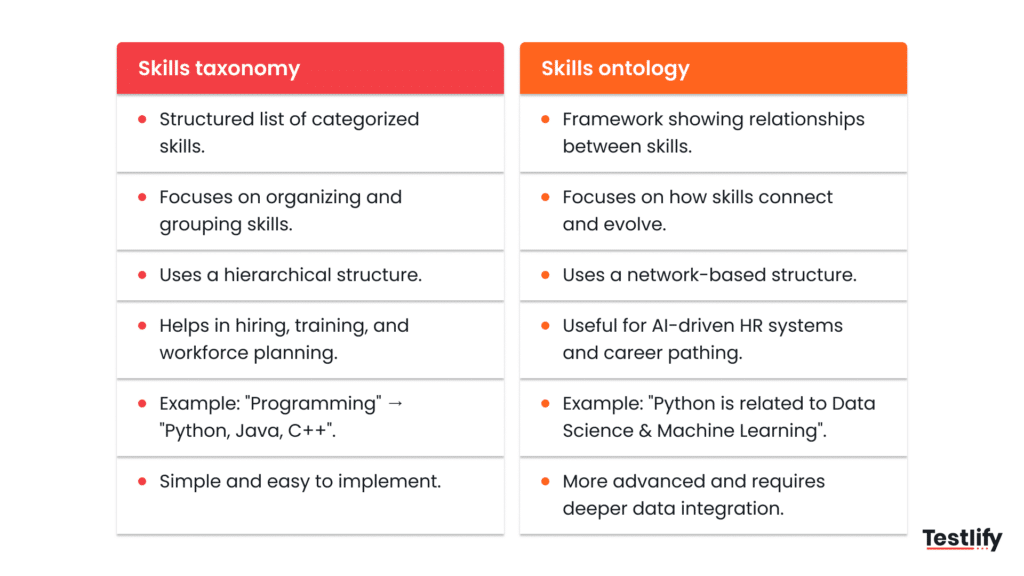
For most HR teams, a taxonomy is the right place to start. It is simpler to build, easier to maintain, and already answers the questions hiring and learning teams ask every day. An ontology becomes worth the extra effort once you want software to infer skill relationships at scale. If you want to go deeper into the distinction, our guide to skills ontology breaks it down further.
Dimension | Skills taxonomy | Skills ontology |
|---|---|---|
Structure | A hierarchical classification of skills into categories and subcategories. | A connected network that maps relationships between skills, roles, tasks, and competencies. |
Main question | What skills exist, and how are they organized? | How are skills, roles, and tasks related to one another? |
Best for | Standardizing job descriptions, competency frameworks, and performance reviews. | Powering skill inference, talent matching, career pathing, and workforce intelligence. |
Effort to build | Lower; a practical starting point for organizing skills. | Higher; requires mapping relationships and maintaining interconnected data. |
Skills taxonomy vs competency framework vs skills matrix
Although these terms are often used interchangeably, they serve different purposes in talent management.
Framework | Purpose | Best Used For |
|---|---|---|
Skills Taxonomy | Organizes skills into categories and proficiency levels | Skills-based hiring and workforce planning |
Skills Ontology | Maps relationships between skills, roles, and tasks | AI-powered talent intelligence |
Competency Framework | Defines behaviors, knowledge, and skills required for success | Performance management and leadership development |
Skills Matrix | Shows who possesses which skills | Team planning and resource allocation |
Most organizations begin with a skills taxonomy before expanding into competency frameworks or AI-powered skills ontologies.
What are the core elements of a taxonomy?
A useful taxonomy has six building blocks. Miss one, and it starts to feel vague or unusable. Together, they turn a pile of skill names into something teams can hire and train against.
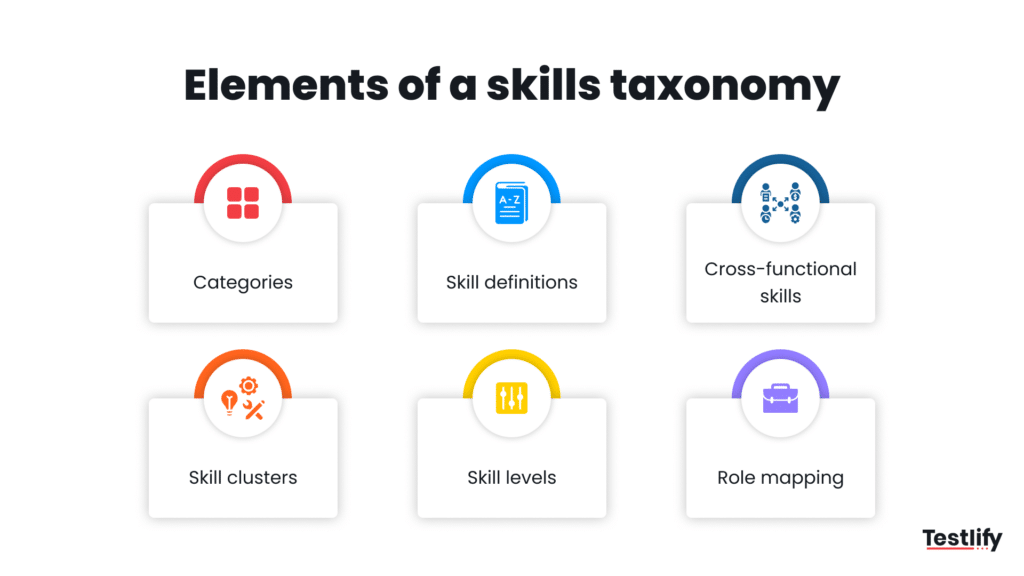
1. Categories
Broad groupings such as technical, commercial, or leadership skills. Categories give the taxonomy its top-level shape and make it easy to navigate.
2. Skill clusters
Related skills grouped inside a category. Under data, a cluster might hold SQL, data visualization, and statistics, so similar capabilities sit together.
3. Skill definitions
A short, precise description of each skill. Clear definitions stop two managers from scoring the same skill against different mental yardsticks.
4. Proficiency levels
A scale, often beginner to expert, that describes what each level looks like in practice. Levels are what let you say a role needs advanced Excel, not just Excel.
5. Cross-functional skills
Skills that show up across many roles, like communication or project management. Tagging them once keeps the taxonomy consistent instead of redefining them per team.
6. Role mapping
The link between each role and the skills and levels it requires. This is the connective tissue that makes the taxonomy usable for hiring, reviews, and internal moves.
Common skills taxonomy categories
While every organization builds its taxonomy differently, most include a combination of technical, functional, and behavioral skills.
Category | Example Skills |
|---|---|
Technical Skills | Python, SQL, AWS, Java |
Functional Skills | Financial Analysis, Sales Forecasting, Recruiting |
Digital Skills | AI Literacy, Data Analysis, Automation |
Leadership Skills | Coaching, Decision Making, Strategic Thinking |
Behavioral Skills | Communication, Collaboration, Adaptability |
Compliance Skills | GDPR, OSHA, ISO Standards |
Grouping similar skills makes the taxonomy easier to maintain and helps hiring teams evaluate candidates consistently across departments.
Why does your organization need one?
A skills taxonomy earns its keep by making talent decisions consistent and evidence-based instead of gut-driven. The payoff shows up across the whole employee lifecycle, from the first job posting to succession planning.
The business case is strong. Deloitte found that skills-based organizations are 63 percent more likely to achieve results than those still organized around rigid job descriptions. A shared taxonomy is the foundation that shift sits on. Without a common vocabulary of skills, a skills-based approach has nothing solid to stand on.
Organizations that implement a structured skills taxonomy gain measurable improvements across hiring, learning, and workforce planning.
Benefit | Business Impact |
|---|---|
Consistent hiring | Standardized candidate evaluation |
Faster recruitment | Clearer job requirements and screening |
Better internal mobility | Easier identification of transferable skills |
Targeted learning | Personalized development plans |
Workforce planning | Better visibility into organizational capabilities |
Skills gap analysis | More effective hiring and upskilling decisions |
A shared skills language helps HR, managers, and employees make decisions using the same criteria rather than relying on inconsistent interpretations.
Sharper recruitment
When every role maps to defined skills and levels, job postings get specific, and screening gets objective. Recruiters stop guessing what strong communication means and start measuring it. That tightens the shortlist and speeds up the whole hiring process.
Visible skill gaps
Compare the skills your workforce has against the skills your roles need, and the gaps surface on their own. That turns a vague worry about readiness into a specific, fundable plan. A structured skill gap analysis depends on having a taxonomy to measure against.
Better development and mobility
Clear skills and levels give people a visible path: here is where you are, here is what the next role needs, here is the gap to close. That fuels internal mobility and feeds directly into performance management and succession planning.
Pro Tip: Do not try to boil the ocean on version one. Pick two or three high-volume or business-critical roles, build the taxonomy for those, and prove the value before you scale. A focused taxonomy that gets used beats a complete one that gathers dust.
How do you build a skills taxonomy?
You do not have to start from a blank page. The fastest path is to borrow a public framework, then shape it around your real roles. Here is a six-step approach that keeps the project grounded.
1. Define objectives and scope
Decide what the taxonomy is for, whether that is hiring, internal mobility, or workforce planning, and which parts of the business it covers first. A clear purpose keeps it from ballooning into an academic exercise.
2. Start from a public framework
You rarely need to invent skill names. Public frameworks give you a tested starting point: O*NET covers the United States workforce, ESCO covers the European Union, and SFIA covers digital and IT roles. Lightcast’s open library lists more than 32,000 skills drawn from real job postings. Adopt one, then adapt it.
3. Identify key roles and skills
Work role by role with the people who do the job. Pull skills from job descriptions, interviews, and real work output, not just from what a template says the role needs. This is where a generic list becomes your list.
4. Define levels and write definitions
Give every skill a plain-language definition and a proficiency scale. Keep the taxonomy focused: most organizations do well with 200 to 500 well-defined skills. Past that, upkeep costs more than the extra detail is worth.
5. Validate with employees and managers
Test the draft against reality. Managers and top performers will tell you fast where a skill is missing, mislabeled, or set at the wrong level. This step is also where skills mapping against your live workforce exposes blind spots.
6. Review and update on a schedule
A taxonomy is a living document, not a one-time project. Set a review cadence, at least twice a year, and revisit fast-moving areas like AI and data skills more often. A taxonomy nobody maintains quietly drifts out of date.
Skills taxonomy implementation checklist
Before rolling out a skills taxonomy across the organization, ensure the following foundations are in place.
- Define the business objectives.
- Identify priority job families.
- Choose a skills framework such as O*NET, ESCO, or SFIA.
- Standardize skill definitions.
- Create proficiency levels.
- Map skills to roles.
- Validate with subject matter experts.
- Connect the taxonomy to hiring and learning systems.
- Review and update the taxonomy regularly.
- Monitor emerging skills and retire outdated ones.
Treat the taxonomy as a living framework rather than a one-time project.
Common skills taxonomy mistakes to avoid
Many taxonomy projects fail because organizations make them unnecessarily complex.
Avoid these common mistakes:
- Creating thousands of skills with no governance.
- Using vague skill definitions.
- Ignoring proficiency levels.
- Building the taxonomy without hiring managers.
- Never reviewing or updating skills.
- Treating the taxonomy as an HR-only initiative.
- Measuring resumes instead of validated skills.
- Failing to connect the taxonomy with hiring, learning, and workforce planning.
A smaller, well-maintained taxonomy delivers far more value than an exhaustive framework that quickly becomes outdated.
How AI uses a skills taxonomy
Modern HR platforms use skills taxonomies to improve talent decisions beyond recruitment. By organizing skills into a standardized framework, AI systems can identify transferable skills, recommend learning opportunities, match employees to internal roles, and support workforce planning.
Common applications include:
- Skills-based candidate matching
- Internal mobility recommendations
- Personalized learning paths
- Career pathing
- Succession planning
- Workforce planning
- Skills gap analysis
- Talent intelligence
- AI-powered job architecture
As organizations adopt AI-driven HR technology, a well-maintained skills taxonomy becomes the foundation that enables accurate matching, reporting, and workforce insights.
How does taxonomy power skills-based hiring?
A taxonomy proves its worth at the point of hire. It converts vague role requirements into specific, measurable skills, which is exactly what skills-based hiring needs to work. And the evidence for that approach is hard to argue with.
McKinsey reports that hiring for skills is roughly five times more predictive of job performance than hiring for education, and more than twice as predictive as hiring for work experience. A degree tells you where someone studied. A skill, measured well, tells you what they can do.
This is where the Testlify Competency-to-Evidence Matrix fits. The framework maps every role to the competencies that matter, then connects each competency to measurable evidence through assessments, work simulations, interviews, and structured reviewer feedback. Your skills taxonomy supplies the vocabulary; the matrix turns each skill into a scored, defensible signal instead of a line on a resume.
Picture a company hiring a mid-level data analyst. The taxonomy already says the role needs SQL at advanced level, data visualization at intermediate, and stakeholder communication at intermediate. Instead of scanning resumes for the right keywords, the team runs a short SQL assessment and a work-sample task, scores each candidate against those exact skills, and builds a shortlist ranked on evidence before the first interview. The taxonomy defines what good looks like; the assessment measures it.
The honest caveat: a taxonomy and a test do not replace human judgment. They give hiring managers cleaner evidence to decide with. AI and assessments narrow and structure the field. People still make the call.
Key takeaways
- A taxonomy is shared infrastructure, not a document. Its value is that hiring, learning, and planning all read skills the same way. That shared vocabulary is what makes every downstream talent decision comparable and defensible.
- Start from real roles, not an ideal org chart. A taxonomy built from actual job output stays usable; one built from theory becomes a spreadsheet nobody opens. Ground it in how work really happens or it will not survive contact with hiring managers.
- Borrow before you build. Public frameworks like O*NET, ESCO, and SFIA give you a tested skeleton. Adapting one is faster and more consistent than inventing skill names, which frees your effort for the role mapping that is actually unique to you.
- Keep it focused at 200 to 500 skills. Beyond that range, maintenance cost outruns the extra precision. A tight taxonomy people actually update beats an exhaustive one that goes stale within a year.
- The payoff is measurable hiring. Because skills predict performance far better than degrees do, a taxonomy that feeds assessments turns hiring from resume-reading into evidence-scoring, which is where quality-of-hire actually improves.
- Treat it as living infrastructure. With 39 percent of core skills set to change by 2030, an unmaintained taxonomy drifts out of date fast. A twice-yearly review keeps it aligned with the roles you are hiring for now, not the ones you had last year.
Frequently asked questions

Content Writer
Yashika Khandelwal is a Content Writer with 3+ years of experience creating research-backed content on hiring, talent assessment, and HR technology. She is a registered Organizational Psychologist and subject matter expert who combines behavioral science with practical recruitment insights to produce accurate, evidence-based content.
LinkedInRelated resources
View all
HR & recruitment
What is departmentalization: Types, benefits and examples

HR & recruitment
Criterion-Related Validity: A Practical Guide for Hiring (2026)
HR & recruitment
How can employers assess candidates’ clerical skills?

HR & recruitment
Types of interviews: A complete HR guide

HR & recruitment
Job characteristics model 101: A complete guide

HR & recruitment
9 HR models every HR professional must know in 2026
Get started.
Hire on proof, not resumes.
Run your first skills-based assessment free — no credit card required.