
9 HR models every HR professional must know in 2026
Discover the 9 essential HR models that shape workforce strategy, improve employee experience, and align HR with business success in 2025.
HR models are a set of frameworks that define how the HR function is structured, what it is responsible for, and how it connects people decisions to business results. Picking the right one is the difference between an HR team that runs payroll and policies and one that actually moves the numbers leaders care about: retention, productivity, and quality of hire.
The catch is that there is no single best HR model. The nine covered here each solve a different problem, and the one that fits a 40-person startup will buckle at a 5,000-person enterprise. This guide explains each model in plain language, shows where it works and where it breaks, and gives you a way to choose so your HR strategy is built on evidence instead of whatever the last consultant recommended.
TL;DR
- An HR model is a blueprint for how HR is organized and how it ties people work to business outcomes.
- There is no universal best model. Fit depends on company size, culture, industry, and strategy.
- The Ulrich model is the most widely adopted; the Harvard and Warwick models are best for strategy; the HR Value Chain and Standard Causal models are best for proving HR impact with data.
- In a McKinsey survey, 48 percent of people leaders said an updated Ulrich-style model best fit their HR operating model, the single most common answer.
- Whichever model you choose, it only works on reliable people data. That is where skills assessment turns a model on paper into decisions you can defend.
 ChatGPT
 Gemini
 Claude
 Grok
Grok Perplexity
What is an HR model?
An HR model is a framework that maps how the HR function is structured, what it owns, and how its work links to business strategy and outcomes. It tells you who does what, how HR creates value, and which results to measure. Think of it as the operating blueprint behind your people strategy.
A model is not the same as an HR strategy. The strategy is the destination (lower attrition, faster hiring, a stronger bench). The model is the structure that gets you there. Most teams borrow from more than one model rather than copying a single one cleanly, and that is fine. The point is to choose deliberately, not by default.

Why do HR models still matter in 2026?
HR models matter because they decide whether HR sits at the strategy table or stays stuck in admin. A clear model aligns people decisions with business goals, sets the metrics HR is accountable for, and gives leaders a shared language for what good HR looks like. Without one, HR runs on habit.
The pressure is real. A June 2024 Gartner survey of 190 HR leaders found 50 percent say their organization does not effectively use the skills it already has, and 41 percent say their workforce lacks the skills it needs. A model gives you a structured way to close that gap instead of guessing.
Adoption data backs this up. When McKinsey asked people leaders which two archetypes best fit their HR operating model, 48 percent picked an updated Ulrich-style model, 47 percent an experience-driven model, 36 percent leader-led, 31 percent agile, and 6 percent a machine-powered model. Most teams are not inventing structure from scratch. They are adapting one of a handful of proven models, which is exactly what the nine below give you.
What are the 9 HR models every HR team should know?
The nine HR models below are the ones that show up again and again in strategic HRM research and real org design. Some define HR roles, some map how HR creates value, and some connect HR activity to financial results. Start with the comparison table, then read the model that matches your problem.
HR model | Created by | Core idea | Best for |
|---|---|---|---|
Ulrich model | Dave Ulrich (1996) | HR plays four (later five) distinct roles | Structuring an HR department by role |
Harvard model | Michael Beer et al. (1984) | Balance stakeholder interests and situational factors | Strategy and stakeholder buy-in |
High-Impact HR operating model | Deloitte | HR organized around outcomes and employee experience | Modernizing and digitizing HR |
Storey model | John Storey | Hard (control) versus soft (commitment) HRM | Defining your HR philosophy |
8-box model | Paul Boselie | External and internal context shape HR outcomes | Diagnosing what limits HR results |
HR Value Chain | Paauwe and Richardson (1997) | HR activities lead to outcomes that lead to goals | Proving HR contributes to results |
HR Value Chain Advanced | Extends the Value Chain | Adds KPIs and HR enablers (tech, budget, skills) | Measuring HR with hard metrics |
Standard Causal model | Classic strategic HRM | Business strategy drives HR practices that drive performance | Linking HR to financial outcomes |
Warwick model | Hendry and Pettigrew | Outer and inner context shape HR content | Managing change across contexts |
1. The Ulrich model
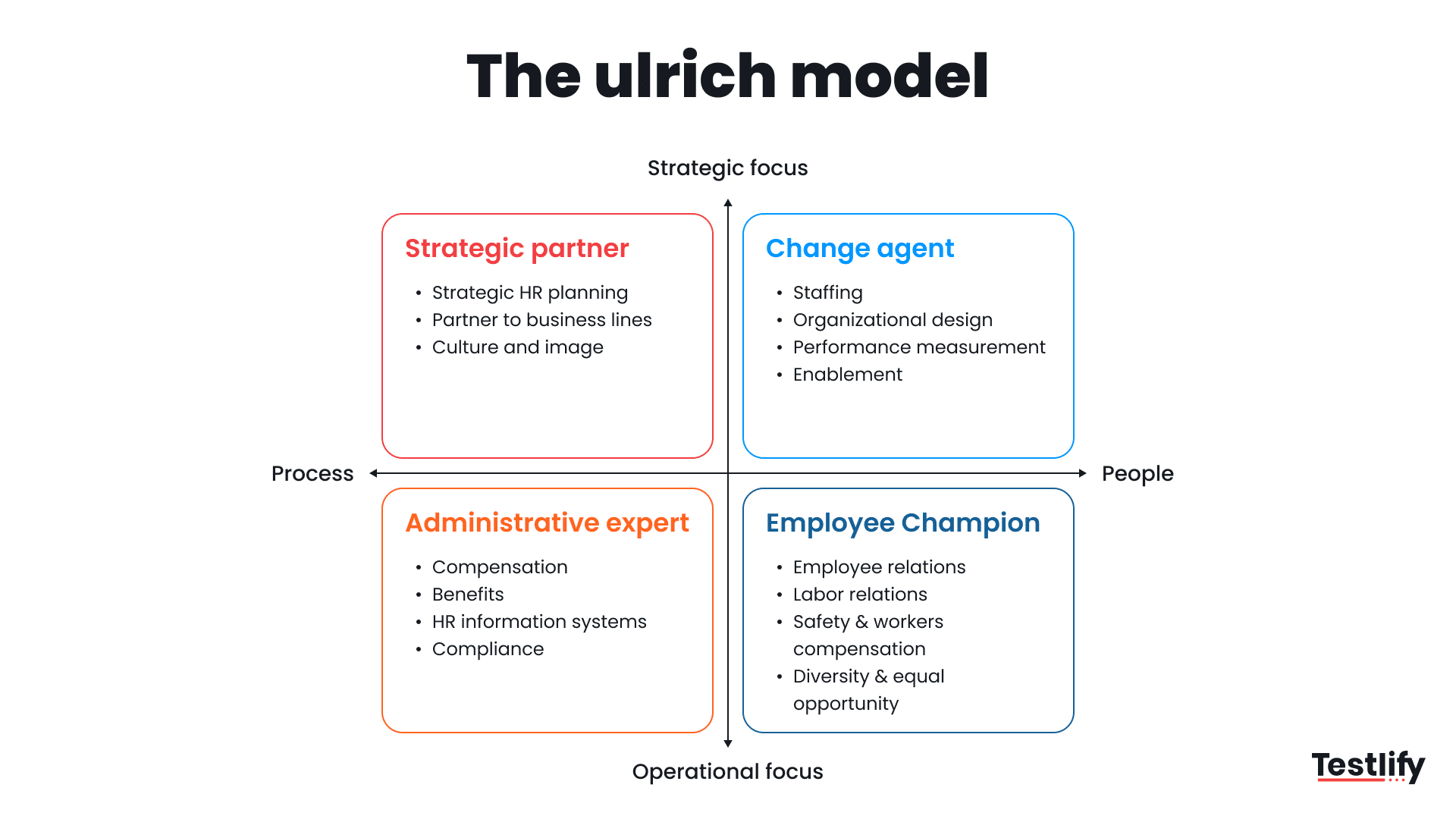
The Ulrich model is the world’s most widely adopted HR framework. Dave Ulrich introduced it in his 1996 book Human Resource Champions, arguing that HR should both run operations well and drive business success by aligning people strategy with company goals.
The original model gave HR four roles. In 2005 Ulrich expanded it to five to match the growing complexity of the work:
- Strategic partner: aligns HR with business needs and long-term workforce planning.
- Administrative expert: keeps HR processes efficient and well run.
- Employee champion (advocate): protects employee well-being and the employer-employee relationship.
- Change agent: helps the organization adapt to new ways of working.
- Human capital developer: the fifth role added in 2005, focused on building tomorrow’s skills today.
Where it works: large organizations that can staff specialist roles. Where it breaks: small teams, where one HR generalist already plays all five roles and formal separation just adds overhead.
2. The Harvard model of HRM

The Harvard model, introduced in 1984 by Michael Beer and colleagues at Harvard University, takes a strategic, people-first view of HR. Instead of treating HR as a set of isolated tasks, it looks at how HR decisions affect employees, stakeholders, and society over the long term.
It is built on five linked components: stakeholder interests, situational factors (like labor markets and laws), HRM policies, HRM outcomes (commitment, competence, cost-effectiveness), and long-term consequences for the business and its people. The core message is to balance what the business needs with what stakeholders need, rather than optimizing for one.
Best for HR leaders who need executive and stakeholder buy-in, because it frames people decisions in business and ethical terms at once. The tradeoff is that it is more of a thinking framework than a step-by-step playbook.
3. The High-Impact HR operating model
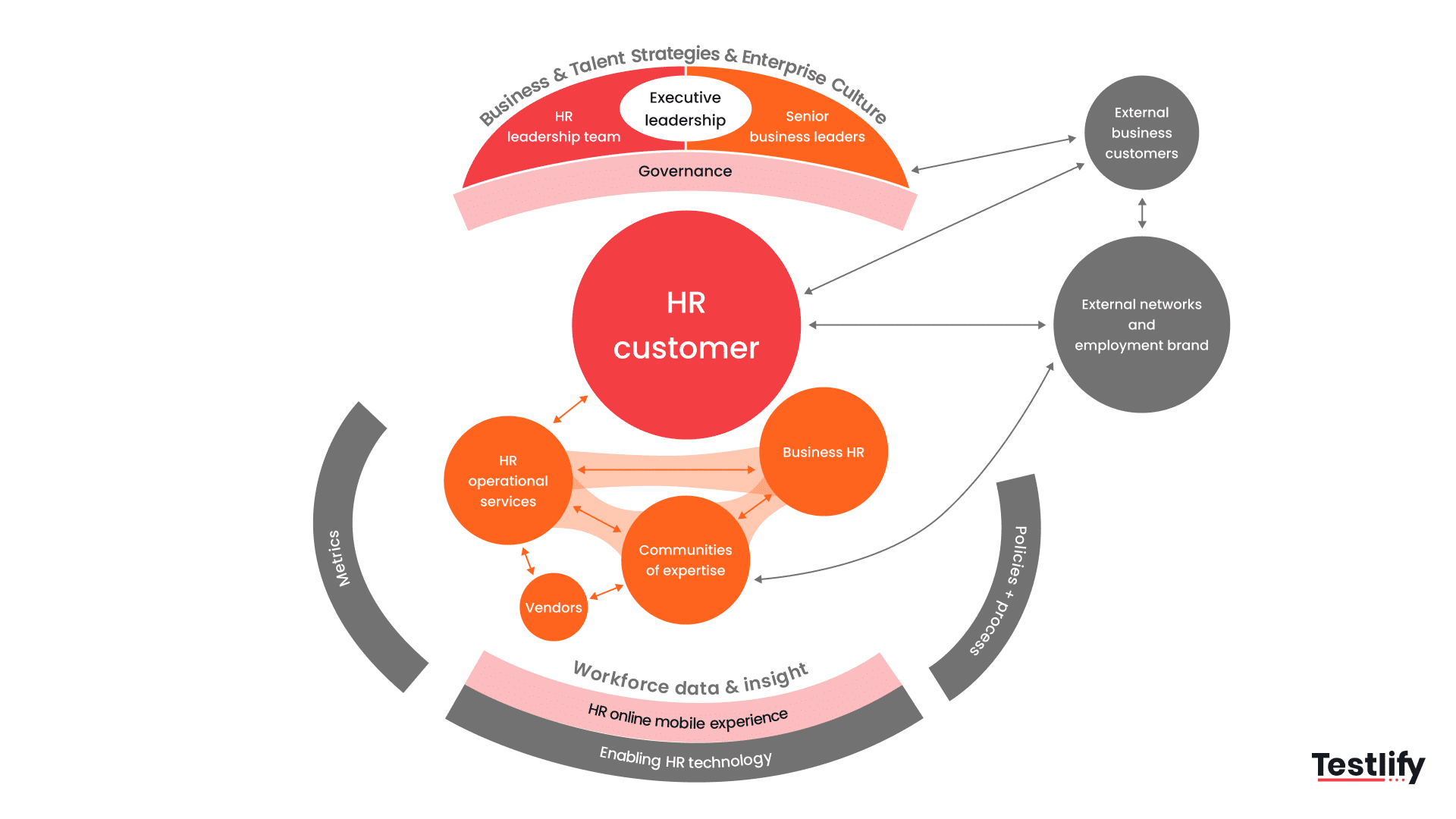
The High-Impact HR operating model, developed by Deloitte, reorganizes HR around business outcomes and employee experience instead of programs and policies. It pushes HR to deliver solutions, not just services, using data, technology, and cross-functional teams.
It rests on a few core ideas: treat employees as customers of HR, organize around problems rather than silos, and build digital and analytics capability into the function. The goal is an HR team that can redeploy quickly to whatever the business needs next.
Best for companies modernizing or digitizing HR. The honest caveat: it assumes a level of data maturity and HR tech that many mid-market teams do not have yet, so it often becomes a multi-year target rather than a switch you flip.
4. The Storey model

Storey’s Model of Human Resource Management, developed by Professor John Storey, explains two contrasting approaches to managing employees: hard HRM and soft HRM. Rather than treating HR as a purely administrative function, the model highlights how organizations balance business objectives with employee needs.
Hard HRM views employees as resources that should be managed efficiently to achieve organizational goals. It emphasizes performance, productivity, cost control, and measurable outcomes. Soft HRM, on the other hand, focuses on employee engagement, development, communication, and long-term commitment, recognizing that motivated employees contribute to sustainable business success.
fvalueMost modern organizations combine elements of both approaches. For example, a company may use performance metrics and workforce planning (hard HRM) while also investing in employee wellbeing, learning, and career development (soft HRM).
Feature | Hard HRM | Soft HRM |
|---|---|---|
Primary focus | Business performance and efficiency | Employee development and engagement |
View of employees | Resources that drive business outcomes | Valuable assets who contribute to long-term success |
Management style | Performance-driven and directive | Collaborative and people-focused |
Typical practices | Performance targets, workforce planning, cost control | Learning and development, recognition, wellbeing initiatives |
Best suited for | Organizations focused on operational efficiency | Organizations prioritizing innovation, retention, and culture |
5. The 8-box model by Paul Boselie

Paul Boselie’s 8-box model maps how outside forces and inside choices together shape HR outcomes. It builds on the Harvard model but adds more structure, especially around the external context HR cannot control.
It starts with external context (the market, the available talent pool, and laws and regulations) and the organization’s own history and technology, then traces how intended HR policies become actual practices, how employees perceive them, and how that drives HR and business outcomes. The gap between intended and perceived HR is where many strategies quietly fail.
Best for diagnosing why HR results stall despite good intentions. It is detailed, which is its strength for analysis and its weakness for quick decisions.
6. The HR Value Chain
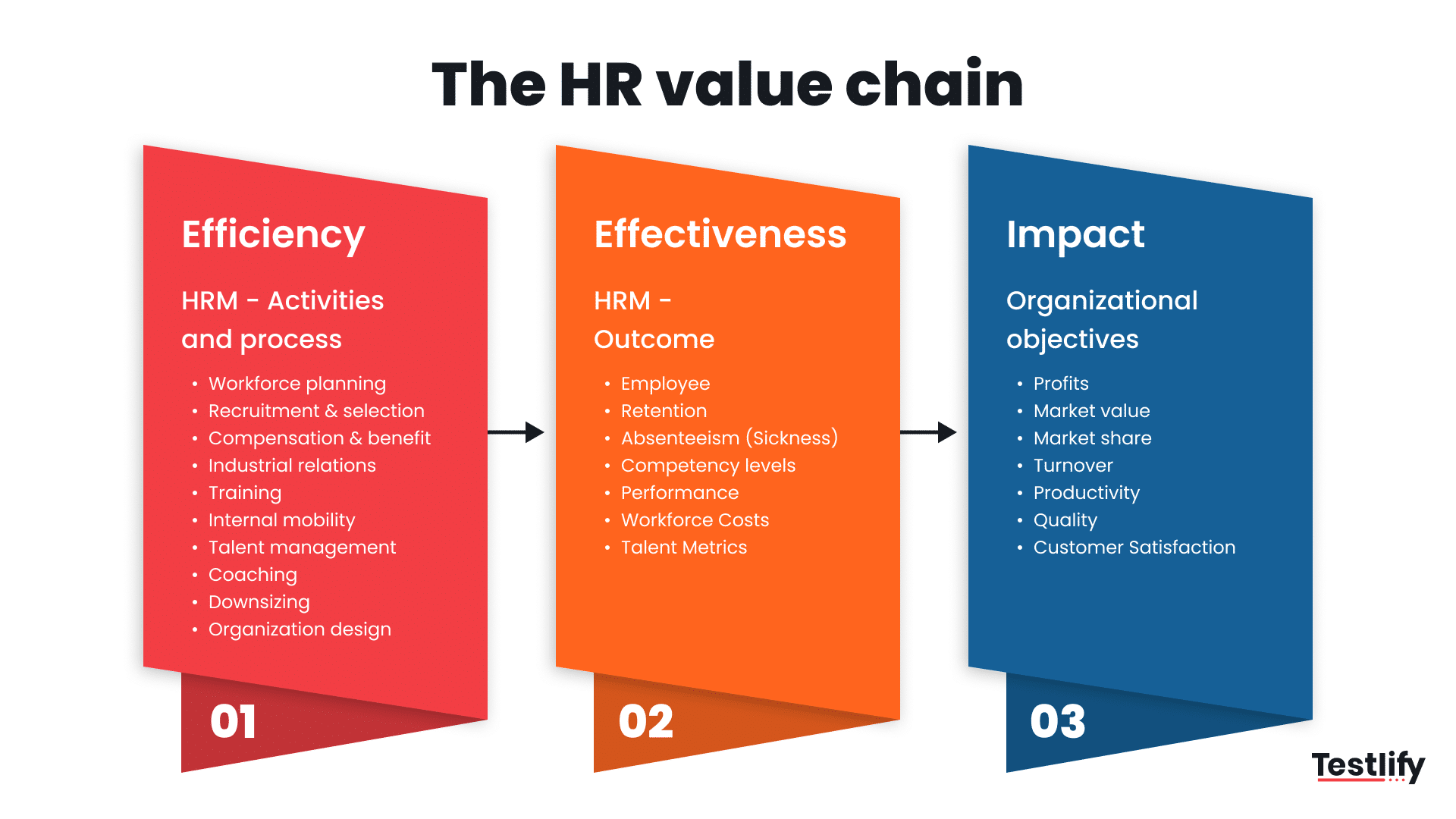
The HR Value Chain Model explains how human resource activities create business value. Instead of measuring HR success by the number of programs delivered, the model focuses on how HR practices improve employee capabilities, influence organizational performance, and contribute to business outcomes.
The model typically follows this sequence:
HR practices → Employee skills and engagement → Improved individual performance → Better organizational performance → Business results
For example, investing in structured hiring, onboarding, and employee development can improve workforce capability, which leads to higher productivity, lower turnover, and stronger financial performance.
The HR Value Chain Model helps HR teams demonstrate how people initiatives contribute directly to organizational goals rather than operating as standalone HR activities.
7. The HR Value Chain Advanced

The HR Value Chain Advanced extends the original by adding two things the basic model lacks: key performance indicators for each stage, and HR enablers, the underlying capabilities HR needs to work at all.
The enablers are the practical part: HR technology, a fit-for-purpose HR structure, skilled HR professionals, and an adequate budget. Without them, even a smart strategy stalls. You cannot improve retention if you have no system to track it, and you cannot prove impact without clean data. A balanced scorecard often sits alongside this model to keep the KPIs honest.
Best for teams that have to report HR in hard metrics. It demands data discipline, so it rewards organizations that have already invested in HR systems and assessment data.
8. The Standard Causal model of HRM

The Standard Causal model lays out a clear cause-and-effect chain from strategy to results. Business strategy shapes HR strategy, which shapes HR practices, which improve employee performance, which improves internal operations and, finally, financial results.
It also recognizes that the chain runs both ways. Strong business performance often funds more HR investment, and good HR practices (like skill development and fair pay) feed back into engagement and output. It is a useful reminder that HR is a driver of results, not just a cost center reacting to them.
Best for connecting HR work to financial outcomes in a way executives follow. The risk is treating the chain as automatic; each link only holds if the practice is actually effective, which is why measurement matters.
9. The Warwick model

The Warwick model, developed by Chris Hendry and Andrew Pettigrew at the University of Warwick, builds on the Harvard model and focuses on how external and internal forces shape HR over time. It is especially useful during change.
It has five elements: the outer context (political, economic, and technological forces), the inner context (culture, leadership, structure, and technology), the business strategy context that links the two, the HRM content (the actual HR functions), and the HRM context (how HR is positioned and run). Mapping all five shows why a change effort succeeds in one company and fails in another with the same plan.
Best for organizations managing transformation or operating across different markets. Its breadth is the cost: it takes real effort to map every context properly.
HR framework vs HR model: What’s the difference?
Although the terms are often used interchangeably, they are not exactly the same.
An HR model explains how people management should work within an organization. It provides theories or approaches for managing employees, such as the Harvard Model or Michigan Model.
An HR framework is a practical structure that organizations use to implement HR processes. Frameworks typically define policies, competencies, workflows, and best practices that guide day-to-day HR activities.
HR Model | HR Framework |
|---|---|
Explains HR concepts and theories | Provides a practical structure for implementation |
Focuses on strategy and principles | Focuses on processes and execution |
Examples: Harvard, Michigan, Storey | Examples: Competency Framework, HR Value Chain |
How do you choose the right HR model?
Choose an HR model by matching it to your biggest current problem, not by picking the most famous one. The right fit depends on company size, culture, industry, and where HR needs to grow next. A startup needs structure (Ulrich); a data-pressured team needs proof (HR Value Chain Advanced); a company in flux needs a change lens (Warwick).
- Name the problem first. Are you structuring a team, proving impact, or managing change? The answer points to a short list of models.
- Match the model to the problem. Use the comparison table above. Role clarity points to Ulrich; financial proof points to the Standard Causal or Value Chain models; strategy and buy-in point to Harvard or Warwick.
- Check your data and tech maturity. Outcome-based models (High-Impact HR, Value Chain Advanced) only work if you can actually measure people data.
- Borrow, do not copy. Most strong HR functions blend two or three models. Take the structure from one and the metrics from another.
- Pressure-test it against real decisions. Run a live hiring or restructuring decision through the model before you commit the whole function to it.
Pro Tip: Before adopting any outcome-based model, audit whether you can measure what it asks for. If you cannot yet track skills, performance, or retention cleanly, start by fixing your people data. A model that demands metrics you do not have will make HR look weaker, not stronger.
Where does evidence-based hiring fit your HR model?
Every model on this list runs on one thing: reliable data about your people. The Ulrich model needs to know which skills its experts hold, the HR Value Chain needs outcome data to prove impact, and the Standard Causal model only holds if your hiring and development practices actually work. Weak people data quietly breaks all of them.
This is where the Testlify Human+AI Evidence-Based Hiring Framework fits. It helps teams combine AI-assisted evaluation with human judgment, using structured evidence (skills assessments, role-based tests, and reviewer feedback) instead of resumes, intuition, or inconsistent interviews. AI helps surface and structure the evidence; people still make the hiring call. That gives whatever HR model you choose a trustworthy starting point: candidates measured on what they can actually do.
In practice, a 500-person company hiring 30 people a quarter can screen for role skills before the first interview, so the shortlist is scored on evidence, not gut feel. That shrinks a six-week screening loop to closer to ten days and feeds clean skills data straight into the model you use to run HR. The model gives you structure; the evidence gives you confidence.
How to choose the right HR model?
No single HR model works for every organization. Each model offers a different perspective on managing people, improving performance, and aligning HR strategy with business goals. Rather than selecting one model exclusively, many organizations combine elements of several approaches based on their workforce, culture, and objectives.
Whether you’re improving recruitment, employee engagement, performance management, or workforce planning, understanding these HR models provides a strong foundation for building more effective people strategies.
Key takeaways
- There is no single best HR model. Fit depends on size, culture, industry, and your current priority, so choosing deliberately beats copying the most famous one. The practical implication: start from your biggest problem, then pick the model that solves it.
- Different models do different jobs. Ulrich structures roles, Harvard and Warwick drive strategy, and the HR Value Chain and Standard Causal models prove impact. Knowing the job each one does means you can blend two or three instead of forcing one to do everything.
- Outcome-based models need data maturity. The High-Impact HR and Value Chain Advanced models only work if you can measure skills, performance, and retention. If you cannot, fixing people data comes before adopting the model, or it will expose gaps rather than close them.
- Adoption favors proven structures. In McKinsey’s data, 48 percent of leaders run an updated Ulrich-style model, which tells you the safest starting point is a known model adapted to your context, not a custom build.
- Every model rests on reliable people data. A framework on paper is only as good as the evidence feeding it, so structured skills assessment is what turns any HR model from theory into decisions you can defend to leadership.
- Models are living tools, not one-time choices. As you grow, the model that fit at 50 people will need to flex at 500, so revisit your choice whenever your size or strategy shifts.
Frequently asked questions (FAQs)

B2B SaaS Content Writer
Rishav Kumar is a B2B SaaS content writer with 4 years of experience. He loves crafting engaging content. Always exploring fresh ideas, he's passionate about helping businesses grow through impactful writing.
LinkedInRelated resources
View all
HR & recruitment
What Is a Projective Assessment? Types, Uses, and Reliability in Hiring (2026)
HR & recruitment
What are personality hires and signs you might be making one

HR & recruitment
Accurate Staffing: How to Improve Hiring Accuracy and Avoid Costly Bad Hires
HR & recruitment
Job Specialization: Benefits, Risks, and Examples (2026)

HR & recruitment
What is a LMS and why do businesses need one?
HR & recruitment
Moonlighting: How can HR detect & prevent it? (Top methods)
Get started.
Hire on proof, not resumes.
Run your first skills-based assessment free — no credit card required.