
Types of interviews: A complete HR guide
Discover the different types of interviews in HRM, their formats, best practices, and key strategies to assess candidates effectively for better hiring decisions.

The interview is where a promising resume either becomes a qualified hire or falls apart under scrutiny. The purpose of an interview is to collect job-relevant evidence about whether someone can do a specific job, under conditions consistent enough that two different interviewers would reach the same conclusion.
Yet, using the same interview format for every role can leave recruiters with an incomplete picture of a candidate’s skills, behavior, and potential. That is why understanding the different types of interviews matters.
In this guide, we’ll explore the most common types of interviews, when to use them, what each one measures, and how to choose the right format for your hiring process.
TL;DR
- An interview exists to produce evidence for one decision: can this person do this job, in this context, better than the other shortlisted candidates.
- The objectives break into five jobs: verify the record, test judgment, check the work matches, give the candidate a real basis to choose, and leave an auditable trail.
- Structure is the whole difference. Decades of selection research keep placing structured interviews among the strongest predictors of job performance and unstructured ones well below.
- Which type of interview you run is a decision about what evidence you need, not a matter of taste or tradition.
- An interview that leaves no written, comparable record hasn't done its job, however good the conversation felt at the time.
 ChatGPT
 Gemini
 Claude
 Grok
Grok Perplexity
What is the purpose of an interview?
The purpose of an interview is to gather job-relevant evidence from a candidate under conditions consistent enough to compare one person against another. It verifies what a resume claims, tests judgment that a test alone cannot reach, and gives the candidate what they need to decide about you. Done properly, it ends in a written decision you could defend.
That last clause is the one teams skip. A conversation that changes nobody's mind and leaves no record behind has cost two people an hour and produced nothing you can use.
The US Office of Personnel Management defines a structured interview as a method "designed to measure job-related competencies of candidates by systematically inquiring about their behavior in past experiences and/or their proposed behavior in hypothetical situations".
Note what's doing the work there: systematically. Same questions, same order, same rating standard, so that differences in the answers mean something.
And it runs both ways. The candidate is deciding too, which is why clarity about the role, the team and what happens next is part of the purpose rather than a courtesy bolted onto the end.

What are the objectives of an interview?
The objectives of an interview are to verify the candidate's record, test their judgment on real problems, confirm the work they'd actually do matches what they want, give them enough to make their own decision, and produce a comparable record for the people who weren't in the room. The key objectives include:

Assessing job fit and competency
Determine whether candidates have the skills and knowledge required for the role. Use role-specific questions to evaluate their ability to perform key responsibilities.
Understanding cultural and organizational fit
Assess whether a candidate’s values, working style, and expectations align with the organization. Focus on how they collaborate, communicate, and adapt.
Predicting future job performance
Explore how candidates handled challenges and made decisions in previous roles. Behavioral and situational questions can provide useful evidence of how they may perform.
Identifying leadership potential
Look for qualities such as accountability, decision-making, communication, and problem-solving. This is especially important when hiring for senior or leadership roles.
Enhancing employee retention
Use interviews to set clear expectations around responsibilities, growth, and workplace culture. This helps candidates make informed decisions and can reduce early turnover.
Understanding candidate motivation
Find out why candidates want the role and what they expect from their next opportunity. This helps recruiters assess whether their goals align with the position.
Supporting workforce planning
Interview results can highlight recurring skill gaps in the talent pool. Organizations can use these insights to improve hiring, training, and future workforce planning.
Strengthening employer branding
Every interview shapes the candidate experience. A professional, transparent, and respectful process can strengthen how candidates perceive the organization.
Improving hiring efficiency
A structured interview keeps the conversation focused on job-relevant criteria. Using consistent questions and scoring criteria also makes candidate comparisons more objective.
Types of interviews and what each is for
Each type of interview is a tool for producing one kind of evidence. Picking by habit, or because the last hire went that way, is how panels end up with four rounds that all test the same thing.
Type of interview | What it is for | Evidence it produces | Typical length |
|---|---|---|---|
Structured | Comparing candidates fairly on the same criteria | Scored, side-by-side ratings | 45 to 60 minutes |
Behavioral | Checking how someone has actually worked before | Worked examples against competencies | 45 to 60 minutes |
Situational | Testing judgment on problems they haven't met yet | Reasoning under a defined scenario | 30 to 45 minutes |
Technical or task-based | Confirming they can do the work itself | Observed output, code or a finished task | 60 to 90 minutes |
Phone or video screen | Qualifying a long shortlist cheaply | Basic fit, motivation, logistics | 15 to 30 minutes |
Panel | Getting several perspectives in one sitting | Cross-functional ratings on one sample | 60 minutes |
Structured interview
In a structured interview, every candidate gets the same predefined questions, in the same order, and is evaluated against the same scoring criteria. This makes comparisons more consistent and reduces the influence of interviewer bias.
It is one of the most reliable interview formats for making evidence-based hiring decisions. If you improve only one part of your interview process, start by adding more structure.
Related resource: How to conduct a structured job interview
Unstructured interview
An unstructured interview is an open-ended conversation without a fixed set of questions or scoring criteria. It gives interviewers flexibility to follow interesting responses and explore areas that a standardized format might overlook.
However, that flexibility can also introduce inconsistency. Different candidates may be asked different questions, making it harder to compare them objectively.
Related resources: Our guide on structured vs. unstructured interviews explores this tradeoff in greater detail.
Behavioral interview
A behavioral interview uses a candidate’s past experiences to understand how they may respond to similar situations in the future. Candidates are typically asked to describe specific examples using the STAR method: situation, task, action, and result.
This format works best when questions are tied to clearly defined competencies. It helps recruiters assess how candidates have demonstrated skills such as leadership, teamwork, problem-solving, and communication.
Situational interview
Situational interviews present candidates with hypothetical scenarios based on challenges they could face in the role. They are particularly useful when assessing judgment, decision-making, and problem-solving.
They can also help evaluate candidates who have limited experience with a specific situation. However, hypothetical answers may not always reflect how someone would behave when facing the situation in real life.
Related resource: How situational judgement tests find the best fits
Technical and task-based interview
Technical and task-based interviews ask candidates to complete a job-relevant problem, coding exercise, work sample, or practical task. They provide direct evidence of how candidates apply their skills rather than relying entirely on what they say they can do.
The key is to keep the task relevant and reasonably scoped. An unnecessarily long take-home assignment can end up measuring a candidate’s available time rather than their actual ability.
Related resource: How to simplify candidate screening with technical interview questions
Case study interview
Case study interviews give candidates a business problem or realistic scenario to analyze and solve. They are commonly used for consulting, finance, strategy, and other roles that require structured problem solving.
Interviewers can assess how candidates break down complex problems, work with incomplete information, evaluate options, and explain their reasoning.
Related resource: How to evaluate problem solving skills in candidates
Phone and video screening
Phone and video interviews are typically used as an initial screening stage before a more detailed interview. They help recruiters quickly assess basic qualifications, communication skills, availability, and interest in the role.
Video interviews are particularly useful for distributed or global teams because they reduce scheduling and location constraints.
Related resource: How to prevent impostors in video interviews
Panel interview
A panel interview involves multiple interviewers assessing the same candidate, usually at a later stage of the hiring process. It gives the organization perspectives from different stakeholders without requiring several separate interviews.
However, group dynamics can influence individual judgments. Having each interviewer score the candidate independently before discussing their assessment can make the process more objective.
Related resource: How to conduct an effective job interview
Group interview
A group interview assesses multiple candidates at the same time, often through a shared discussion, exercise, or problem solving activity. It can reveal how candidates communicate, collaborate, influence others, and respond to different personalities.
The format can be particularly useful for roles that require strong teamwork or interpersonal skills. However, recruiters should avoid favoring candidates simply because they are more vocal, as quieter candidates may demonstrate equally valuable abilities.
Key aspects to assess during interviews
A strong interview should go beyond a candidate’s resume and years of experience. Recruiters should focus on the skills, behaviors, and qualities that indicate whether someone can succeed in the role.
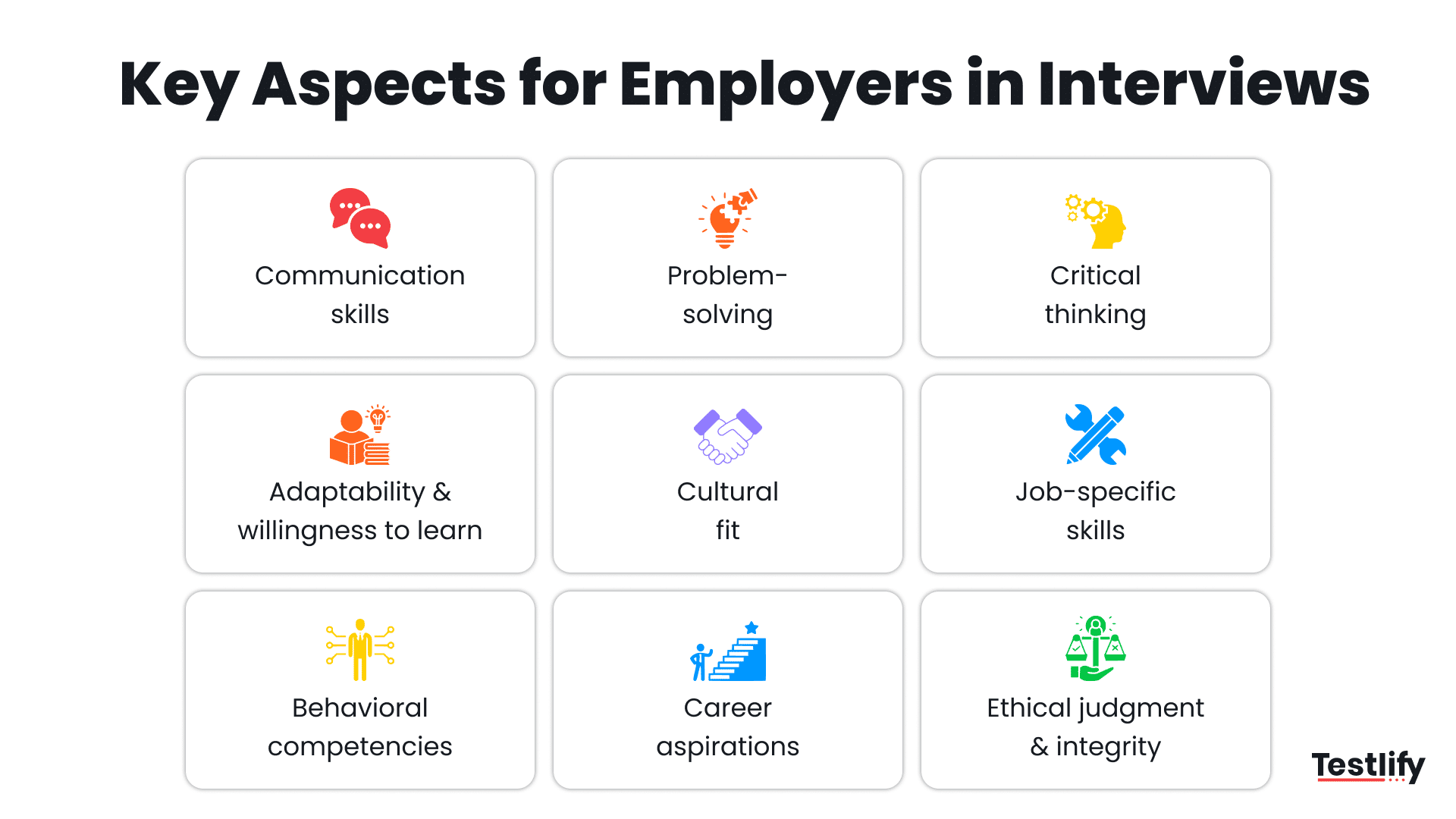
Communication skills
Assess how clearly candidates express ideas and interact with others by looking at:
- Clarity and confidence
- Active listening
- Ability to explain complex ideas
Problem solving
Understand how candidates approach challenges by exploring:
- Their problem-solving process
- How they evaluate possible solutions
- Examples of challenges they have overcome
Critical thinking
Evaluate how candidates analyze information and make decisions by assessing:
- Reasoning ability
- Judgment
- Ability to evaluate different perspectives
Adaptability and willingness to learn
Determine whether candidates can adjust to changing requirements by exploring:
- How they handle change
- Examples of learning new skills
- Their response to feedback
Cultural fit
Assess whether candidates can work effectively within the organization by considering:
- Working style
- Collaboration
- Alignment with organizational values
Job-specific skills
Evaluate whether candidates have the capabilities required for the position by assessing:
- Technical knowledge
- Role-specific competencies
- Practical experience
Behavioral competencies
Understand how candidates are likely to behave at work by exploring:
- Past workplace situations
- Conflict management
- Teamwork and accountability
Career aspirations
Understand whether the opportunity aligns with the candidate’s goals by discussing:
- Short- and long-term goals
- Desired career progression
- Expectations from the role
Ethical judgment and integrity
Assess how candidates respond to sensitive or difficult situations by exploring:
- Ethical decision-making
- Accountability
- How they handle workplace dilemmas
How to run an interview that serves its purpose
Six steps, in order, and the first two are the ones that get skipped:
- Name the competencies the role actually requires. Four or five, not twelve.
- Write the rating scale, then the questions that feed it. Same questions, same order, for everyone.
- Put the cheap evidence first. A skills assessment before the first call means the interview spends its hour on judgment rather than on verifying whether someone can do the basics.
- Run the round. Take notes on what the candidate said, not on how it felt.
- Rate independently, before the debrief. Then compare and argue about the gaps.
- Tell the candidate what happens next, with a date. This is where most processes lose people they'd already decided to hire.
Ready to put structured evidence in front of your next interview round?
Book a demo, and we'll walk through how assessments, AI interviews, and reviewer scorecards fit the process you already run.
FAQs

People and Talent Partner
Arushi Shah runs day-to-day talent acquisition and candidate experience at Testlify. She writes on interviewing, structured hiring, and giving candidates a fair, fast process.
LinkedInRelated resources
View all
HR & recruitment
Job characteristics model 101: A complete guide
HR & recruitment
9 HR models every HR professional must know in 2026

HR & recruitment
What Is a Projective Assessment? Types, Uses, and Reliability in Hiring (2026)

HR & recruitment
What are personality hires and signs you might be making one

HR & recruitment
Accurate Staffing: How to Improve Hiring Accuracy and Avoid Costly Bad Hires

HR & recruitment
Job Specialization: Benefits, Risks, and Examples (2026)
Get started.
Hire on proof, not resumes.
Run your first skills-based assessment free — no credit card required.