
Web designer interview questions: 25 to ask and what good answers sound like
Explore 40 web designer interview questions, complete with strong answer indicators to help you identify the right candidates.
A strong portfolio does not tell you who made the decisions or how long the work took. Interviews are where you find out. Without a fixed set of web designer interview questions, every interviewer asks something different. Hiring then turns on who got along with whom, not on evidence.
In this article, we explore 40 web designer interview questions, complete with strong answer indicators to help you identify the right candidates.
TL;DR:
- 40 questions grouped by the five skills a web designer needs, each with a note on what a strong answer sounds like.
- Extra questions for junior and senior candidates.
- A red flag list and a weighted scorecard, so every interviewer grades answers the same way.
- A short, paid work sample brief to test real work.
- Where interviews fit: after the skills test and portfolio review, before the work sample.
 ChatGPT
 Gemini
 Claude
 Grok
 Perplexity
What does a web designer do, and what should the interview test?
A web designer plans the layout, look and flow of a website, turns it into designs that work on every screen size, and hands it to developers or builds it in a CMS. The interview should test five areas: design process, visual craft, responsive and accessible design, front-end and hand-off skills, and collaboration.
Demand for the role is steady. The US Bureau of Labor Statistics groups web developers and digital designers together and puts median pay at $99,520 in 2025, with about 13,600 openings a year and 5% growth projected from 2025 to 2035. With that many openings, a fixed question set saves time on every hire.
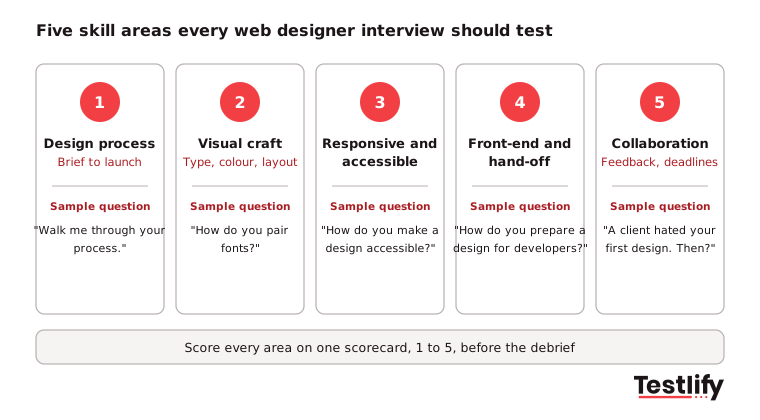
Skill area | What you are checking | How to check it |
|---|---|---|
Design process | A repeatable way to go from brief to launch | Interview questions, portfolio walk-through |
Visual craft | Typography, colour, layout, hierarchy | Portfolio review, Figma or Photoshop test |
Responsive and accessible design | Works on every screen and for every user | Interview questions, work sample |
Front-end and hand-off | HTML and CSS basics, CMS, performance, specs for developers | HTML and CSS skills test, interview questions |
Collaboration | Feedback, deadlines, stakeholder pushback | Behavioral and situational questions |

What general web designer interview questions should you ask?
General web designer interview questions open the conversation and show how the candidate works from brief to launch. Ask these six first, and push for one real project in every answer.
- Walk me through your design process, from brief to launch.
Strong answer: a clear, repeatable process (discovery, sitemap, wireframes, visual design, testing, hand-off) and why each step exists. The steps can differ from yours. - Which project in your portfolio best shows how you think?
Strong answer: the problem, the constraints, the options they rejected and the result, not just the final screens. - What was your exact role on that project?
Strong answer: a clear split between their work and the team's. Vague "we did everything" answers need a follow-up. - Which design tools do you use, and why those?
Strong answer: Figma or Adobe tools named with reasons, plus how they keep files organised for others. - What makes a website successful?
Strong answer: ties design to goals such as sign-ups, sales or support calls avoided, not only looks. - What would you change about our website?
Strong answer: two or three specific, tactful fixes linked to users and business goals. Pure praise is a weak answer.
Which technical web design interview questions test visual craft?
Technical web design interview questions on visual craft check that the candidate makes layout, type and colour choices for a reason. Strong candidates explain the rule behind each choice and when they break it.
- How do you pair fonts, and how many do you use on one site?
Strong answer: one or two families, paired on shared traits such as x-height, with a clear type scale. - How do you choose a colour scheme for a brand?
Strong answer: starts from brand and audience, uses a limited palette, and checks contrast for text. - How do you use white space?
Strong answer: white space groups related items and sets hierarchy; it is not empty space to fill. - What is a grid system, and when do you break it?
Strong answer: columns and gutters for consistent layout, broken on purpose for emphasis, never by accident. - When do you use JPEG, PNG, SVG or WebP?
Strong answer: JPEG or WebP for photos, PNG for transparency, SVG for logos and icons that must stay sharp. - How do you build visual hierarchy on a busy page?
Strong answer: size, weight, colour, spacing and position, with one primary action per screen.
What questions test responsive design and accessibility?
Responsive design and accessibility questions check that a site works on every screen and for every user, including people using screen readers or keyboards. Most sites still fall short.
The WebAIM Million 2026 report found WCAG failures on 95.9% of home pages. It also found low contrast text on 83.9% and missing alt text on 53.1%.
- What is the difference between responsive and adaptive design?
Strong answer: responsive layouts flow with the screen; adaptive layouts switch between fixed layouts at set sizes. Bonus for knowing when each suits. - Do you design mobile-first or desktop-first, and why?
Strong answer: mobile-first for most sites, as it forces content priority; desktop-first can suit complex dashboards. - How do you handle navigation on small screens?
Strong answer: few top-level items, a clear menu pattern, and tap targets large enough for thumbs. - How do you make a design accessible?
Strong answer: names WCAG 2.2 from the W3C, colour contrast, alt text, focus states, heading order and form labels. - How do you check colour contrast?
Strong answer: a contrast checker during design, not a fix after launch, and no meaning carried by colour alone. - What should good alt text say?
Strong answer: the purpose of the image in context; decorative images get empty alt text. - How do you test a design on real devices?
Strong answer: I test the design on real phones, tablets, and desktop browsers, checking responsiveness, interactions, keyboard navigation, screen reader compatibility, and accessibility across different devices and screen sizes.
Pro tip: If accessibility matters for your clients or regulators, give accessibility questions their own score on the scorecard. When it is folded into "visual design", it usually gets skipped.
Which questions test front-end and hand-off skills?
Front-end and hand-off questions check that the designs survive the build. A web designer does not need to be a developer, but should know enough HTML, CSS, and CMS basics to design things that can be built on time.
- How much HTML and CSS do you write, and where do you stop?
Strong answer: an honest level, plus examples of using code to test an idea. For deeper coding roles, see our web developer interview questions. - What is the difference between CSS Grid and Flexbox?
Strong answer: Grid for two-dimensional page layout, Flexbox for one direction, such as a row of buttons. - How do you prepare a design for developers?
Strong answer: components, spacing and type tokens, states (hover, focus, error, empty), and notes on behaviour. - Which CMS platforms have you designed for?
Strong answer: names platforms such as WordPress or Webflow and the limits they had to design around. - How do your designs affect page speed?
Strong answer: image sizes, font loading and heavy effects, with awareness of Google's Core Web Vitals such as a Largest Contentful Paint within 2.5 seconds. - How do you handle SEO basics in a design?
Strong answer: one clear H1, sensible heading order, readable URLs and text that is not baked into images. - How do you use AI tools in your design work?
Strong answer: names where AI speeds up drafts or copy and where they still check every output by hand.
What behavioral and situational questions should you ask a web designer?
Behavioral and situational questions show how the candidate handles feedback, deadlines and disagreement, which is where most design projects slip. Ask for a real example first, then a "what would you do" scenario.
- Tell me about a time a client hated your first design. What happened?
Strong answer: asked questions to find the real objection, revised with reasons, and kept the relationship. - A stakeholder asks for a big change two days before launch. What do you do?
Strong answer: weighs the impact, offers options and trade-offs, and agrees on scope in writing. - How do you persuade a manager to change a design direction?
Strong answer: uses user data, examples or a quick test, not taste alone. - How do you manage several projects at once?
Strong answer: a clear system for priorities and deadlines, not "I work late". - Describe a project that went wrong and what you changed after.
Strong answer: owns their part and names a concrete change to how they work. - How do you get unstuck when you have a creative block?
Strong answer: a method, such as sketching options, reviewing references or getting early feedback.
Which web designer interview questions suit junior vs senior candidates?
Junior web designer interview questions should test fundamentals and learning speed, while senior questions should test judgment, leadership, and business results. Use the same core questions for everyone at a level, then add these.
For junior web designers:
- What is one design skill you have improved in the last six months, and how?
- Show me a project from a course or side project. What would you redo now?
- How do you ask for feedback on your work?
- Explain a design choice in plain words, as if to a client.
For senior web designers:
- How have you built or kept a design system up to date?
- Tell me about a redesign you led. How did you measure if it worked?
- How do you review and coach other designers' work?
- How do you balance brand, user needs and deadlines when they conflict?
What red flags should you watch for in a web designer interview?
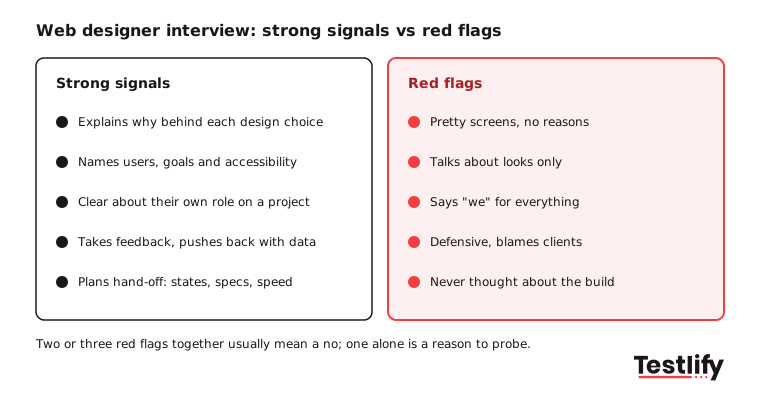
Red flags in a web designer interview are signs that the candidate cannot explain their own work or will struggle with feedback. One alone is not a reason to reject, but two or three together usually are.
How do you score web designer interview answers fairly?
Web designer interview answers are scored fairly when every interviewer uses the same scorecard and rates each answer before any discussion. A shared interview scorecard stops the debrief from turning into a vote on who liked whom.
LinkedIn's Future of Recruiting 2025 found that 93% of TA pros say accurately assessing a candidate's skills is crucial to quality of hire. Only 25% feel highly confident they can measure it.
Area | Weight | 1 (weak) | 3 (meets the bar) | 5 (strong) |
|---|---|---|---|---|
Design process | 20% | No clear steps | Clear steps, some reasons | Repeatable process, adapts it to the project |
Visual craft | 25% | Choices by taste only | Sound type, colour and layout | Explains rules and when to break them |
Responsive and accessible | 20% | Not considered | Knows the basics | Designs for it from the start, tests it |
Front-end and hand-off | 15% | No idea how it is built | Clean files and specs | Components, states, speed in mind |
Collaboration | 20% | Defensive or vague | Handles feedback well | Uses data to win agreement |
We have seen debriefs shrink from an hour of opinions to a short check of the scores once every interviewer fills the scorecard first. Rate each area 1 to 5, multiply by the weight, and compare totals only after every interviewer has submitted.
Adjust the weights to the role. A designer who builds in a CMS needs more weight on front-end skills.
What work sample should a web designer complete?
A web designer work sample should be a short, paid task that mirrors the real job. For example, redesign one page of your site for mobile in three to four hours, with a short note explaining the choices.
Score it with the same scorecard as the interview.
A good brief includes:
- The page and the goal: For example, "the pricing page, to raise demo requests".
- The audience: Who visits the page and on what device.
- Constraints: Brand colours and fonts, any components that must stay.
- Deliverables: One mobile and one desktop frame, plus a 200-word rationale.
- Time box: Three to four hours, paid, so you do not lose strong candidates who are working elsewhere.
Across the teams we work with, the rationale note tells you more than the visuals: it shows whether the candidate can explain trade-offs to a client.
Where do interview questions fit in the web designer hiring process?
Interview questions fit after a skills test and portfolio review and before the work sample, so you spend interview time only on candidates who already show the basics. A simple order is: job description, skills test, portfolio review, structured interview, work sample, then the offer.
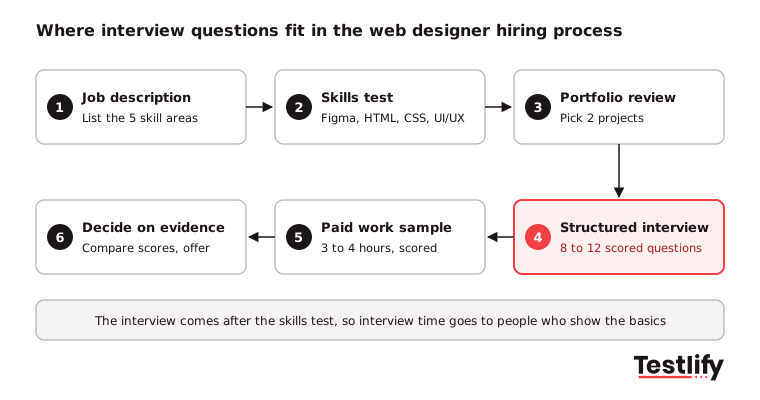
- Write the job description: Start from our web designer job description template and list the five skill areas.
- Run a skills test: A test such as the UI/UX designer test, the Figma test or the HTML5 test checks the basics before anyone spends time on interviews.
- Review the portfolio: Pick two projects to discuss in the interview.
- Run a structured interview: Use the questions above, the same order for every candidate, as in a structured interview. For a related role, see our UI/UX designer interview questions.
- Set the work sample: Paid, time-boxed, scored on the same scorecard.
- Decide on evidence: Compare scorecard totals, then make the offer.
Testlify supports the testing step with a library of 3,500+ tests, including the CSS test and Adobe Photoshop test. Add your own design questions using 25+ question types, and use 20+ proctoring checks to confirm remote work is the candidate's own.
Ready to test web design skills before the first interview? Book a demo to see Testlify in action.
Frequently asked questions (FAQs)

Human Resources Lead
Snehi Parmar leads People at Testlify, owning hiring, culture, performance, and retention for a 90-person team. She writes on practical HR strategy and building people processes that scale.
Related resources
View all
Interview questions
Truck driver interview questions: 40 to ask and how to score them

Interview questions
Marketing internship interview questions: 30 to ask and what to listen for
Interview questions
Interior designer interview questions: 40 to ask in 2026

Interview questions
40 electrician interview questions and what good answers sound like

Interview questions
25 accounting clerk interview questions and answers
Interview questions
25 Zendesk Software Engineer Interview Questions (2026)
Get started.
Hire on proof, not resumes.
Run your first skills-based assessment free — no credit card required.