
Truck driver interview questions: 40 to ask and how to score them
40 questions to ask truck drivers about safety, hours of service, inspections and reliability, plus answers to listen for and red flags.

Truck driver interview questions are the questions a carrier or fleet asks a driver applicant to check safe driving habits, knowledge of federal rules, judgment on the road, reliability and fit for the route. A good set asks every candidate the same things, in the same order, so answers are easy to compare. Each answer ties to a score, which keeps hiring decisions fair and consistent. Paperwork checks, such as the driving record and medical certificate, belong in the qualification file, not the interview. This guide gives 40 questions, strong and weak answers, and a simple scoring sheet.
TL;DR / Key Takeaways
- Experience, safety and compliance, judgment on the road, reliability and customer service, and fit for the schedule.
- Each area shows what a strong answer sounds like and which answers are red flags.
- Rate each area from 1 to 5, apply weights, and end the process on any 1 in safety and compliance.
- Federal rules require checks on driving record, past employers, drug and alcohol history, medical certificate and a road test before a driver gets the keys.
- Stay off age, family, health and other protected topics before an offer.
- A short test before the interview saves recruiter time.
Driver hiring never really slows down. The BLS Occupational Outlook Handbook counts about 2.2 million heavy and tractor-trailer truck drivers in the US and projects about 214,500 openings every year through 2035, most of them to replace drivers who retire or change jobs. With that much churn, recruiters need an interview that is quick to run and still separates safe drivers from risky ones.
 ChatGPT
 Gemini
 Claude
 Grok
 Perplexity
What should truck driver interview questions cover?
Truck driver interview questions should cover five areas: experience and licensing, safety and compliance, judgment on the road, reliability and customer service, and fit for the schedule and route. Safety and compliance deserve the most weight, because one unsafe driver costs more than any delay in filling the seat.
Use the same questions, in the same order, for every candidate for the same role. A structured interview makes answers easy to compare and keeps one interviewer's gut feel from deciding the hire. Pick 8 to 12 questions from the lists below for a 30 to 40 minute interview, and keep the rest for a second round or a phone screen.

What general and experience questions should you ask a truck driver?
General truck driver interview questions confirm what the candidate has driven, where, and for how long. They set up the rest of the interview, so ask them first and listen for specifics: equipment types, freight types, lanes and years.
- What class of CDL do you hold, and which endorsements do you have (hazmat, tanker, doubles and triples)?
- What types of trucks and trailers have you driven: dry van, reefer, flatbed, tanker, box truck?
- What kind of routes have you run: local, regional or over the road?
- What is the longest haul you have driven, and how did you plan it?
- Which states or regions do you know well, and which are new to you?
- Why did you leave your last driving job, or why are you looking now?
- What do you want from your next carrier that your last one did not give you?
- Have you worked with an ELD, and which systems have you used?
The federal baseline is simple. Under 49 CFR 391.11, an interstate driver must be at least 21, read and speak English well enough to talk with the public, hold one valid commercial license and pass a road test. The questions above check what sits on top of that baseline.
Pro tip: Ask question 6 early and without judgment. A clear, specific reason for leaving tells you far more than a tidy answer about career goals, and it shows what will make this driver leave you.
Which safety and compliance questions should you ask?
Safety and compliance questions check whether the driver knows the rules well enough to follow them without a dispatcher watching. The best answers name the rule, explain a real situation, and show the driver chose safety over the clock.
- Walk me through your pre-trip inspection, step by step.
- Tell me about a time an inspection found a problem. What did you do?
- How do you plan your day around the 11-hour driving limit and the 14-hour window?
- What do you do when a delivery window and your hours of service do not both fit?
- Have you ever been asked to run over your hours? How did you handle it?
- What is the 7/3 sleeper berth split, and when would you use it?
- How do you secure a load you have not hauled before?
- Describe your driving record over the last three years, including tickets and accidents.
- Tell me about an accident or near miss. What happened and what changed afterwards?
- What would you do if your ELD showed a different duty status from what you actually did?
Hours of service come up often for a reason. Under 49 CFR 395.3, a property-carrying driver may drive up to 11 hours inside a 14-hour window after 10 hours off, needs a 30-minute break after 8 hours of driving, and stops at 60 or 70 on-duty hours in 7 or 8 days. In the 2025 International Roadcheck, the Commercial Vehicle Safety Alliance found that hours of service caused 32.4% of driver out-of-service violations across 56,178 inspections, and false logs another 10%.
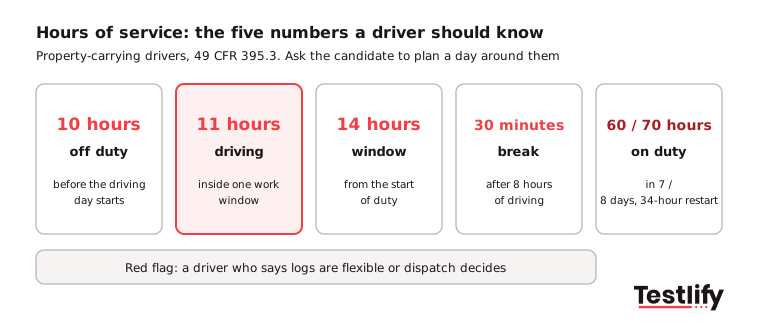
A strong answer to question 5 sounds like this: "Dispatch asked me to take one more load that would have put me over. I told them my clock, offered the earliest legal time, and logged it." A weak answer blames dispatch or says "everyone does it".
Which situational questions test a driver's judgment on the road?
Situational truck driver interview questions put the candidate in a realistic problem and ask what they would do. Long-haul drivers work alone most of the day, so these questions show whether they can make a safe call when nobody is there to approve it.
- You are two hours from the customer and the weather turns bad. What do you do?
- Your truck breaks down on the shoulder at night. Walk me through your next 30 minutes.
- A dispatcher gives you a pickup address that does not match the bill of lading. What do you do?
- You feel tired but your delivery is due in an hour. How do you decide whether to keep going?
- A shipper wants you to leave with a load you think is not secured. How do you handle it?
- Your GPS sends you toward a low bridge or a road trucks cannot use. What then?
- Tell me about the hardest safety decision you made alone on the road.
For situational answers, use a behavioral interview follow-up: "Has that happened to you? What did you do?" Real stories with details beat textbook answers every time.
What questions show a driver's reliability and customer service?
Reliability questions show whether the driver arrives on time, keeps people informed and treats customers well. For many shippers, the driver is the only person from your company they ever meet, so communication counts as much as driving.
- How do you make sure you hit delivery windows?
- Tell me about a late delivery. Who did you tell, and when?
- How do you handle a customer who is angry about a delay?
- Has a customer ever complained about you? What happened?
- How do you keep your paperwork, logs and receipts accurate?
- How do you stay in touch with dispatch during a long run?
- Tell me about a time you got wrong information from dispatch or a coworker.
Listen for the word "early". Strong drivers call ahead before they are late, not after.
What questions check fit for the schedule and route?
Fit questions check whether the job's schedule, home time and equipment match what the driver wants. Most driver turnover starts here: a driver who wanted to be home every night will not stay long on an over-the-road route.
- How much home time do you need, and how often?
- Are you comfortable with nights, weekends and holidays on the road?
- How do you feel about slip seating, sharing a truck with other drivers?
- How do you feel about cameras and real-time tracking in the cab?
- What do you do to stay healthy and alert on long runs?
- Where do you want to be in three years: driving, training new drivers, or dispatch?
- If you joined us, what would make you stay three years?
- What questions do you have for us?
Be honest about the route in return. A clear picture of miles, home time and equipment in the interview costs a few candidates now and saves a lot of early quits later. For more on the cost of early quits, see turnover rate.
What do strong and weak answers to truck driver interview questions sound like?
Strong answers to truck driver interview questions are specific, honest and put safety first. Weak answers are vague, blame others, or treat rules as optional. Use the table below as a quick guide during the interview.
Area | Strong answer | Red flag |
|---|---|---|
Pre-trip inspection | Walks through a set order: lights, tires, brakes, coupling, fluids, load | "I just check the tires and go" |
Hours of service | Plans stops around the 11 and 14 hour limits, knows the 30-minute break | Says dispatch decides, or logs are "flexible" |
Accidents and tickets | Owns what happened and says what changed after | Blames everyone else, or says "never" when the record says otherwise |
Breakdown | Hazard lights, triangles, safe position, calls dispatch and roadside help | Tries a roadside fix without telling anyone |
Late delivery | Calls the customer and dispatch early with a new ETA | Speeds to make it up, or stays silent |
Load securement | Checks and rechecks, refuses an unsafe load | "The shipper loaded it, not my problem" |
Reason for leaving | Clear, specific, fair to the old employer | Many short jobs with no clear reason |
Key takeaway: Ask for real examples, not opinions. "Tell me about a time" beats "What would you do" for any area where the driver has years behind them.
How do you score truck driver interview answers?
Scoring truck driver interview answers works best with a simple sheet: each interviewer rates every area from 1 to 5 right after the interview, then the scores are weighted and added up. Agree on what a 1, 3 and 5 look like before the first interview, so two interviewers score the same answer the same way.
Area | Weight | 1 (poor) | 3 (fine) | 5 (strong) |
|---|---|---|---|---|
Safety and compliance | 30% | Unsure of hours of service or inspection steps | Knows the rules, few real examples | Knows the rules and gives clear stories of choosing safety |
Judgment on the road | 25% | Vague or risky choices in scenarios | Sensible but generic | Calm, step-by-step, tells dispatch and the customer |
Reliability and customer service | 20% | Blames others for delays | On time most of the time | Calls ahead, keeps records tidy |
Experience and licensing | 15% | Equipment or lanes do not match | Some match | Full match on class, endorsements and freight |
Fit for schedule and route | 10% | Wants a different schedule | Open to it | Wants exactly this route and home time |
Set one hard rule on top of the weights: any 1 in safety and compliance ends the process, whatever the total. A driver with great customer service and weak safety is still the wrong hire.
What should you verify instead of asking in the interview?
Verification covers what an interview cannot prove: the driving record, past employer safety history, drug and alcohol history, medical fitness and real driving skill. Federal rules require most of these checks, so build them into the process instead of asking the candidate to vouch for themselves.
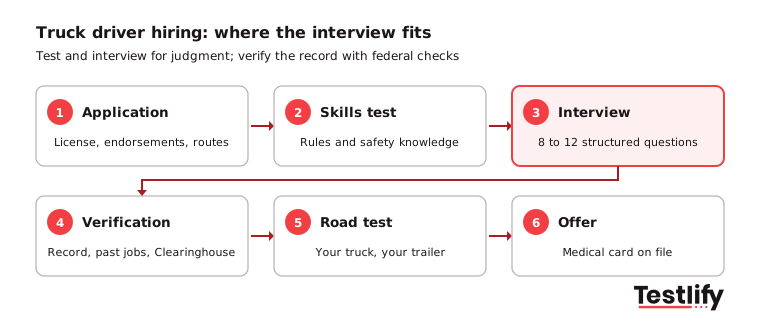
- Driving record: Under 49 CFR 391.23, carriers must get a motor vehicle record from every state where the driver held a license in the past three years.
- Past employer safety history: The same rule requires a check with each DOT-regulated employer from the past three years, with the replies filed within 30 days of the start date.
- Drug and alcohol history: Carriers must run a pre-employment query in the FMCSA Drug and Alcohol Clearinghouse. According to the Clearinghouse FAQ, the driver must give electronic consent first, and a driver who refuses cannot drive for you.
- Medical certificate: Confirm a current medical examiner's certificate from an examiner on the national registry.
- Road test: Watch the driver couple, inspect and drive the equipment they will actually use.
For the wider process, see the Testlify guide on background checks.
Which truck driver interview questions should you avoid?
Truck driver interview questions should stay on the job: driving, safety, rules, reliability and schedule. Avoid questions about age, race, religion, national origin, pregnancy, family plans, or health and disability before a job offer, even when they seem friendly.
The EEOC says employers may not ask about disability before an offer, and that questions about race, sex, national origin, age or religion are irrelevant to hiring decisions. Medical fitness for a commercial license is handled by the DOT medical exam, not by interview questions.
Instead of asking | Ask this |
|---|---|
"How old are you?" | "Do you meet the minimum age for this route?" |
"Do you have kids at home?" | "This route has you out five nights a week. Does that work for you?" |
"Any health problems?" | "Do you hold a current DOT medical certificate?" |
"Where are you from?" | "Can you read and speak English well enough to talk with customers and officers?" |
How can a skills test shorten truck driver hiring?
A short skills test before the interview checks rules and safety knowledge for every applicant at once, so recruiters spend interview time only on drivers who already know the basics. The interview then focuses on stories, judgment and fit, which a test cannot cover.
Testlify's test library holds 3,500+ tests, including blue-collar roles. The Truck Driver test covers areas like vehicle operation, defensive driving, route planning, load securing and safety rules, according to its test page, and there is a separate CDL-A Driver test. Candidates take the test on their own time, scores rank the shortlist, and 20+ proctoring checks help confirm the answers are the driver's own. The platform supports 15+ languages, and results sync to 100+ ATS and HRIS tools.
For the full hiring process, from job ad to offer, read how to hire a truck driver, or see how fleets use Testlify on the logistics and supply chain page.
Frequently asked questions
Find drivers who know the rules before the interview
Send every applicant the Truck Driver test first, then interview only the drivers who pass. Start a 7-day free trial of Testlify, no credit card required, and build a driver assessment from your own job description.

Content Writer
Yashika Khandelwal is a Content Writer with 3+ years of experience creating research-backed content on hiring, talent assessment, and HR technology. She is a registered Organizational Psychologist and subject matter expert who combines behavioral science with practical recruitment insights to produce accurate, evidence-based content.
LinkedInRelated resources
View all
Interview questions
Marketing internship interview questions: 30 to ask and what to listen for

Interview questions
Interior designer interview questions: 40 to ask in 2026

Interview questions
40 electrician interview questions and what good answers sound like

Interview questions
25 accounting clerk interview questions and answers

Interview questions
25 Zendesk Software Engineer Interview Questions (2026)

Interview questions
7 interview questions to check if the candidate is tech-savvy
Get started.
Hire on proof, not resumes.
Run your first skills-based assessment free — no credit card required.