
Salesforce interview questions: 40 questions with answer keys
Forty Salesforce questions for admin, developer, architect and BA hires, each with what a good answer covers and a red flag to watch for.

The best Salesforce interview questions ask a candidate to explain a decision, not recite a definition: when to use Flow instead of Apex, how to bulkify a trigger, how to open record access without opening too much. Below are 40 Salesforce interview questions for admins, developers, architects, business analysts and Agentforce work, each with what a strong answer covers and the red flag to listen for.
Hiring teams have good reason to get this right. In LinkedIn's Future of Recruiting 2025 report, 93% of talent acquisition pros said accurately assessing a candidate's skills is crucial to quality of hire, yet only 25% felt highly confident they could measure quality of hire at all. A Salesforce org is usually run by a small team, so one weak hire shows up fast in broken automation, bad data and slow releases.
 ChatGPT
 Gemini
 Claude
 Grok
 Perplexity
TL;DR
- The strongest Salesforce interview questions are "why" and "what would you do" questions. Definitions are easy to memorize; trade-offs are not.
- For admins, ask about the sharing model, Flow design, data quality and release habits. For developers, ask about governor limits, bulkified triggers, test classes and Lightning Web Components.
- Scenario questions (a user cannot see a record, a trigger fails after a data load) separate people with production experience from people with only certifications.
- Architects should be asked about trade-offs: one org or many, large data volumes, integration patterns and governance.
- In 2026, add Agentforce questions on when to use an agent, how it is grounded in data and how it is tested before go-live.
- Score every answer on a 1, 3, 5 scale written down before the interview, and use the same questions for every candidate.
- Test hands-on Salesforce skills before the interview, then spend interview time on judgment and real project stories.

What should Salesforce interview questions test?
Salesforce interview questions should test five things: platform knowledge, configuration and automation, code (for developers), data and integration, and judgment with stakeholders. How much weight each area gets depends on the role. An admin interview leans on configuration and data, a developer interview on code and limits, and an architect interview on trade-offs.
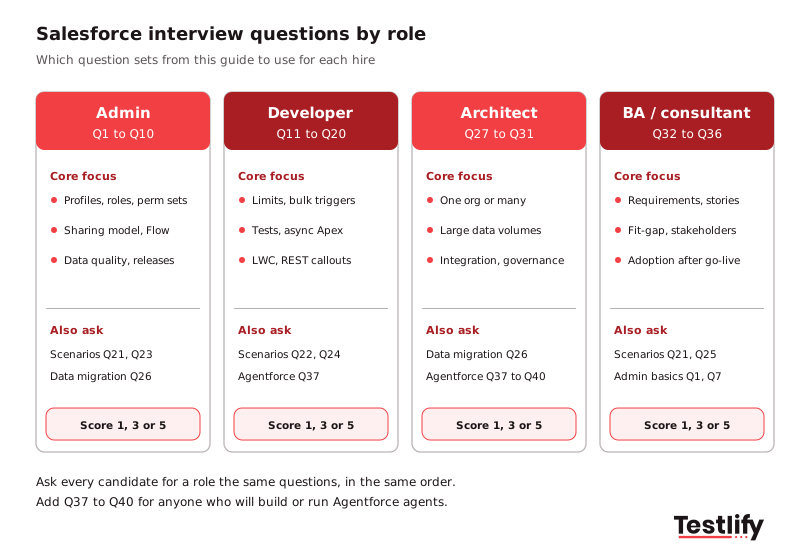
A simple rule helps: ask fewer definition questions than you think you need. A candidate who can define a master-detail relationship may still build a data model that breaks reporting. Ask what they built, why they chose it and what they would change. If you are new to the platform yourself, the Salesforce entry in the Testlify tech glossary covers the basics.
Role | Main focus | Sections below | Good interview length |
|---|---|---|---|
Salesforce admin | Security, Flow, data quality, releases | Admin, scenarios | 45 to 60 minutes |
Salesforce developer | Apex, limits, triggers, testing, LWC, integration | Developer, scenarios, Agentforce | 60 to 90 minutes, plus a code task |
Salesforce architect | Org strategy, data volume, integration, governance | Architect, scenarios, Agentforce | 90 minutes, often a design session |
Business analyst or consultant | Requirements, fit-gap, stakeholders, adoption | BA and consultant, scenarios | 45 to 60 minutes |
What Salesforce admin interview questions should you ask?
Salesforce admin interview questions should cover security and access, automation with Flow, data quality, reporting and how the candidate ships changes safely. These 10 questions work for mid-level admins; for juniors, keep questions 1 to 5 and drop the release questions.
1. What is the difference between a profile, a role and a permission set?
- Strong answer covers: Profiles and permission sets control what a user can do (objects, fields, system permissions). Roles control which records a user can see through the role hierarchy. Strong admins say they keep profiles minimal and grant access with permission sets and permission set groups.
- Red flag: Treating roles and profiles as the same thing.
2. Walk me through how record access works in Salesforce.
- Strong answer covers: Org-wide defaults set the most restrictive baseline, then the role hierarchy, sharing rules, teams and manual sharing open access up. The candidate should know that sharing can only widen access from the baseline.
- Red flag: Setting org-wide defaults to Public Read/Write to "fix" visibility problems.
3. When would you use a validation rule, and when would you use Flow?
- Strong answer covers: Validation rules block bad data at save with a clear message. Flow changes data or runs logic. Good admins mention keeping error messages helpful to users.
- Red flag: Using a Flow to block saves that a simple validation rule would handle.
4. Salesforce retired Workflow Rules and Process Builder. How did you handle the move to Flow?
- Strong answer covers: An inventory of old automation, consolidation into fewer record-triggered flows per object, before-save flows for simple field updates, and testing in a sandbox first.
- Red flag: No awareness that the older tools are retired.
5. How do you prevent duplicate records?
- Strong answer covers: Matching rules and duplicate rules, alert versus block, plus a plan for duplicates already in the org (a cleanup project, merge rules, ownership of data quality).
6. A sales manager says a dashboard shows the wrong numbers. How do you investigate?
- Strong answer covers: Check the source report filters, the running user of the dashboard, date ranges, record access of the viewer, and whether the data itself is wrong.
7. How do you decide between a lookup and a master-detail relationship?
- Strong answer covers: Master-detail ties ownership, sharing and deletion to the parent and allows roll-up summary fields. Lookup keeps records independent. The candidate should mention the impact on reporting and record access.
8. How do you move changes from a sandbox to production?
- Strong answer covers: Change sets or DevOps Center, a test plan, a release window, communication to users and a rollback plan.
- Red flag: Making changes directly in production as a habit.
9. How do you keep up with Salesforce's three releases a year?
- Strong answer covers: Reading release notes, testing in a preview sandbox, and flagging features that affect their own org. Trailhead badges are fine; a story about a release they planned for is better.
10. Tell me about a time a user asked for something you said no to.
- Strong answer covers: The real need behind the request, the risk or cost they explained, and what they offered instead.
Before the interview, a Salesforce admin test can check the configuration knowledge, so the interview can focus on questions 6, 8 and 10.
What Salesforce developer interview questions should you ask?
Salesforce developer interview questions should test Apex, governor limits, trigger design, testing, Lightning Web Components and integration. The best ones ask the candidate to explain how they would write something, then why, because most Salesforce code problems come from code that works for one record and fails for 200.
11. What are governor limits, and which ones have you hit in production?
- Strong answer covers: Salesforce runs on shared infrastructure, so every transaction has limits. Salesforce's published limits include 100 SOQL queries and 150 DML statements per synchronous transaction. A strong candidate names a limit they actually hit and how they fixed it.
- Red flag: Reciting the numbers with no story behind them.
12. How do you bulkify a trigger?
- Strong answer covers: No SOQL or DML inside loops; collect IDs into sets, query once, use maps, and do one DML on a list. Triggers receive up to 200 records at a time, so code must handle all of them.
13. How do you structure triggers in a large org?
- Strong answer covers: One trigger per object, logic in a handler class, a way to stop recursion and a way to switch logic off during data loads.
14. When do you choose Flow over Apex?
- Strong answer covers: Flow for logic an admin can maintain, Apex for complex logic, heavy data volume, callouts with error handling or anything that needs real unit tests. Strong developers do not over-code what Flow can do.
- Red flag: "I always write Apex" or "I never write Apex."
15. What is the difference between with sharing and without sharing?
- Strong answer covers: With sharing enforces the running user's record access; without sharing ignores it. Good answers mention inherited sharing, checking field and object permissions, and why "without sharing" needs a reason.
16. How do you write a good test class?
- Strong answer covers: Tests create their own data, test bulk cases and negative cases, use asserts that check behavior and use Test.startTest and Test.stopTest for async work. The candidate should know 75% org-wide code coverage is needed to deploy, and that coverage alone proves little.
- Red flag: Tests with no asserts written only to reach coverage.
17. When would you use Queueable, Batch or Future methods?
- Strong answer covers: Future for simple fire-and-forget work, Queueable for chaining and complex types, Batch Apex for millions of records, scheduled Apex for timed jobs.
18. How do two Lightning Web Components talk to each other?
- Strong answer covers: Public properties from parent to child, custom events from child to parent and Lightning Message Service between unrelated components. Bonus: Lightning Data Service and wire adapters to avoid needless Apex calls.
19. How would you call an external REST API from Salesforce?
- Strong answer covers: Named Credentials for authentication, a callout from async Apex when triggered by a record change, timeouts, retries, logging and mock classes for tests. The REST API glossary entry is a useful primer for non-technical interviewers.
20. Describe a bug you shipped and how you found it.
- Strong answer covers: Debug logs, the developer console or a log framework, how they reproduced the problem and what they changed in their process afterwards.
For a hands-on check before the interview, Testlify has a Salesforce development test and an Apex test.
Which scenario-based Salesforce interview questions work best?
Scenario-based Salesforce interview questions work best when they come from problems your own org has had. Give the candidate the situation, let them ask questions and listen for a calm order of checks. These six work for admins, developers and architects; adjust the depth to the role.
21. A user says they cannot see an account their colleague can see. What do you check?
- Strong answer covers: Org-wide defaults, the role hierarchy, sharing rules, record ownership, the user's profile and permission sets, and the "Sharing Hierarchy" button to see why access exists.
22. A trigger works in testing but fails after a data load of 50,000 records. Why?
- Strong answer covers: Non-bulkified code, SOQL in loops, recursion or other automation on the same object adding to the limits. The fix includes bulk tests and a switch to bypass logic during loads.
23. A record-triggered flow has made saves slow. How do you fix it?
- Strong answer covers: Count the automation on the object, move simple field updates to before-save flows, add entry conditions, and remove queries inside loops.
24. A nightly integration fails silently. What do you build so it does not happen again?
- Strong answer covers: Error logging, alerts to a named owner, retry logic, and a way to replay failed records.
25. A release broke a key process in production on a Friday afternoon. Walk me through the next hour.
- Strong answer covers: Tell users, assess impact, roll back or deactivate the change, find the cause, and run a short review afterwards.
26. You are asked to migrate 2 million records from a legacy CRM. How do you plan it?
- Strong answer covers: Data mapping, cleaning before loading, external IDs and upserts, load order (accounts before contacts before opportunities), turning off automation during loads, Bulk API for volume, and a test load in a full sandbox.
Pro tip: Ask scenario questions out loud, then stay quiet. Across the teams we work with, the clearest signal is whether the candidate asks a clarifying question before answering. People who have run a real org almost always do.
What should you ask a Salesforce architect?
Salesforce architect interview questions should be about trade-offs, not features: one org or many, how to design for data volume, which integration pattern fits, and how to govern a platform many teams change. Expect the candidate to draw. A 30-minute design exercise tells you more than ten questions.
27. When would you recommend a single org, and when multiple orgs?
- Strong answer covers: Shared customers and processes favor one org; strong legal, regional or business-unit separation can justify several. The candidate should name the cost of each, such as integration and reporting across orgs.
28. How do you design for large data volumes?
- Strong answer covers: Selective queries and indexed fields, avoiding ownership and parent-record skew, archiving strategy, and when to keep data outside Salesforce.
29. Which integration patterns have you used, and why?
- Strong answer covers: Request and reply, fire and forget with Platform Events, batch data sync, Change Data Capture and middleware. A strong architect explains why each choice fit that system.
30. How do you govern an org where five teams ship changes?
- Strong answer covers: A source-driven release process, environment strategy, code and design reviews, naming standards and a change advisory group that does not slow everything down.
31. Tell me about a design decision you got wrong.
- Strong answer covers: A real mistake, what it cost and what they now do differently.
- Red flag: No example at all.
What should you ask a Salesforce business analyst or consultant?
Salesforce business analyst and consultant interview questions should test how the candidate turns messy business needs into clear requirements and a solution people actually adopt. Technical depth matters less here than listening, writing and saying no with evidence.
32. How do you gather requirements from people who do not know what Salesforce can do?
- Strong answer covers: Asking about the process and pain, not the feature; watching users work; writing user stories with acceptance criteria.
33. Two stakeholders want opposite things. How do you resolve it?
- Strong answer covers: Tying both requests to a business goal, showing the cost of each option, and getting a named decision owner.
34. How do you run a fit-gap analysis?
- Strong answer covers: Mapping each requirement to standard functionality, configuration or custom work, and pushing for standard features first.
35. How do you know a release succeeded after go-live?
- Strong answer covers: Adoption metrics, login and usage reports, data quality checks and feedback sessions, not just "it deployed."
36. Tell me about a project where the scope changed halfway through.
- Strong answer covers: A change process, impact on timeline and cost, and clear communication.
For more question sets in this format, see Testlify's business analyst interview questions and role guides such as the GIS specialist interview questions.
Which Agentforce and AI questions belong in a 2026 interview?
Agentforce and AI questions belong in any 2026 interview for senior Salesforce developers, architects and admins working on service or sales automation. Agentforce is Salesforce's platform for AI agents. You do not need candidates with years of agent experience; you need people who can say when an agent is the right tool and how to keep it safe.
37. When would you use an Agentforce agent instead of a Flow or Apex?
- Strong answer covers: Agents for open-ended requests in natural language; Flow and Apex for predictable, rule-based steps. Good answers note that agents often call flows and Apex as their actions.
38. How do you ground an agent in your company's data?
- Strong answer covers: Giving the agent clean, permission-aware data, clear topics and instructions, and limiting what actions it can take.
39. How do you protect sensitive data when using generative AI in Salesforce?
- Strong answer covers: The Einstein Trust Layer, data masking, respecting user permissions and logging what the model sees and returns.
40. How would you test an agent before go-live?
- Strong answer covers: A set of test conversations including edge cases, a human handoff path, monitoring after launch and a clear owner for fixes.
- Red flag: "We will see how it does in production."
How do you score answers to Salesforce interview questions?
Scoring answers to Salesforce interview questions works best with a 1, 3, 5 scale written before the first interview, the same questions for every candidate, and each interviewer scoring alone before the debrief. The US Office of Personnel Management's guidance on structured interviews describes the same idea: the same questions in the same order, rated against one scale and agreed standards for acceptable answers.
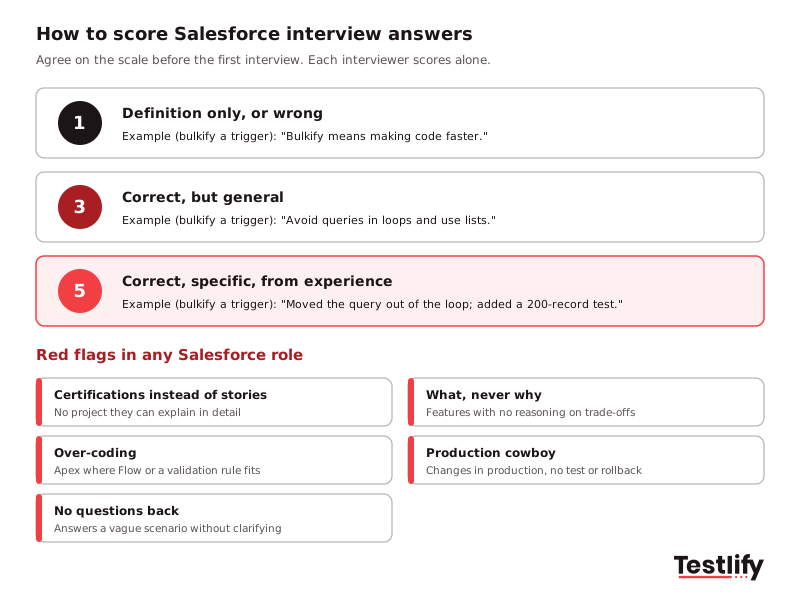
Score | What the answer sounds like | Example (question 12, bulkify a trigger) |
|---|---|---|
1 | Definition only, or wrong | "Bulkify means making code faster." |
3 | Correct, but general | "Avoid queries in loops and use lists." |
5 | Correct, specific and from experience | "Our lead trigger hit the SOQL limit on a 10,000-row import. I moved the query out of the loop into a map keyed by account ID and added a 200-record test." |
These red flags matter across every role:
- Certifications instead of stories: A list of credentials but no project they can explain in detail.
- What, never why: Correct features with no reasoning about trade-offs.
- Over-coding: Apex for work that a Flow or a validation rule handles.
- Production cowboy: Changes made directly in production with no testing or rollback plan.
- No questions back: Answering a vague scenario without asking a single clarifying question.
A shared interview scorecard keeps the panel honest, and the structured interview glossary entry explains why the same questions matter.
Should you test Salesforce skills before the interview?
Testing Salesforce skills before the interview is the fastest way to protect interview time. A short online test checks configuration and coding knowledge for every applicant, so the interview can focus on scenarios, judgment and project stories that a test cannot capture.
Demand for platform skills keeps pressure on hiring teams. The US Bureau of Labor Statistics' software developer outlook projects 10% growth from 2025 to 2035 and about 106,100 openings a year, with a median pay of $134,040 in May 2025. Many Salesforce developers sit in that group, and good ones get several offers.
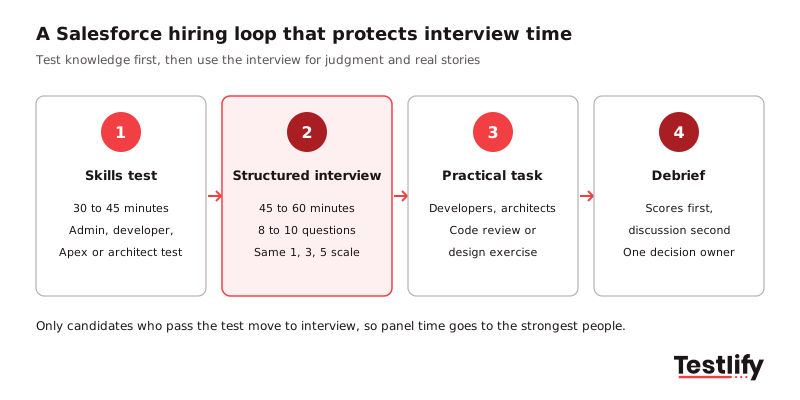
A loop that works for most Salesforce roles:
- Skills test: 30 to 45 minutes, matched to the role. Testlify's library of 3,500+ tests includes tests for Salesforce Lightning, the Salesforce architect role and Salesforce Marketing Cloud, alongside the admin and development tests above.
- Structured interview: 45 to 60 minutes, using 8 to 10 questions from this list and the 1, 3, 5 scale.
- Practical task: for developers and architects, a short code review or design exercise based on a real problem in your org.
- Debrief: scores first, discussion second.
Certifications still help as a filter for basics, but we have seen certified candidates struggle with question 21 and uncertified ones nail it. Treat a certification as proof of study, and the test and interview as proof of skill. For remote tests, Testlify includes 20+ proctoring checks, described on the anti-cheating and proctoring page.
Key takeaway: Use a test to check what a candidate knows, and use Salesforce interview questions to learn how they think. Ask why, ask for a real example, and score every answer against the same scale.
Ready to hire your next Salesforce admin or developer?
Pick the Salesforce test that matches the role in the Testlify test library, send it to every applicant, and bring only the strongest into the interview with the questions above. You can start with a 7-day free trial, no credit card needed.
Frequently asked questions (FAQs)

Related resources
View all
Interview questions
MongoDB interview questions: 30 questions with answers for every level

Interview questions
40 delivery driver interview questions and what good answers sound like

Interview questions
Lab assistant interview questions: 30 to ask, with strong answers

Interview questions
30 scenario based interview questions to ask candidates

Interview questions
30 Selenium interview questions to ask and what strong answers sound like

Interview questions
Situational based interview questions: 30 examples for hiring teams
Get started.
Hire on proof, not resumes.
Run your first skills-based assessment free — no credit card required.