
50 business analyst interview questions to ask in 2026
Fifty business analyst interview questions grouped by skill, with what good answers include, a scoring rubric and the red flags to watch.

Business analyst interview questions are the prompts a hiring team uses to check how a candidate gathers requirements, works with stakeholders, analyzes data and turns findings into decisions. The best sets mix general, technical, scenario, behavioral and work-style questions, and score every answer against the same criteria so the panel compares candidates on evidence, not gut feel.
TL;DR:
- The most useful business analyst interview questions test five skills: requirements, stakeholder management, data and SQL, process modeling and communication.
- Ask candidates to take a skills test before the interview, so interview time goes to judgment and experience instead of basics.
- Scenario prompts, such as a vague dashboard request, reveal more about a business analyst than definition questions do.
- Score every answer on a 1 to 5 scale with written anchors, and have each interviewer score before the debrief.
- Red flags include jumping to a solution, blaming others, happy-path-only acceptance criteria and trusting AI output without checking it.
- Junior candidates need more process and tool questions. Senior candidates need more questions on influence, scope and business cases.
- The US Bureau of Labor Statistics puts median pay for management analysts, the group that includes many business analysts, at $101,860 (May 2025).
 ChatGPT
 Gemini
 Claude
 Grok
 Perplexity
What should business analyst interview questions assess?
Business analyst interview questions should assess five skills: eliciting and writing requirements, managing stakeholders, working with data, modeling processes and communicating findings. O*NET lists "Business Analyst" as a reported title for management analysts, whose core tasks are gathering information on problems, analyzing data, and documenting findings and recommendations.
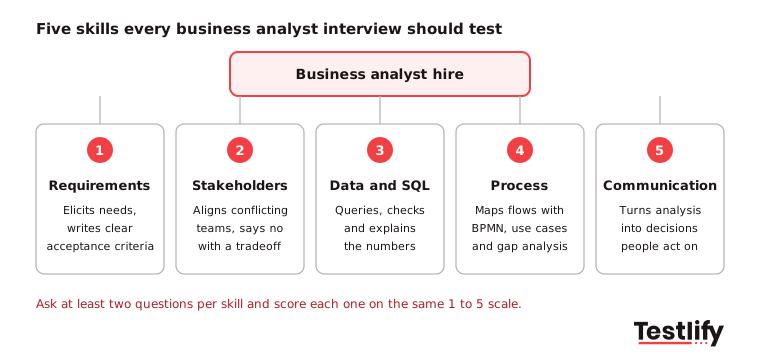
Skill | What a strong candidate shows | Questions in this list |
|---|---|---|
Requirements | Asks before solving, writes testable criteria | 2, 3, 11, 12, 20, 25, 26 |
Stakeholders | Aligns conflicting teams, says no with a tradeoff | 4, 8, 32, 37, 41 |
Data and SQL | Writes and checks queries, explains numbers | 21, 22, 23, 27, 35 |
Process | Maps flows, finds gaps and root causes | 13, 14, 15, 16, 17 |
Communication | Turns analysis into a decision people act on | 9, 10, 28, 46, 48 |
O*NET's profile for management analysts lists active listening, critical thinking, writing and complex problem solving among the core skills, which map closely to the five above.
Set the skills before you write the questions. A business analyst on a data team needs a higher SQL bar than one on a process improvement team, so adjust the weights to the role in your business analyst job description.

When should you ask these questions in the hiring process?
Hiring teams get the most from business analyst interview questions after candidates pass a skills assessment. A test filters out people who lack the analytical and technical basics, so every interview slot goes to someone who can already do the core work, and the questions can probe judgment, experience and fit.
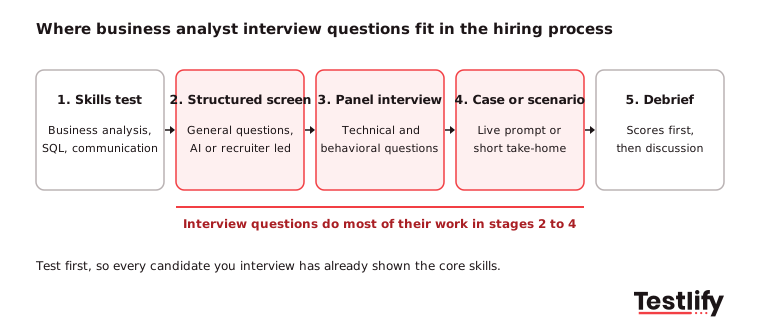
- Skills test: Send a business analyst test with a short SQL or data section to every applicant who meets the basic criteria.
- Structured screen: Ask 5 or 6 general questions from this list, the same for every candidate. A recruiter can run it, or an AI interview by chat, voice or video.
- Panel interview: Split technical and behavioral questions between two interviewers so each one probes fewer skills in more depth.
- Case or scenario: Give one live prompt from the scenario section, or a take-home task capped at about two hours.
- Debrief: Every interviewer submits scores first, then the panel discusses.
LinkedIn's Future of Recruiting 2025 report found that 93% of talent acquisition professionals believe accurately assessing a candidate's skills is crucial for improving quality of hire. LinkedIn Economic Graph research from March 2025 adds that a skills-based approach expands the talent pool a median 6.1 times globally, and 15.9 times in the United States.
Pro tip: Keep the interview loop to four conversations or fewer. More rounds add days to time-to-hire without adding much new evidence, and strong business analysts often hold more than one offer.
Which general business analyst interview questions should you ask?
General business analyst interview questions open the conversation and show how a candidate thinks about the job as a whole. Use them in the structured screen, and ask every candidate the same ones in the same order.
- Can you give an overview of your experience as a business analyst and the types of projects you have worked on?
- How do you gather requirements from stakeholders and make sure they line up with business goals?
- Describe how you analyze and document a complex business process. How do you check that your analysis is accurate and complete?
- How do you work with developers, designers and project managers to deliver a project?
- Tell me about a hard problem on a past project and how you solved it.
- Which techniques and tools do you use to find, evaluate and prioritize business needs?
- How do you make sure the solutions you recommend support the company's overall strategy?
- How do you handle a change in project scope, and how do you manage stakeholder expectations when it happens?
- How do you run a feasibility study and assess the risks of a proposed solution?
- How do you keep up with new practices and tools in business analysis?
Which technical questions test core business analysis knowledge?
Technical business analyst interview questions check whether a candidate knows the methods and artifacts the job runs on: use cases, process models, traceability, prioritization and SQL. Each answer should define the concept briefly, then show when the candidate used it and what it changed.
# | Question | A strong answer covers |
|---|---|---|
11 | What is a use case, and how would you write one? | Actors, main flow, alternate and exception flows, all scenarios covered |
12 | What is the difference between functional and non-functional requirements? | What the system does vs how well it does it (performance, security, usability), with an example of each |
13 | What is a data flow diagram, and when do you use one? | How data moves through a system; context, level 1 and level 2 diagrams |
14 | How do you use Business Process Model and Notation (BPMN)? | Events, activities, gateways; using the model to find delays and handoffs |
15 | Why does a requirements traceability matrix matter? | Links each requirement to design, build and test; protects scope and sign-off |
16 | How do you run a gap analysis? | Current state, target state, the gaps, causes and an action plan |
17 | Which root cause analysis techniques do you use? | 5 Whys, fishbone diagrams, data checks before conclusions |
18 | How do you prioritize requirements? | MoSCoW, weighted scoring or value vs effort, with stakeholders in the room |
19 | How does the business analyst role differ in Agile and Waterfall projects? | Iterative backlog work vs upfront documentation; when each fits |
20 | How do you write a user story and its acceptance criteria? | Role, need and value; the INVEST checks; testable criteria including edge cases |
21 | What is the role of user acceptance testing? | Confirms the system meets user needs before go-live; planning, running and signing off |
22 | How do you build a business case for a project? | Objectives, costs, benefits, risks and return on investment, with a clear recommendation |
23 | Write a query that returns total order value per customer for the last 90 days. | Correct join, GROUP BY, date filter, and a check for duplicates or nulls |
24 | Which tools do you use for data analysis and visualization? | Excel, SQL, Tableau or Power BI, with a real example of a decision the work supported |
O*NET's business intelligence analyst profile also lists "Business Analyst" as a reported title and names Microsoft Power BI and SQL tools among its technology skills, so expect at least a working SQL floor for any data-facing business analyst role.
For a deeper data check, pair these questions with a SQL test or a Tableau test before the panel.
Which scenario questions show how a business analyst really works?
Scenario questions show how a business analyst handles a real, messy request, which definition questions cannot. Give the prompt, stay quiet, and score what the candidate asks before proposing anything.
- A sales director asks for "a dashboard that shows how we are doing." Walk me through your next 30 minutes.
- Write acceptance criteria for a password reset feature. Include what should happen when things go wrong.
- Monthly revenue on a key report dropped 40% overnight. How do you find out whether the business changed or the data broke?
- Finance and operations define "active customer" differently, and the project is stuck. What do you do?
- You are asked to "improve onboarding" with no other detail. How do you scope the work in the first week?
Strong candidates ask clarifying questions first: who will use it, which decision it supports and how success will be measured. Weak candidates start drawing charts or listing features.
Which behavioral questions reveal a strong business analyst?
Behavioral business analyst interview questions ask for real past situations, which predict on-the-job behavior better than hypotheticals. Ask the candidate to describe the situation, what they did and the measurable result, then probe the part they played themselves.
- Tell me about a time you had to analyze a complex business problem. How did you gather and analyze the information?
- Describe a project where you worked with stakeholders from several departments to gather requirements. How did you keep communication clear?
- Tell me about a time stakeholders pushed back on a solution you proposed. How did you handle it and gain buy-in?
- Tell me about a project where you defined scope and objectives. How did you make sure every key requirement was captured and managed?
- Give an example of a time you had to prioritize competing requirements or tasks. What did you do?
- Describe a time you used data to spot a trend that changed a business decision. How did you present it?
- Tell me about a workshop you ran to draw out and clarify requirements. How did you make sure every voice was heard?
- Tell me about a disagreement between stakeholders with different priorities. How did you reach a decision?
- Describe a project where you worked with a cross-functional team to launch a new system or process.
- Tell me about a time business priorities changed mid-project. How did you adapt the requirements, and what was the outcome?
Which personality and work-style questions should you ask?
Personality and work-style questions show how a business analyst handles pressure, detail and difficult people. Keep them tied to real examples, and score them with the same rubric as the rest of the interview.
- Describe a time you had to adapt to a big change in a project or at work. How did you stay focused?
- Tell me about a difficult stakeholder you worked with. How did you build trust and open communication?
- Describe a project that needed strong attention to detail. How did you make sure every requirement was reviewed and validated?
- Tell me about a time you handled competing priorities and tight deadlines at once.
- Tell me about a time you found a creative solution to a complex problem or a big obstacle.
For a structured read on these traits before the interview, a communication test adds objective data to what you hear.
Which questions show how a business analyst uses AI?
AI questions show whether a business analyst uses AI tools to work faster while still checking the output. In 2026, most analysts use AI to draft user stories, summarize interviews or write SQL, so the question is not whether they use it but how they verify it.
- Where do you use AI in your analysis work today, and where do you refuse to use it?
- Tell me about a time AI output was wrong. How did you catch it?
- How would you check an AI-generated set of requirements before sharing it with the team?
Good answers name specific checks, such as tracing each requirement back to a stakeholder, testing a generated query on known data, or never pasting confidential data into public tools.
What do good answers to business analyst interview questions sound like?
Good answers to business analyst interview questions follow a clear structure: the situation, what the candidate did, and a result with a number or a decision. Here are six sample answers to questions from this list, with what to look for in each.
Question 35: Using data to change a business decision
Look for: Real data analysis experience, a clear insight and a recommendation the business acted on.
Example answer: "In my last role I analyzed customer transaction data to understand why repeat purchases were falling. I segmented customers by purchase pattern, built visuals in Tableau and found that buyers who missed a second order within 60 days rarely came back. I recommended a targeted reminder campaign for that group, which marketing launched the next quarter, and repeat purchase rates went up."
Question 31: Keeping stakeholders and developers aligned
Look for: Communication that bridges business and technical teams.
Example answer: "On a CRM rollout I worked with sales, marketing and customer service. I held short weekly reviews, shared mock-ups early and turned every agreed requirement into a user story with acceptance criteria the developers could test. When two teams disagreed, I brought the data on each option to one meeting instead of passing messages back and forth."
Question 42: Making sure requirements are accurate
Look for: Attention to detail and a repeatable quality process.
Example answer: "I write every requirement so it is clear, testable and tied to a business goal. I run a review with stakeholders and a separate walkthrough with developers and testers, and I track each requirement in a traceability matrix. Any change goes through version control, so we always know what was agreed and why."
Question 32: Gaining buy-in after pushback
Look for: The ability to handle resistance and bring people along.
Example answer: "Finance pushed back on a new billing system because they feared disruption at month end. I met each lead one to one to understand the concern, showed a demo with their own data, and worked with the change team on a training plan and a cutover date outside the close. We went live with no missed invoices."
Question 34: Prioritizing competing requirements
Look for: A named prioritization method and stakeholder involvement.
Example answer: "Three teams wanted different features in the same release, and we had capacity for about half. I ran a MoSCoW session with all three leads, scored each item on value and effort, and showed what each choice would push back. We agreed on the must-haves in one meeting and moved the rest to the next release with dates."
Question 44: Finding a creative solution
Look for: Creative problem solving within real constraints.
Example answer: "Our budget for a reporting project was cut by a third. Instead of dropping scope, I worked with the team to reuse an existing data warehouse and replace a planned custom tool with dashboards in the BI tool we already licensed. We delivered the core reports on time and within the new budget."
How do you score answers and spot red flags?
Hiring teams score business analyst interview questions best with a 1 to 5 scale and written anchors for 1, 3 and 5. Each interviewer scores alone before the debrief, so the loudest opinion in the room does not set the result.
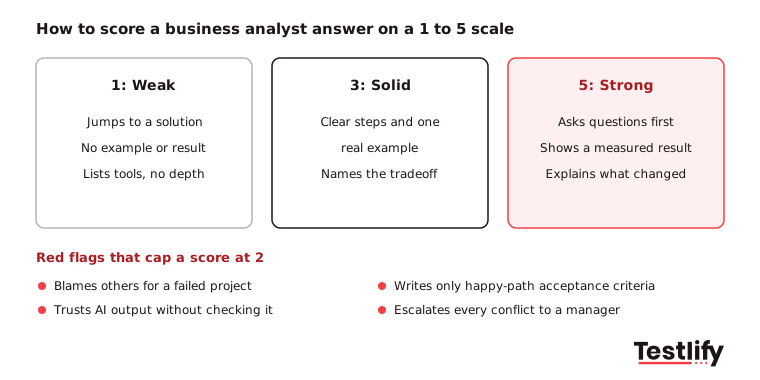
Score | What the answer shows |
|---|---|
1 | Jumps to a solution, gives no example or result, lists tools without depth |
2 | Generic example, unclear personal role, no measure of success |
3 | Clear steps, one real example, names the tradeoff it involved |
4 | Clear steps and result, adapts the approach to the situation |
5 | Asks questions first, shows a measured result, explains what changed afterwards |
Watch for these red flags across the interview:
- Solution first: Proposes a fix before asking what problem the stakeholder is trying to solve.
- Blame: Describes failed projects only in terms of what others did wrong.
- Happy path only: Writes acceptance criteria that ignore errors and edge cases.
- Escalation as a first move: Takes every conflict straight to a manager.
- Tool lists: Names many tools but cannot describe one piece of work done with them.
- Unchecked AI: Trusts AI output fully, or refuses to use it at all.
Key takeaway: A consistent rubric matters more than the exact questions. Two candidates asked different questions but scored on the same anchors are easier to compare than two asked the same questions and judged on gut feel.
How should questions differ for junior and senior business analysts?
Junior and senior business analyst interviews should weight the question types differently. Junior candidates need more questions on process, tools and documentation. Senior candidates need more on influence, scope, business cases and leading other analysts.
Level | Weight more on | Example questions |
|---|---|---|
Junior (0 to 2 years) | Process, tools, documentation, learning speed | 11, 12, 20, 24, 48, 49 |
Mid-level (3 to 5 years) | Requirements, SQL, stakeholder handling | 18, 23, 25, 26, 32 |
Senior (6+ years) | Scope, business cases, influence, strategy | 22, 28, 29, 37, 50 |
Add these three questions to round out the set:
- Walk me through how you would document a process you have never seen before. (Junior)
- Which business analysis artifacts have you produced, and which one are you proudest of? (Junior)
- Can you explain how you used data to influence a strategic decision in a previous role? (Senior)
Which skills assessments work best before the interview?
Skills assessments give hiring teams objective evidence of a business analyst's ability before the first interview. The most useful mix covers business analysis knowledge, data analysis, and written communication and documentation.
- Technical knowledge: Tests a candidate's grasp of business analysis methods, tools and concepts such as requirements, use cases and process models.
- Case studies or scenarios: Ask the candidate to gather requirements, analyze data and propose a solution in a realistic business setting.
- Data analysis exercises: Check how well the candidate reads data, runs quantitative analysis and makes a recommendation. A data analyst test covers this well.
- Communication and documentation: Measure how clearly the candidate writes requirements and reports. Try a documentation test.
Testlify's library holds 3,500+ tests, and you can combine several in one assessment, add your own questions, and use 20+ proctoring checks to protect the results. Scores sync back to your ATS through 100+ integrations, so recruiters see results next to each application. For related roles, see the business process analyst interview questions.
Ready to hire your next business analyst?
Start with a skills test, then use the business analyst interview questions above to go deeper with the candidates who pass. Testlify gives you the assessments, AI interviews and scoring in one place, so your team spends interview time on judgment instead of basics. Browse the Testlify test library, start a 7-day free trial with no credit card, or book a demo to see it with your own roles.
Frequently asked questions (FAQs)

Director of Marketing
Akash Patange is the Director of Marketing at Testlify, where he works closely with HR leaders and recruiters to help organizations improve hiring outcomes. He writes about talent assessment, recruitment technology, and data-driven hiring practices.
LinkedInRelated resources
View all
HR & recruitment
Pre-hire assessments for Warehouse Operatives

HR & recruitment
Pre-Employment Assessments for Hospitality: What to Test and Why

HR & recruitment
Critical recruitment roles for building successful teams

HR & recruitment
Front end developer hiring: a step-by-step guide for 2027

HR & recruitment
Inclusive hiring process: 7 steps to build a fair one

HR & recruitment
How to hire a backend developer
Get started.
Hire on proof, not resumes.
Run your first skills-based assessment free — no credit card required.