
Interview calibration: how to get interviewers scoring alike
Interview calibration keeps every interviewer scoring to one standard. Learn to run a session, read the score spread and fix rating drift.

Interview calibration is the practice of getting every interviewer on a hiring panel to apply the same standard to the same evidence, so a candidate's score depends on their answers and not on who happened to interview them. Teams do it by scoring the same interview independently, comparing the scores and agreeing what each rating level looks like.
TL;DR / Key takeaways
- Interview calibration means every interviewer gives the same answer the same score, so the hiring bar does not move from one panel to the next.
- The core method is simple: everyone scores one real interview alone, the scores are revealed together, and the team rewrites the rubric where scores differ.
- A good session takes 45 to 60 minutes and covers one or two candidates. More than that turns into a general debate.
- Calibration is not agreement. Scores within one point on a four or five point scale are the goal, and a session with no disagreement usually picked the wrong example.
- Recalibrate every quarter, and always when new interviewers join, the rubric changes or a hiring surge starts.
- Watch the data between sessions: each interviewer's average score, spread and pass rate show who is drifting long before a bad hire does.
 ChatGPT
 Gemini
 Claude
 Grok
 Perplexity
What is interview calibration?
Interview calibration is the process of aligning interviewers on what each score means and where the hiring bar sits for a role. A calibrated panel gives the same answer roughly the same rating, whichever interviewer hears it. Without it, a structured interview still produces uneven scores, because people read the same rubric in different ways.
Structure and calibration work together. Structure gives every candidate the same questions and the same scale. The US Office of Personnel Management describes a structured interview as one where all responses are judged with the same rating scale and the same standards for acceptable answers. Calibration is the work that makes sure every interviewer holds those standards in the same place.
A short example shows the gap. Two interviewers hear the same answer about handling an angry customer. One gives it a 4 because the candidate stayed calm. The other gives it a 2 because the candidate never solved the problem. Both followed the interview scorecard. Only calibration tells you which reading the team actually wants.

Why does interview calibration matter?
Interview calibration matters because an uncalibrated panel turns hiring into a lottery: the same candidate passes with one interviewer and fails with another. Calibration makes scores comparable across interviewers, cuts the room for personal bias and gives the team a shared definition of a good hire.
- Fairer decisions: Candidates are judged on what they said, not on whether they drew a tough grader. That matters for fairness and for any later review of a hiring decision.
- Better quality of hire: Comparable scores let you link interview ratings to on-the-job results later and see which questions actually predict success. Read more on how to improve quality of hire.
- Faster debriefs: When everyone reads the scale the same way, debriefs focus on evidence instead of arguing about what a 3 means.
- Less bias: Agreed anchors leave less room for gut feel, the halo effect and "they remind me of me" scoring.
The pressure to measure hiring well is rising. LinkedIn's Future of Recruiting 2025 report found that 89% of talent acquisition professionals say measuring quality of hire will become more important, yet only 25% are highly confident their organization can measure it. The same survey found 93% say accurately assessing candidate skills is crucial to quality of hire. Interview scores that mean different things to different people make both goals harder.
What are the types of interview calibration?
Interview calibration comes in two kinds: role calibration and interviewer calibration. Role calibration aligns the recruiter and hiring manager on what a strong candidate looks like for one opening. Interviewer calibration aligns the people on the panel on how to score answers. Most hiring teams need both.
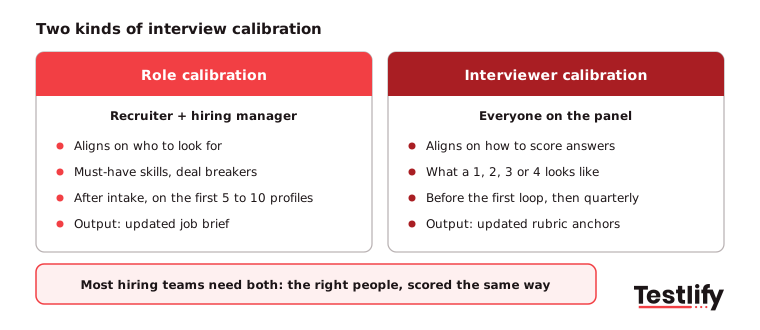
Within interviewer calibration, teams use four methods:
- Shadowing: A new interviewer watches an experienced one run the interview, then they compare notes and scores.
- Reverse shadowing: The new interviewer leads while the experienced one observes and gives feedback. After a few of these, the new interviewer runs interviews alone.
- Joint scoring: Several interviewers score the same recorded interview independently, then compare. This is the core of a calibration session.
- Score data review: The team looks at each interviewer's average scores, spread and pass rates over many interviews to find drift.
How do you run an interview calibration session?
An interview calibration session runs in five steps: pick one real interview, have everyone score it alone, reveal all scores at once, discuss the gaps against the evidence, and write the agreed changes into the rubric. A session of 45 to 60 minutes with 3 to 6 interviewers works for most roles.
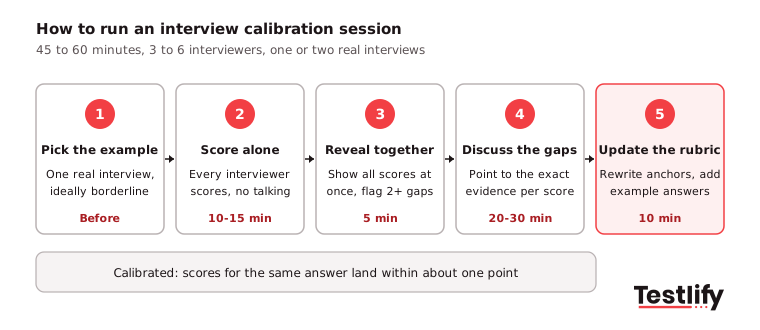
- Pick the example (before the session): Choose one recorded or recent interview, ideally a borderline candidate. Clear passes and clear fails teach little, because everyone already agrees on them.
- Score alone (10 to 15 minutes): Every interviewer scores each question on the usual scorecard, with a one-line reason, before any discussion. The CIPD selection methods factsheet advises that interviewers score each response independently before discussing as a group, because early discussion lets people be swayed by others or by the most senior person present.
- Reveal together (5 minutes): Show all scores at once in a shared sheet. Highlight every question where scores differ by two points or more.
- Discuss the gaps (20 to 30 minutes): For each highlighted question, each interviewer points to the exact part of the answer behind their score. Most gaps come from one of three causes: an unclear anchor, a skill the question does not really test, or one person weighting something the rubric never mentions.
- Update the rubric (10 minutes): Rewrite the anchors that caused the gaps, add the discussed answer as an example of a 2, 3 or 4, and note the date. A session that changes nothing on paper will be forgotten by the next loop.
Pro tip: Write anchors as things a candidate says or does, not how the interviewer felt. "Names two trade-offs and picks one with a reason" can be scored the same way by anyone. "Impressive answer" cannot. A behaviourally anchored rating scale is a ready format for this.
What does a calibration score spread look like?
A calibration score spread is the set of scores the panel gave the same answer, and its shape tells you what to fix. Here is one candidate's interview for a customer success manager role, scored by four interviewers on a 1 to 4 scale before any discussion.
Question (skill) | Interviewer A | Interviewer B | Interviewer C | Interviewer D | What the spread means |
|---|---|---|---|---|---|
Handling an escalated client | 3 | 3 | 2 | 3 | Calibrated. One point apart, no action needed |
Renewal risk planning | 4 | 2 | 3 | 1 | Anchor problem. The rubric does not say what a strong plan includes |
Product knowledge | 2 | 2 | 2 | 4 | One outlier. D scored enthusiasm, not knowledge |
Cross-team communication | 3 | 3 | 3 | 3 | Agreement. Check the question still separates candidates |
Only the second row needs a rubric change. The third row needs a conversation with one interviewer, not a new anchor. The last row looks perfect, but if every candidate gets a 3 on that question, the question is not telling you anything and should be replaced.
How do you know if interviewers are calibrated?
Interviewers are calibrated when their scores for the same answer land within about one point of each other, and when their score patterns over many interviews look alike. Between sessions, the best signal is each interviewer's average score, score spread and pass rate compared with the rest of the panel.
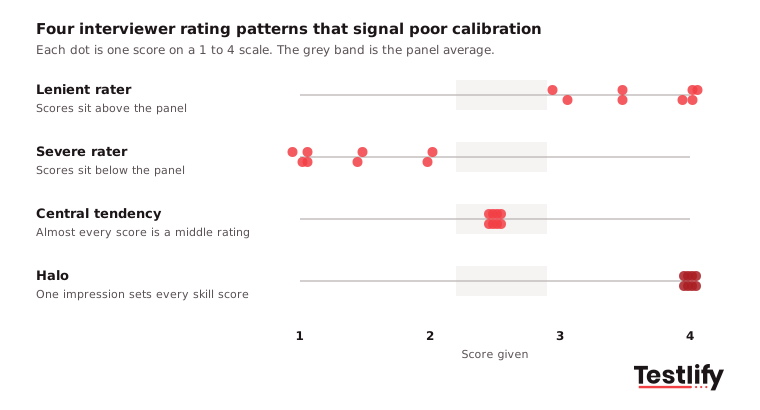
Most applicant tracking systems can show this. Greenhouse, for example, offers an interviewer calibration report with each interviewer's completed scorecards, ratings given and how consistently they fill in the focus attributes. Look for these patterns:
Pattern | What the data shows | Likely cause | Fix |
|---|---|---|---|
Lenient rater | Average score well above the panel, high pass rate | Avoids conflict, scores potential over evidence | Pair with a tougher scorer in joint scoring |
Severe rater | Average well below the panel, very few passes | Holds candidates to their own level, not the role's | Rewrite anchors for the role's real level |
Central tendency | Almost every score is a middle rating | Unsure of the scale, avoids committing | Ask for a written reason on every score |
Halo | Same score on every skill for a candidate | One strong or weak moment colors everything | Score each question right after it is asked |
Not every gap means drift. An interviewer who always sees the final round will see stronger candidates and should score higher. Compare people who interview at the same stage, over at least 10 to 15 interviews, before you act.
How often should hiring teams recalibrate?
Hiring teams should recalibrate at least once a quarter, and always at five trigger points: when new interviewers join a panel, when the rubric or questions change, before a hiring surge, when a new role opens, and when score data shows one interviewer drifting. Calibration fades because interviewers slowly anchor on the candidates they have recently seen.
A weak candidate pool is a common cause of drift. After weeks of weak applicants, an average answer starts to look strong, and the bar quietly drops. A quarterly session on a fixed example answer, scored against the written anchors, pulls interviewers back to the role's real standard.
Demand makes this harder to keep up. SHRM's 2025 Talent Trends research found that 69% of organizations still struggle to fill full-time roles. Under that pressure, panels add new interviewers fast, and those are exactly the people most likely to score off the shared bar.
What are common interview calibration mistakes?
The most common interview calibration mistakes are treating it as a one-time training, discussing before scoring, calibrating only the final hire or no-hire call, and never changing the rubric afterwards. Each one leaves the panel feeling aligned while scores keep drifting apart.
- One-time training: Calibration fades. A single session at onboarding is gone within a few months.
- Discussing first: Once the most senior person speaks, others adjust their scores to match. Always score alone first.
- Only the final decision: Two interviewers can both say "hire" for different reasons. Calibrate each question's score, not just the verdict.
- Assuming tenure equals calibration: Experienced interviewers drift too, often further, because nobody checks their scores.
- Ignoring the data: Score averages and pass rates per interviewer are often sitting unused in the ATS.
- Chasing perfect agreement: Forcing every score to match hides real differences in what people saw. The aim is shared standards, not identical numbers.
Key takeaway: Interview calibration only sticks when it changes the rubric. Score alone, compare against the evidence, rewrite the unclear anchors and check the score data every quarter.
How do skills data and AI scores support interview calibration?
Skills test results and AI interview scores support interview calibration by giving the panel one consistent reference point for every candidate. Every candidate answers the same questions and is scored against the same criteria, so interviewers can compare their own ratings with evidence that did not depend on who ran the interview. The team still owns the rubric and the final decision.
Testlify fits here in a few ways:
- Shared criteria from the start: Testlify's AI suggests competencies and scoring criteria from the job description, which gives the panel a first draft of the rubric to calibrate against.
- Consistently scored first rounds: Video AI, Voice AI and Chat AI interviews ask every candidate role-based questions and score every answer against the same criteria. See how AI interviews work.
- Evidence for the debrief: Each candidate report shows a per-skill breakdown, AI-written strengths and gaps, and suggested follow-up questions, alongside results from 3,500+ tests. The Reviewers Portal gives interviewers one place to score and comment.
- Data to spot drift: Weighted scoring, benchmarking and question analytics in Testlify reporting show which questions separate candidates and which do not.
Ready to give every interviewer the same evidence?
Calibrated panels start with consistent evidence. Start a 7-day free trial of Testlify, no credit card required, and build a skills assessment or AI interview from your own job description so every interviewer walks into the debrief with the same scored results.
Frequently asked questions

Content Writer
Yashika Khandelwal is a Content Writer with 3+ years of experience creating research-backed content on hiring, talent assessment, and HR technology. She is a registered Organizational Psychologist and subject matter expert who combines behavioral science with practical recruitment insights to produce accurate, evidence-based content.
LinkedInRelated resources
View all
Talent Acquisition
Healthcare hiring: a practical guide for 2026

Talent Acquisition
Full cycle recruiting: what it is, the 6 stages and how to run it

Talent Acquisition
What is a hiring manager? Role and duties explained

Talent Acquisition
Contingent workforce management: a guide for hiring teams

Talent Acquisition
Public sector recruitment: a practical guide for hiring teams

Talent Acquisition
Hiring military veterans: a practical guide for employers in 2026
Get started.
Hire on proof, not resumes.
Run your first skills-based assessment free — no credit card required.