
Disparate Impact
Disparate Impact refers to policies or practices that disproportionately affect certain protected groups negatively, recognized as a claim under Civil Rights Act of 1964 in US.
 ChatGPT
 Gemini
 Claude
 Grok
Grok Perplexity
What is disparate impact?
Disparate treatment is intentional discrimination : treating someone differently because of their protected characteristic.
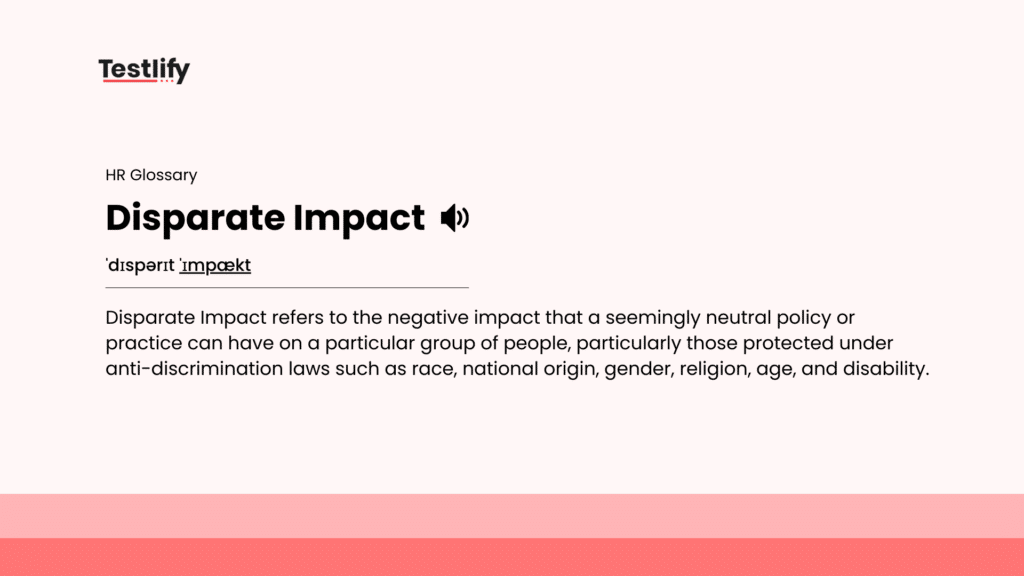
Even when a policy appears fair on the surface, it might still result in a negative effect on specific groups. Unlike intentional discrimination, disparate impact focuses on the outcome, not the intent. For example, if a hiring test disproportionately excludes job applicants from a certain group of people, it may be considered a case of disparate impact under employment discrimination law.
The concept is rooted in federal laws like Title VII of the Civil Rights Act, which is enforced by the Equal Employment Opportunity Commission (EEOC). Organizations must prove that policies causing disparate impact are necessary for their operations and cannot be achieved through less discriminatory alternatives. HBR’s diversity and inclusion research shows that many common hiring practices : including degree requirements, certain personality tests, and unstructured interviews : carry measurable disparate impact risk that organizations often fail to audit proactively.
Characteristics of disparate impact
Some key characteristics of disparate impact include:
- Neutral appearance: The policy or practice seems unbiased but disproportionately affects certain groups.
- Outcome-based: It occurs due to the negative impact on protected groups, not because of intentional discrimination.
- Protected classes: It typically impacts groups protected under anti-discrimination laws, such as women, people of color, and individuals with disabilities.
- Various contexts: It can arise in employment, housing, lending, or education.
- Illegal under certain circumstances: Even unintentional discriminatory practices may violate laws if they harm protected groups.
- Burden of proof: Organizations must justify their policies and show they are essential and cannot be adjusted to reduce harm.
- Hard to detect: It may be subtle, requiring detailed analysis to identify.
Causes of disparate impact
Several factors can lead to disparate impact:
- Historical discrimination: Structural inequalities, stemming from past biases, create barriers for some groups of people.
- Unconscious bias: Decision-makers may unknowingly create policies that disadvantage certain groups.
- Lack of representation: Policies designed without input from diverse perspectives can unintentionally harm protected groups.
- Socio-economic factors: Issues like poverty, limited access to education, or healthcare can exacerbate disparities.
Consequences of disparate impact
The effects of disparate impact can be far-reaching:
- Economic harm: Affected individuals may face lost job opportunities or financial hardship.
- Social isolation: Excluded groups may feel marginalized, reducing community cohesion.
- Legal liability: Organizations found engaging in discriminatory practices may face penalties under federal laws.
- Reputational damage: Employers risk losing trust and credibility, making it harder to attract employees and customers.
Legal protections and actions
The federal government plays a key role in addressing disparate impact. Agencies like the EEOC, Department of Justice, and other federal agencies enforce laws to prohibit discrimination. Individuals who believe they’ve been affected can file a complaint with the EEOC or other relevant authorities.
Under laws like Title VII, the burden lies on employers to show that their policies, even if neutral, are justified. These laws aim to protect against discrimination based on race, color, gender, and other characteristics. SHRM’s employment law guidance recommends regular adverse impact analyses of all selection procedures, with remediation plans for any practice where selection rates for protected groups fall below the 4/5ths threshold.
Skills-based hiring directly reduces disparate impact risk by focusing on demonstrated ability. Using pre-employment assessments alongside a structured hiring plan drives compliance. Strong talent acquisition practices focused on skills-based hiring improve outcomes.
Frequently asked questions
Disparate impact (also called adverse impact) occurs when a facially neutral employment practice : a test, credential requirement, or screening criterion : disproportionately screens out members of a protected group, regardless of intent. Disparate treatment is intentional discrimination : treating someone differently because of their protected characteristic. Disparate impact focuses on outcomes; disparate treatment focuses on intent.
Cite this page
Copy a ready-made citation for this page in your preferred style.
- APA
Testlify. (2023). Disparate Impact. https://testlify.com/hr-glossary/disparate-impact/
- MLA
"Disparate Impact." Testlify, 11 January 2023, https://testlify.com/hr-glossary/disparate-impact/.
- Chicago
Testlify. "Disparate Impact." Testlify. Last modified September 15, 2026. https://testlify.com/hr-glossary/disparate-impact/.
- HTML link
<a href="https://testlify.com/hr-glossary/disparate-impact/">Disparate Impact</a>, Testlify (2023)
Related terms
Disparate Treatment
Disparate Treatment refers to discrimination where an individual or group is treated less favorably based on a protected characteristic, recognized as a claim under federal civil rights laws in US.
Distance Learning
Distance Learning refers to a method of education where students learn remotely through online materials, with little or no face-to-face interaction. It offers flexibility and accessibility but with limited interaction and potential technical difficulties.
Distributive Bargaining
Distributive Bargaining, also known as “competitive” or “zero-sum” bargaining, is a negotiation strategy where parties aim to maximize their own outcomes while minimizing the other party’s outcomes, by using pressure and concessions.
Diversity
Diversity encompasses differences in characteristics such as race, ethnicity, gender, sexual orientation, and more; fostering inclusiveness, multidimensionality, and respect, resulting in increased innovation and better decision making.
Diversity Candidate
Diversity Candidate hiring is actively seeking and considering candidates from diverse backgrounds and experiences for job openings within an organization.
Diversity Training
Diversity Training educates and increases awareness on issues of diversity, inclusion, and cultural competence for creating inclusive workplaces.
Get started.
Hire on proof, not resumes.
Run your first skills-based assessment free — no credit card required.