
Churn Rate
Employee churn rate is the % of staff leaving over a period. See formula, churn vs turnover vs attrition, industry benchmarks, and reduction playbook.
 ChatGPT
 Gemini
 Claude
 Grok
Grok Perplexity
Aggregate churn rate is the headline number, but acting on churn requires disaggregation.
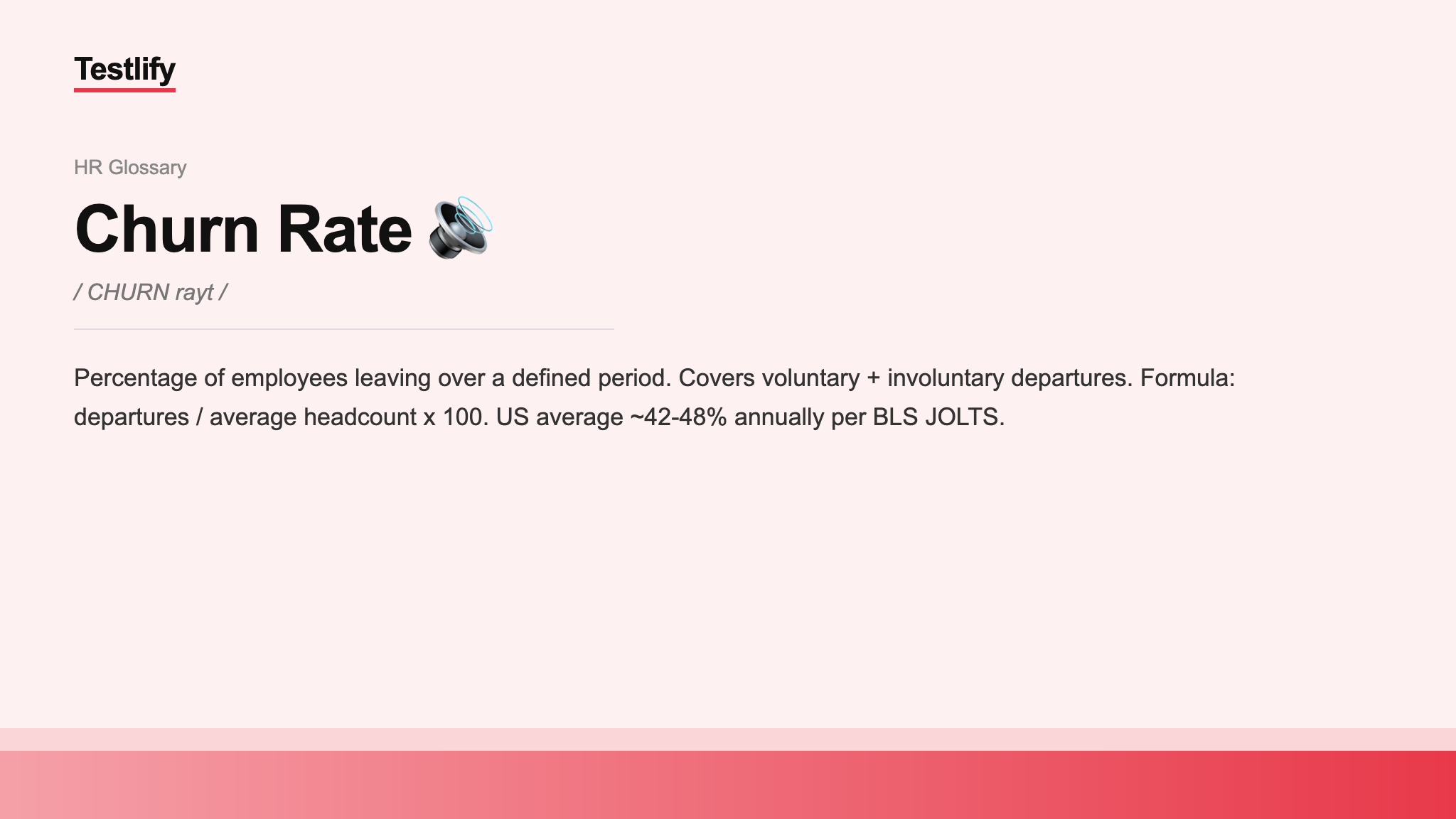
Churn Rate is a workforce metric measuring the percentage of employees leaving an organisation over a defined period, covering both voluntary departures (resignations, retirements) and involuntary departures (layoffs, terminations). Also called: employee churn, staff churn, workforce churn.
Churn vs turnover vs attrition: the persistent terminology confusion
These three terms are routinely used interchangeably, which confuses analysis and reporting. The substantive distinctions used in mature HR analytics:
Practical guidance: use ‘churn’ as the umbrella metric covering all departures, then disaggregate by voluntary vs involuntary, and within voluntary by ‘regrettable’ (high performers, critical roles) vs other. Tracking only aggregate churn obscures the patterns that matter for action.
How to calculate churn rate: the two main formulas
Two formulas appear in HR practice. Both are valid but produce different numbers; reporting which formula was used matters when comparing across companies.
Formula 1, average headcount basis (most common)
Churn Rate (%) = (Number of departures during period / Average headcount during period) x 100
Where ‘average headcount’ is typically calculated as (beginning headcount + ending headcount) / 2, or as the average of monthly headcount across the period for more precision. This is the formula used in US BLS JOLTS reporting, SHRM benchmarks, and most enterprise HR analytics platforms.
Formula 2, remaining employees basis (less common)
Churn Rate (%) = (Number of departures during period / Total remaining employees) x 100
This formula appears in some HR sources and produces slightly different numbers. Less common in benchmark databases.
Worked example
Company starts the year with 500 employees, ends the year with 510 employees, and 80 employees left during the year (some of whom were replaced; total hires during year = 90).
- Average headcount basis: 80 / ((500 + 510) / 2) x 100 = 80 / 505 x 100 = 15.8%
- Remaining employees basis: 80 / 510 x 100 = 15.7%
In this example the two formulas produce nearly identical results because headcount is roughly stable. With material growth or shrinkage, the two formulas diverge significantly.
Industry benchmarks for employee churn
Churn rates vary materially by industry, geography, role type, and economic cycle. Per BLS JOLTS, SHRM, Work Institute, and industry-specific research:
Benchmarks are reference points, not targets. The right churn rate for any specific company depends on workforce composition, industry maturity, growth stage, and strategic context.
The cost of churn: a realistic calculation
Per SHRM and industry research, the fully-loaded cost of losing and replacing an employee typically ranges from 50% to 200% of annual salary. The components:
- Direct recruiting cost. Recruiter time and fees, job board fees, agency fees if external. Typical: $4,000-$15,000 per hire for mid-level roles; $20,000-$50,000+ for senior or specialised roles.
- Lost productivity during vacancy. Position open for typical 30-90 days; work uncovered, deferred, or distributed across remaining team. Typically 25-50% of the departing employee’s salary annualised over the vacancy period.
- Onboarding and training. New employee productivity ramp typically 3-12 months depending on role complexity. Cost: 25-50% of base salary in productivity foregone. The Backfill Position process itself adds direct recruiting and onboarding cost.
- Team disruption. Remaining team morale impact, workload redistribution, knowledge gaps. Hard to quantify but real.
- Customer impact. For customer-facing roles, departures often produce measurable customer-relationship impact.
- Institutional knowledge loss. Tenure-based knowledge that doesn’t transfer easily.
- Manager time. Recruiting, interviewing, onboarding consume manager attention that would otherwise be deployed productively.
Practical estimate: for a mid-level professional role with $80,000 salary, fully-loaded churn cost typically falls in the $40,000-$120,000 range. Specialised, senior, or critical-skill roles can exceed $250,000 per departure.
Disaggregating churn: what to measure
Aggregate churn rate is the headline number, but acting on churn requires disaggregation. Mature HR analytics tracks:
- Voluntary vs involuntary. Different causes, different interventions. Layoffs are strategy; resignations are signal.
- Regrettable vs non-regrettable. High-performer departures and critical-role departures matter more than the aggregate. Track regrettable attrition rate separately.
- First-year churn. New-hire departures within 12 months indicate hiring or onboarding failures. Industry data: 30-50% of all voluntary departures occur within the first year.
- By manager. Manager-level churn analysis often reveals concentration in specific teams. The classic finding: ‘people leave managers, not companies’ (Marcus Buckingham, Gallup).
- By tenure cohort. Departures clustered at 18-month, 3-year, or 5-year marks suggest specific retention failure points.
- By department or function. Engineering, sales, customer support, and operations often have different churn dynamics.
- By demographic and equity dimensions. Churn rates differing by gender, race, or other characteristics surface potential equity issues.
- By exit reason. Compensation, career growth, manager, culture, work-life balance, role fit. Exit Interview themes drive the right intervention. Symptoms like Boreout (chronic under-stimulation leading to disengagement) often surface only through systematic exit data.
Reducing churn: 8-point playbook
1. Address compensation competitiveness. Run periodic compensation benchmarking against current market. Underpaying current market by 10%+ produces predictable departures regardless of other levers.
- Invest in manager quality. Manager effectiveness is consistently the single strongest predictor of voluntary departures. Train, develop, and select managers carefully.
- Build career development infrastructure. Visible career paths, internal mobility, learning investment. Among the top 3 cited reasons in exit interviews.
- Conduct stay interviews. Talk to your stayers about what keeps them, not just your leavers about what drove them out. More actionable signal than Exit Interview data alone.
- Fix onboarding. First-year churn is among the highest-ROI areas. Structured 30/60/90/365-day onboarding programs reduce first-year departures by 25%+ in industry studies.
- Measure engagement and act on it. Pulse surveys, annual engagement surveys, and visible action on themes. Engagement is a leading indicator; churn is a trailing one.
- Recognition and pay equity. Compensation equity reviews, recognition programs, transparent pay practices.
- Improve hiring quality. Hiring the right people reduces churn at source. Use structured assessments and the Quality of Hire Calculator to benchmark new-hire performance and predict retention.
See also Rightsizing for structural workforce reduction context, Labour Turnover for the closely related paired metric, Backfill Position for downstream cost context, and Exit Interview for the primary diagnostic tool when churn rates require investigation.
Frequently asked questions
Employee churn rate is a workforce metric that measures the percentage of employees leaving an organisation over a defined period, typically expressed as a percentage on an annual, quarterly, or monthly basis. Churn captures both voluntary departures (resignations, retirements) and involuntary departures (layoffs, terminations). High churn indicates retention problems; low churn indicates workforce stability.
Cite this page
Copy a ready-made citation for this page in your preferred style.
- APA
Testlify. (2023). Churn Rate. https://testlify.com/hr-glossary/churn-rate/
- MLA
"Churn Rate." Testlify, 9 January 2023, https://testlify.com/hr-glossary/churn-rate/.
- Chicago
Testlify. "Churn Rate." Testlify. Last modified August 6, 2026. https://testlify.com/hr-glossary/churn-rate/.
- HTML link
<a href="https://testlify.com/hr-glossary/churn-rate/">Churn Rate</a>, Testlify (2023)
Related terms
Climate Surveys
A climate survey measures the perceived workplace environment. See climate vs engagement vs culture, key dimensions, questions, and design playbook.
Cloud Computing
Cloud computing delivers IT resources via the internet. See IaaS/PaaS/SaaS, public/private/hybrid, AWS/Azure/GCP, HR use cases, and security risks.
Cloud-Based HR Software
Cloud-based HR software (HRIS / HCM) runs in the cloud rather than on-premise. See Workday, SAP, Rippling, BambooHR, AI shift, and selection guide.
Co-Employment
Co-employment is a shared employer relationship. See PEO vs joint employer, FLSA NLRB tests, Microsoft Vizcaino case, and risk mitigation playbook.
Coaching
Workplace coaching builds capability through structured 1:1 development. See exec / career / team / manager coaching, ICF vs EMCC, ROI, and selection.
Code of Conduct
A code of conduct is the rules employees must follow at work. See structure, vs code of ethics, enforcement, SOX 406 requirements, and template.
Get started.
Hire on proof, not resumes.
Run your first skills-based assessment free — no credit card required.