
Business Ethics
Business ethics refers to the principles and values that guide the behavior of individuals and organizations in the business world, including issues such as honesty, fairness, and responsibility.
 ChatGPT
 Gemini
 Claude
 Grok
Grok Perplexity
What is business ethics?
Business ethics is no longer optional : it is a necessity for sustainable success.
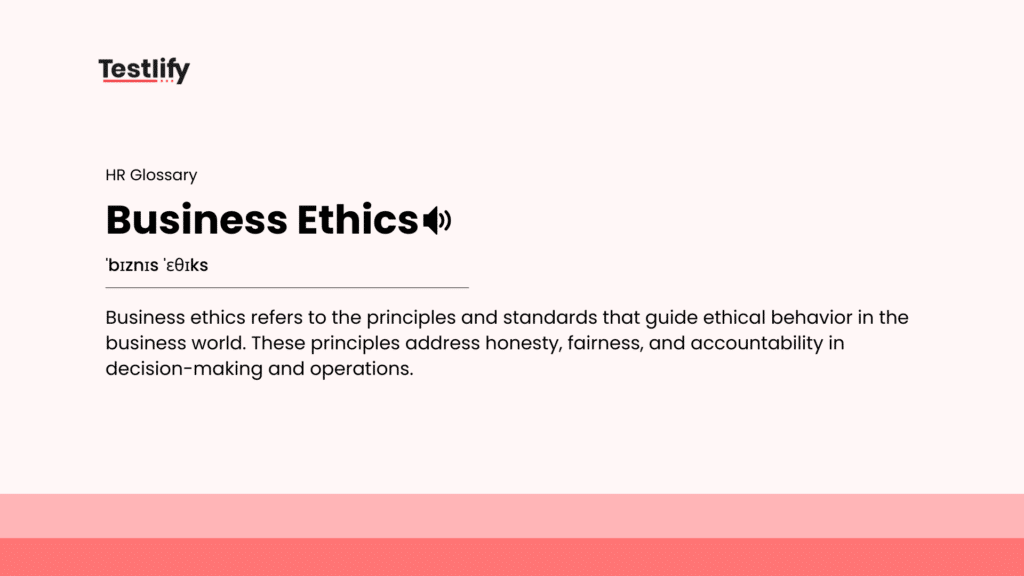
Businesses apply these principles to resolve ethical dilemmas and maintain trust among stakeholders. This includes considering the long-term impact of actions on employees, customers, shareholders, and local communities.
Ethical business practices are essential for sustaining trust and navigating challenges like environmental impacts, evolving regulations, and globalization. Business ethics also intersect with corporate social responsibility (CSR), ensuring companies contribute positively to society while pursuing their goals.
Essential features of business ethics
Core features of business ethics define how organizations maintain integrity while achieving success. These features include:
- Integrity: Acting with honesty and transparency in all interactions.
- Responsibility: Acknowledging and being accountable for the outcomes of business actions, including environmental impacts and effects on local communities.
- Fairness: Treating all stakeholders equitably, fostering a culture of non-discrimination.
- Respect: Upholding the dignity and rights of employees, customers, and other stakeholders.
- Trustworthiness: Being reliable and consistent in fulfilling promises and commitments.
- Compliance: Adhering to legal requirements and ethical standards across all operations.
- Sustainability: Addressing environmental concerns and planning for long-term growth that balances profit with social responsibility.
- Professionalism: Demonstrating expertise, competence, and ethical behavior in every aspect of business operations.
Types of business ethics
With changing business landscapes, the types of business ethics have expanded to address contemporary challenges:
- Personal ethics: Guides individual decisions, helping employees make choices that reflect their moral values within a professional setting.
- Professional ethics: Tailored standards for industries like technology, healthcare, and law that address unique ethical dilemmas.
- Corporate ethics: An organization’s internal ethical framework, often defined in a formal code of ethics.
- Social responsibility: Businesses addressing societal needs, from reducing carbon footprints to supporting community initiatives.
- Environmental ethics: Focusing on eco-friendly practices like reducing waste, adopting renewable energy, and mitigating climate change.
- International business ethics: Addressing cultural, legal, and economic differences in global markets while ensuring ethical consistency.
- Technological ethics: Emerging area that addresses ethical issues in AI, data privacy, cybersecurity, and digital transformation.
How can businesses use ethics effectively?
Ethical decision-making is increasingly vital for success in today’s competitive and transparent environment. Here’s how organizations can leverage business ethics:
- Guide decision-making: Provides clarity when faced with ethical dilemmas, ensuring actions align with core values and legal requirements.
- Build trust: Cultivates trust among stakeholders, enhancing customer loyalty, investor confidence, and employee morale.
- Create a positive culture: Promotes ethical behavior at all levels, fostering collaboration and inclusivity.
- Avoid legal issues: Prevents unethical behavior that could lead to lawsuits, penalties, or reputational damage.
- Promote sustainability: Integrates long-term goals by reducing environmental impacts and fostering eco-friendly innovations.
- Enhance reputation: Ethical behavior positions businesses as socially responsible, improving their brand image and competitive advantage.
- Attract and retain talent: Employees increasingly prefer ethical organizations that value corporate social responsibility and diversity.
- Improve bottom line: Ethical practices can lead to better customer retention and higher profitability, showing that doing good is good business.
Trends in business ethics
As industries evolve, the scope of business ethics continues to expand. Some current trends include:
- Focus on Diversity, Equity, and Inclusion (DEI): Businesses are addressing systemic biases to ensure a diverse and inclusive workplace.
- Sustainability and green practices: Increasing numbers of organizations are aligning with environmental, social, and governance (ESG) goals.
- Ethical use of technology: Companies are developing frameworks to address ethical issues in AI, data protection, and automation.
- Employee advocacy: Empowering employees to be ambassadors of ethical practices within and outside the organization.
- Globalization challenges: Businesses are adapting to the complexities of ethical practices in international markets, respecting cultural differences while maintaining ethical consistency.
Business ethics is no longer optional : it is a necessity for sustainable success. SHRM research shows that candidates increasingly evaluate a company’s ethical reputation before accepting offers, making ethics a direct talent acquisition lever.
Following a robust code of ethics not only ensures compliance with legal requirements but also supports long-term growth by addressing the needs of an increasing number of stakeholders.
Ethical behavior builds trust, improves the bottom line, and ensures businesses remain resilient in the face of evolving challenges.
By embracing ethical business practices, organizations can positively impact their communities, reduce environmental impacts, and lead by example in creating a better future.
Ethical organizations attract better talent. Companies using objective pre-employment assessments signal that merit : not connections : drives decisions. A fair, transparent hiring plan is itself an ethical act. Talent acquisition practices that prioritize inclusion help attract and retain top talent who value integrity.
Frequently asked questions
Business ethics is the application of ethical principles : honesty, fairness, accountability, and respect : to all business activities and decisions. It governs how companies treat employees, customers, suppliers, competitors, and communities. Strong business ethics creates a culture where doing the right thing is the default, not the exception.
Cite this page
Copy a ready-made citation for this page in your preferred style.
- APA
Testlify. (2023). Business Ethics. https://testlify.com/hr-glossary/business-ethics/
- MLA
"Business Ethics." Testlify, 6 January 2023, https://testlify.com/hr-glossary/business-ethics/.
- Chicago
Testlify. "Business Ethics." Testlify. Last modified September 14, 2026. https://testlify.com/hr-glossary/business-ethics/.
- HTML link
<a href="https://testlify.com/hr-glossary/business-ethics/">Business Ethics</a>, Testlify (2023)
Related terms
Business necessity
Business necessity is the EEOC legal standard requiring employers to prove a selection criterion or employment practice is directly job-related and essential to safe, efficient business operation. Enterprise HR compliance guide.
Business process outsourcing (BPO)
Business process outsourcing (BPO) lets enterprises delegate HR, payroll and compliance to specialist vendors. Learn types, risks and how to evaluate vendors.
Butterfly effect
The butterfly effect in HR shows how one hiring decision, policy change, or manager behavior cascades into major organizational outcomes. Workplace examples and HR strategy.
Buzz marketing
Buzz marketing in HR turns employees into brand advocates, driving word-of-mouth for employer branding and talent acquisition. Enterprise HR teams guide.
CIPD
The CIPD is the UK’s chartered professional body for HR & L&D. See levels 3/5/7, Foundation/Associate/Chartered membership, salary impact, value.
Cafeteria plan
A cafeteria plan (Section 125) lets employees pick pre-tax benefits from a flexible menu. Learn eligibility, FSA/HSA/HRA options, compliance rules and setup steps for enterprise HR teams.
Get started.
Hire on proof, not resumes.
Run your first skills-based assessment free — no credit card required.