
Baby Boomers
Baby boomers are people who were born between 1946 and 1964, during a period of increased birth rates following World War II.
 ChatGPT
 Gemini
 Claude
 Grok
Grok Perplexity
The Silver Tsunami is a metaphor for the wave of baby boomer retirements expected to reshape the US workforce over the 2020s and 2030s.
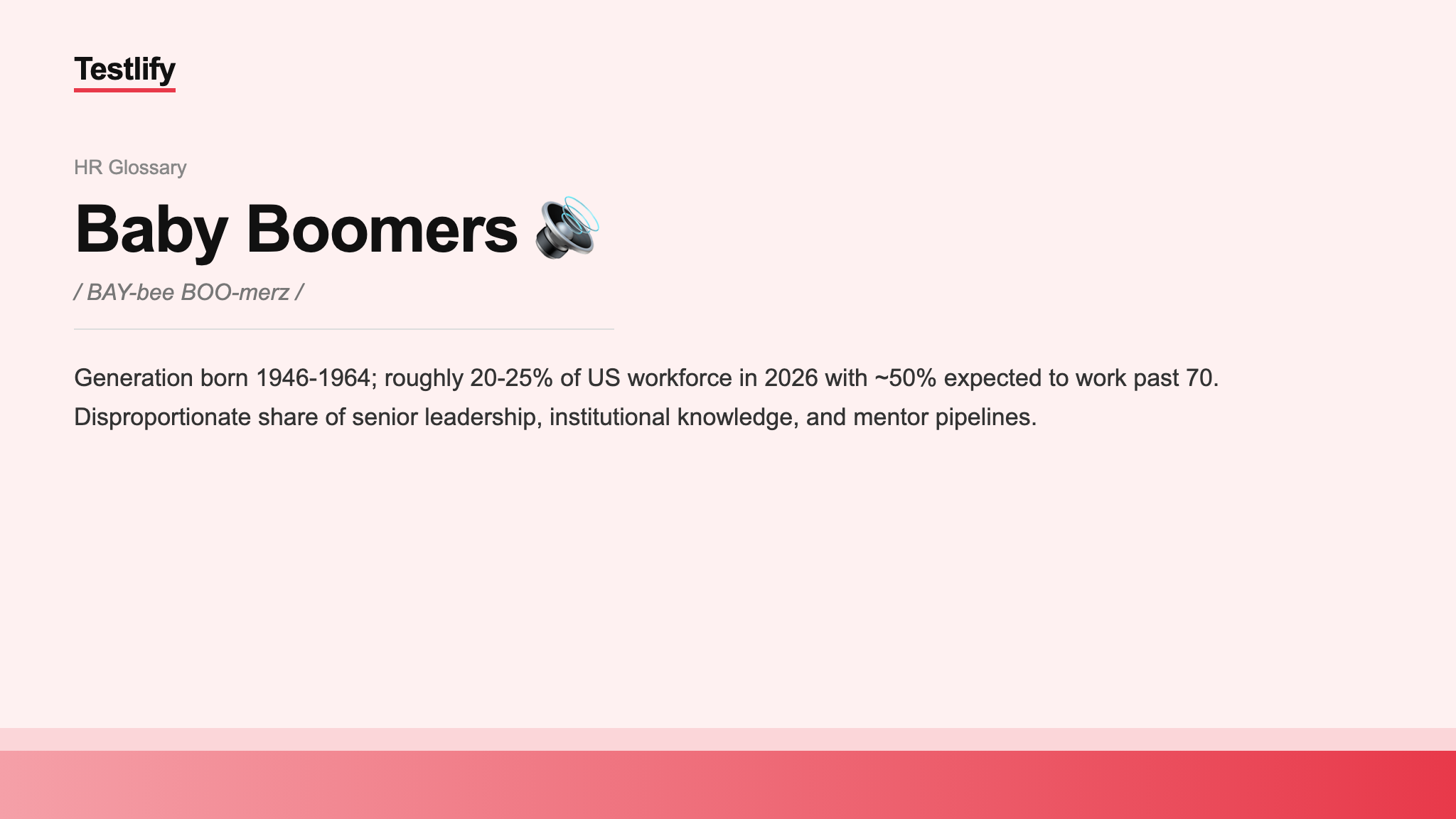
Baby Boomers are the generation born between 1946 and 1964, named for the post-World War II demographic boom in births. Approximately 62-80 years old as of 2026 and roughly 20-25% of the US labour force. Disproportionate share of senior leadership and institutional knowledge. Also called: boomers.
Baby boomers in the 2026 workforce
Per US Bureau of Labor Statistics labour force data and industry research:
- Workforce share: Baby boomers represent approximately 20-25% of the US labour force in 2026, down from their peak of over 35% in the late 1990s but holding steady as retirement is increasingly delayed.
- Retirement trajectory: Roughly half of baby boomers expect to work past age 70, per Purdue Global and AARP research. Drivers include longevity, inadequate retirement savings, increased health, and the meaning derived from work.
- Leadership concentration: Boomers continue to hold a disproportionate share of senior executive and board roles, though that share is declining as Gen X takes over.
- Industry concentration: Boomer workforce share is highest in manufacturing, healthcare administration, education, financial services, government, and small business ownership.
Commonly cited workplace characteristics
Generational characterisations are generalisations – they describe distributional tendencies, not individuals. Treating any specific employee through a generational lens is poor practice and can violate ADEA. With that caveat, the characteristics commonly attributed to baby boomers in management and HR research:
- Strong work ethic and dedication. Boomers were raised in a post-war ethic of hard work as the path to advancement; long hours are commonly associated with commitment.
- Career-defined identity. Many boomers derive significant identity and purpose from their work, which contributes to retirement-delay patterns.
- Loyalty to employer. Longer tenure norms compared to later generations; boomers are more likely to spend extended periods (10+ years) at single employers.
- Preference for in-person and structured communication. Face-to-face meetings, formal reviews, and structured feedback are more comfortable than fully async or fully remote modes.
- Strong institutional knowledge. Decades of accumulated knowledge about customers, products, processes, and informal networks that exists nowhere else in the organisation.
- Coaching and mentoring orientation. Many boomers find significant meaning in mentoring younger colleagues, particularly late in their careers.
Baby boomers vs other generations: a quick comparison
Source: Pew Research Center generational definitions.
How to manage and retain baby boomers in the workplace
1. Offer phased retirement. Many boomers want to taper rather than retire abruptly. Phased retirement options – reduced hours, part-time work, advisory roles, project-based engagement – extend tenure while reducing burnout risk. Compressed work week is a useful structural option.
- Invest in mentor and ‘reverse mentor’ programs. Structured mentoring pairs boomer expertise with younger employees’ learning needs. Reverse mentoring – younger employees teaching boomers digital tools – works in mature programs.
- Recognise tenure and expertise formally. Long-service awards, expertise-based titles, and consultative roles signal that experience is valued.
- Communicate change clearly. Large-scale change – agile transformations, AI adoption, restructuring – lands harder when context is missing.
- Address technology adoption directly. Avoid stereotyping (‘boomers can’t use the new tool’). Provide structured training options without the embarrassment of being ‘left behind’.
- Provide health and retirement benefits. Comprehensive health coverage, 401(k) match, financial wellness programs, and long-term care information are disproportionately important to boomer employees.
- Avoid age-based assumptions. Under ADEA, employment decisions based on age (40+) are unlawful. Assumptions about retirement intent, technology aptitude, or fit for new roles must not drive hiring, promotion, or termination decisions. See also ageism for the broader cultural framework.
Knowledge transfer: the silver tsunami challenge
The retirement of even 25-50% of the boomer workforce over the next decade represents one of the largest institutional knowledge transfer challenges in modern HR. Unlike formal documents and process maps, much of this knowledge is tacit – relationships, exceptions, customer history, internal politics, problem-solving heuristics.
A knowledge transfer playbook
1. Identify critical-knowledge roles. Not every retiring employee holds critical knowledge; prioritise senior technical, customer-facing, and process-critical roles.
- Map the knowledge inventory. Interview the incumbent: what do they know that nobody else knows?
- Pair with successors well in advance. 18-36 months before planned retirement, identify a successor. Structure shadowing, joint work, and gradually escalating ownership.
- Document the tacit. Video interviews on ‘how to handle this situation’ capture more usable knowledge than written process documents.
- Build advisory engagements. Retired boomers as part-time advisors or consultants for 12-24 months post-retirement maintain access to knowledge during the transition.
- Reward knowledge transfer. Make successful transfer a measured outcome with reward, not an optional extra during the last six months.
ADEA and age discrimination considerations
The Age Discrimination in Employment Act (ADEA) prohibits employment discrimination against individuals 40 years of age or older. In practice this covers virtually all baby boomers in 2026. Per EEOC guidance, common ADEA exposure points:
- Reduction in force selection. RIF decisions that disproportionately select older workers face heightened scrutiny; OWBPA imposes specific waiver requirements.
- Hiring for ‘cultural fit’ or ‘high energy’. Coded language that can map to age bias is increasingly being challenged in EEOC charges.
- ‘You should be retiring soon’ comments. Stray remarks about retirement timing can become evidence in age discrimination litigation.
- Recruiting language. Job postings stating ‘digital native’ or ‘recent graduate’ may be challenged as proxy age discrimination.
Frequently asked questions
Baby boomers are the generation born between 1946 and 1964, named for the post-WWII demographic boom in births. They are roughly 62 to 80 years old as of 2026 and represent approximately 20-25% of the US workforce. The Pew Research Center defines the boomer cohort using these birth years.
Cite this page
Copy a ready-made citation for this page in your preferred style.
- APA
Testlify. (2023). Baby Boomers. https://testlify.com/hr-glossary/baby-boomers/
- MLA
"Baby Boomers." Testlify, 4 January 2023, https://testlify.com/hr-glossary/baby-boomers/.
- Chicago
Testlify. "Baby Boomers." Testlify. Last modified September 14, 2026. https://testlify.com/hr-glossary/baby-boomers/.
- HTML link
<a href="https://testlify.com/hr-glossary/baby-boomers/">Baby Boomers</a>, Testlify (2023)
Related terms
Back Pay
Back pay is a type of payment that is made to an employee to compensate them for wages that they should have been paid in the past but were not. This can occur for a variety of reasons, such as an error in payroll, a violation of the employee’s contract or employment law, or a period of time when the employee was not paid due to a dispute with their employer.
Backfill Position
Backfill position refers to a job that is temporarily or permanently filled by another employee after the original employee leaves or is promoted.
Background Check HR
A background check is a process of verifying an individual’s personal, employment, and/or criminal history to ensure the safety and security of the employer, landlord, or organization.
Background Screening
Background screening verifies identity, work history, education, and more to ensure candidate suitability, protect employers, and support safe hiring decisions.
Background Verification
Background verification is the process of verifying and checking the accuracy of information provided by an individual.
Balanced Scorecard
A balanced scorecard is a strategic performance measurement system that helps organizations to track and monitor their performance across four different perspectives: financial, customer, internal process, and learning and growth.
Get started.
Hire on proof, not resumes.
Run your first skills-based assessment free — no credit card required.