
How to evaluate team performance: a practical guide for 2026
A step-by-step guide to evaluating team performance: what to measure, which methods work, how often to review and how to act on gaps.

Most teams know when they miss a target, but few know why. The cause often sits in process, workload or missing skills, which individual reviews rarely show.
Knowing how to evaluate team performance means judging four things at once: results, process, team health and skills. This guide shows how to do it with agreed metrics, feedback from several sources and real skills data, ending in clear actions.
TL;DR:
- Team performance evaluation is a structured review of how a group works toward shared goals.
- Measure four areas: results, process, team health and skills.
- Follow seven steps, from agreeing shared goals to owning follow-up actions.
- Use a simple team scorecard and combine two or three methods, such as 360 feedback and skills assessments.
- Review monthly, quarterly and annually, with extra reviews after big changes.
- Turn each skills gap into a decision to develop, redeploy or hire.
- Avoid common mistakes by adding objective skills data to your evaluation.
 ChatGPT
 Gemini
 Claude
 Grok
 Perplexity
What is team performance evaluation?
Team performance evaluation is a structured review of how well a group of people works toward shared goals. Team performance evaluation looks at the team as a unit: its combined output, how decisions get made, how work moves between people, and whether the team has the skills it needs.
Individual reviews still matter, but they answer a different question. An individual review asks, "How did this person do?" A team evaluation asks, "Is this group set up to win, and if not, what is holding it back?"
The answer is often a process or skills problem, not a people problem. A support team can miss its response target because two experienced agents left and nobody on the team knows the billing system, not because anyone is lazy.
Most organizations run both. Individual reviews feed pay and promotion decisions, while team evaluations shape workload, structure, training and hiring.
If you want a refresher on the individual side, see our guide to conducting effective employee performance reviews.

Why does evaluating team performance matter?
Evaluating team performance matters because most work now depends on groups, and problems inside a team rarely show up in individual scores. Regular evaluation shows where time is lost, where skills are thin and where the manager needs support, before missed targets and resignations make the problem obvious.
The cost of getting this wrong is high. Gallup's State of the Global Workplace report found that global employee engagement fell to 20% in 2025, and that low engagement costs the world economy about $10 trillion in lost productivity, or 9% of global GDP.
Manager engagement fell to 22%, down nine points since 2022, which matters because managers run most team evaluations. The drop is not even across regions: Gallup's 2026 takeaways note that manager engagement in South Asia fell by eight points in 2025.
Wasted effort is a team-level problem too. Atlassian's State of Teams 2025 found that leaders and teams waste 25% of their time just searching for answers.
No individual review would catch that. A team evaluation that looks at process will.
What should you measure when you evaluate team performance?
A team evaluation should measure four areas: results, process, team health and skills. Results show what the team delivered and process shows how work gets done.
Team health shows whether people can keep performing. Skills show whether the team can meet the goals for the next six to twelve months.
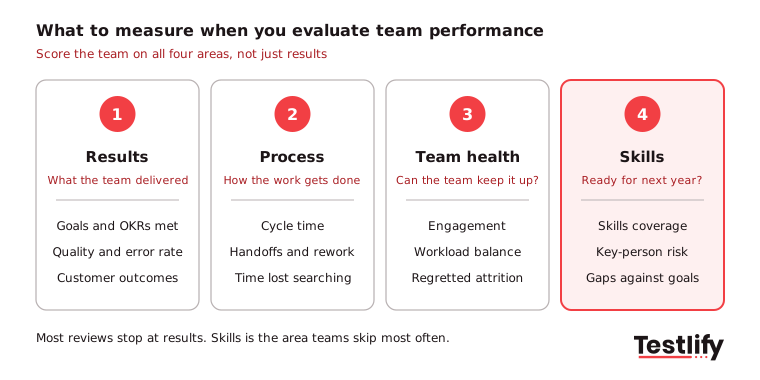
- Results: goals met, output, quality, customer outcomes and cost. Results are the reason the team exists, so start here.
- Process: cycle time, handoffs, rework, how decisions are made and how fast blockers get cleared.
- Team health: engagement, workload, trust, retention and whether people feel safe raising problems.
- Skills: the skills the team has today against the skills its goals will need. Most guides leave this area out, yet skills gaps explain a large share of missed results.
Across the teams we work with, the skills area is the one most often skipped because it is the hardest to measure with gut feel. Managers can usually tell you whether a team hit its numbers, but far fewer can say which skills the team is missing for next year's plan.
How to evaluate team performance in 7 steps
To evaluate team performance, agree on goals first, pick a small set of metrics across all four areas, collect data from systems and people, check skills objectively, review the findings with the team, and turn them into a short action plan with owners and dates. Then repeat the cycle on a fixed rhythm.
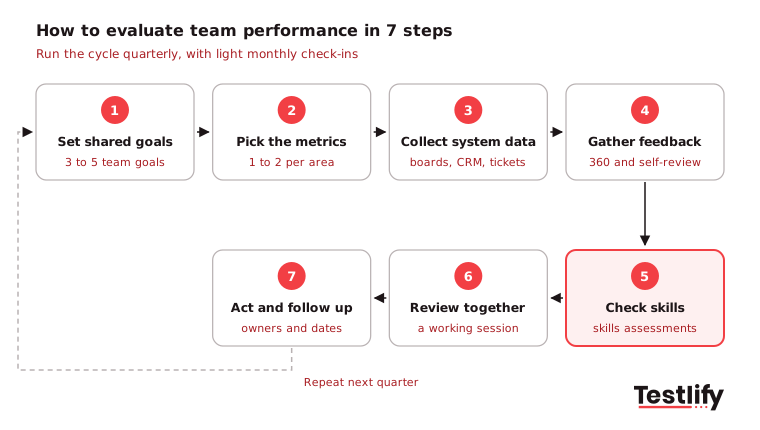
- Set shared goals. Write down three to five team goals for the period, tied to business outcomes. Use OKRs or SMART goals, but make sure the whole team owns them, not one person.
- Pick the metrics. Choose one or two metrics per area: results, process, health and skills. Fewer metrics, read well, beat a dashboard nobody opens.
- Collect system data. Pull what you can from the tools the team already uses: project boards, CRM, ticketing, code repositories, finance reports. System data is cheap and hard to argue with.
- Gather feedback from several sources. Run a short 360 review with peers, stakeholders and the manager, plus a team self-assessment. Ask the same questions each cycle so you can compare.
- Check skills objectively. Use short skills assessments for the skills your goals depend on. A skills matrix built from test results is far more reliable than one built from self-ratings.
- Review together. Share the findings with the team in a working session, not a verdict. Ask what the data misses and what the team thinks is causing each gap.
- Act and follow up. Agree on two or three actions, each with an owner and a date. Check progress at the next monthly check-in.
Context matters when you read the numbers. The Microsoft Work Trend Index 2025 found that 80% of the global workforce say they lack the time or energy to do their work, and that employees are interrupted every 2 minutes, about 275 times a day.
A dip in output can be a workload or focus problem, not a skills or effort problem.
Pro tip: Run step 5 before step 6. When the team sees objective skills data in the review, the conversation moves from blame to fixes much faster.
Which team performance metrics should you track?
The best team performance metrics are a small mix that covers results, process, team health and skills, with a clear data source for each. The scorecard below is a starting point.
Swap the sample metrics for ones that match your team's work, but keep at least one metric in every row.
Area | Sample metric | Where the data comes from | Warning sign |
|---|---|---|---|
Results | Goals or OKRs met per quarter | Goal tracker, business reports | Goals met only by a few people working late |
Results | Quality or error rate | QA reviews, customer complaints, defect logs | Rising rework after a deadline push |
Process | Cycle time from start to done | Project board, ticketing system | Work waits days between handoffs |
Process | Time lost to searching and meetings | Team survey, calendar data | People cannot find decisions or documents |
Team health | Engagement and workload scores | Pulse survey, 1:1 notes | One or two people carry most of the load |
Team health | Regretted attrition | HRIS | Strong performers leave within a year |
Skills | Skills coverage against next year's goals | Skills assessments, skills matrix | Only one person can do a critical task |
Skills | Time for new hires to reach full output | Onboarding data, manager review | New hires take longer each cycle |
Sales, engineering and support teams will each weight these rows differently. For more ideas on people metrics at the company level, see our list of HR KPIs.
What methods can you use to evaluate a team?
The most common methods for evaluating a team are goal and KPI reviews, 360 feedback, team self-assessments, skills assessments, performance dashboards and retrospectives. Each method answers a different question, so most teams combine two or three.
The table shows what each method is good for and where it falls short.
Method | Best for | Watch out for |
|---|---|---|
Goal and KPI review (OKRs, SMART goals) | Results against plan | Hitting the number while quality drops |
360 feedback | Collaboration, communication, leadership | Popularity bias if questions are vague |
Team self-assessment | Process problems the team can see | Groupthink if the manager speaks first |
Skills assessment | Objective view of skills and gaps | Testing skills the goals do not need |
Performance dashboard | Trends over time | Tracking activity instead of outcomes |
Retrospective | Learning after a project or sprint | Same issues raised with no follow-up |
SWOT analysis | Strategy and planning sessions | Lists without owners or actions |
A structured 360 degree feedback test keeps the questions the same for every rater, which makes results easier to compare across cycles. Pair it with skills data so feedback about behavior sits next to evidence about ability.
How often should you evaluate team performance?
Team performance is best evaluated on three rhythms: light monthly check-ins on goals and blockers, a fuller quarterly review across all four areas, and an annual look at skills and structure tied to planning. Add an extra review after a big project, a reorganization or a jump in attrition.
Monthly check-ins keep small problems small. Quarterly reviews are where the scorecard, 360 feedback and skills data come together.
The annual review should ask a bigger question: does this team have the shape and skills for next year's plan? Our guide to the performance management cycle covers how these rhythms fit with individual reviews.
How do you turn a team evaluation into hiring and development decisions?
A team evaluation becomes useful when each skills gap gets one of three answers: develop someone already on the team, redeploy someone from elsewhere, or hire. The right answer depends on how fast the skill is needed, how hard it is to learn, and whether anyone nearby already has most of it.
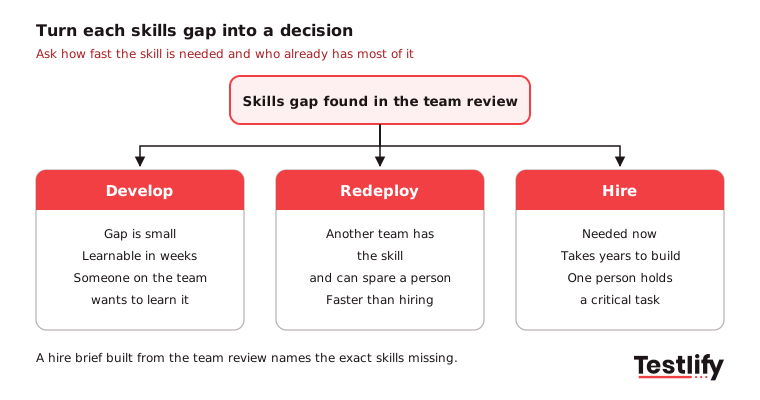
- Develop when the gap is small, the skill can be learned in weeks, and someone on the team is motivated to learn it.
- Redeploy when another team already has the skill and can spare a person, which is often faster than hiring.
- Hire when the skill is needed now, takes years to build, or the team has a single point of failure.
The skills problem is wide. The LinkedIn Workplace Learning Report 2025 found that 49% of L&D and talent professionals say their executives worry employees lack the skills to execute the business strategy.
The same report found that only 15% of employees say their manager helped them build a career plan in the past six months.
When the answer is to hire, the team evaluation gives talent acquisition a far better brief than an old job description. The recruiter knows exactly which skills the team lacks, which ones it already has in depth, and how the new person will be judged after joining.
That link is what lifts quality of hire. Before you open a new role, though, read why not every skills gap needs a headcount.
In my work with hiring teams, the best job briefs I have seen came straight out of a team review, because the hiring manager could point to a real gap instead of a wish list.
What mistakes should you avoid when evaluating team performance?
The most common mistakes in team evaluations are measuring activity instead of outcomes, letting the loudest voice set the score, blaming individuals for system problems, and ending the review without actions. Each mistake makes the evaluation feel like a ritual, and teams stop taking it seriously.
- Measuring activity, not outcomes. Hours logged, messages sent and tickets touched say little about value. Track what the work achieved.
- Rating on impressions. Without agreed metrics and skills data, the person who talks most in meetings often looks like the top performer.
- Blaming people for process problems. If work waits three days between handoffs, coaching one person will not fix it.
- Ignoring team health. A team can hit every target for two quarters while burning out its best people.
- Skipping the skills check. Results look back. Skills tell you whether the team can hit next year's goals.
- No follow-up. If the same issues appear at every review, the process is broken, not the team.
Key takeaway: A team evaluation is only as good as the actions it produces. Two or three owned actions per quarter beat a long report.
How can Testlify help you evaluate team skills?
Testlify helps teams add objective skills data to a team evaluation. Testlify is a skills assessment platform with a library of 3,500+ tests, covering role-specific skills, software and coding, cognitive ability, situational judgment, language, personality and 360 feedback.
Furthermore, assessment reports break each result down by skill, with benchmarks, so a manager can see which skills are deep across the team and which rest on one person.
The same tests can then screen candidates for the roles the review says you need, so the skills you evaluate in the team are the skills you hire for.
You can browse the test library to see which tests fit your teams, or compare options in our roundup of team assessment tools for performance management.
Ready to see your team's skills in one view? Book a demo to get started today.
Frequently asked questions (FAQs)

Founder and CEO, Testlify
Abhishek Shah is the Founder and CEO of Testlify, a pre-employment assessment platform used by 1,500+ companies globally to hire fairly and at scale. He focuses on skills-based, bias-free hiring technology. Testlify is part of the SHRM Labs 2026 WorkplaceTech Accelerator.
LinkedInRelated resources
View all
HR & recruitment
How Do Employee Benefits Affect Total Employment Compensation?

HR & recruitment
What Is Leadership Coaching? A 2026 Guide for HR Teams

HR & recruitment
Methods of Job Analysis: 10 Methods and How to Choose (2026)

HR & recruitment
AI across all stages of the hiring process in 2026

HR & recruitment
What are key KPIs for measuring assessment impact on hiring?

HR & recruitment
How to assess ethical judgment and decision-making in hiring?
Get started.
Hire on proof, not resumes.
Run your first skills-based assessment free — no credit card required.