
What Is Leadership Coaching? A 2026 Guide for HR Teams
A plain guide to leadership coaching for HR teams: how it works, the main types, who should get it and how to check what it changed.

Leadership coaching is a one-to-one or small-group partnership in which a trained coach helps a current or future leader build specific leadership behaviours, such as giving feedback, delegating and making decisions under pressure. The leader sets the goals, practises between sessions and is measured on whether the people around them notice the change.
TL;DR: Leadership coaching helps leaders improve specific behaviours through goal-setting, practice, and feedback. Its effectiveness depends on choosing the right leaders, setting measurable goals, and tracking changes in leadership behaviour and team outcomes. HR teams should also consider the coaching format, cost, and confidentiality when building a program.
 ChatGPT
 Gemini
 Claude
 Grok
 Perplexity
What is leadership coaching?
Leadership coaching is a structured development process in which a coach works with a leader over several months to close a small number of agreed skill gaps. The coach asks questions rather than giving answers, the leader owns the plan, and progress is checked against goals set at the start.
Three things separate leadership coaching from other development work:
- It is individual. Goals come from one leader's strengths, gaps and role, not from a course outline.
- It is applied. Leaders practise new behaviours in real meetings and real decisions between sessions, then review what happened.
- It is measured. Good programs set a baseline at the start and check it again at the end, usually with feedback from the leader's manager, peers and team.
The audience is wider than the C-suite. First-time managers, team leads, high-potential employees and senior leaders in a new role all use leadership coaching. When the client is a CEO or a member of the top team, most providers call it executive coaching.
Coaching is now mostly an employer purchase. The ICF 2025 Global Coaching Study reports that more than 50% of coaching clients are employer-sponsored and that the profession earned an estimated $5.34 billion in annual revenue.

How does leadership coaching work?
Leadership coaching works in five stages: assess the leader, agree goals with the leader and their manager, run regular coaching sessions, practise new behaviours at work with feedback, and re-measure at the end. A typical engagement lasts three to nine months with sessions every two to four weeks.
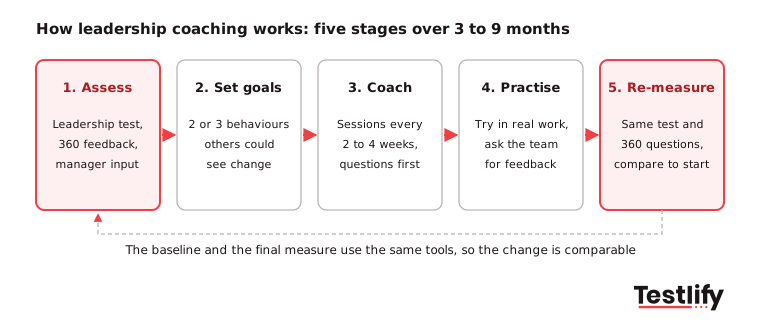
- Assess. The coach gathers a starting picture: a leadership assessment, 360 feedback from people who work with the leader, and a conversation with the leader's manager.
- Set goals. The leader picks two or three behaviours to change, written so that others could see the difference, for example "lets the team propose solutions before giving mine".
- Coach. Sessions of 45 to 90 minutes, in person or by video. The coach asks questions, challenges assumptions and helps the leader plan the next few weeks.
- Practise and get feedback. Between sessions the leader tries the new behaviour in real work and asks for quick feedback from the team or manager.
- Re-measure. At the end, the same assessment and 360 questions are repeated so the leader, the manager and HR can see what changed.
The Center for Creative Leadership sums up the coach's job in six coaching principles: create a safe but challenging space, follow the coachee's agenda, collaborate rather than advise, build self-awareness, help the leader learn from experience, and model the behaviour being coached.
Pro tip: Agree in writing who sees what before the first session. Most programs keep session content between coach and leader, while goals and progress scores are shared with the manager and HR.
What are the types of leadership coaching?
Leadership coaching comes in five common types: one-to-one coaching with an external coach, internal coaching by trained HR or L&D staff, group coaching for a cohort of leaders, team coaching for an intact leadership team, and digital or AI-assisted coaching. Each suits a different budget, leader level and goal.
Type | Who it suits | Strength | Watch out for |
|---|---|---|---|
External one-to-one | Senior leaders, critical roles, new executives | Independent view, deep focus, full confidentiality | Highest cost per leader |
Internal coaching | Managers and team leads at scale | Knows the culture, lower cost | Confidentiality and coach capacity |
Group coaching | Cohorts of new or high-potential managers | Peer learning, more leaders reached | Less time per person |
Team coaching | An intact leadership team | Fixes how the team works together | Needs the whole team to commit |
Digital or AI-assisted | Large manager populations, practice between sessions | Always available, low cost per user | Weaker on complex, sensitive issues |
Many organizations mix them: external coaches for the top 50 to 100 leaders, internal or group coaching for first-line managers, and digital tools to keep practice going between sessions.
How is leadership coaching different from executive coaching, mentoring and training?
Leadership coaching differs from executive coaching mainly in audience, from mentoring in method, and from training in format. Executive coaching is leadership coaching for the top team. Mentoring passes on the mentor's own experience and advice. Training teaches the same content to a group. Coaching helps one leader find and practise their own answers.
Leadership coaching | Executive coaching | Mentoring | Training | |
|---|---|---|---|---|
Main audience | Managers at every level | C-suite and senior executives | Anyone earlier in a career path | Groups of employees |
Who sets the agenda | The leader, with manager input | The executive and the board or CEO | Often the mentor | The course designer |
Method | Questions, practice, feedback | Same, with a strategy and stakeholder focus | Advice and shared experience | Teaching and exercises |
Typical length | 3 to 9 months | 6 to 12 months | Open-ended | Hours to days |
How success is judged | Behaviour change others notice | Business and stakeholder results | Career progress | Course completion and knowledge |
Act Leader's comparison makes the same split: executive coaching serves established senior leaders, while leadership coaching serves anyone in a leadership role, including middle managers and new team leads. For a short definition of the senior version, see the executive coaching glossary entry.
What are the benefits of leadership coaching?
Leadership coaching benefits the leader, their team and the organization. Leaders gain self-awareness and specific skills, teams get clearer direction and better feedback, and the organization builds a stronger bench of people ready for bigger roles. The benefits show up fastest when goals are tied to real business problems.
- For the leader: sharper self-awareness, better feedback and delegation habits, and more confidence in hard conversations.
- For the team: a manager who listens more, sets clearer goals and develops people instead of only assigning tasks.
- For the organization: more internal promotions, fewer failed leadership moves, and leaders who can carry change.
The need is real. Gallup's State of the Global Workplace 2026 report found that manager engagement dropped from 31% in 2022 to 22% in 2025, and that many managers have not received the training they need to coach teams toward high performance.
HR leaders see the same gap. In a Gartner survey of 1,403 HR leaders reported by HR Brew, leader and manager development ranked as the top HR priority for 2025, 75% said managers are overwhelmed by changing responsibilities, and only 36% rated their leadership development programs as effective.
What is the coaching leadership style?
The coaching leadership style is a way of managing in which a leader develops people through questions, feedback and support instead of only giving instructions. Leadership coaching is a service a leader receives; the coaching leadership style is a behaviour a leader uses with their own team. Good leadership coaching often teaches the coaching style.
Leaders who use a coaching style tend to:
- ask "what do you think we should do?" before offering an answer
- hold regular one-to-ones focused on growth, not only status updates
- give specific, timely feedback and agree next steps together
- let people stretch on real work, with support when they get stuck
The style works best with capable people who are ready to grow. In a crisis or with a brand-new hire who needs clear direction, a more directive approach is often the better fit.
Who should get leadership coaching?
Leadership coaching gives the best return to leaders at a transition point or in roles where one person's behaviour affects many others. Typical groups are first-time managers, high-potential employees on a succession list, leaders stepping into a bigger role, and managers whose teams show low engagement or high turnover.
Most organizations cannot coach everyone, so selection matters. Picking participants only by nomination tends to favour the most visible people, not the ones who would gain most. A fairer approach uses data:
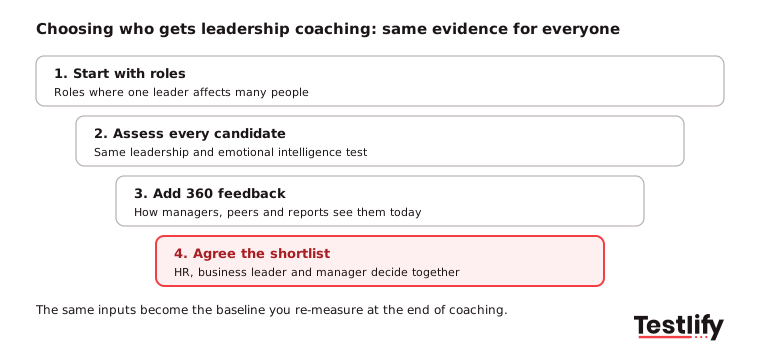
- Start with roles. List the roles where leadership quality has the biggest effect on results, such as frontline managers in large teams.
- Assess potential and readiness. Use the same leadership and emotional intelligence assessment for every candidate, so selection does not depend on who shouts loudest.
- Add 360 feedback. Ask the people who work with each candidate how they experience their leadership today.
- Agree the shortlist. HR, the business leader and the candidate's manager agree who gets coaching and why, using the same evidence for everyone.
Using the same inputs for everyone also gives you a clean baseline, so results are comparable across the teams in the program.
How do you measure leadership coaching results?
Measuring leadership coaching means comparing a leader's starting point with where they end up, using the same tools both times, and then watching business numbers over the following months. Leading indicators show whether behaviour is changing; lagging indicators show whether that change is paying off for the team and the organization.
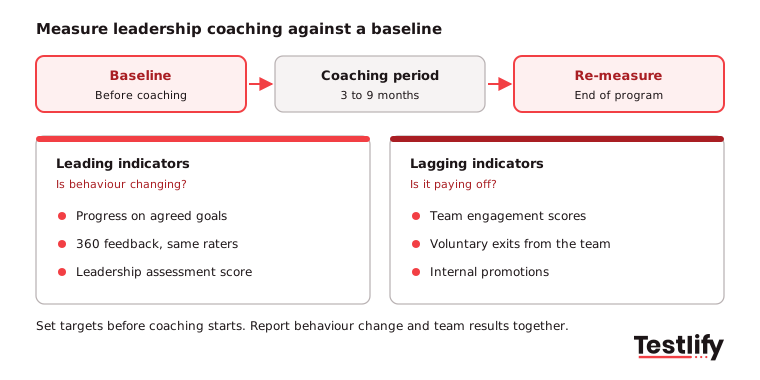
Indicator | Type | How to measure | When |
|---|---|---|---|
Progress on agreed goals | Leading | Coach and manager check-in against written goals | Monthly |
Behaviour others notice | Leading | Repeat the same 360 feedback questions | Start and end |
Leadership skills | Leading | Repeat the same leadership assessment | Start and end |
Team engagement | Lagging | Engagement or pulse survey scores for the leader's team | Every 6 months |
Team turnover | Lagging | Voluntary exits from the leader's team | Every 6 to 12 months |
Promotion readiness | Lagging | Internal promotions and succession moves | Yearly |
Set targets before coaching starts. If the baseline shows a leader scores low on delegation, the goal is a clear rise in that area at re-measurement, not a general sense that things went well. Ask the same raters both times so the comparison holds.
Key takeaway: Leadership coaching is only as accountable as its baseline. Measure before you start, use the same tools at the end, and report behaviour change and team results together.
How do you choose a leadership coach?
Choosing a leadership coach starts with fit for the leader's goals, then checks credentials, experience and method. Ask for a recognised coaching credential, experience with leaders at the same level and in a similar setting, a clear process with a baseline and re-measurement, and a chemistry call before you commit.
Questions to ask every coach or provider:
- What coaching credential do you hold, and how many hours have you coached?
- Which leader levels and industries have you coached most often?
- How do you set goals and measure progress, and what will HR and the manager see?
- How do you handle confidentiality, and when would you refer a leader elsewhere?
- Can the leader meet two or three coaches before choosing one?
Credentials are now expected. The ICF study found 73% of coaches say clients and organizations expect a coaching certification or credential. Give the leader a say in the final pick, since trust between coach and leader drives most of the result.
How much does leadership coaching cost?
Leadership coaching cost depends on the format, the coach's experience, the leader's level and the length of the program. External one-to-one coaching for senior leaders costs the most per person. Group, internal and digital coaching cost far less per leader, which is why many organizations use them for first-line managers.
To build a budget, price the whole engagement rather than single sessions. Include the starting assessment and 360 feedback, the number and length of sessions, manager check-ins and the final re-measurement. Ask providers for a fixed program fee so costs are easy to compare.
How do you assess leadership skills?
Leadership skills are best assessed by running the same validated test and 360 feedback at the start and end of coaching. HR teams can then compare results across every leader in the cohort. Testlify offers 3,500+ tests, including these for leadership:
- Leadership test: run it before and after coaching to set a baseline and see what changed.
- Leadership potential test: use it to help decide which people should be coached.
- Emotional intelligence test: measure emotional intelligence at the start and end of the program.
- 360 degree feedback: collect structured feedback from managers, peers and direct reports.
To turn results into a development plan, see how to create a leadership development plan.
Frequently asked questions

Content Writer
Yashika Khandelwal is a Content Writer with 3+ years of experience creating research-backed content on hiring, talent assessment, and HR technology. She is a registered Organizational Psychologist and subject matter expert who combines behavioral science with practical recruitment insights to produce accurate, evidence-based content.
LinkedInRelated resources
View all
HR & recruitment
Methods of Job Analysis: 10 Methods and How to Choose (2026)

HR & recruitment
AI across all stages of the hiring process in 2026
HR & recruitment
What are key KPIs for measuring assessment impact on hiring?
HR & recruitment
How to assess ethical judgment and decision-making in hiring?
HR & recruitment
Skills gap analysis tools: What HR teams should look for

HR & recruitment
Benefits of conducting a skills gap analysis
Get started.
Hire on proof, not resumes.
Run your first skills-based assessment free — no credit card required.