
How Do Employee Benefits Affect Total Employment Compensation?
Benefits add about 30% on top of wages. Learn what counts, how to calculate total compensation, and how to show it in your job offers.

Employee benefits affect total employment compensation by adding the cash value of everything an employer pays for beyond wages: health insurance, retirement contributions, paid leave, insurance and payroll taxes. In US private industry, benefits make up 30% of what employers spend on each employee, so a salary alone shows only about two thirds of what a job is worth.
TL;DR: Employee benefits account for 30% of total compensation in US private industry, according to june 2026 BLS data. total compensation includes salary, bonuses, and employer-paid benefits such as health insurance, retirement contributions, and paid leave. comparing the full package helps candidates evaluate offers more accurately and helps hiring teams communicate an offer's true value.
 ChatGPT
 Gemini
 Claude
 Grok
 Perplexity
What is total employment compensation?
Total employment compensation is the full value an employee receives in return for their work, counted in dollars. It adds three things together: base pay (salary or hourly wages), variable cash pay (bonuses, commissions, overtime and shift pay) and the employer's cost of benefits (health cover, retirement, paid leave, insurance and legally required contributions).
The US Bureau of Labor Statistics measures it the same way. Its quarterly Employer Costs for Employee Compensation release splits every hour of employer spending into wages and salaries on one side and benefits on the other. Total compensation is the sum of both.
Salary is the number people remember, but total compensation is the number that shows what a job is really worth and what an employee really costs. For a deeper look at the parts, see the different types of compensation and benefits.

How do employee benefits affect total employment compensation?
Employee benefits affect total employment compensation in five ways: they raise its total value, they shift part of pay into tax-free form, they protect income when something goes wrong, they raise the employer's cost per employee, and they change how two job offers compare. A smaller salary with strong benefits can be worth more than a bigger salary with weak ones.
- Benefits raise the total. Every dollar an employer spends on health cover, a retirement match or paid leave is part of the employee's pay, even though it never shows up in the paycheck.
- Benefits change the tax picture. Many benefits, such as employer health contributions, are not taxed as income, so a dollar in benefits can be worth more than a dollar in salary.
- Benefits add security. Health, life and disability insurance protect the employee from large, sudden costs that salary alone would have to absorb.
- Benefits raise the cost of each hire. For the employer, total compensation is the true cost per employee, which is the number that belongs in headcount budgets.
- Benefits change how offers compare. Two offers with the same salary can differ by thousands of dollars once benefits are counted.
How much of total compensation do benefits make up?
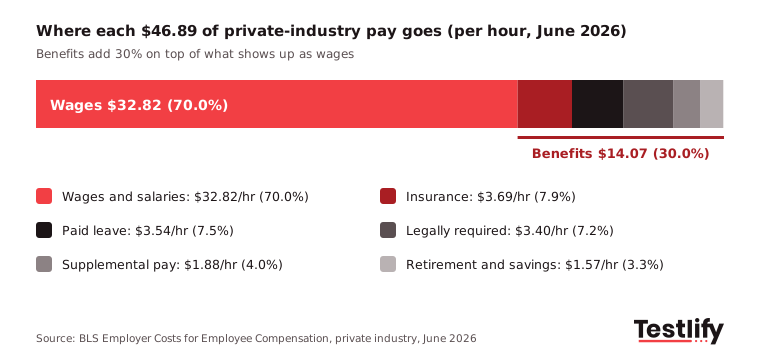
Employee benefits affect total employment compensation benefits make up 30.0% of total compensation in US private industry, according to the BLS release for June 2026. Private employers spent an average of $46.89 per hour worked on each employee: $32.82 in wages and salaries and $14.07 in benefits. In state and local government the benefit share is higher, at 38.8%.
Worker group (June 2026) | Total cost per hour | Wages and salaries | Benefits | Benefits share |
|---|---|---|---|---|
Private industry | $46.89 | $32.82 | $14.07 | 30.0% |
State and local government | $66.45 | $40.67 | $25.78 | 38.8% |
All civilian workers | $49.46 | $33.85 | $15.61 | 31.6% |
Source: BLS Employer Costs for Employee Compensation, released September 9, 2026. The civilian share is calculated from the BLS dollar figures.
Inside that 30%, the BLS private industry detail table shows where the money goes: insurance is 7.9% of total compensation, paid leave 7.5%, legally required benefits such as Social Security, Medicare, and unemployment insurance 7.2%, supplemental pay such as overtime and bonuses 4.0%, and retirement and savings 3.3%.
Which employee benefits count toward total compensation?
Employee benefits count toward total compensation when the employer pays for them and they have a dollar value the employee would otherwise have to cover. That includes insurance, retirement contributions, paid leave, legally required payroll contributions, and many smaller perks. Benefits the employee pays for in full do not add to the total.
Benefit type | Examples | How to put a dollar value on it |
|---|---|---|
Health insurance | Medical, dental, vision | Employer's share of the annual premium |
Retirement | 401(k) match, pension contributions | Employer contributions for the year |
Paid leave | Vacation, holidays, sick leave, parental leave | Daily pay multiplied by paid days off |
Legally required | Social Security, Medicare, unemployment, workers' compensation | Employer payroll tax and premium cost |
Other insurance | Life, short and long term disability | Employer's annual premium cost |
Perks and allowances | Tuition aid, wellness stipend, remote work allowance | Amount the employer pays out per year |
Health cover is usually the largest single item. The KFF 2025 Employer Health Benefits Survey puts the average annual premium at $9,325 for single coverage and $26,993 for family coverage. Workers pay 16% and 26% of those premiums on average, which leaves employers paying about $7,900 for a single plan and about $20,100 for a family plan.
Employers know this is what employees value most. In the SHRM 2025 Employee Benefits Survey, 88% of HR leaders rated health care as very or extremely important, 97% of employers offer health coverage, and leave and retirement benefits tied for second at 81%.
For definitions of each item, see the employee benefits glossary entry.
How do total job benefits and total employee compensation differ?
Total job benefits and total employee compensation differ in scope: total job benefits are only the non-wage part of the package, while total employee compensation is the whole package, wages and benefits together. Total job benefits are one input; total employee compensation is the result.
- Total job benefits answer the question "What does the employer provide on top of pay?" Health cover, retirement contributions, paid leave and insurance all sit here.
- Total employee compensation answers the question "What is this job worth in total?" It is base pay plus variable pay plus total job benefits.
- The link between them is simple: when total job benefits rise and pay stays the same, total employee compensation rises by the same amount.
The difference matters most when comparing offers or budgeting a role. Comparing salaries alone compares only part of total employee compensation.
How do you calculate total employment compensation?
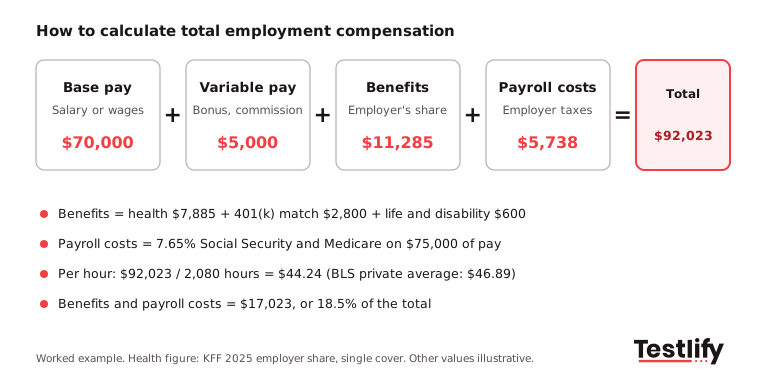
Total employment compensation is calculated by adding base pay, variable cash pay and the employer's annual cost for every benefit. Divide the total by hours worked in a year, usually 2,080 for a full-time role, to get an hourly figure you can compare with the BLS average of $46.89.
- Start with base pay. Annual salary, or hourly rate multiplied by scheduled hours.
- Add variable cash pay. Expected bonus, commission, overtime and shift pay for the year.
- Add the employer's benefit costs. Use the employer's share of each premium and contribution, not the list price.
- Add legally required costs. Employer Social Security and Medicare (7.65% of wages in the US), plus unemployment and workers' compensation where they apply.
- Divide by hours worked. This gives a cost per hour you can compare across roles and with national data.
Here is a worked example for a full-time employee on a $70,000 salary. The health figure uses the KFF employer share for single coverage; the other figures are illustrative.
Item | Annual value |
|---|---|
Base salary | $70,000 |
Target bonus | $5,000 |
Employer health premium (single) | $7,885 |
401(k) match at 4% of salary | $2,800 |
Employer Social Security and Medicare (7.65% of $75,000) | $5,738 |
Life and disability insurance | $600 |
Total employment compensation | $92,023 |
In this example benefits and payroll costs add $17,023, or 18.5% of the total, and the hourly figure is $44.24. Paid leave is already inside the salary here. Counted separately the way BLS counts it, 25 paid days off are worth about $6,731, which takes the benefit share to roughly 26% and closer to the national 30%.
Pro tip: Use the employer's actual cost for each benefit, not what the plan would cost on the open market. Your benefits broker or payroll provider can give you the per-employee figures in one export.
Why are benefits worth more than the same amount in salary?
Benefits are often worth more than the same amount in salary because many of them are not taxed as income. IRS rules exclude employer contributions to accident and health plans from an employee's wages, so the employee gets the full value without paying income tax, Social Security or Medicare on it.
IRS Publication 15-B (2026) defines a fringe benefit as "a form of pay for the performance of services" and says every benefit is taxable unless the law specifically excludes it. Health plan contributions, dependent care assistance up to $7,500 and group term life insurance up to $50,000 of coverage are among the exclusions.
Here is what that means in dollars. An employer paying $7,885 toward health cover gives the employee $7,885 of value. To buy the same cover with taxable salary at an illustrative combined tax rate of 30%, the employee would need about $11,264 more in gross pay. That gap is why a strong benefits package can beat a higher salary.
Why does total compensation matter for hiring teams?
Total compensation matters for hiring teams because candidates compare offers, employers compete on value and the law in some places now requires benefits in the job post. A team that sells only the salary leaves up to a third of its offer unexplained, and candidates often accept the offer with the bigger headline number.
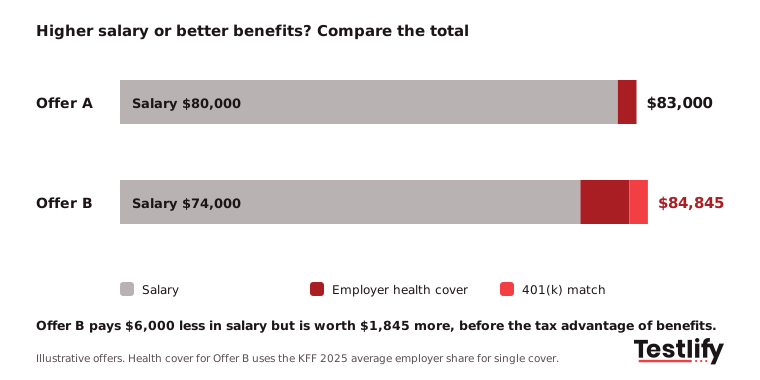
- Offer acceptance. Offer A pays $80,000 with $3,000 of employer health cover and no match, worth $83,000. Offer B pays $74,000 with $7,885 of health cover and a $2,960 match, worth $84,845 before the tax advantage. A candidate comparing salaries alone would pick Offer A.
- Job posts. Pay transparency rules are moving beyond salary. In Washington State, employers with 15 or more employees must include a wage scale or salary range and a general description of all benefits in job postings. See our guide to pay transparency.
- Budgets and cost per hire. A role advertised at $70,000 costs closer to $92,000 a year. Hiring managers who see the full number take headcount and hiring decisions more seriously.
- Employer brand. A clear view of total compensation is one of the easiest ways to show candidates what working for you is really worth. It belongs in your employer branding alongside culture and growth.
The bigger the full package, the more a wrong hire costs. A role with $92,000 in total compensation puts far more at risk than its $70,000 salary suggests, a gap that adds up fast across the teams that make many offers a year.
How should you show total compensation to candidates?
Total compensation is best shown to candidates in writing, as a dollar figure, at three points: the job post, the interview and the offer letter. Candidates should never have to work out the value of your benefits themselves, because most will not.
- In the job post. Give the salary range and name the main benefits, with a dollar value where you can, such as "employer pays 84% of health premiums" or "4% 401(k) match".
- In the interview. Recruiters should be able to explain the full package in one minute, including the employer's share of health cover.
- In the offer letter. Add a total compensation table that lists base pay, bonus and each benefit with its annual value. Our free offer letter generator is a starting point.
- After the hire. Send a yearly total compensation statement so employees keep seeing the full value. See how to communicate compensation and benefits to employees.
A total compensation package is a large investment, so make sure the person receiving it can do the job. Testlify helps hiring teams check skills before the offer stage with 3,500+ ready-made tests across technical and non-technical roles, so offers go to candidates who have already shown they can do the work. Browse the Testlify test library.
Key takeaway: Employee benefits affect total employment compensation benefits add about 30% on top of wages in the US, and some of that value is tax-free for the employee. Calculate total compensation for every role, show it as a dollar figure in the job post and the offer, and compare offers on the total, never on salary alone.
Ready to make every offer count?
Total compensation shows what a job is worth. Skills tests show whether a candidate is the right person to receive it. Start a 7-day free trial of Testlify, no credit card required, and test candidates for your next role before the offer goes out.
Frequently asked questions

Related resources
View all
HR & recruitment
What Is Leadership Coaching? A 2026 Guide for HR Teams

HR & recruitment
Methods of Job Analysis: 10 Methods and How to Choose (2026)

HR & recruitment
AI across all stages of the hiring process in 2026

HR & recruitment
What are key KPIs for measuring assessment impact on hiring?

HR & recruitment
How to assess ethical judgment and decision-making in hiring?

HR & recruitment
Skills gap analysis tools: What HR teams should look for
Get started.
Hire on proof, not resumes.
Run your first skills-based assessment free — no credit card required.