
Methods of Job Analysis: 10 Methods and How to Choose (2026)
A plain guide to 10 job analysis methods, how each one works, where each fits, and how hiring teams can mix them to define any role well.

The methods of job analysis are the ways HR and hiring teams collect and organize facts about a job: what the person does, how often, with which tools, and which skills the work needs. The common methods are observation, interviews, questionnaires, work diaries, the critical incident technique, task inventories, functional job analysis, the Position Analysis Questionnaire, technical conferences and doing the job yourself.
TL;DR: This guide explains the 10 main methods of job analysis, how each one works, and what each is good and bad at. It compares them in one table, explains the task, worker and hybrid types, and gives a simple way to pick the right mix for frontline, professional, new and senior roles. It ends with the steps to run a job analysis and how to turn the result into skills tests and interview scorecards.
 ChatGPT
 Gemini
 Claude
 Grok
Grok Perplexity
What is job analysis?
Job analysis is the process of studying a job to record its tasks, duties and working conditions, and the knowledge, skills, abilities and other traits (KSAOs) a person needs to do it well. The output feeds the job description, the job specification, the hiring criteria, pay grading and training plans.
The US Office of Personnel Management puts it plainly: "Job analysis is the foundation for all assessment and selection decisions". If the analysis is wrong, every later step, from the job ad to the final interview, measures the wrong things.
For the full picture of components, uses and challenges, see our job analysis guide for HR professionals. This post goes deep on the methods.

What are the main methods of job analysis?
The main methods of job analysis are observation, interviews, questionnaires, work diaries, the critical incident technique, task inventories, functional job analysis, the Position Analysis Questionnaire, technical conferences and the job performance method. The first four are ways to collect data. The rest are structured systems that organize what you collect.
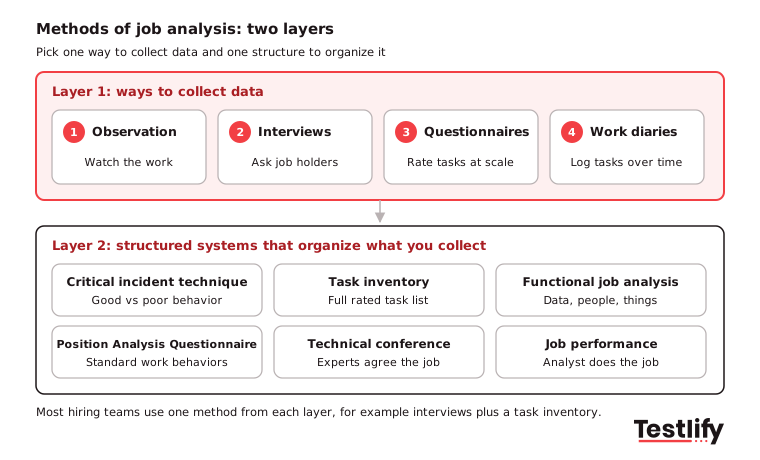
That split explains why one source lists five methods and another lists eight. Some guides count only the ways of collecting data, others add the named systems. In practice you pick at least one from each layer: a way to gather facts, and a structure to turn those facts into a usable list of tasks and skills.
How does each job analysis method work?
Each job analysis method answers the same question, "what does this job really involve?", from a different angle. Some watch the work, some ask the people doing it, and some score tasks against a fixed list. Here is how the 10 methods work, with what each does well and where each falls short.
1. Observation method
An analyst watches people do the job and records the tasks, tools, steps and conditions. Observation works best for physical, repetitive and short-cycle work, such as warehouse, retail floor or assembly roles. Observation cannot see thinking, planning or rare tasks, and people often work differently when watched.
2. Interview method
The analyst asks job holders and their managers about duties, decisions, tools, problems and what good work looks like. Interviews can be one-to-one or in groups, and work best when every interview follows the same set of questions. Interviews give rich detail for professional and knowledge roles, but they take time and depend on the skill of the interviewer.
3. Questionnaire method
Job holders fill in a survey that lists tasks and asks how often each is done, how important it is and how hard it is. Questionnaires reach many people across sites quickly and give data that is easy to compare. The trade-off is that people rate what they think they do, and poorly written questions produce poor answers.
4. Work diary or log method
Employees record what they do, and for how long, over a few days or weeks. Diaries suit jobs with varied or unpredictable work, such as field sales or support leads. Diaries produce a lot of data, much of it not useful, and the quality depends on how carefully people keep them.
5. Critical incident technique (CIT)
The critical incident technique collects real examples of very good and very poor performance from managers and job holders, then groups them into the behaviors that separate the two. CIT is excellent for defining what "good" looks like for interview questions and scorecards. CIT relies on memory, and on its own it misses routine tasks.
6. Task inventory
A task inventory is a full list of the tasks in a job, built with job holders and managers, and then rated for frequency, importance and difficulty. A typical job breaks into a handful of duties and dozens of tasks. Task inventories are the backbone of job descriptions and skills lists, but they take effort to build and need updating as roles change.
7. Functional job analysis (FJA)
Functional job analysis describes each task by how the worker deals with data, people and things, and at what level. FJA produces precise, standard task statements that suit high-stakes or technical roles. FJA is detailed and slow, and usually needs a trained analyst.
8. Position Analysis Questionnaire (PAQ)
The PAQ is a long, standard questionnaire that rates a job on general work behaviors, such as information input, mental processes, work output and relationships with others. Because every job is rated on the same items, the PAQ makes it easy to compare different jobs. The PAQ is less useful for writing role-specific hiring criteria, since its items are generic.
9. Technical conference method
A group of experienced supervisors or subject matter experts meets to describe the job and agree on its tasks and skills. The technical conference is fast and draws on deep knowledge. The risk is that supervisors describe the job as it should be, not as it is done.
10. Job performance method
The analyst does the job for a period to experience its demands directly. The job performance method gives first-hand insight into physical effort, pace and pressure points. The method only works for jobs that are safe and quick to learn, and it does not scale.
Pro tip: Use at least two methods from different angles, such as interviews plus a questionnaire, or observation plus critical incidents. Where the two disagree, you have found the part of the job that most needs a closer look.
How do the methods of job analysis compare?
The methods of job analysis differ mainly in cost, scale and the kind of facts they capture. Observation and the job performance method capture what people do. Interviews, CIT and the technical conference capture judgment and context. Questionnaires, task inventories and the PAQ capture ratings you can compare across many people.
Method | Best for | Effort | What it captures | Main risk |
|---|---|---|---|---|
Observation | Physical, repetitive roles | Medium | Visible tasks, tools, conditions | Misses thinking and rare tasks |
Interview | Professional and knowledge roles | High | Duties, decisions, context | Interviewer skill and bias |
Questionnaire | Many people or sites | Low per person | Task ratings at scale | Self-report, weak questions |
Work diary | Varied, unpredictable work | Medium | Time use and task mix | Incomplete or careless logs |
Critical incident technique | Defining good vs poor performance | Medium | Behaviors that matter most | Memory, misses routine work |
Task inventory | Job descriptions, skills lists | High to build | Full task list with ratings | Goes out of date |
Functional job analysis | Technical, high-stakes roles | High | Standard task statements | Slow, needs a trained analyst |
Position Analysis Questionnaire | Comparing different jobs | Medium | General work behaviors | Too generic for hiring criteria |
Technical conference | New roles, fast agreement | Low | Expert view of the job | Ideal job, not the real one |
Job performance | Simple, safe hands-on jobs | High per role | First-hand demands | Does not scale |
What are the types of job analysis?
The types of job analysis are task-oriented, worker-oriented and hybrid. Task-oriented analysis focuses on the work itself: duties, tasks, tools and results. Worker-oriented analysis focuses on the person: the knowledge, skills, abilities and traits the work needs. Hybrid analysis covers both, which is what most hiring teams need.
- Task-oriented: task inventories, functional job analysis and observation lean this way. Good for job descriptions and training plans.
- Worker-oriented: the PAQ and competency-based analysis lean this way. Good for comparing roles and building competency maps.
- Hybrid: a task list plus the skills behind each task. Good for hiring, because you can test the skills and still check them against real tasks.
Which methods of job analysis should you use?
The methods of job analysis you should use depend on the role, the number of people doing it and how much the role is changing. Start with the role type, then pick one way to collect data and one structure to organize it.
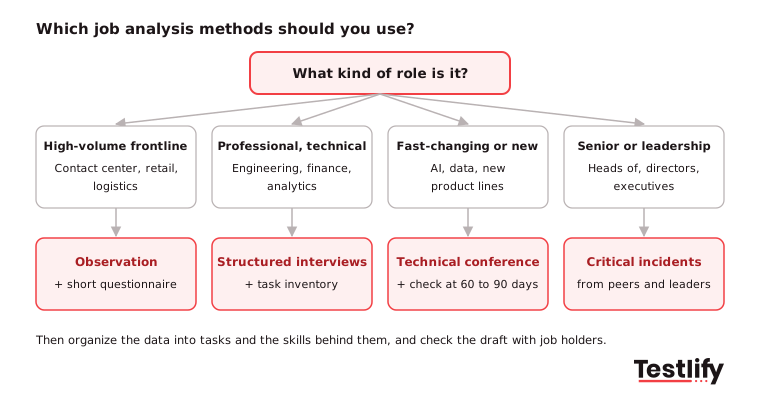
- High-volume frontline roles (contact center, retail, logistics): observation plus a short questionnaire across sites. Volume makes ratings worth collecting, and the work is visible.
- Professional and technical roles (engineering, finance, analytics): structured interviews with top performers and managers, plus a task inventory.
- New or fast-changing roles (AI, data, new product lines): technical conference with experts, then check the draft against a few real job holders after 60 to 90 days.
- Senior and leadership roles: critical incident interviews with peers and stakeholders, because judgment matters more than a task list.
How do you conduct a job analysis step by step?
A job analysis follows six steps: set the purpose, choose the methods, collect the data, organize it into tasks and skills, check it with job holders and managers, and put it to use. Most of the time goes into collecting and checking data.
- Set the purpose. Hiring, pay grading and training need different detail. For hiring, you need tasks and the skills behind them.
- Choose the methods. Pick one way to collect data and one structure, using the role guide above.
- Collect the data. Talk to several job holders, ideally including strong and average performers, and their managers. Use the same questions for everyone.
- Organize the findings. Group tasks into duties, rate them for importance and frequency, and list the skills each important task needs.
- Check with job holders and managers. Share the draft and ask what is missing or wrong. This step also builds buy-in.
- Use and update it. Feed the result into the job description, the job specification, the assessment and the scorecard. Review it at least once a year, or when the role changes.
O*NET, the US occupational database covers more than 900 occupation profiles. A matching O*NET profile is a useful first draft for steps 3 and 4, but it describes the average job in the market, not your job.
How does job analysis improve hiring?
Job analysis improves hiring by turning a vague role into a short list of skills you can test and score the same way for every candidate. Without it, teams screen on job titles, years of experience and degrees, which say little about whether someone can do the work.
The need is real. SHRM's 2025 Talent Trends survey of 2,040 US HR professionals found that nearly 70% of organizations still struggle to recruit for full-time roles, and 28% now require new skills for full-time roles. When the skills a job needs keep shifting, an old job description is a weak guide.
A skills list from job analysis also widens the talent pool. LinkedIn's March 2025 research on skills-based hiring found that looking for people who have at least half of a job's top skills, rather than people who held the same title, grows talent pools by a median of 6.1 times globally. That only works if you know which skills are the top ones, which is exactly what job analysis tells you. Our guide to skills-based hiring covers the wider shift.
Job analysis also keeps selection job-related, which matters for fairness and compliance. The US Uniform Guidelines on Employee Selection Procedures expect selection procedures to be based on a review of information about the job, including an analysis of the important work behaviors. A documented job analysis is the simplest way to show why each test and interview question is there.
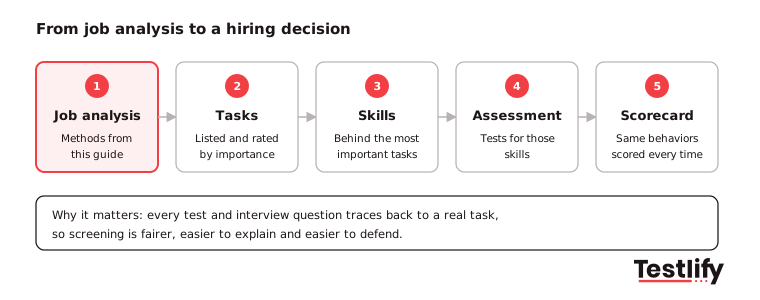
In practice, the chain looks like this:
- Tasks from the task inventory or interviews.
- Skills behind the most important tasks.
- Assessment that tests those skills, such as role-specific, coding, cognitive or situational judgment tests from a test library of 3,500+ tests.
- Structured interview and scorecard built from the critical incidents, so every interviewer scores the same behaviors. See how to build an interview scorecard.
Key takeaway: A job analysis is only finished when it has produced the skills you will test and the behaviors you will score. Stop at a job description and most of the value is lost.
Can AI speed up job analysis?
AI can speed up job analysis by drafting task lists and skills from job descriptions, job postings, O*NET profiles and performance data, so analysts start from a draft instead of a blank page. AI cannot confirm what your job really involves. People still need to check the draft with job holders and managers.
Good uses of AI in job analysis:
- Drafting a first task inventory and skills list from an existing job description.
- Summarizing interview notes and grouping critical incidents into themes.
- Comparing your role with similar roles and flagging skills that are missing.
- Turning the final skills list into a role-specific assessment. Testlify, for example, can generate an assessment from a job description in under a minute, which the hiring team then reviews and edits.
Keep the human check. An AI draft repeats whatever is in the source material, including outdated duties and inflated requirements.
What mistakes should you avoid in job analysis?
The most common job analysis mistakes are analyzing the current person instead of the job, relying on a single source, asking only managers, mixing up nice-to-have and must-have skills, and never updating the result. Each one leads to hiring criteria that screen out good candidates or let weak ones through.
- Describing the person, not the job. A long-serving employee's habits are not job requirements.
- One method, one source. A single interview or a single survey gives a partial picture.
- Only asking managers. Managers often describe the ideal job. Job holders know the real one.
- Treating every skill as essential. Rate importance, and only test the skills that matter for success in the first year.
- Never refreshing it. Roles change fast. Review the analysis yearly and whenever tools or targets change.
Frequently asked questions (FAQs)

Related resources
View all
HR & recruitment
AI across all stages of the hiring process in 2026

HR & recruitment
What are key KPIs for measuring assessment impact on hiring?
HR & recruitment
How to assess ethical judgment and decision-making in hiring?
HR & recruitment
Skills gap analysis tools: What HR teams should look for

HR & recruitment
Benefits of conducting a skills gap analysis

HR & recruitment
10 top social media recruiting tools
Get started.
Hire on proof, not resumes.
Run your first skills-based assessment free — no credit card required.