
How to future-proof recruitment process with AI in hiring?
Discover strategies to future-proof the recruitment process with AI in hiring, ensuring efficiency, fairness, and effectiveness in talent acquisition.

Talent acquisition teams that do not use artificial intelligence (AI) might be set up for failure. A Tidio survey indicates that 65% of hiring managers use AI and more than 75% benefit from it.
Yet, success is not guaranteed even if you use AI in hiring. The key lies in how you include these technologies in hiring and how well you prepare for potential pitfalls. This blog discusses how to prove your hiring process against AI technologies in the future.
 ChatGPT
 Gemini
 Claude
 Grok
Grok Perplexity
How is AI revolutionizing the hiring process?
88% of companies worldwide use artificial intelligence (AI) to hire, improve candidate experience, and make better hiring decisions. Below are some of the trends on how AI will impact hiring.
“AI is going to revolutionize the whole talent acquisition industry,” says Jo-Ann Feely, global managing director of innovation at AMS’s talent solutions firm.
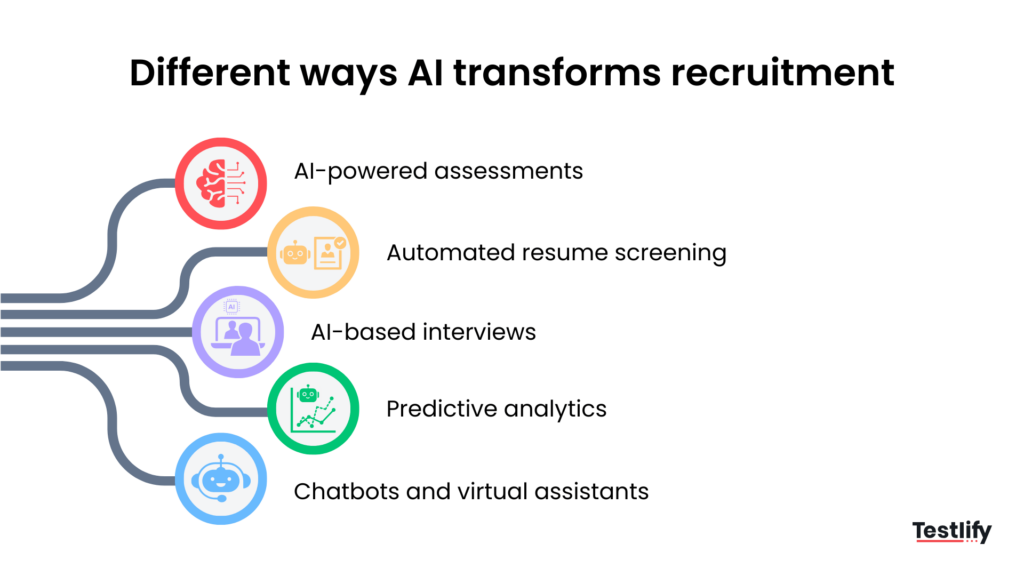
AI-powered assessments
AI-driven pre-employment assessments transform candidate evaluation. 78% of recruiters say AI assessments have improved the quality of their hires. HR professionals no longer need to rely on traditional sources like resumes or cover letters, which 58% of candidates admit to manipulating.
As hiring managers increasingly prioritize soft skills, pre-employment assessments comprehensively assess a candidate’s skill set, knowledge, and competencies. Testlify provides an extensive library of 1500+ tests customized for 50+ roles.
These assessments provide objective insights into candidates’ abilities, minimize unconscious bias, and help employers make informed hiring decisions.
Automated resume screening
An average job posting receives 500 applications; reviewing each resume is time-consuming for recruiters.
Automated resume screening tools use natural language processing (NLP) and machine learning (ML) to review thousands of resumes in a fraction of the time it would take a human recruiter to do so.
These tools can identify keywords, relevant experiences, and qualifications, ranking candidates based on how well their resumes match job descriptions. This accelerates the initial screening process and helps reduce human bias by focusing on data-driven criteria.
AI-based interviews
AI-based interview platforms are changing the way organizations conduct initial candidate interviews. Using video interviews and AI analytics, these tools assess candidates’ responses, body language, and vocal tones to gauge their suitability for a role.
This technology allows recruiters to focus on the most promising candidates while automating parts of the interview process.
Testlify offers video and audio interviews, which enable employers to assess candidates’ communication skills and cultural fit more dynamically and engagingly, providing valuable insights beyond what traditional interviews can capture.
Recruiters can use audio questions to check candidate’s verbal communication, critical thinking, problem-solving, etc. This is especially useful when assessing specific skills or abilities required for a particular role.
Check out how you can slash hiring time by 90% using Testlify’s video interviewing tool.
Predictive analytics
Predictive analytics tools use historical data to forecast candidate success and turnover rates. These tools help employers identify traits and experiences that correlate with high performance by analyzing patterns from previous hires.
According to a Deloitte report, 71% of companies have already invested in data analytics tools, highlighting a shift from intuition-based hiring to a more scientifically informed approach.
This data-driven approach enables organizations to make proactive hiring decisions, tailoring their recruitment strategies to attract top talent.
Chatbots and virtual assistants
Chatbots and virtual assistants are becoming essential tools for enhancing candidate engagement. These AI-powered systems can handle common inquiries, schedule interviews, and provide timely updates to candidates throughout the recruitment process.
By automating these interactions, recruiters can focus on more strategic tasks while ensuring candidates feel informed and valued.

Benefits of AI in the hiring process
Here are five key benefits of an AI-driven hiring process:
Enhanced candidate screening
AI algorithms can efficiently sift through vast applications, identifying the most qualified candidates based on predefined criteria. This speeds up the initial screening and reduces human bias, allowing for a more diverse pool of candidates.
Data-driven decision making
AI provides valuable insights by analyzing hiring data, such as candidate performance and turnover rates. This allows HR teams to make informed decisions, optimize hiring strategies, and continually refine their processes to align with organizational goals.
Improved candidate experience
AI-driven tools can streamline communication with candidates, providing timely updates and personalized interactions throughout the hiring process. This enhances the overall candidate experience, making it more engaging and transparent, which can lead to better employer branding.
Predictive analytics for talent fit
AI can analyze historical data to predict which candidates will likely succeed in specific roles. Organizations can improve retention rates and performance outcomes by evaluating a candidate’s skills, experiences, and cultural fit against past successful hires.
Key risks and vulnerabilities in AI-driven hiring process
AI in hiring offers both benefits and challenges. Some of the key vulnerabilities in using AI for recruitment include:
AI bias and fairness
Research shows that 49% of respondents believe AI in hiring introduces more bias than human decision-making.
AI systems are often trained on historical pre-programmed data, which can have inherent biases. If left unchecked, such bias might amplify and lead to unfair hiring decisions, eventually impacting diversity in the workplace.
Testlify’s AI-powered assessments are designed with diversity and fairness in mind. The platform continually monitors and evaluates its algorithms to identify potential biases and take corrective action.
Additionally, Testlify’s AI assessments focus on objective skills and job-relevant criteria, reducing the reliance on subjective factors that could lead to biased outcomes.
Automation vs. human judgment
Completely relying on AI for talent evaluation can lead to critical errors, such as misinterpreting a candidate’s true potential or missing out on nuances in personality and cultural fit.
Human oversight is necessary to complement AI and ensure that important aspects of hiring, such as empathy and intuition, are still incorporated into the process.
Testlify uses artificial intelligence to create questions, track, record, and evaluate in real time without overlooking the human aspect. Industry experts vet all the questions equally.
While the platform automates time-consuming tasks like initial candidate assessments and skill evaluations, it is built to complement, not replace, human decision-making.
Testlify offers detailed assessment reports that allow hiring managers to review AI-generated insights and make the final judgment based on a combination of data-driven results and their own expertise.
Candidate cheating
As AI technologies advance, candidates have found new ways to cheat on AI assessments. Research found that about 50% of candidates admit to cheating during online assessments. Candidates cheat using chatbots, impersonation, fraud, and multiple device usage.
Testlify uses AI-enabled anti-cheating measures by implementing various security features within its AI assessments. These include real-time proctoring, monitoring candidates during assessments to prevent dishonest behavior, and advanced fraud detection algorithms that flag suspicious patterns.
Additionally, Testlify’s assessments are designed to evaluate practical, job-relevant skills that are difficult to fake through AI tools.
By incorporating adaptive testing and unique question formats, Testlify makes it challenging for candidates to use external tools or cheat through assessments, ensuring a fair evaluation.
How to use AI to improve the hiring process in 2025 and beyond?
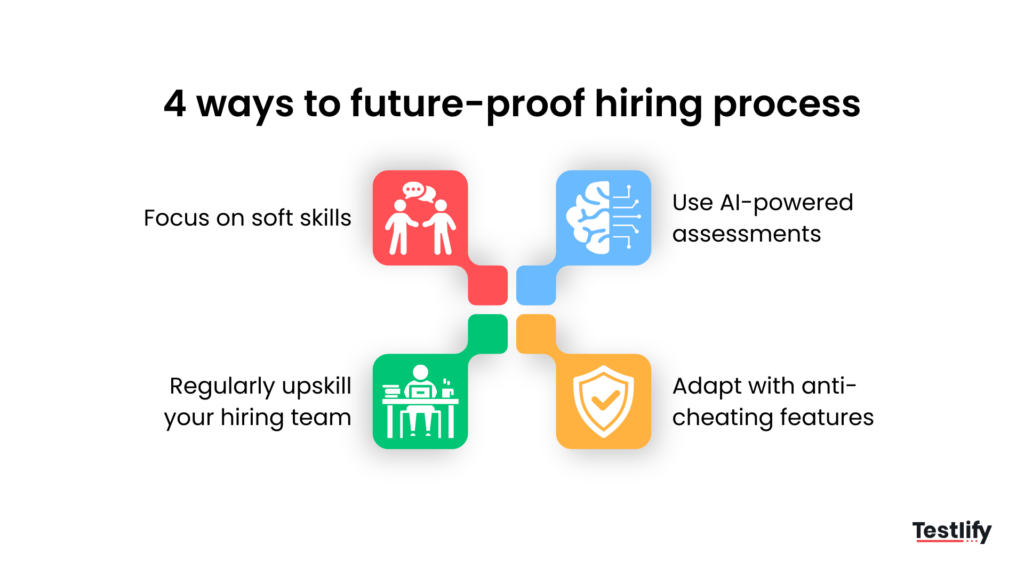
Use AI-powered assessments
By incorporating AI-powered assessments, like those offered by Testlify, you can streamline the candidate evaluation process, reduce human bias, and make data-driven decisions.
These assessments use machine learning to assess relevant skills and competencies, ensuring you’re hiring based on objective criteria rather than subjective judgment.
Adopting such tools can significantly improve the efficiency and accuracy of your hiring process.
Focus on soft skills
Soft or power skills are the most in-demand skills in any workplace. 91% of talent acquisition teams agree that soft skills are fundamental. You need software that assesses candidates’ competencies or knowledge and evaluates their soft skills.
Testlify offers AI-driven assessments beyond technical qualifications, providing an in-depth analysis of a candidate’s soft skills. Using situational judgment tests, behavioral assessments, and tailored simulations, Testlify helps you gauge how candidates will perform in real-world scenarios.
Assess your candidate’s soft skills from test library and discover how the right fit can improve your workplace culture and performance.
Regularly upskill your hiring team
With the global AI technologies market capturing $590.5 million by the end of 2025, it is no surprise that AI will stay. Your recruitment team must also be skilled at integrating and using AI tools.
Train your team to understand AI insights, use AI-powered assessments effectively, and make decisions that blend AI accuracy with human judgment. This will help your recruiters get the most out of AI while reducing potential risks.
“Talent leaders really need to take a few days to just dive into AI tools so that they can be making decisions from a position of knowledge and not theory,” Hung Lee says.
There will be a need to stop checking the ROI and cost-saving aspects of recruitment; rather, HR professionals will need to check the impact on applicants, candidate experience, etc.
While cost savings might be advantageous, other areas could have negative consequences, such as a poorer candidate experience or longer hiring times. Ultimately, companies must decide which aspects of their hiring process are most important to them and prioritize accordingly when making strategic decisions.
Adapt with anti-cheating features
As mentioned, some candidates might exploit this opportunity since AI-driven online assessments are carried out with an external invigilator. Hence, using an application that counteracts and prevents candidates from cheating is essential.
Testlify offers advanced anti-cheating features such as live monitoring, screen recording, mouse tracking, IP address tracking, full-screen mode, etc. These functionalities make Testlify the best choice for organizations looking to ensure the integrity and authenticity of their assessments.
With robust security measures, businesses can confidently evaluate candidates, knowing that the results accurately reflect their true skills and abilities.
Future-proof recruitment with Testlify
Every company worldwide increasingly uses AI technology in some form or another, especially in the recruitment sector. A McKinsey report states that about 60% of talent acquisition teams already use AI.
It is essential to future-proof your hiring process to stay ahead of the competition. This includes finding ways to prevent candidates from cheating, hire without bias, and provide a positive candidate experience. About 58% of candidates reject job offers due to poor experience.
By investing in advanced tools like Testlify, companies can safeguard their recruitment processes and provide candidates with a fair and engaging experience.
Book a free demo or sign up for free now.
Frequently asked questions (FAQs)

Related resources
View all
Hiring Guide
How does Testlify prevent cheating in AI pre-hire assessments?
Hiring Guide
Why are hiring and training employees essential in 2026?
Hiring Guide
Internships in Talent Acquisition: A 2026 Strategy Guide
Hiring Guide
Top 9 people management skills and how to assess them
Hiring Guide
How to create a recruitment dashboard that drive results?
Hiring Guide
7 simple steps to create a hiring process flowchart
Get started.
Hire on proof, not resumes.
Run your first skills-based assessment free — no credit card required.