
Marketing internship interview questions: 30 to ask and what to listen for
30 marketing internship interview questions grouped by skill, with what a strong answer sounds like for each one.

Marketing internship interview questions have to test potential, because almost no candidate has run a real campaign yet. Ask only about experience, and you screen out the people who would do the job well.
This guide gives you 30 questions across six skill areas, each with what a strong answer sounds like and how to score it.
TL;DR
- Marketing internship interviews should test potential, since most candidates have not run a real campaign.
- The 30 questions are grouped into six areas: fundamentals, digital and social media, writing, analytics, motivation and a case exercise.
- Each question lists what a strong answer sounds like, so you can score answers instead of just collecting them.
- A simple 1-to-3 score per answer makes candidates easier to compare fairly.
- Six to eight questions per interview is enough, so pick a few from each area.
- A short skills assessment before the interview leaves more interview time for fit and judgment.
 ChatGPT
 Gemini
 Claude
 Grok
 Perplexity
What should a marketing internship interview actually test?
A marketing internship interview should test fundamentals, digital fluency, writing ability, a basic read on data, and work style, not polished campaign experience. Most candidates have not run a real campaign yet, so a question that only rewards experience filters out people who would otherwise do the job well.
NACE's Job Outlook 2025 survey found that nearly 90% of employers look for problem-solving ability in entry-level candidates. More than 80% want teamwork, and over three-quarters look for communication skills, ahead of most technical criteria.
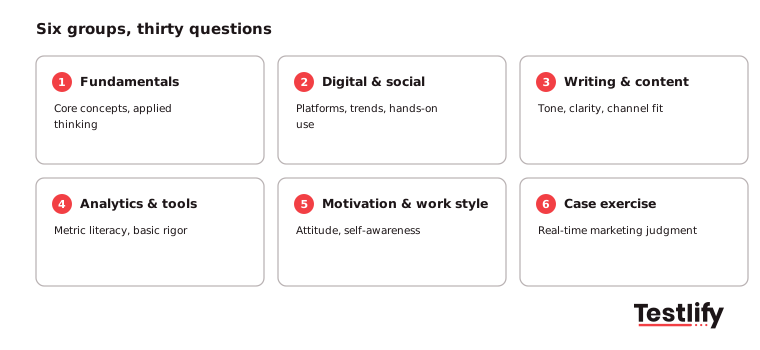

Which marketing internship interview questions test core fundamentals?
Fundamentals questions check whether the candidate understands core marketing concepts well enough to apply them, not recite a textbook definition.
- How would you explain marketing to someone outside the field?
A strong answer connects marketing to understanding a customer's need and communicating a solution to it, in plain language, not a dictionary definition. - What is the difference between marketing and sales?
Look for a clear distinction between the two, with marketing focused on building awareness and generating demand while sales focuses on converting that interest into revenue. - What is a target audience, and how would you define one for a product you like?
The answer should name specific traits (age range, needs, where they spend time online), not "everyone who might want it." - What makes a marketing campaign successful, in your view?
Look for a mention of a measurable goal, not just "it goes viral." - Can you walk through the customer journey for a brand you've interacted with recently?
This checks whether the candidate can map awareness, consideration and decision stages onto a real example.
What digital and social media questions should you ask?
Most marketing interns touch social media or paid channels early, so these questions test hands-on familiarity rather than theory.
- What experience do you have managing a social media account, personal or for a club, team or business?
Specific platforms, posting cadence and any metric they tracked (even informally) are good signs. - Which social platforms do you think matter most for [the company's industry], and why?
Tests whether they have thought about audience fit, not just personal platform preference. - What is a digital marketing trend you've noticed recently, and what do you think is driving it?
A specific, current example beats a generic answer like "AI is big right now." - How would you repurpose one piece of content across three different channels?
Tests practical thinking about format and audience differences, a skill interns use constantly. - Have you used any design or scheduling tools (Canva, Figma, Buffer, Hootsuite, similar)?
Direct tool experience is a bonus, not a requirement; look for willingness to learn fast if they have not.
What writing and content questions work well?
Interns write more than most people expect: captions, emails, briefs, first drafts. These questions test that directly.
- Write a one-sentence social caption for [a product the company sells].
Scores on clarity and whether it fits the brand's likely tone, not literary flair. - How do you adjust your writing style for a Gen Z social audience versus an email to a B2B buyer?
Tests awareness that voice changes by channel and audience, a core content skill. - Tell me about a time you had to write something you did not want to write. How did you approach it?
Internships involve plenty of unglamorous writing tasks; this checks attitude toward that reality. - What makes a subject line or headline make you stop scrolling?
Look for specificity, curiosity or a clear benefit, not "something catchy." - How would you check a piece of content for errors before it goes out?
Tests basic rigor: a second read, a second pair of eyes, a style guide, rather than "I'd just read it once."
What analytics and tools questions should you include?
A marketing intern does not need to be a data analyst, but should be comfortable looking at numbers and asking what they mean.
- If a social post got a lot of likes but no clicks to the website, what would that tell you?
Tests basic metric literacy: engagement and intent are not the same thing. - Have you used Google Analytics, Meta Ads Manager, or a similar reporting tool, even in a class project?
Any hands-on exposure counts; look for curiosity about what the numbers mean, not memorized definitions. - How would you decide if a campaign worked?
Strong answers tie back to the original goal (signups, clicks, sales) rather than "it felt successful." - What is A/B testing, and when would you use it?
Tests whether they grasp the idea of testing one variable at a time, even if they have never run a formal test. - If you had to track one number to know if your work this week mattered, what would it be?
This question is less about the "right" answer and more about whether the candidate thinks in terms of outcomes at all.
What motivation and work style questions reveal the most?
Motivation and work style questions surface attitude and self-awareness, which matter more at internship level than a long resume.
- What interests you about a marketing internship specifically?
Look for a real reason tied to coursework, a project, or a brand they admire, not a generic "I like creative work." - How do you keep up with marketing trends or news?
Specific sources (a newsletter, a podcast, a LinkedIn creator they follow) beat "I just see things online." - Tell me about a less glamorous task you completed well.
Look for a real task, a clear account of how they handled it, and no resentment toward routine work, which makes up a large share of any internship. - How do you prioritize when you have three deadlines on the same day?
Tests basic time management, not a perfect system. - Tell me about feedback you received on a piece of work. How did you respond to it?
Look for genuine reflection and a behavior change, not just "I took it well." - What are you hoping to learn in this internship that you can't learn in a classroom?
Tests whether they have thought past "getting a line on my resume."
What case exercise works best in a marketing internship interview?
- Thought about the actual role, not just the interview. Write better
- Here is one sentence about our product and our main competitor. In two minutes, write three bullet points explaining how you would position us differently.
This is a strong real-time test of marketing thinking because it shows how quickly a candidate can identify differentiation and turn it into clear positioning. - Pick a brand you think markets itself well and explain what specifically makes its marketing effective.
This reveals whether the candidate can support their opinions with specific observations rather than simply naming brands they admire. - If our campaign budget for next month were cut in half, what would you cut first and why?
This tests the candidate’s ability to prioritize, make tradeoffs, and protect the activities most likely to drive results. - What would you want to learn in your first week here to do this job well?
This reveals whether the candidate has thought seriously about the role and understands what they would need to learn to contribute effectively.
How should you score these answers?
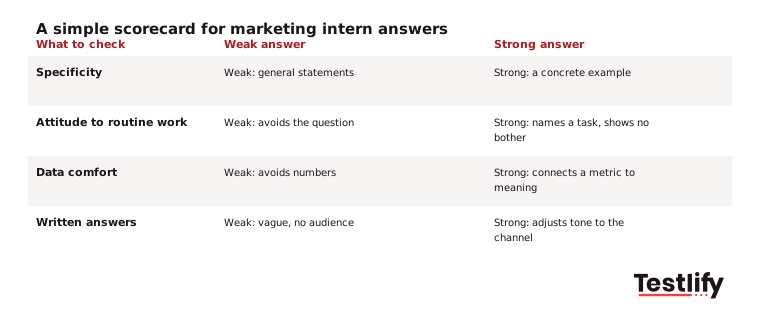
Score marketing internship answers on three things: did the candidate understand the question's real point, did they give a specific example instead of a general statement, and did the answer show the skill the role actually needs.
A simple 1-to-3 scale per question (weak, adequate, strong) across a handful of these questions gives a far more comparable result across candidates than an unscored gut impression.
What to check | Weak answer | Strong answer |
|---|---|---|
Specificity | General statements, no example | A concrete example from coursework, a club, or a part-time job |
Attitude toward routine work | Avoids the question or focuses only on creative work | Names an unglamorous task and shows it did not bother them |
Data comfort | Avoids numbers entirely | Connects a metric to what it actually tells you |
Written answers | Vague, no clear audience | Adjusts tone and specificity to the channel named in the question |
How can a skills assessment help before the interview?
Getting this interview right matters beyond the summer. NACE's latest Internship & Co-op report put intern full-time conversion at 62%, depending on in-person or hybrid format.
A short skills assessment before the interview filters for the fundamentals above: basic marketing concepts, a short writing sample, and a simple data-reading question. The interview itself can then focus on fit and judgment rather than re-testing things a test could check in 15 minutes.
Testlify's test library includes role-specific and situational judgment tests that work well as a first screen for high-volume internship hiring, where dozens of applicants apply for a handful of seats.
Want to screen interns faster and interview only the strongest applicants? Book a demo to see how Testlify fits your hiring process.
Frequently asked questions (FAQs)

Director of Marketing
Akash Patange is the Director of Marketing at Testlify, where he works closely with HR leaders and recruiters to help organizations improve hiring outcomes. He writes about talent assessment, recruitment technology, and data-driven hiring practices.
LinkedInRelated resources
View all
Interview questions
Interior designer interview questions: 40 to ask in 2026

Interview questions
40 electrician interview questions and what good answers sound like

Interview questions
25 accounting clerk interview questions and answers

Interview questions
25 Zendesk Software Engineer Interview Questions (2026)

Interview questions
7 interview questions to check if the candidate is tech-savvy

Interview questions
60 HRIS Analyst interview questions to ask job applicants
Get started.
Hire on proof, not resumes.
Run your first skills-based assessment free — no credit card required.