
What is experiential recruiting
Experiential recruiting helps hiring teams assess candidates by seeing them perform real or simulated work. Learn the key formats, benefits, steps, challenges, and metrics to build a more effective hiring process.

A candidate can say they handle angry customers well. Until you hear them on a live call with one, you are guessing.
Resumes and interview answers show how well people talk about work, not how well they do it. Many hiring teams now want proof of the work itself, and that gap is why bad hires still happen after a strong interview.
Experiential recruiting closes that gap. It is a hiring approach that judges candidates on how they handle real or simulated work, such as a job simulation, case study, role-play, micro-internship or paid work trial. Candidates get a preview of the job, and the hiring team sees the skill in action before making an offer. This guide covers the formats, the steps to run it and the metrics to track.
TL;DR: - What experiential recruiting is, and how it differs from experiential recruitment marketing, which is about employer brand events. - The five main formats and when to use each. - Why more hiring teams are moving to it. - A six-step way to run it without overloading candidates or interviewers. - The challenges to plan for and the metrics to track. - How to run the first scored stage at volume.
 ChatGPT
 Gemini
 Claude
 Grok
 Perplexity
What is experiential recruiting?
Experiential recruiting means hiring people based on work they actually do during the process. Instead of asking "tell me about a time you handled an angry customer", the team hands the candidate an angry customer, real or simulated, and scores how the conversation goes.
The term started in early-career and campus hiring, where students have thin resumes and little work history. Employers there use micro-internships, case competitions and project-based events to see how students think. The same idea now runs through skills-based hiring for every level: a short, scored task tells a recruiter more than a degree or a job title.
In SHRM's skills-first research, HR professionals ranked relevant work experience and demonstrated skills as the top factors when deciding who to hire, and 70% expect skills-first practices to play a larger role over the next three years. The same study found that 24% of HR professionals and 33% of supervisors find it too difficult to judge the quality of skills behind a credential. Watching someone do the work removes that guesswork.

Is experiential recruiting the same as experiential recruitment marketing?
Experiential recruiting and experiential recruitment marketing are related but not the same. Experiential recruiting assesses candidates through hands-on work. Experiential recruitment marketing creates memorable employer brand events, such as immersive open houses or campus installations, to attract job seekers before they apply.
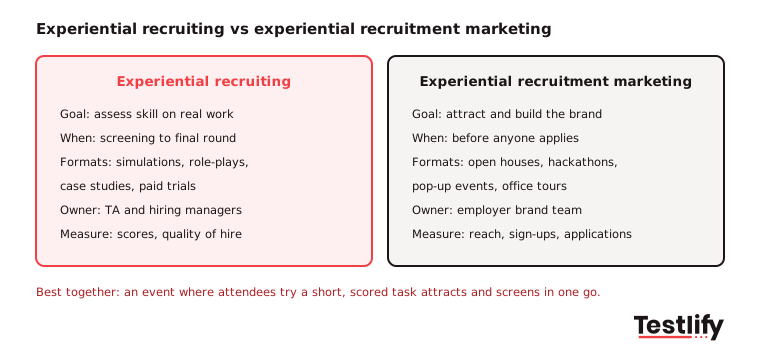
Comparison point | Experiential recruiting | Experiential recruitment marketing |
|---|---|---|
Main goal | Assess skill on real work | Attract candidates and build the employer brand |
Stage | Screening to final round | Before anyone applies |
Typical formats | Job simulations, case studies, role-plays, work trials | Open houses, hackathons, pop-up events, office tours |
Owned by | TA and hiring managers | Employer brand and recruitment marketing |
What you measure | Scores, quality of hire, retention | Reach, sign-ups, applications |
Symphony Talent describes the marketing side as a shared moment job seekers feel, not just see. The two work best together: an event that lets attendees try a short task attracts people and screens them in one go. The rest of this guide focuses on the assessment side.
Types of experiential recruiting
Experiential recruiting comes in five main formats: job simulations, case studies, role-plays, micro-internships and paid work trials. They differ mostly in how much time they ask of the candidate, so the right choice depends on the hiring stage and how many people you need to assess.
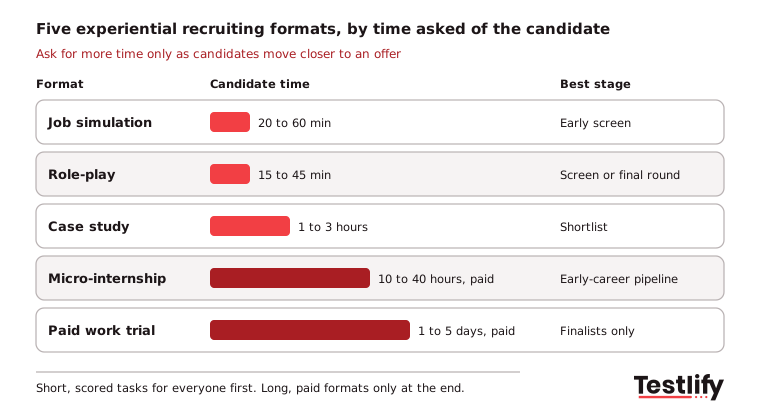
Format | Candidate time | Pay expected | Best stage | Best for |
|---|---|---|---|---|
Job simulation | 20 to 60 minutes | No | Early screen | Volume roles, any role with a clear daily task |
Case study | 1 to 3 hours | Usually no | Mid stage | Analysts, consultants, marketers |
Role-play | 15 to 45 minutes | No | Screen or final round | Sales, support, managers |
Micro-internship | 10 to 40 hours | Yes | Early career pipeline | Students and graduates |
Paid work trial | 1 to 5 days | Yes | Final round | Senior or hard-to-reverse hires |
- Job simulations recreate a slice of the job in a test: answering a support ticket, cleaning a spreadsheet, fixing a bug.
- Case studies give a realistic problem and ask for a recommendation or a short presentation.
- Role-plays put the candidate in a live conversation, such as a sales call or an upset customer. Here is how to run role simulations.
- Micro-internships are short, paid projects for students, often run through a university or a platform.
- Paid work trials bring a finalist into the team for a day or more. The work trial glossary entry covers the basics.
Why are hiring teams using experiential recruiting?
Hiring teams use experiential recruiting because resumes and unstructured interviews say little about what a person can actually do. Seeing real work gives a clearer read on skill, widens the talent pool beyond the usual schools and job titles, and gives candidates an honest preview of the job.
- Wider talent pools. The LinkedIn Economic Graph skills-based hiring report (March 2025) estimates that hiring on skills rather than past job titles could grow the typical talent pool by a median of 6.1x worldwide, with workers without a degree gaining 6% more than degree holders.
- It is already mainstream for entry-level hiring. NACE's Job Outlook 2025 found that 64.8% of employers use skills-based hiring for new entry-level hires.
- Internships alone are a weaker signal than they were. NACE's 2025 internship survey reports that employers offered full-time jobs to 62% of their 2024 intern class, the lowest rate in five years. Shorter, scored tasks let teams test more people before committing a summer to them.
- Fewer surprises after day one. Candidates see the real work before they accept, so the people who join know what they signed up for.
- A stronger candidate experience. A task that feels like the job is more engaging than a generic questionnaire, and every candidate gets a fair shot at showing what they can do.
How do you run experiential recruiting?
Experiential recruiting works best when it is planned like any other hiring process, not bolted on at the end. A good setup starts with what the role needs, carries through to how you score the work, and ends with a check on whether it paid off. The aim is to keep early tasks short for candidates and save the longer, paid formats for the shortlist.
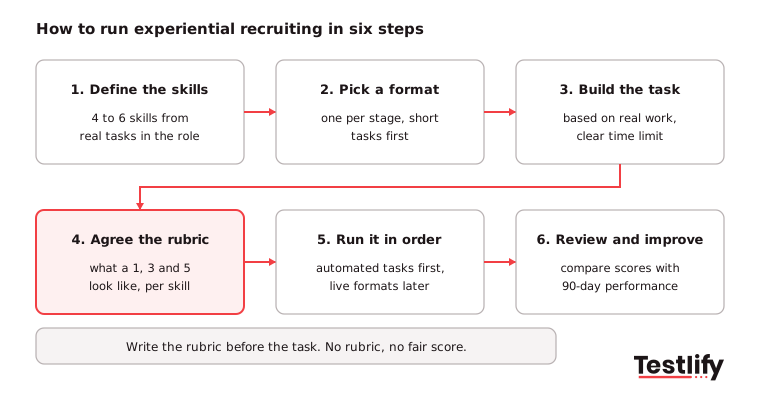
- Define the skills. List the four to six skills that separate a strong hire from an average one in this role. Use real tasks from the job, not adjectives.
- Pick a format for each stage. A 30-minute simulation for everyone who applies, a role-play or case for the shortlist, and a paid trial only for finalists, if at all.
- Build a realistic task. Base it on work the team did last month. Give clear instructions, a time limit and the tools the person would really use.
- Agree the scoring rubric. Write what a 1, 3 and 5 look like for each skill before anyone sees a submission, and have two reviewers score the same work early on to check they agree.
- Run it at the right point. Put short, automated tasks first, so many candidates can take them on their own time, and live formats later, when the pool is small.
- Review and improve. Compare task scores with hiring manager ratings and 90-day performance, then cut any task that does not separate strong hires from weak ones.
Pro tip: Write the rubric before you write the task. If you cannot describe what a top answer looks like, the task is not ready, and reviewers will fall back on gut feel.
Challenges of experiential recruiting
Experiential recruiting has four common challenges: the time it asks of candidates, the time it asks of reviewers, keeping scoring fair, and the legal and pay questions around unpaid work. Each one is manageable if you plan for it before launch rather than after complaints arrive.
- Candidate time. Long unpaid tasks push strong candidates away, especially those already in a job. Keep early tasks under an hour and tell people up front how long they will take.
- Reviewer time and buy-in. In NACE's Job Outlook 2025, the top barriers to skills-based hiring were lack of time or resources (53%) and lack of hiring manager buy-in (50%). Automated scoring for early tasks and a clear rubric for live ones keep the load down.
- Fair scoring. Without a rubric, two reviewers can score the same work very differently. Use the same task, time limit and criteria for every candidate in a role.
- Unpaid work. A task should test skill, not produce work the company will use. Pay for multi-day trials and anything that looks like real output, and check local labour law before running trials.
- Cheating and outside help. Take-home tasks are easy to outsource or hand to an AI tool. Proctoring, identity checks and a short live follow-up on the submitted work reduce the risk.
How do you measure experiential recruiting?
Measuring experiential recruiting means comparing it with the old process on a few hiring metrics: completion rate, time-to-hire, offer acceptance, quality of hire and early retention. Track them for one role for at least one hiring cycle before you roll the approach out further.
Metric | What it tells you | Warning sign |
|---|---|---|
Task completion rate | Whether the task is too long or unclear | Drop-off above your normal application drop-off |
Score spread | Whether the task separates candidates | Most candidates land on the same score |
Time-to-hire | Whether the process is faster or slower | Live tasks booked weeks out |
Offer acceptance | Whether candidates liked what they saw | Acceptance falls after the trial stage |
90-day retention and manager rating | Whether high scorers turn into strong hires | No link between task score and performance |
Key takeaway: Experiential recruiting works when the task looks like the job, the scoring is agreed in advance, and the time asked of candidates grows only as they move closer to an offer.
How does Testlify support experiential recruiting?
Testlify supports experiential recruiting by turning the early, high-volume stage into scored, job-like tasks that candidates take on their own time. Hiring teams get evidence on every applicant before they spend interviewer hours on live role-simulations, case studies or trials.
- Job simulations and practical tasks: Candidates can complete Microsoft Office and Google Workspace simulations, live coding, typing tests and chat simulations from the 3,500+ tests in the Testlify test library, alongside 25+ question types such as practical tasks and file uploads.
- Role-plays at scale: Chat AI interviews, Voice AI and Video AI put candidates in role-based conversations and score every answer, so a support or sales role-play no longer needs a person on the other side.
- Fair and secure: Every candidate gets the same task and criteria, 20+ proctoring checks help keep take-home work honest, and assessments run in 15+ languages.
Ready to see candidates do the work? Build a short job simulation from your own job description and see who can do the job before the first interview. Book a demo to see how it works, or start a 7-day free trial of Testlify, no credit card required.
Frequently asked questions

People and Talent Partner
Arushi Shah runs day-to-day talent acquisition and candidate experience at Testlify. She writes on interviewing, structured hiring, and giving candidates a fair, fast process.
LinkedInRelated resources
View all
Talent Acquisition
Realistic Job Preview: Examples, Template and How-To (2026)

Talent Acquisition
How to scale talent acquisition without losing quality?
Talent Acquisition
Top 10 targeted training strategies to bridge the skills gap

Talent Acquisition
Diversity and inclusion in talent acquisition: Best practices for success

Talent Acquisition
Leveraging technology in talent acquisition: Trends and tools

Talent Acquisition
Building a winning talent acquisition strategy: A step-by-step guide
Get started.
Hire on proof, not resumes.
Run your first skills-based assessment free — no credit card required.