
Why HR teams optimize recruitment budget for AI-first Hiring
Find out why 75% of Indian recruiters are now channeling most of their recruitment budget into AI-powered recruitment tools.

As global hiring practices evolve, HR teams are under pressure to streamline their recruitment processes while ensuring quality hires. To meet this challenge, HR departments are now reallocating their recruitment budget for automating repetitive tasks such as resume screening, interview scheduling, and initial assessments
According to LinkedIn’s India Hiring ROI report, 3 in 4 recruiters now invest up to 70% of their recruitment budgets in AI-driven recruitment tools, signaling a decisive shift towards prioritizing quality over volume in the hiring process.
 ChatGPT
 Gemini
 Claude
 Grok
Grok Perplexity
The rise of AI-first hiring
Across industries and geographies, organizations are integrating AI at every stage of the hiring process. According to SHRM’s 2024 report, 64% of organizations worldwide are utilizing AI in recruitment, interviewing, and hiring processes.
A recent Deloitte analysis similarly finds that 68% of large enterprises have embedded AI into at least one stage of their hiring process. These tools streamline sourcing and screening: for instance, nearly 9 in 10 recruiters say AI helps them save time or boost efficiency.
In practice, AI algorithms can scan thousands of resumes and profiles to surface candidates with specific skills and experiences, far faster than human recruiters alone.
At the same time, leaders emphasize responsible use of AI. Most organizations maintain human oversight: a study found 85% of companies still require a human decision for final hire choices. This hybrid approach balances efficiency with fairness.
As Deloitte highlights in its report on India’s talent strategy, the focus is shifting from merely chasing a high volume of talent to prioritizing the quality of talent. This involves reskilling efforts and an emphasis on developing core skills rather than just increasing headcount.
In short, AI is helping recruiters target candidates more precisely and measure outcomes more rigorously.

Shifting recruitment budgets towards AI hiring tools
Surveys show that when budgets tighten, HR leaders prioritize maximizing value over headcount. For example, an HR Dive report notes that many firms cite insufficient hiring budgets, leading HR teams to focus on “maximizing value within budgetary constraints.
Instead of spending on endless job fairs or recruiting agencies, companies are investing in technology that yields better hires. Indeed, LinkedIn’s India study finds nearly 75% of recruiters now allocate the majority of their talent-acquisition budget to AI and tech platforms.
This trend spans all segments: large enterprises can deploy sophisticated AI systems across global operations, while mid-size firms and startups often turn to affordable cloud-based assessment tools.
Prioritizing quality yields tangible ROI. A bad on the other hand hire can be extremely costly. It is estimated that hiring the wrong talent can cost 30% of the role’s salary and result in low productivity.
Also, delays in making quality hires carry costs, with 58% of recruiters in India saying they lost top candidates to direct competitors when hiring dragged on. In practice, AI and analytics enable teams to tighten feedback loops, improve outreach, and measure outcomes.
As the global talent ecosystem evolves, one thing is clear: the era of hiring for volume is giving way to an era defined by value, skills, and long-term impact. Recruiters are increasingly using data to guide their spending decisions. In fact, over 69% now leverage analytics for decision-making, while 63% utilize AI tools to enhance accuracy and efficiency.
An AI-first approach helps recruiters maximize their budget by improving candidate fit and reducing time spent on poor-fit candidates.
Companies that align their recruitment budgets with this philosophy are seeing benefits across the board, from lower turnover to higher revenue per employee.
Should skills assessment tools be a key priority in recruitment budgets?
A key reason to reallocate budget is the rise of AI-powered assessment tools. Modern skills assessment platforms can evaluate both technical skills and non-technical skills, such as cognitive abilities, as well as cultural fit, before any human interview.
For example, an AI-powered assessment tool such as Testlify uses coding tests, conversational AI interviews, or situational judgment tests to objectively rank candidates on job-critical competencies. This complements human judgment and dramatically improves “quality of hire.”
Testlify enables HR teams to craft custom tests and auto-score them, allowing recruiters to quickly narrow down hundreds of applicants to a handful of qualified prospects. Importantly, it integrates with 100+ existing Applicant Tracking Systems (ATS), making it easy to embed into any recruitment workflow.
Deploying AI-powered skills assessment tools like Testlify aligns with global best practices and helps organizations determine the gap between where talent is today and where it needs to be in the future
Large enterprises also benefit from using AI in recruiting, resulting in 2–3× faster hiring and markedly higher-quality candidates. Although that particular source is an industry report, it reflects an emerging consensus: when budgets fund smart tech, HR teams become “career advisors” rather than order-takers.
Balancing AI with human judgment
Despite enthusiasm, experts warn against over-reliance on AI. Concerns about bias, data privacy, and candidate trust persist. In fact, only 37% of job seekers trust AI to select qualified applicants.
To address this, the best organizations follow AI governance practices: validating models, auditing outcomes, and always keeping humans in the loop. For example, a recent study found 85% of recruiters believe human oversight remains critical in final hiring decisions.
Some companies use part of their recruitment budget to subscribe to AI ethics or compliance workshops. Others incorporate AI-awareness into their employer branding to set candidate expectations. In short, effective AI-first hiring budgets must cover the full spectrum: technology, people, and processes.
Action plan for HR leaders
For recruiters and HR leaders looking to shift budgets toward quality hires, the path is clear:
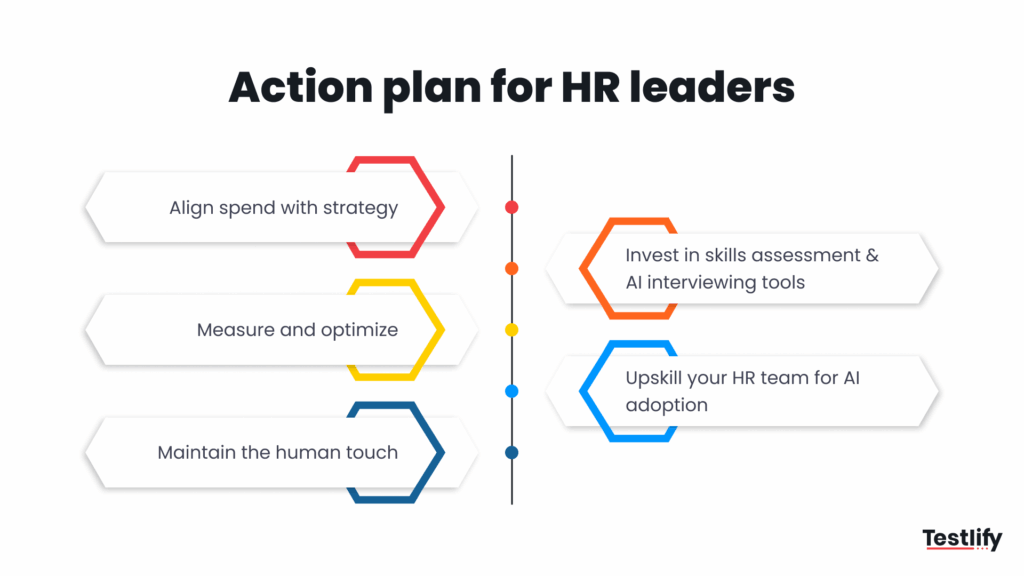
- Align spend with strategy: Define the skills and attributes that predict success in your roles. Redirect budget from low-yield channels (generic job boards, high-volume agencies) into a skills assessment tool that helps you effectively screen for those skills.
- Invest in skills assessment & AI interviewing tool: Allocate budget to platforms that streamline volume hiring by automating candidate assessments, enhancing efficiency, and ensuring a more personalized, data-driven evaluation process.
- Measure and optimize: Track metrics beyond time-to-fill. Include quality-of-hire (performance ratings, retention) and cost-of-bad-hire (turnover expenses). Use analytics to prove ROI on your hiring spend.
- Upskill your HR team for AI adoption: HR teams need skills to interpret AI outputs and to communicate clearly with candidates. For the recruitment budget, this means allocating funds not just for tools but also for change management training.
- Maintain the human touch: Even in an AI-first model, candidate relationships matter. Budget for recruiter-candidate engagement (personalized outreach, interview debriefs) to complement automation efforts.
Final thoughts
Organizations that continue to allocate recruitment budgets to outdated, volume-driven strategies risk higher attrition rates, lower productivity, and wasted resources. The future belongs to HR leaders who adopt an AI-first approach to hiring.
Whether you’re leading a large enterprise, scaling a mid-sized company, or building a startup team, investing in an AI-first hiring process will pay dividends in performance, retention, and business growth.
Platforms like Testlify play a key role in this shift. By combining role-specific skills tests, conversational AI interviews, and actionable analytics, Testlify enables recruiters to hire with confidence while avoiding budget inflation.
If you’re ready to future-proof your hiring strategy and maximize your recruitment budget, there’s no better time to get started.
Book a free demo today and see how you can transform your recruitment process into a competitive advantage.
For further reading, explore First Podcast Demo.
Frequently asked questions (FAQs)

Related resources
View all
Mental Health
Why U.S. employers use mental health perks to attract top talent

Skill assessment
What skills-based hiring data shows beyond the US and UK

HR & recruitment
AI across all stages of the hiring process in 2026

AI in recruitment
Best practices for hiring data analysts using assessments?

Candidate assessment
What tools support voice responses for language proficiency testing?

Candidate assessment
How do ATS-integrated assessments streamline hiring workflows?
Get started.
Hire on proof, not resumes.
Run your first skills-based assessment free — no credit card required.