
What are the benefits of using a PEO? A guide for growing teams
A PEO gives growing firms big-company benefits, payroll and HR compliance help. See the benefits, the downsides and when a PEO is worth it.

Growing a team should mean more customers and better products. Too often it means more payroll runs, benefits quotes and compliance notices landing on the founder's desk.
A professional employer organization (PEO) is an outside firm that becomes the co-employer of your staff and takes over payroll, benefits, HR compliance and workers' compensation. You keep running the business and directing the work.
So what are the benefits of using a PEO? Expect access to large-group health plans, fewer payroll and compliance mistakes, HR expertise on call and more time for growth.
The trade-off is cost and some loss of control, which this guide weighs against the gains.
TL;DR:
- The main benefits of using a PEO are cheaper and better employee benefits, payroll and tax handled for you, help with HR compliance, workers' comp support and more time for leaders to grow the business.
- NAPEO's 2024 research found PEO clients grow more than twice as fast as similar businesses, have 12% lower employee turnover and are 50% less likely to go out of business.
- Employees gain too: access to large-group health, dental and retirement plans, accurate pay and an HR team they can ask.
- The downsides are fees that rise with headcount, less control over plans and policies, and extra work if you leave mid-year.
- A PEO fits best for companies with roughly 10 to 200 employees, no full HR team and staff in several states.
- A PEO handles people once they are hired. Sourcing, screening and skills testing stay with your hiring team.
 ChatGPT
 Gemini
 Claude
 Grok
 Perplexity
What is a PEO?
A PEO, or professional employer organization, is a company that enters a co-employment arrangement with your business. The PEO becomes the employer of record for tax and benefits purposes, runs payroll, files employment taxes and sponsors benefit plans.
Your business still hires, manages, pays and directs the people who do the work. Testlify's glossary entry on the professional employer organization (PEO) covers the term in short.
PEOs are a big part of how small and mid-size US businesses run HR. According to NAPEO's PEO Industry Footprint 2026, 502 PEOs served 5.4 million worksite employees at 233,000 client businesses at the end of 2025.
The average client has 23 employees, and about 14% of businesses with 20 to 499 employees use a PEO. PEO worksite employment has grown 7.2% a year since 2008, against 0.7% for total US employment.

How does a PEO work?
A PEO works through co-employment: the PEO and your company share employer duties under a client service agreement. The PEO takes the administrative and legal side of employment, and your company keeps everything to do with the work itself, including who to hire and how people perform.
Task | PEO handles | Your company keeps |
|---|---|---|
Payroll and employment taxes | Runs payroll, files and pays federal and state taxes | Approves hours, pay rates and raises |
Employee benefits | Sponsors health, dental, vision and retirement plans | Picks which plans to offer and how much to contribute |
Workers' compensation | Provides coverage, manages claims and safety programs | Keeps the workplace safe day to day |
HR compliance | Tracks law changes, updates handbooks and required notices | Applies policies fairly and documents decisions |
Hiring | Onboarding paperwork, I-9 and tax forms | Sourcing, screening, assessing and choosing candidates |
Daily work | None | Assigns work, manages performance, decides on promotions and exits |
The split is set out in the client service agreement, so read it closely. Each PEO draws the line in a slightly different place.
What are the benefits of using a PEO?
The benefits of using a PEO fall into eight groups: better benefits at lower cost, payroll and tax handled, compliance support, workers' comp help, HR expertise, lower turnover, faster growth and more time for leaders. Most businesses sign up for the benefits and stay for the time saved.
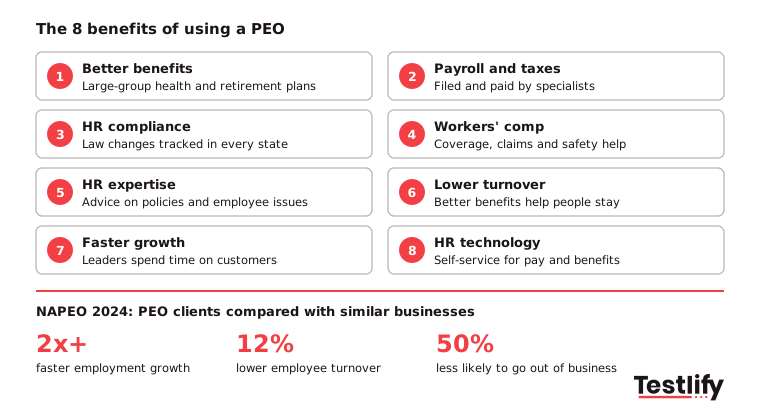
The growth and retention figures come from NAPEO's 2024 report on PEO clients, prepared by McBassi & Company. The report compared PEO clients with similar businesses.
PEO clients grew employment by 4.3% from January 2023 to January 2024, against 1.9% for comparable US employers.
PEO clients also had 12% lower employee turnover and were 50% less likely to go out of business. NAPEO is the PEO trade body, so treat these as industry figures, but the comparison groups were matched on size and, in one analysis, on industry and location.
Key takeaway: For most small and mid-size firms, the benefits plan and the hours saved on payroll and compliance are the two benefits that pay for the PEO fee.
How does a PEO help you offer better employee benefits?
A PEO helps you offer better employee benefits by putting your staff into its large group, which gives a small company the plan choice, pricing and stability that usually only big employers get. Benefits are also administered for you: enrollment, COBRA, open enrollment and carrier issues all go to the PEO.
Benefits are a large share of what employees cost. The US Bureau of Labor Statistics Employer Costs for Employee Compensation release for June 2026 put private industry compensation at $46.89 per hour worked, of which benefits made up $14.07, or 30.0%.
Small changes in plan pricing therefore move total labor costs.
A PEO plan usually covers:
- Medical, dental and vision insurance
- Life and disability insurance
- 401(k) or other retirement plans
- Health savings and flexible spending accounts
- Commuter benefits, employee assistance programs and discounts
For more on the work behind this, see benefits administration.
Pro tip: Ask for the PEO's plan rates in writing for your actual headcount and ages, and compare them with a quote from a broker for your company alone. Large-group rates are often better, but not always.
What are the benefits of using a PEO for employees?
The benefits of using a PEO for employees are better health and retirement plans, accurate and on-time pay, a real HR team to ask, and self-service tools for pay, benefits and time off. Employees still work for your company day to day; the PEO appears on their pay stubs and benefits cards.
- Better benefits: Plan options closer to what large employers offer, often with lower premiums or deductibles.
- Accurate pay: Payroll and tax withholding handled by specialists, with fewer errors.
- HR support: A place to ask about leave, benefits and workplace issues, outside the direct line of their manager.
- Self-service: A portal or app for pay stubs, tax forms, enrollment and documents.
- Compliance protection: Required notices, leave rights and wage rules applied consistently.
How does a PEO help hiring teams?
A PEO helps hiring teams by making offers more competitive, getting new hires set up faster and making it easier to hire in new states. Recruiters can promise large-company benefits on day one, and onboarding paperwork, tax forms and benefits enrollment run through the PEO instead of the recruiter or hiring manager.
The challenge it helps with is real. Paychex's 2024 Priorities for Business Leaders survey found that 46% of business leaders rank hiring and keeping good employees as their top operational challenge.
Where a PEO helps hiring
- Stronger offers: Better benefits help close candidates who are comparing you with larger employers.
- Faster onboarding: New hire forms, I-9s and benefits enrollment run through one system. Our onboarding checklist covers what else to plan for the first weeks.
- New states: The PEO already has tax accounts and compliance knowledge in most states, so a remote hire in a new state does not stall.
What a PEO does not do is decide who to hire. Sourcing, screening, skills testing, interviews and the final choice stay with your hiring team.
A PEO also does not reduce the cost per hire of a bad hire; it only makes the paperwork easier. Pair the PEO with a structured, skills-based selection process so the people it onboards are the right ones.
What are the disadvantages of using a PEO?
The disadvantages of using a PEO are cost that grows with headcount, less control over benefits and policies, shared employer duties that can confuse staff, and switching costs if the fit is wrong. These cons matter most for companies that already have an HR team or very specific benefits needs.
- Cost rises with headcount: Fees are charged per employee or as a share of payroll, so rapid hiring raises the bill.
- Less control: You choose from the PEO's plans and processes rather than designing your own.
- Co-employment confusion: Employees may not know who to call about what, and the PEO name on pay stubs can feel odd.
- Service quality varies: Some PEOs assign a dedicated contact; others route everything through a call center.
- Hard to leave mid-year: Moving out means new payroll setup, new benefits enrollment and tax account changes, often mid-plan year.
- Data access: Employee records sit in the PEO's system, so exports and integrations with your other tools matter.
How much does a PEO cost?
A PEO costs either a flat fee per employee per month or a percentage of total payroll, and the fee usually does not include the cost of the benefits plans themselves. The IRS describes PEOs as typically paid a fee based on payroll costs.
Price depends on headcount, industry risk, states and the services you choose.
When you compare quotes, separate three numbers:
- The admin fee: The PEO's charge for payroll, HR and compliance services.
- Benefits premiums: What the health, dental and other plans cost per employee.
- Workers' comp: Often priced on your payroll and industry risk class.
A PEO that looks cheaper on the admin fee can cost more once benefits and workers' comp are added. Ask for an all-in cost per employee per year for your real team.
How is a PEO different from an EOR, ASO or RPO?
A PEO is different from an EOR, ASO or RPO in who is the legal employer and what work is outsourced. A PEO shares employment with you; an EOR is the sole legal employer, often in another country; an ASO handles HR admin without co-employment; and an RPO runs recruiting, not HR administration.
Model | Legal employer | What it handles | Best for |
|---|---|---|---|
PEO | Shared (co-employment) | Payroll, benefits, compliance, workers' comp | US firms with 10 to 200 staff and no full HR team |
EOR (employer of record) | The EOR alone | Hiring and employing staff where you have no entity | Hiring in a new country without setting up a company |
ASO (administrative services organization) | Your company | Payroll and HR admin, you keep your own benefits plans | Firms that want admin help but own benefits |
RPO (recruitment process outsourcing) | Your company | Sourcing, screening and recruiting | Firms that need hiring capacity, not HR admin |
For more, read our guides to employer of record services, recruitment process outsourcing and the wider benefits of outsourcing HR functions.
When is a PEO worth it, and when do you outgrow one?
A PEO is worth it when you have roughly 10 to 200 employees, no full HR team, staff in several states, and benefits that cost too much or do not compete. Companies usually outgrow a PEO once they pass about 200 employees, hire an HR leader, or need custom benefits and HR systems.
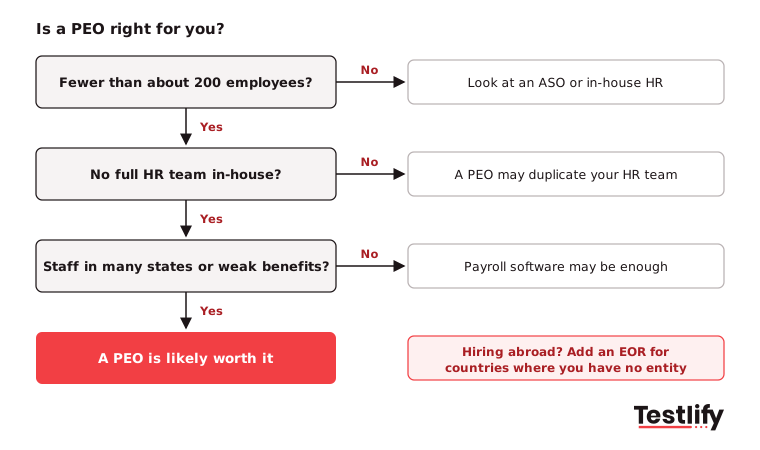
Signs a PEO is worth it
- Founders or office managers spend hours a week on payroll and HR.
- Candidates turn down offers because of weak benefits.
- You are hiring remote staff in new states.
- You have had a payroll tax notice or a compliance scare.
Signs you are outgrowing it
- You now have an HR team that could run payroll and benefits in-house.
- Your benefits broker can beat the PEO's rates for your group alone.
- You need HR and recruiting tools the PEO platform does not support.
- You are hiring in other countries, where an EOR or your own entity fits better.
How do you choose the right PEO?
Choosing the right PEO comes down to six checks: certification, benefits fit, service model, total cost, technology and exit terms. Ask every finalist the same questions and get answers in writing.
- Certification: Check whether the PEO is on the IRS list of certified professional employer organizations. Certification is voluntary, but it shows the PEO has met federal requirements. Many PEOs are also accredited by the Employer Services Assurance Corporation (ESAC).
- Benefits fit: Compare plan options and rates for your real team, including the states your people live in.
- Service model: Ask who your day-to-day contact is and how fast they respond.
- Total cost: Get the admin fee, benefits premiums and workers' comp as one yearly cost per employee.
- Technology: Check the employee portal and whether data can sync with your ATS, HRIS and accounting tools.
- Exit terms: Read the notice period, fees for leaving and how your data will be handed back.
Hire the right people before your PEO onboards them
A PEO takes care of employees once they join. Choosing who joins is still your job, and it is where the biggest cost of a wrong hire sits.
Testlify helps hiring teams screen on skills instead of resumes with 3,500+ tests, 25+ question types, AI interviews and 20+ proctoring checks, in 15+ languages. Browse the Testlify test library to see what is available.
Ready to see it in action? Book a demo with the Testlify team, or start a 7-day free trial, no credit card needed.
Frequently asked questions (FAQs)

People and Talent Partner
Arushi Shah runs day-to-day talent acquisition and candidate experience at Testlify. She writes on interviewing, structured hiring, and giving candidates a fair, fast process.
LinkedInRelated resources
View all
HR & recruitment
PEO for startups: what it does and when it pays off

HR & recruitment
Labor forecasting: what it is and how to do it in 2026

HR & recruitment
Payroll advance: what it is, how it works and how to offer one

HR & recruitment
How to evaluate team performance: a practical guide for 2026

HR & recruitment
How Do Employee Benefits Affect Total Employment Compensation?

HR & recruitment
What Is Leadership Coaching? A 2026 Guide for HR Teams
Get started.
Hire on proof, not resumes.
Run your first skills-based assessment free — no credit card required.