
Labor forecasting: what it is and how to do it in 2026
Labor forecasting predicts how many workers you need and when, so hiring teams can staff shifts without over- or under-hiring.

Labor forecasting is the work of predicting how many people you need, and when you need them. Get it right and shifts are covered, costs stay in check and candidates are ready before the gap opens. Get it wrong and managers scramble, overtime climbs and recruiters fill roles in a panic. For TA leaders, recruiters and HR teams, the forecast is also the starting point for every hiring plan. This guide explains what labor forecasting is and how the calculation works. It also covers which methods fit which demand, and how to build a process your team can trust.
TL;DR / Key Takeaways
- Labor forecasting predicts how much work is coming and converts it into the people-hours, shifts or headcount needed to handle it.
- Labor hours needed equals forecasted demand divided by the productivity rate. 600 calls at 15 calls per agent-hour needs 40 agent-hours.
- Use historical trend or moving average for steady demand, time series for seasonal demand and regression when a reliable driver exists.
- Use Delphi or zero-based forecasting when there is no usable history, such as a new location or service line.
- Build from 12 to 24 months of data, and count absenteeism, training time and required breaks in the hours.
- Compare the forecast to actuals every period. Landing within about 5 to 10% of actual demand is useful for steady operations.
- Look 8 to 12 weeks ahead for seasonal peaks, so hiring, testing and training finish before demand arrives.
Short-staffed on a Saturday, overstaffed on a Tuesday: most scheduling headaches trace back to a labor forecast nobody built, or built once and never checked.

 ChatGPT
 Gemini
 Claude
 Grok
 Perplexity
What is labor forecasting?
Labor forecasting is the process of predicting how much work is coming and how many people, hours or shifts are needed to handle it, over a given day, week or season. Industry guidance on the topic describes it as a two-part equation: a demand forecast (how much work is coming) converted into a labor forecast (how many people-hours that work takes).
The US Bureau of Labor Statistics' Employment Projections program uses a similar logic at the national level, projecting employment by industry and occupation from economic output. Retailers, call centers, warehouses, healthcare and hospitality employers rely on labor forecasting most, because their demand swings by day, hour or season and overstaffing or understaffing both carry a real cost.
A good forecast is a working number, not a guess: it is built from data, checked against what actually happened, and adjusted the next time it is wrong.

Why does labor forecasting matter for hiring teams?
Labor forecasting matters because it is the number that drives both scheduling and hiring: get it wrong and you either carry labor cost you do not need or scramble to fill shifts at the last minute. According to the US Bureau of Labor Statistics' JOLTS data, millions of job openings churn every month in the US alone, much of it in the hourly roles where demand is hardest to predict, so the gap between a forecast and reality shows up fast on the schedule.
A forecast that runs a few weeks or months ahead also gives recruiting and hiring teams lead time. Instead of posting a job the week a shortage shows up, a team working from a labor forecast can start sourcing, testing and interviewing candidates before the gap opens, which is exactly where seasonal and project-based hiring plans and high-volume hiring strategies connect to the forecast upstream.
How does labor forecasting work?
Labor forecasting works by converting a demand forecast into labor hours, then dividing those hours by a standard shift length to get a headcount. In its simplest form: labor hours needed = forecasted demand divided by the productivity rate (how much one worker produces or serves per hour).
A call center forecasting 600 calls in an hour, where one agent handles 15 calls an hour, needs 40 agent-hours for that hour. A retailer forecasting 300 transactions on a Saturday afternoon, at 12 transactions per cashier-hour, needs 25 cashier-hours across that afternoon. The arithmetic is simple; the work is in forecasting demand accurately and knowing the real productivity rate for each role, shift and location, because both drift over time.
What methods are used for labor forecasting?
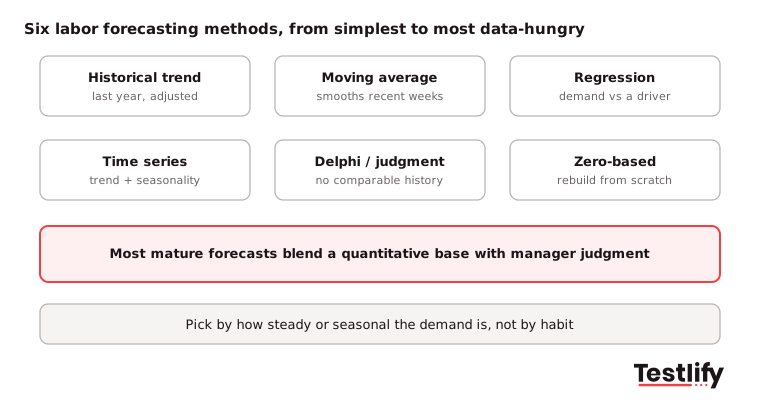
Labor forecasting methods fall into two groups: quantitative methods that forecast from historical numbers, and qualitative methods that bring in judgment for situations with little or no history.
- Historical trend analysis: Use last year's same period, adjusted for known changes (a new store, a longer menu, a marketing push). The simplest method and often the most accurate for steady, repeating demand.
- Moving average: Average the last several weeks or periods to smooth out noise, useful when demand is fairly stable but has some week-to-week variation.
- Regression analysis: Model demand against a driver that predicts it, such as foot traffic, website sessions, call volume or booked appointments, when a reliable driver exists.
- Time series and seasonal decomposition: Separate a trend, a seasonal pattern and random noise from historical data, useful for businesses with strong seasonality such as retail around holidays or hospitality around tourist seasons.
- Delphi and expert judgment: Gather estimates from managers and planners who know the business, useful for a new location, a new service line or any period with no comparable history.
- Zero-based forecasting: Build the forecast from the ground up for each period rather than adjusting a prior number, used when the business has changed enough that history no longer applies.
Most mature labor forecasts blend two or three of these: a quantitative base from historical data, adjusted by manager judgment for known one-off events such as a promotion, a product launch or a local event.
How do you build a labor forecasting process?
- Gather clean historical data: Pull at least 12 to 24 months of demand data (transactions, calls, patient visits, units shipped) and actual hours worked, by role, shift and location, and fix any obvious data errors before forecasting from it.
- Forecast demand for the period ahead: Apply the method that fits your demand pattern: historical trend or moving average for steady demand, time series decomposition for seasonal demand, regression where a reliable driver exists.
- Convert demand into labor hours: Divide the demand forecast by the productivity rate for each role, and account for absenteeism, training time and legally required breaks so the number reflects real coverage, not theoretical output.
- Build the schedule from the forecast: Turn labor hours into shifts that match when demand actually happens by hour and day, not an even spread across the week.
- Measure the forecast against what happened, and adjust: Compare forecasted hours to actual hours and actual demand every period, track the size of the miss, and feed that error back into the next forecast.
What tools help with labor forecasting?
Workforce management software is the main tool for labor forecasting at scale, since it pulls point-of-sale, time and attendance, and scheduling data into one place and automates the demand-to-hours calculation. Spreadsheets still work for a single site or a steady operation; most multi-site or high-volume employers move to dedicated software once manual forecasting starts missing shifts or taking too many hours each week to run.
Whatever the tool, the forecast is only as good as the hiring pipeline behind it. A forecast that flags a seasonal spike eight weeks out is only useful if the team can actually screen and test candidates fast enough to staff it.
Pro tip: Treat the forecast's lead time as a hiring deadline, not a planning nicety; a high-volume hiring checklist and pre-built skills tests shorten the gap between the forecast and a filled shift. Testlify's test library covers role-specific, cognitive and situational judgment tests that can screen a volume of applicants on the same criteria once a forecast tells you how many to hire.
Key takeaway: A labor forecast only pays off when the hiring process behind it can move as fast as the number says it needs to.
Labor forecasting vs workforce planning
Labor forecasting and workforce planning both deal with future staffing, but at different distances and detail.
Factor | Labor forecasting | Workforce planning |
|---|---|---|
Time horizon | Days to months ahead | Months to years ahead |
Unit | Hours, shifts, headcount by role | Roles, skills, org structure |
Main question | How many people-hours do we need this week or month? | What roles and skills will we need, and do we build, buy or borrow them? |
Output | A schedule and a short-term hiring number | A hiring, training and succession plan |
Owner | Operations and scheduling managers | HR and workforce planning teams |
Workforce planning sets the longer-range plan for roles and skills; labor forecasting fills in the near-term number of people-hours needed to run the operation inside that plan.
What mistakes should you avoid in labor forecasting?
- Forecasting from too little history: A few weeks of data cannot show a seasonal pattern; use at least a full cycle, usually 12 months, before trusting a trend.
- Ignoring known one-off events: A pure historical model misses a new promotion, a local event or a product launch; layer manager judgment on top of the number.
- Using a stale productivity rate: A rate measured two years ago, before a process or tool changed, understates or overstates how many people you actually need now.
- Never checking the forecast against what happened: A forecast that is never compared to actual hours and demand never improves, and the same errors repeat every period. SHRM on the strategic blind spot in workforce planning found that organizations often forecast headcount without revisiting the plan once demand shifts, which is the same gap that breaks a labor forecast.
- Treating the forecast as the hiring plan: The forecast says how many people-hours are needed; a hiring team still has to convert that into a sourcing and screening timeline long enough to actually fill the gap.
Ready to staff to your forecast?
A labor forecast tells you how many people you need; a skills test tells you which applicants can do the work. Browse the Testlify test library to find a test for your next high-volume role, or start a 7-day free trial, no credit card needed.
Frequently asked questions

Content Writer
Yashika Khandelwal is a Content Writer with 3+ years of experience creating research-backed content on hiring, talent assessment, and HR technology. She is a registered Organizational Psychologist and subject matter expert who combines behavioral science with practical recruitment insights to produce accurate, evidence-based content.
LinkedInRelated resources
View all
HR & recruitment
Payroll advance: what it is, how it works and how to offer one

HR & recruitment
How to evaluate team performance: a practical guide for 2026

HR & recruitment
How Do Employee Benefits Affect Total Employment Compensation?

HR & recruitment
What Is Leadership Coaching? A 2026 Guide for HR Teams

HR & recruitment
Methods of Job Analysis: 10 Methods and How to Choose (2026)

HR & recruitment
AI across all stages of the hiring process in 2026
Get started.
Hire on proof, not resumes.
Run your first skills-based assessment free — no credit card required.