
PEO for startups: what it does and when it pays off
What a PEO does for a startup, what it costs, and when co-employment beats in-house HR, an EOR, or payroll software alone.

A professional employer organization, or PEO, is a company that enters a co-employment arrangement with a startup to run payroll, benefits, and HR compliance under one shared employer relationship. The startup still directs the work and makes the hiring and firing calls. The PEO becomes the employer of record for tax and benefits purposes, pools its clients together to buy group health plans at better rates, and takes on a share of the compliance risk.
 ChatGPT
 Gemini
 Claude
 Grok
 Perplexity
TL;DR
- A PEO is a co-employer that runs payroll, benefits, and compliance for a startup, while the startup keeps control of hiring, firing, and day-to-day management.
- Most PEOs charge 2% to 12% of gross payroll, or $40 to $160 per employee per month, depending on headcount and the benefits package.
- The main payoff is access to enterprise-grade health, dental, and vision plans that a small team could not negotiate alone, plus one vendor handling multi-state payroll tax and compliance.
- A PEO only works for US-based teams with an existing legal entity. Hiring abroad calls for an employer of record (EOR) instead.
- Some PEOs will not take on companies with fewer than 10 employees. Below that size, payroll software or an outsourced bookkeeper is often enough.
- Compare total annual cost across at least two or three providers, since pricing and renewal increases vary widely between vendors.

What is a PEO, and how does it work for a startup?
A PEO works for a startup by signing a co-employment contract that splits employer responsibilities between the startup and the PEO. The startup keeps control of who it hires, what they do, and who it fires. The PEO takes on payroll processing, tax filings, workers' compensation, and benefits administration as the employer of record for those functions. For the full legal definition, see Testlify's professional employer organization (PEO) glossary entry.
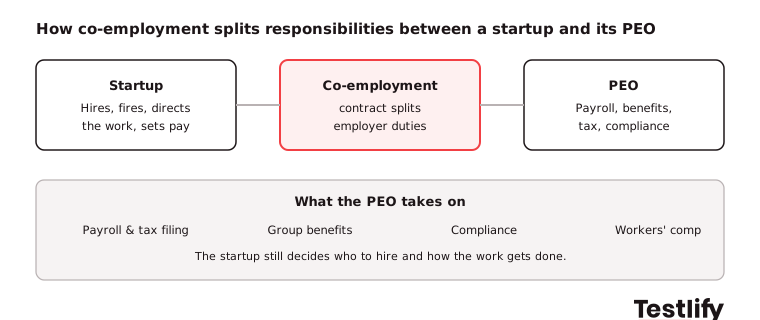
In practice, a startup that signs with a PEO moves its employees onto the PEO's payroll system and benefits plans. Pay stubs and tax forms often show the PEO's name alongside the startup's, since both are legally the employer for those purposes. The startup keeps its own brand, management structure, and culture; the PEO handles the paperwork behind it.
What does a PEO actually do day to day?
A PEO runs five core functions for a startup: payroll, benefits, HR compliance, workers' compensation, and basic HR support.
- Payroll: Calculates pay, withholds taxes, and files the paperwork across every state the startup has employees in, so one late multi-state filing does not fall on a founder's desk.
- Benefits: Pools the startup's headcount with every other client on the PEO's plan, which unlocks group health, dental, vision, and retirement plans usually reserved for companies with hundreds of employees, a point TriNet's own PEO guidance for startups makes directly.
- Compliance: Tracks changing wage, leave, and labor law requirements across every state and updates policies and handbooks to match.
- Workers' compensation: Carries the policy and manages claims, often at a lower rate than a 10-person company could get on its own.
- HR support: Gives a startup access to an HR generalist for onboarding paperwork, offer letters, and policy questions, without hiring one in-house.
How much does a PEO cost?
A PEO typically costs 2% to 12% of gross payroll, or $40 to $160 per employee per month, depending on the provider, the benefits included, and how risky the industry looks to an insurer, according to Oyster HR's 2026 PEO cost guide. Most PEOs land in the 3% to 6% range for a standard package. A team that pays higher salaries usually does better on a flat per-employee fee than a percentage-of-payroll model, since the percentage model scales with salary and the flat fee does not.
Pricing model | How it is charged | Best fit |
|---|---|---|
Percentage of payroll | 2% to 12% of gross payroll | Lower-salary teams, since the fee tracks pay |
Per employee per month (PEPM) | $40 to $160 per employee | Higher-salary teams, since the fee is flat per head |
Bundled flat fee | One price per employee for a fixed benefits tier | Teams that want a predictable monthly bill |
Treat the headline fee as a starting point, not the final number. Health plan costs inside a PEO bundle can rise faster at renewal than the service fee itself, and support can slow down during open enrollment and tax season. Ask every PEO for the total annual cost, including benefits, before comparing quotes.
PEO vs EOR vs in-house HR: which fits a startup?
The right choice between a PEO, an EOR, and in-house HR depends mainly on where the startup's employees are and how many it has, according to a Business News Daily comparison of the two models.
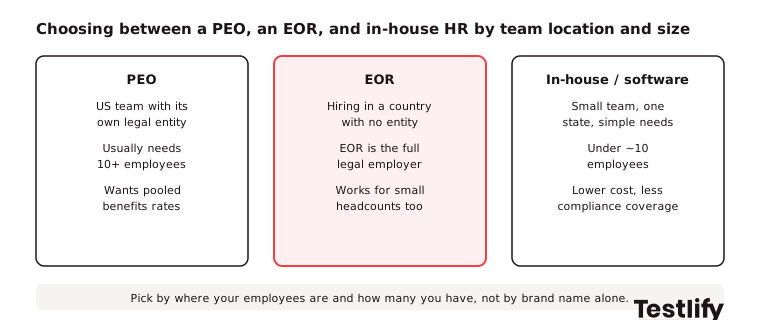
- PEO: Fits a US-based team with its own legal entity that wants better benefits and shared compliance risk. Gusto's comparison of the two models notes that many PEOs set a minimum headcount, often around 10 employees, and will not take on a team below it.
- EOR (employer of record): Fits hiring in a country where the startup has no legal entity. An EOR becomes the full legal employer there, so the startup can hire without setting up a foreign entity first.
- In-house HR or payroll software: Fits a very small team in one state with simple compliance needs. A PEO's compliance coverage and benefits pooling add less value until headcount or state-count grows.
A startup that is purely domestic and past the minimum headcount usually gets the most from a PEO. A startup hiring its first employee in another country needs an EOR for that hire, regardless of whether it also uses a PEO at home.
What are the risks of using a PEO?
The main risks of using a PEO are a benefits renewal that costs more than expected, slower support during peak season, and picking a provider that will not grow with the company. SHRM on the pros and cons of keeping a PEO notes that a PEO arrangement can become limiting as a company grows, with costs rising and flexibility falling. Because the PEO becomes a co-employer, switching providers later means moving payroll, benefits, and HR records to a new system, which takes real coordination time. Ask about multi-year price guarantees, renewal history on health plans, and whether the PEO has clients at the size the startup expects to reach in two to three years.
How should a startup choose a PEO?
A startup should choose a PEO by comparing total annual cost, not just the headline fee, across at least two or three providers, and by checking that the PEO already serves companies at its planned headcount and industry.
Pro tip: Ask each PEO for a renewal history on its health plans from the last two years, not just a quote for year one. A plan that jumped 10% at the second renewal tells you more about real cost than the first invoice does.
- List every state the startup has or plans to have employees in, since PEO compliance value grows with state count.
- Get a full annual cost estimate from each PEO, including the benefits tier the team actually wants, not the cheapest one.
- Ask whether the PEO accepts the startup's current headcount, and what happens if headcount drops.
- Check how claims and support are handled during open enrollment and tax season, when PEO support teams are busiest.
- Confirm the PEO holds IRS certification as a CPEO. A certified professional employer organization has passed IRS background, bonding, and tax-compliance checks, and the IRS publishes a public list of certified and revoked providers to check against.
- Confirm the PEO integrates with (or replaces) the applicant tracking system and HR tools already in use.
Does a PEO help a startup hire better, not just pay people correctly?
A PEO does not evaluate candidates or run interviews; it runs payroll, benefits, and compliance after someone is hired. The hiring decision itself, who to interview and who to extend an offer to, stays with the startup's own process. Testlify fits alongside a PEO at that earlier stage: a startup builds a skills test or AI interview from the job description, scores every candidate on the same criteria, and sends an offer before HR admin even starts. AI interviews explained
For a startup scaling fast, the combination is practical: Testlify for deciding who to hire with 3,500+ validated tests and 25+ question types, and a PEO for running payroll and benefits once that person signs an offer.
Ready to hire before you need a PEO?
Get your next hire right before payroll, benefits, or compliance even enter the picture. Start a 7-day free trial of Testlify, no credit card required, and build a skills-based assessment from your next job description.
Frequently asked questions (FAQs)

Related resources
View all
HR & recruitment
Labor forecasting: what it is and how to do it in 2026

HR & recruitment
Payroll advance: what it is, how it works and how to offer one

HR & recruitment
How to evaluate team performance: a practical guide for 2026

HR & recruitment
How Do Employee Benefits Affect Total Employment Compensation?

HR & recruitment
What Is Leadership Coaching? A 2026 Guide for HR Teams

HR & recruitment
Methods of Job Analysis: 10 Methods and How to Choose (2026)
Get started.
Hire on proof, not resumes.
Run your first skills-based assessment free — no credit card required.