
Payroll advance: what it is, how it works and how to offer one
What a payroll advance is, how it works, how it is taxed, the wage rules that apply, and how to write a fair policy your team can run.

A car breaks down three days before payday, and the repair bill cannot wait. A payroll advance is a short-term loan from an employer, paid before payday and repaid through deductions from the employee's next paychecks.
Used well, it helps staff avoid high-interest payday loans. This guide shows how to offer one fairly, with a written policy, the right tax setup and the wage rules that apply.
TL;DR
- A payroll advance is an employer loan paid before payday and repaid through deductions from later paychecks.
- It differs from a payday loan, an employee loan and earned wage access in who pays and whether the wages are already earned.
- The advance itself is not taxed when paid, and repayment comes out of net pay after tax.
- Federal and state wage rules apply, and state rules are often stricter.
- A written policy and a signed agreement keep decisions fair and protect both sides.
- Large hourly teams may be better served by earned wage access than by manual advances.
 ChatGPT
 Gemini
 Claude
 Grok
 Perplexity
What is a payroll advance?
A payroll advance is money an employer pays an employee ahead of the normal payday, which the employee pays back from future wages over one or more pay periods. Most employers charge no interest, run no credit check, and recover the amount through an agreed payroll deduction.
Employees usually ask for an advance when a bill lands before payday: a car repair, a medical cost, a rent gap or a family emergency. The need is common.
According to the Federal Reserve's report on household economic well-being in 2024, only 63% of US adults said they could cover a $400 emergency expense with cash or its equivalent. PwC's 2026 Employee Financial Wellness Survey, as reported by HR Dive, found that 59% of employees are stressed about their finances and 30% have less than $1,000 saved for emergencies.
You will also see the same idea called a salary advance, a paycheck advance or a wage advance. The names mean the same thing: the employer fronts pay that the employee has not yet received.

How does a payroll advance work?
A payroll advance works in five steps: the employee asks in writing, the employer checks the request against its policy, both sides sign a repayment agreement, payroll pays the advance, and later paychecks recover it until the balance reaches zero.
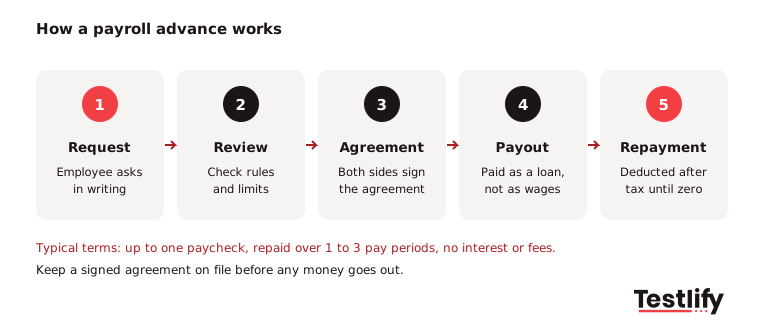
- Request: The employee submits a short form with the amount and the date they need it. Asking for the reason is optional; many employers skip it to keep the process private.
- Review: HR or payroll checks eligibility, the amount limit and whether another advance is still open.
- Agreement: Both sides sign a payroll advance agreement that sets the repayment schedule and authorizes the deductions.
- Payout: Payroll pays the advance, either in the next run or as an off-cycle payment, and records it as a loan, not as wages.
- Repayment: A fixed after-tax deduction comes out of each following paycheck until the advance is repaid.
Pro tip: Set the advance up in your payroll software as its own non-taxable pay item and its own repayment deduction. Keeping both separate from regular wages is what stops tax errors and lost balances later.
Payroll advance vs payday loan vs earned wage access
A payroll advance differs from the other options in who pays out the money and whether the wages are already earned. A payroll advance and an employee loan both come from the employer.
A payday loan comes from an outside lender at high cost. Earned wage access gives early access to pay the employee has already earned, usually through a provider.
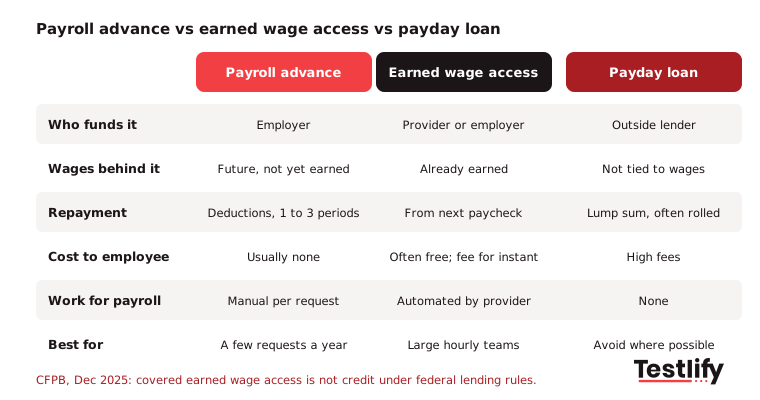
The legal picture for earned wage access also shifted recently. In a December 2025 advisory opinion, the Consumer Financial Protection Bureau said that earned wage access products based on wages already earned, repaid by payroll deduction and offered without credit checks or recourse are not credit under federal lending rules.
The same opinion also withdrew a 2024 proposal that would have treated most of these products as loans. Several states run their own rules for these providers, so check your state before choosing one.
Pros and cons of payroll advances for employers
Payroll advances help employers keep staff steady through a money shock and build loyalty at low cost, but they add manual work, tie up cash and carry a loss if someone leaves before repaying.
Pros
- Less financial stress at work: Staff who can cover an emergency spend less time worried and away from work.
- A real alternative to payday loans: An interest-free advance keeps employees away from high-cost lenders.
- Loyalty and retention: Help in a hard week is remembered, which supports employee retention.
- A low-cost benefit: The money comes back, so the main cost is admin time.
Cons
- Cash flow: Every open advance is company cash out the door until it is repaid.
- Admin load: Each request needs a review, an agreement, a payout and a deduction schedule.
- Repayment risk: If an employee leaves with a balance, recovery depends on your agreement and state law.
- Dependency: Smaller paychecks after an advance can lead to the next request, and the cycle repeats.
- Fairness pressure: Saying yes to one person and no to another without a written rule invites complaints.
How are payroll advances taxed?
Payroll advances are usually not taxed when paid out, because a documented advance is a loan the employee repays. Income tax and payroll taxes still apply in full to the wages in each later paycheck, and the repayment comes out after tax.
A worked example makes it clear. An employee earns $2,000 gross every two weeks and takes a $400 advance, repaid at $200 over the next two paychecks:
Step | Amount |
|---|---|
Gross pay for the period | $2,000 |
Taxes withheld on the full $2,000 | Calculated as normal |
After-tax deduction: advance repayment | $200 |
Net pay | Normal net pay minus $200 |
The most common error is processing the advance as earnings. That withholds tax on money that is later repaid, and it creates a mismatch at year-end.
If you forgive an advance instead of collecting it, treat the forgiven amount as taxable wages. Confirm the setup with your payroll provider or tax adviser, since payroll processing rules differ by system and state.
What laws apply to payroll advances?
Payroll advances fall under federal wage law and, usually more strictly, state wage deduction law. Under the federal Fair Labor Standards Act, the US Department of Labor has long held that an employer may deduct the principal of a wage advance even if that cuts into minimum wage, but interest or admin fees may not reduce pay below minimum wage or overtime due.
That nuance comes from a Department of Labor opinion letter on loans and advances, which also says a written agreement is not required federally but is desirable as proof of the loan and its terms. Many guides simply say deductions can never drop pay below minimum wage.
That is the safer rule to write into a policy, because many states go further than federal law:
- Written consent: Many states require the employee's signed authorization before any deduction, and some require it for each deduction.
- Final paychecks: Some states limit or bar recovering an advance from a final paycheck, even with a signed agreement.
- Fees and interest: Some states bar or cap fees on employee advances. Employers should not profit from an advance anywhere.
- Equal treatment: Eligibility rules must apply the same way to everyone in a role, so the program cannot become a source of discrimination claims.
Key takeaway: Write your policy to the strictest rule that applies to your workforce: no fees, signed consent before every advance, deductions that keep pay at or above minimum wage, and a final-paycheck clause checked against each state you employ in.
What should a payroll advance policy include?
A payroll advance policy should include eligibility, amount limits, frequency limits, the repayment schedule, what happens when someone leaves, and the request and approval steps. Putting these in writing keeps decisions consistent and protects both sides.
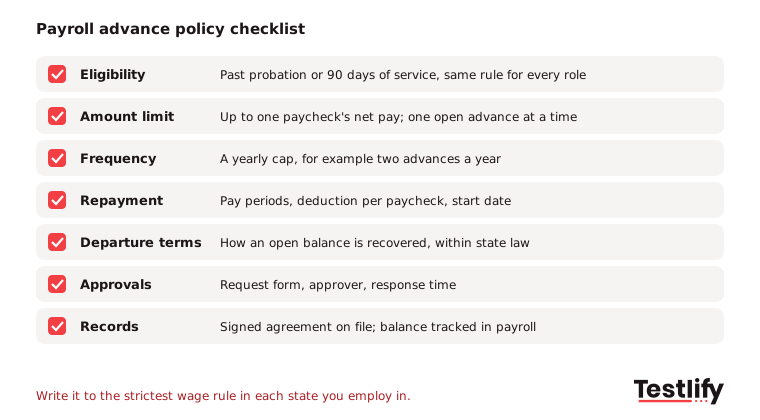
Add the policy to your handbook and benefits pages alongside your other employee benefits, so staff know it exists before they need it.
What should a payroll advance agreement include?
A payroll advance agreement should include the employee's name, the advance amount, the payout date, the repayment schedule, written authorization for the deductions, the departure terms and both signatures with dates. Sign it before any money goes out and keep a copy in the payroll file.
- Employee name and ID
- Advance amount and payout date
- Total to repay (the same as the advance when there are no fees)
- Deduction amount per paycheck and the first and last deduction dates
- Explicit authorization to deduct the repayments from wages
- What happens to any balance if employment ends
- Signatures and dates from the employee and an authorized manager
Should you offer payroll advances or earned wage access?
Payroll advances suit employers who get a few requests a year and can handle each one by hand. Earned wage access suits employers with large hourly teams, where requests are frequent and manual advances would swamp payroll.
Use this rough guide:
- A handful of requests a year: Handle advances case by case under a short written policy.
- Regular requests in one team or site: Formalize the policy, set an approval owner and track balances in payroll.
- Hundreds of hourly staff: Look at an earned wage access provider that connects to your payroll, so staff draw on pay they have already earned and payroll does not front cash.
Whichever route you pick, review the vendor's fees to employees and check that it fits your total rewards strategy rather than sitting beside it.
How do payroll advances help hiring and retention?
Payroll advances and other pay access options help hiring by making an offer more attractive to hourly candidates, and they help retention by keeping staff from leaving over a short-term money gap. For hourly candidates, when they get paid can matter almost as much as how much.
For contact centers, healthcare support roles, warehouses and retail operations, a candidate comparing two similar offers often picks the one that shows how and when they get paid. If you offer advances or earned wage access, say so in the job ad and at the offer stage.
Pay access also helps keep new hires through their first few pay cycles, when the gap between start date and first payday hurts most.
Pay access only helps if the people you hire are right for the role. For hourly roles at scale, see how teams combine fast screening with structured skills tests in volume hiring.
If you are building the payroll team that will run your advance policy, the payroll specialist interview questions guide and the accounting and HR tests in the Testlify test library help you check the skills before you hire. For the bigger picture, see the guide to payroll management.
To see how Testlify's 3,500+ validated tests help you hire the right people for payroll, HR and hourly roles, book a demo today
Frequently asked questions (FAQs)

People and Talent Partner
Arushi Shah runs day-to-day talent acquisition and candidate experience at Testlify. She writes on interviewing, structured hiring, and giving candidates a fair, fast process.
LinkedInRelated resources
View all
HR & recruitment
How to evaluate team performance: a practical guide for 2026

HR & recruitment
How Do Employee Benefits Affect Total Employment Compensation?

HR & recruitment
What Is Leadership Coaching? A 2026 Guide for HR Teams

HR & recruitment
Methods of Job Analysis: 10 Methods and How to Choose (2026)

HR & recruitment
AI across all stages of the hiring process in 2026

HR & recruitment
What are key KPIs for measuring assessment impact on hiring?
Get started.
Hire on proof, not resumes.
Run your first skills-based assessment free — no credit card required.