
How to create an employee recognition program in 9 steps
A practical guide to building an employee recognition program in nine steps, with types, budget options, metrics and common mistakes.

Knowing how to create an employee recognition program comes down to one idea: make it easy for everyone to notice good work, say so specifically, and do it often. An employee recognition program is the set of habits, rules and tools a company uses to thank people for the work and behavior it wants more of. Done well, it lifts engagement and keeps your best people from leaving.
TL;DR / Key Takeaways
- An employee recognition program is a structured way to thank people for contributions, behavior and milestones, with clear criteria, a budget and tracking.
- Gallup found only 22% of employees get the right amount of recognition. Well-recognized employees were 45% less likely to leave within two years.
- Peer-to-peer, manager-led, formal awards and milestones. Strong programs combine all four.
- Set goals, name an owner, ask employees what they value, define what to recognize, choose the mix, set budget and rules, pick tools, train managers and launch, then measure and adjust.
- Most teams can launch a first version in six to eight weeks.
- Recognition should be fulfilling, authentic, personalized, equitable and embedded in the culture.
- Start with peer and manager recognition, which cost only time. Spend any money on a few meaningful rewards.
- Track participation, reach, engagement scores, regretted turnover and internal moves against your baseline.
- Vague praise, manager-only recognition, rewards without thanks, the same winners every year and no owner.
- Use recognition data to see which skills the company values, then test for those skills before the offer.
 ChatGPT
 Gemini
 Claude
 Grok
 Perplexity
What is an employee recognition program?
An employee recognition program is a structured way for a company to acknowledge employees for their contributions, behavior and milestones. A good program covers everyday thanks from peers and managers, formal awards, and service anniversaries, with clear criteria for what gets recognized, a budget, and a way to track whether recognition is reaching everyone.
The program is different from pay or bonuses. Compensation rewards the job. Recognition tells a person that a specific piece of work was seen and mattered. Rewards such as gift cards or extra time off can be part of it, but the thank-you is the core. For a short definition of the wider term, see our rewards and recognition glossary entry.

Why does an employee recognition program matter?
An employee recognition program matters because recognition is one of the cheapest ways to keep good people, and most employees say they do not get enough of it. Gallup and Workhuman tracked nearly 3,500 employees from 2022 to 2024 and found that well-recognized employees were 45% less likely to have left two years later.
The gap is wide. Gallup's 2024 recognition research found that just 22% of employees get the right amount of recognition, unchanged since 2022. The 2025 State of Recognition report from the Achievers Workforce Institute, a survey of 3,600 employees, puts the share who feel meaningfully recognized at 23%, and only 15% say their manager recognizes them regularly, down from 20% a year earlier.
Engagement is low too. Gallup's August 2025 update put US employee engagement at 32%, and 51% of employees are looking for or watching for a new job.
For hiring teams, every regretted leaver turns into a new requisition. Gallup estimates the cost of replacing an employee at about 40% of salary for frontline roles, 80% for technical roles and 200% for leaders and managers. You can run your own numbers with our cost of employee turnover calculator.
What are the types of employee recognition?
Employee recognition comes in four main types: peer-to-peer, manager-led, formal awards and milestone recognition. Most strong programs combine all four, because each one reaches people the others miss. Peer recognition is frequent and spreads thanks widely, while formal awards are rare but carry weight.
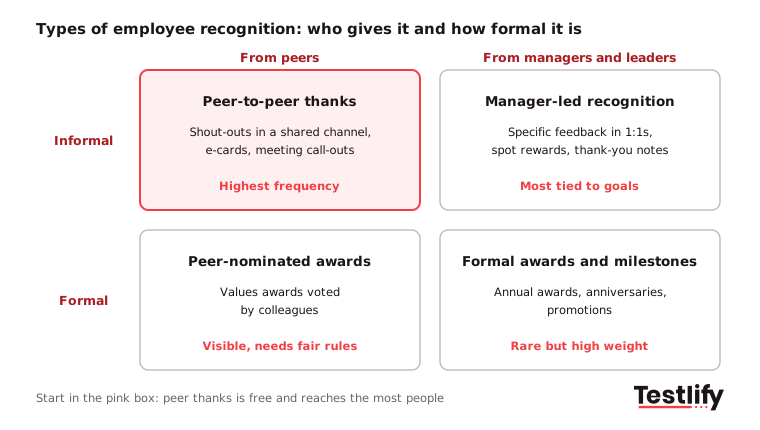
Type | Who gives it | Best for | Watch out for |
|---|---|---|---|
Peer-to-peer | Colleagues | Everyday thanks, cross-team help | Turning into a popularity contest |
Manager-led | Direct managers | Specific feedback tied to goals | Varies a lot from manager to manager |
Formal awards | Panel or nominations | Big wins, values in action | Reaches only a few people a year |
Milestones | Leaders or automated | Work anniversaries, promotions, project launches | Feels generic if it is only automated |
Values-based | Anyone, tagged to a value | Making company values visible | Needs clear, concrete values first |
How to create an employee recognition program: which 9 steps work?
Creating an employee recognition program takes nine steps: set goals, name an owner, ask employees what they value, define what to recognize, choose the mix of recognition types, set the budget and rules, pick tools, train managers and launch, then measure and adjust. Most teams can launch a first version in six to eight weeks.
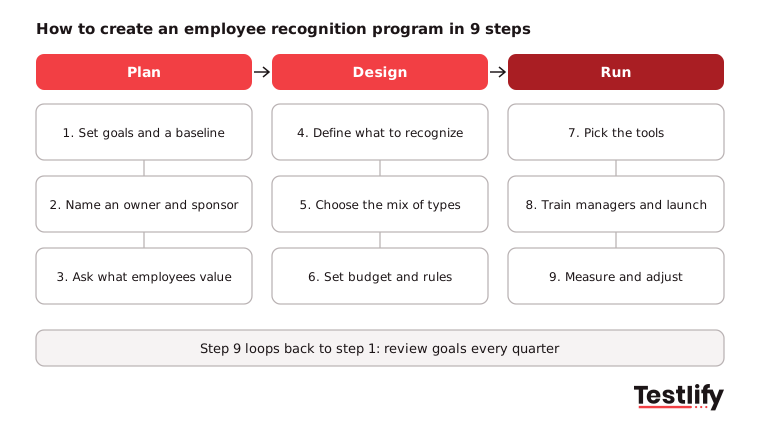
- Set clear goals and a baseline: Pick two or three outcomes, such as lower regretted turnover in the first year, higher engagement scores or more internal moves. Record today's numbers so you can compare later.
- Name an owner and an executive sponsor: A program with no owner fades in a quarter. One person in People Ops runs it, and a senior leader gives visible recognition first.
- Ask employees what they value: Run a short survey or a few focus groups. Ask how people like to be thanked (public or private), what rewards they care about, and what currently goes unnoticed.
- Define what to recognize: Tie recognition to your company values and to the skills each role needs. Write two or three concrete behaviors per value, so people know what good looks like.
- Choose the mix of recognition types: Combine peer thanks, manager recognition, milestones and a small number of formal awards. Decide how often each happens.
- Set the budget and the rules: Decide who can give rewards, how much, and how nominations work. Publish the criteria so recognition feels fair.
- Pick the tools: Put recognition where people already work, such as Slack, Microsoft Teams or your HR system. Smaller teams can start with a shared channel. For software options, see our list of top employee recognition tools.
- Train managers and launch: Show managers how to give specific, timely recognition. Launch with a short kickoff where leaders recognize people first.
- Measure and adjust: Review participation and outcomes monthly for the first quarter, then quarterly. Fix gaps before the program goes stale.
Pro tip: Recognition works best when it names the action and the impact. "Thanks for rewriting the onboarding checklist, three new hires finished setup on day one" beats "great job" every time.
What are the five pillars of meaningful recognition?
The five pillars of meaningful recognition, from Gallup and Workhuman research, are fulfilling, authentic, personalized, equitable and embedded in the culture. Recognition that meets at least four of them makes employees nine times as likely to be engaged as recognition that meets none, so the pillars are a useful check on any program design.
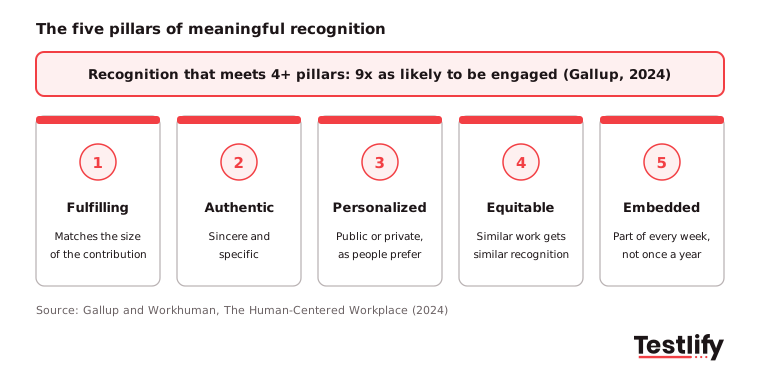
- Fulfilling: The recognition meets the person's expectations and matches the size of the contribution.
- Authentic: The thanks is sincere and specific, not a template message.
- Personalized: The form suits the person, public for some, private for others.
- Equitable: People with similar performance get similar recognition, across teams, levels and locations.
- Embedded: Recognition is part of how work gets done every week, not a once-a-year event.
According to the Workhuman and Gallup announcement of the 2024 study, 55% of US employees either get no recognition or get recognition that meets none of the five pillars. Workhuman sells recognition software, so treat the figures as a strong signal rather than the final word.
How to create an employee recognition program on a small budget?
Creating an employee recognition program on a small budget starts with peer and manager recognition, which cost nothing but time. Add a shared channel for public thanks, a short recognition slot in team meetings, and handwritten notes. Spend the money you have on a few meaningful rewards, such as extra time off or learning budgets, not on many small gifts.
- Zero budget: peer shout-outs in a shared channel, recognition at the start of team meetings, manager notes, leader thank-you emails.
- Low budget: small spot rewards, team lunches, learning stipends, an extra afternoon off.
- Full program: a recognition platform with points, a rewards catalog, milestone automation and reporting.
For more reward options at each level, see our employee reward ideas.
How do you measure an employee recognition program?
Measuring an employee recognition program means tracking both activity and outcomes. Activity shows whether recognition is happening and reaching everyone. Outcomes show whether it changes retention and engagement. Compare each metric against the baseline you recorded before launch.
Metric | What it shows | Healthy signal |
|---|---|---|
Participation rate | Share of employees who gave recognition this month | Rising month on month |
Reach | Share of employees who received recognition | Nobody goes a quarter without any |
Peer vs manager split | Who drives recognition | Both are active |
Distribution by team and level | Whether recognition is fair | No team far below the rest |
Engagement survey score | How valued people feel | Up from baseline |
Regretted turnover | Whether good people stay | Down from baseline |
Internal moves | Whether recognized people grow | More promotions from within |
What mistakes make recognition programs fail?
Recognition programs usually fail for five reasons: vague praise, recognition that only comes from managers, rewards that replace thanks, awards that go to the same few people, and no owner after launch. Each mistake is easy to spot in the data and easy to fix early.
- Vague praise: "Great work" says nothing. Name the action and the result.
- Manager-only recognition: Managers miss much of the daily help colleagues give each other.
- Rewards instead of recognition: Points with no message become another payroll line.
- The same winners every year: Check who gets recognized by team, level, location and work pattern.
- No owner: Without someone reviewing the data, participation drops within months.
What can hiring teams learn from recognition data?
Hiring teams can use recognition data to see which skills and behaviors the company actually values, then hire for them. Recognition messages describe real work in plain words: who solved problems, who helped new joiners, who learned something new. Read together, the messages show what good looks like in each role.
- Find the skills behind top performers: Group recognition messages by role and note the skills that come up most. Use them to update job descriptions and interview scorecards.
- Recognize skills and learning: Workhuman and Gallup found only 14% of employees say learning a new skill is among the most common reasons they are recognized. Recognizing new skills builds internal mobility and fills roles without external hiring.
- Recognize the hiring work: Interview panelists, referrers and onboarding buddies rarely get thanks. Add them to your recognition criteria, and pair it with a well-designed employee referral program.
- Hire for the same skills you recognize: Once you know which skills the company rewards, test for them before the offer. Testlify lets teams build role-based assessments from 3,500+ tests, so the skills you recognize at work are the same skills you check in hiring.
Key takeaway: A recognition program only works if it is specific, frequent and fair. Start small with peer and manager recognition, measure who it reaches, and use what you learn to hire people who will earn the same thanks.
Frequently asked questions
Ready to hire for the skills you recognize?
Once your recognition program shows which skills drive results, make them part of hiring. Browse the Testlify test library to find assessments for the roles you hire most, and start a 7-day free trial, no credit card required.

Content Writer
Yashika Khandelwal is a Content Writer with 3+ years of experience creating research-backed content on hiring, talent assessment, and HR technology. She is a registered Organizational Psychologist and subject matter expert who combines behavioral science with practical recruitment insights to produce accurate, evidence-based content.
LinkedInRelated resources
View all
Workplace culture
How to communicate with Gen Z workers: 9 tips for managers

Workplace culture
Participative Leadership: Meaning, Types, Pros and Cons

Workplace culture
12 Best Employee Engagement Strategies That Work in 2026

Workplace culture
50+ Core Values Examples for Companies, Teams and Hiring
Workplace culture
How HR can support managers in layoff communication

Workplace culture
What is cultural alignment and why is important in 2026?
Get started.
Hire on proof, not resumes.
Run your first skills-based assessment free — no credit card required.