
12 Best Employee Engagement Strategies That Work in 2026
Twelve employee engagement strategies for HR teams, mapped from hiring to retention, with the metrics that show which ones are working.

Employee engagement strategies are the deliberate actions a company takes to help people feel involved in, committed to and enthusiastic about their work. The strategies that work are not perks or parties. They are better hiring, better onboarding, better managers, clear goals, growth, recognition and a habit of listening and acting on what employees say.
TL;DR: Employee engagement depends on more than perks. Clear expectations, role fit, supportive managers, recognition, career growth, and acting on employee feedback are what help people stay motivated and committed. HR teams should track engagement alongside attrition, absenteeism, and internal mobility to identify gaps and measure whether their strategies are working.
 ChatGPT
 Gemini
 Claude
 Grok
 Perplexity
What is employee engagement?
Employee engagement is the level of involvement and enthusiasm people bring to their work and workplace. Engaged employees know what is expected of them, have what they need to do it, and care about the result. Gallup, which has tracked engagement for more than 25 years, sorts employees into three groups:
- Engaged: involved, enthusiastic and willing to go beyond the minimum.
- Not engaged: doing what the job requires, but with little energy or attachment.
- Actively disengaged: unhappy at work and often spreading that unhappiness to the team.
Engagement is not the same as happiness or satisfaction. A satisfied employee may like the pay and the office. An engaged employee is invested in the work itself. That difference matters, because perks can raise satisfaction for a few weeks without moving engagement at all.

Why do employee engagement strategies matter in 2026?
Employee engagement strategies matter in 2026 because engagement is falling and the cost is large. Gallup's State of the Global Workplace 2026 found that global engagement fell to 20% in 2025, its lowest level since 2020 and the first two-year drop on record. Gallup estimates low engagement costs the world economy about $10 trillion in lost productivity, roughly 9% of global GDP.
The U.S. picture is only a little better. According to Gallup's engagement indicator, 31% of U.S. employees were engaged as of May 2026, while 17% were actively disengaged. Gallup also reports that engaged employees are 69% less likely to experience burnout and 47% less likely to be job hunting.
Retention is the business case most HR leaders feel first. The LinkedIn Workplace Learning Report 2025 found that 88% of organizations are concerned about employee retention. For TA teams, every disengaged hire who leaves in the first year is a role you fill twice.
What drives employee engagement?
Employee engagement is driven mostly by the day-to-day experience of work, and the manager shapes most of that experience. Gallup reports that managers account for at least 70% of the variance in team engagement, which is why engagement scores often differ more across the teams inside one company than between companies.
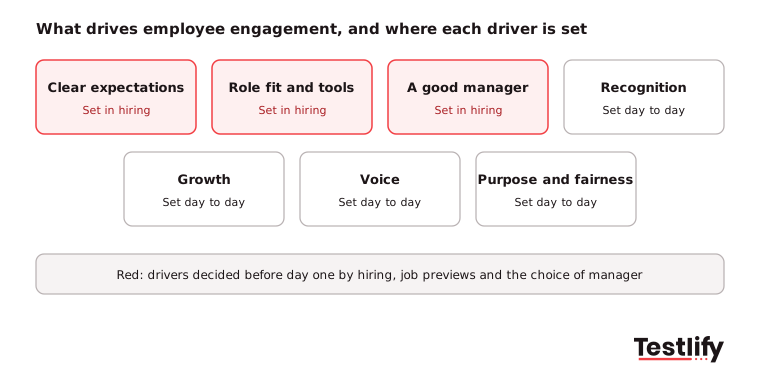
The main drivers that appear in research and in the top HR guides are:
- Clear expectations. People know what good work looks like in their role.
- The right fit and tools. The job matches the person's skills, and they have what they need to do it.
- A good manager. Regular, useful conversations with someone who cares about their progress.
- Recognition. Good work is noticed, quickly and specifically.
- Growth. A visible path to learn and move up or across.
- Voice. Opinions count, and people see changes made because of feedback.
- Purpose and fairness. The work connects to something that matters, and decisions feel fair.
Notice how many of these are set before an employee's first day. Role fit, honest expectations and the choice of manager are hiring decisions.
What are the most effective employee engagement strategies?
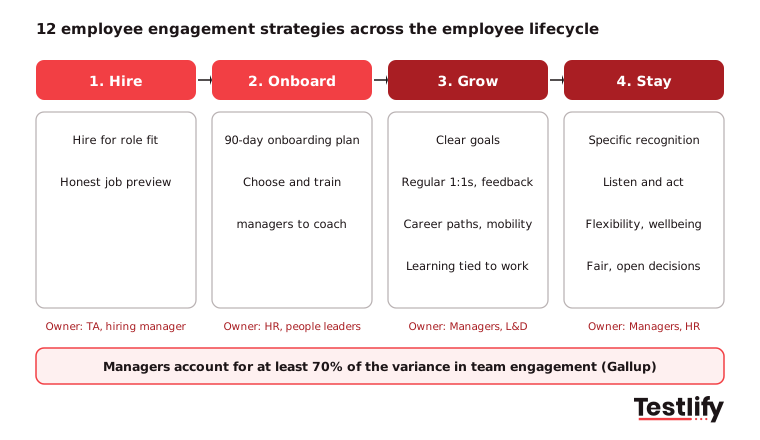
The most effective employee engagement strategies fix the drivers above at each stage of the employee lifecycle: hire, onboard, grow and stay. The 12 below are ordered by when they happen, so you can start where your biggest gap is.
1. Hire for role fit, not only for the resume
Engagement starts with the hire. A person who cannot do the job well, or who dislikes the core tasks, is unlikely to become engaged however good the perks are. Use structured interviews and skills tests that reflect the real work, and check work-style preferences against what the team actually needs. When people are good at the work, they are more likely to enjoy it.
2. Give candidates an honest preview of the job
Disengagement often begins when the job turns out to be different from the job ad. Show candidates the real day: the hard parts, the targets, the schedule and the tools. A short work sample or a conversation with a future peer sets honest expectations, and the people who still say yes are choosing the actual role.
3. Run onboarding as a 90-day plan, not a one-day event
The first 90 days decide whether a new hire settles in or starts looking again. Give every hire a written plan with goals for 30, 60 and 90 days, a named buddy, and planned check-ins with the manager. See the employee onboarding guide for a full checklist.
4. Choose and train managers for coaching
Managers drive most of the variance in engagement, and their own engagement is slipping: Gallup found manager engagement fell from 27% to 22% in 2025. Promote people into management for their ability to coach and communicate, not only for being the best individual performer.
Then train them, because the LinkedIn report found lack of manager support is the top obstacle to career development, cited by 50% of respondents according to UNLEASH's summary. More on this in the role of leadership in employee engagement.
5. Set clear goals and expectations
People cannot be engaged in work they do not understand. Agree a small number of goals per quarter, link each one to a team or company goal, and write down what success looks like. Revisit them at every 1:1 rather than once a year.
6. Hold regular 1:1s with real feedback
A weekly or fortnightly 1:1 is the single habit that makes most other strategies work. Use it for progress, blockers, feedback both ways and career talk. Base feedback on specific, observed work so it is easy to act on.
7. Recognize good work quickly and specifically
Recognition is most useful when it is timely and names what the person did. "Your call notes saved the client renewal" beats a generic "great job". Make peer-to-peer recognition easy, and make sure recognition is spread fairly, not only to the most visible people.
8. Make career growth and internal mobility visible
People disengage when they cannot see a future. Publish internal roles first, show the skills each next step needs, and let employees test themselves against those skills. Internal moves keep knowledge in the company and give people a reason to stay. The guide to internal mobility covers how to set this up.
9. Invest in learning tied to real work
LinkedIn found that providing learning opportunities is the No. 1 retention strategy among the organizations it surveyed. Tie learning to current projects and the next role, give people time in the week to do it, and let managers sign off on progress.
10. Listen, then act where people can see it
Engagement surveys only help when employees see a change. Run a short pulse survey each quarter, add stay interviews for key people, share the results within a few weeks, and pick two or three actions per team. Then report back on what changed. Gallup's guide to improving engagement warns that programs fail when they stop at measurement.
11. Offer flexibility and protect wellbeing
Flexible hours, location where the role allows it, and realistic workloads all help. Watch the signals of burnout, such as rising overtime and sick days, and treat them as a manager conversation, not a perks problem.
12. Keep decisions fair and transparent
Explain how pay, promotion and performance decisions are made. Share company news openly, including bad news. People engage more with an employer they trust, and trust breaks fast when decisions look random.
Pro tip: Do not launch all 12 at once. Pick the two or three that match your lowest survey scores or your highest early attrition, run them well for a quarter, and measure the result.
Which strategy fits which stage of the employee lifecycle?
Each stage of the employee lifecycle has its own engagement strategies, owner and metric. Hiring and onboarding sit mostly with TA and HR, while growth and retention sit with managers and HR business partners. Use the table to agree who owns what before you launch anything.
Stage | Strategies | Main owner | Metric to watch |
|---|---|---|---|
Hire | Role fit, honest job preview | TA team, hiring manager | Offer acceptance rate, 90-day attrition |
Onboard | 90-day plan, buddy, manager check-ins | HR, hiring manager | New-hire survey score at 30 and 90 days |
Manage | Manager selection and training, goals, 1:1s | People leaders, HRBP | Team engagement score, 1:1 completion |
Grow | Career paths, internal mobility, learning | L&D, HRBP | Internal fill rate, promotion rate |
Stay | Recognition, listening, flexibility, fairness | Managers, HR | Regretted attrition, eNPS, stay interview themes |
How do you measure employee engagement?
Employee engagement is measured with a mix of survey scores and behavior data that HR already collects. Surveys tell you how people feel. Turnover, absence and internal moves tell you what they do. Track both, by team, every quarter.
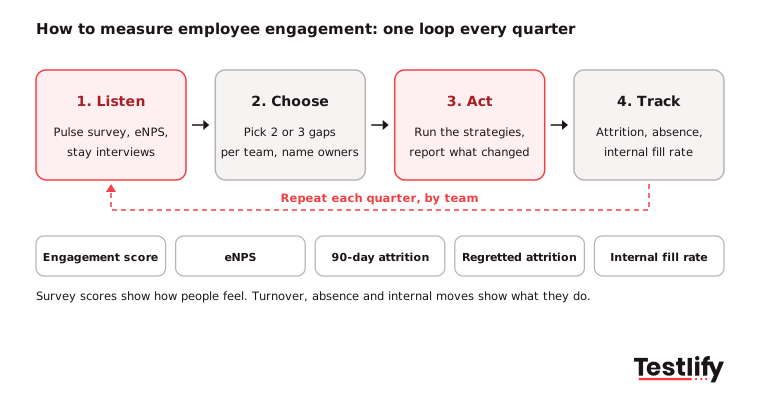
- Engagement survey score: a short, consistent survey run each quarter, broken down by team. Gallup's Q12 is a widely used model.
- eNPS: how likely employees are to recommend the company as a place to work.
- Regretted attrition: people you wanted to keep who left.
- 90-day attrition: new hires who leave in the first three months, a direct check on hiring and onboarding.
- Absence and overtime: rising numbers often signal burnout before surveys do.
- Internal fill rate: the share of open roles filled by current employees.
- Survey response rate: low or falling participation is itself a sign people think nothing will change.
For ideas on turning these numbers into action, read how to use employee engagement data.
How do you build an employee engagement strategy in 90 days?
Building an employee engagement strategy in 90 days means one cycle of listen, choose, act and measure. A short, finished cycle teaches you more than a long plan that never ships. Here is a simple schedule:
- Days 1 to 15: get a baseline. Run a short engagement survey, and pull 90-day attrition, regretted attrition and absence by team.
- Days 16 to 30: find the gaps. Compare teams. Look for patterns such as one manager, one location or one hiring source.
- Days 31 to 45: pick two or three strategies. Choose from the 12 above based on the gaps, and name an owner and a metric for each.
- Days 46 to 75: run them. Train the managers involved, share the plan with employees, and start.
- Days 76 to 90: measure and report back. Re-run a short pulse survey, compare against the baseline, and tell employees what changed and what comes next.
The step-by-step engagement strategy guide goes deeper on writing the plan.
Key takeaway: The best employee engagement strategies start before day one and run on managers. Hire for fit, onboard with a plan, choose managers who coach, and act visibly on what people tell you.
How do you keep remote and hybrid employees engaged?
Remote and hybrid employees stay engaged when the basics of good management are made deliberate. Without office contact, clear goals, scheduled 1:1s, visible recognition and fair access to growth have to be planned, not left to chance.
- Hold 1:1s on video and keep them even when the week is busy.
- Write decisions down so remote staff are not the last to know.
- Make recognition public in team channels, not only in the office.
- Give remote employees equal access to stretch projects and promotions.
- Bring people together in person for a purpose, such as planning or onboarding, not only for socializing.
See more ideas in fostering engagement in a remote workforce.
What mistakes make engagement strategies fail?
Engagement strategies usually fail for five reasons: no action after surveys, perks used in place of better management, no manager involvement, too many initiatives at once, and ignoring the hiring and onboarding stage.
- Surveying without acting. Each survey with no follow-up lowers trust and response rates.
- Perks instead of management. Snacks and events do not fix unclear goals or a poor manager.
- HR owning it alone. Managers drive most of the variance, so they must own team actions.
- Launching everything. Too many programs dilute attention and make results impossible to measure.
- Starting too late. A poor fit hired today becomes next year's engagement problem.
How does Testlify support employee engagement?
Testlify supports employee engagement at the start of the lifecycle, where role fit is decided. Testlify is a skills assessment and AI interviewing platform, so hiring teams can check skills and work style before an offer and use the same tests for internal moves.
- Hire for fit. A library of 3,500+ tests covers role skills, cognitive ability, situational judgment, and personality and culture. browse the test library
- Pick managers on evidence. Tests such as leadership and people management help assess coaching and people skills before a promotion.
- Support internal mobility and growth. Run the same skills tests for current employees to show the gap to their next role, and use 360 feedback assessments for development.
- Reach every team. Assessments run in 15+ languages, which helps global and frontline teams.
Start where engagement starts
Better engagement begins with hiring people who fit the work. Start a 7-day free trial of Testlify, no credit card required, and build a role-based assessment from your own job description.
Frequently asked questions

Related resources
View all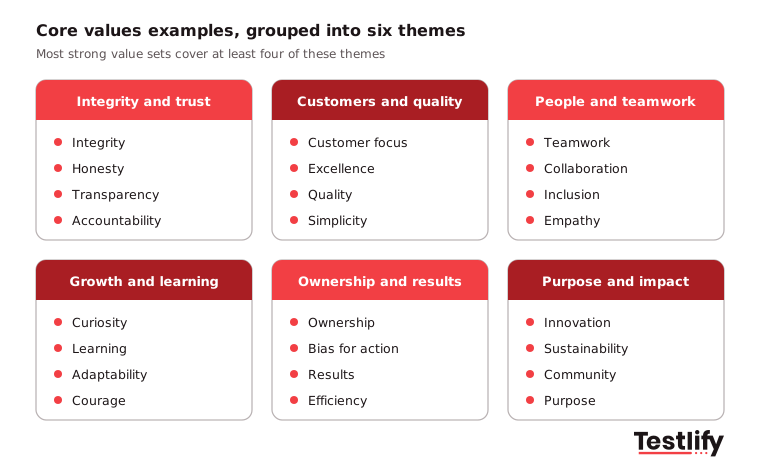
Workplace culture
50+ Core Values Examples for Companies, Teams and Hiring
Workplace culture
How HR can support managers in layoff communication

Workplace culture
What is cultural alignment and why is important in 2026?

Workplace culture
How Toxic Company Culture Drives Employee Attrition

Workplace culture
5 most pressing issues in the workplace (with solutions)

Workplace culture
5 methods to improve team dynamics and employee behaviors
Get started.
Hire on proof, not resumes.
Run your first skills-based assessment free — no credit card required.