
How to communicate with Gen Z workers: 9 tips for managers
A practical guide to talking with Gen Z employees: the channels they use, feedback that lands, and why good communication starts in hiring.

To communicate with Gen Z workers well, keep everyday messages short and in chat, save important conversations for face to face, explain the reason behind decisions, and give specific feedback often. Gen Z, people born roughly between 1997 and 2012, grew up online, but most still want a manager who talks to them in person and coaches them.
 ChatGPT
 Gemini
 Claude
 Grok
 Perplexity
TL;DR
- Gen Z workers prefer quick messages for routine updates and face-to-face conversations for important discussions.
- Managers should communicate clearly, explain the reasons behind decisions, and give frequent, specific feedback.
- Coaching, regular check-ins, and learning opportunities help Gen Z employees feel supported at work.
- During hiring, set clear expectations, send timely updates, and keep assessments accessible on mobile.
- Use a structured 90-day communication plan to help new hires settle in, understand their goals, and take ownership of their work.
- Avoid forced slang, vague feedback, after-hours messages, and assumptions based on age.
- Assess communication skills through relevant work samples rather than relying on resumes alone.

Who are Gen Z workers?
Gen Z workers are employees born roughly between 1997 and 2012, so the oldest are now in their late twenties and the youngest are finishing school. Many started their careers during or after the pandemic, in hybrid teams, with fewer chances to learn office habits by watching colleagues.
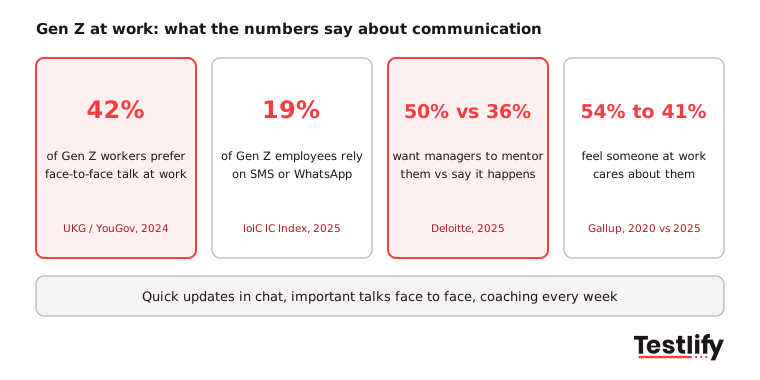
That gap shows up in engagement data. Gallup found that the share of Gen Z and younger millennial employees who strongly agree that someone at work cares about them as a person fell from 54% in 2020 to 41% in 2025. Agreement that they have chances to learn and grow fell from 48% to 37%.
For hiring teams, Gen Z is also the bulk of entry-level, graduate and contact center hiring. How you talk to them affects whether they accept the offer, finish onboarding and stay past the first year.
For a quick definition, see the Generation Z glossary entry.
How do Gen Z workers prefer to communicate?
Gen Z workers prefer quick chat messages for routine updates and face-to-face conversations for anything that matters. The common idea that young employees want everything by text is only half true.
A UKG and YouGov survey of 1,021 Australian workers found that 42% of Gen Z workers picked face to face as their preferred way to communicate at work, well ahead of email (18%), instant messaging (15%), text (12%), phone (9%) and video calls (4%). The same survey found that 48% find it hard to speak up in video meetings.
Mobile channels still matter for reach. The UK Institute of Internal Communication's IC Index 2025 found that 19% of Gen Z employees rely on SMS or WhatsApp for work updates, compared with 5% of Baby Boomers, and that Boomers are twice as likely to use the intranet. IoIC IC Index 2025
Key takeaway: Gen Z wants speed for small things and real conversation for big things. Use chat to keep work moving and a meeting to build trust.
How do you communicate with Gen Z workers?
Managers communicate with Gen Z workers best by being brief, direct and present: short messages in the right channel, honest reasons for decisions, and frequent, specific feedback. The nine tips below cover daily habits that work in office, hybrid and remote teams.
- Lead with the point: Put the ask or the decision in the first line, then add context. A message that opens with "Can you send the Q3 report by 3 pm? Details below" gets acted on faster than three paragraphs of background.
- Ask each person how they like to communicate: Preferences vary inside any generation. A two-minute question in the first one-to-one ("chat, call or quick meeting for urgent things?") avoids months of guessing.
- Explain the why: Gen Z employees push back on rules that come with no reason. A one-line reason ("we freeze deploys on Fridays because weekend fixes cost us two outages last year") turns a rule into something people follow.
- Be honest, including about bad news: Softened or vague updates read as evasive. Say what you know, what you do not know yet and when you will update them.
- Check in often, briefly: Silence from a manager is often read as a sign that something is wrong. A ten-minute weekly one-to-one and a quick daily chat check-in prevent that.
- Coach, do not only supervise: Deloitte's 2025 survey of 14,751 Gen Zs found that 50% want their managers to teach and mentor them, but only 36% say this happens. Deloitte 2025 Gen Z and Millennial Survey
- Use visuals and short video for how-to content: A two-minute screen recording of a process is easier to follow and revisit than a long written guide.
- Respect boundaries: Send non-urgent messages in working hours, or schedule them. Hold longer or harder talks earlier in the day, not at 6 pm on a Friday.
- Treat ideas on merit: Judge suggestions on what they would change, not on the tenure of the person making them. Young employees who feel heard speak up sooner when something is going wrong.
Pro tip: Write your team's communication norms down in five lines: what goes in chat, what needs a call, expected reply times, after-hours rules and where decisions are recorded. Share it in onboarding so nobody has to guess.
Which channel should you use to communicate with Gen Z workers?
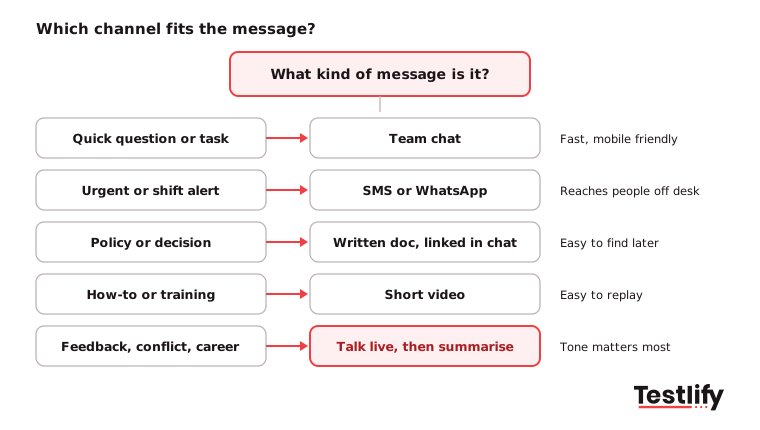
The right channel to communicate with Gen Z workers depends on the message, not the person's age. Use chat for quick, low-stakes updates, writing for anything people need to refer back to, and a live conversation for feedback, conflict, change, and career talks.
Message type | Best channel | Why |
|---|---|---|
Quick question or task | Team chat (Slack, Teams) | Fast, easy to reply on mobile |
Shift, schedule or urgent alert | SMS or WhatsApp | Reaches frontline and remote staff fast |
Policy, process or decision | Written doc or email, linked in chat | Easy to find and check later |
How-to or training | Short video or screen recording | Easier to follow and replay |
Feedback on work | One-to-one, in person or video | Tone and follow-up questions matter |
Conflict, change or bad news | In person first, written summary after | Builds trust, avoids misreading tone |
Career and growth | Scheduled one-to-one | Shows the topic is a priority |
How should you give feedback to Gen Z employees?
Feedback for Gen Z employees works best when it is frequent, specific and tied to what to do next. A short, regular note on real work beats a long annual review, and naming the behavior and the next step beats general praise or general criticism.
Gallup's 2026 report quotes employees asking for "more regular, consistent communication from my manager." Feedback is where that request is most visible. Compare two versions of the same message:
- Vague: "Your client email was a bit off. Be more professional."
- Specific: "Your email answered the client's question, good. Next time, put the answer in the first line and drop the emoji for external clients. Want to look at the next one together before it goes out?"
The second version names what worked, says exactly what to change and offers help. It also takes less than a minute to write. Three habits make feedback land:
- Give it close to the work. Feedback a day later is useful. Feedback a quarter later is history.
- Balance without padding. Name real strengths, but do not wrap every point in praise. Gen Z workers notice when compliments are only there to soften a blow.
- Make it two-way. End with a question such as "What would help you do this faster?" and act on the answer.
For more on building a feedback habit, see these employee feedback and communication tips.
How do you communicate with Gen Z candidates during hiring?
Communication with Gen Z workers starts before they are hired. Gen Z candidates judge an employer on how fast and how clearly it replies, and many will drop out of a slow, silent process before an offer is made.
Research from UK recruiter Gi Group found that more than half of candidates aged 18 to 25 expect to hear back within seven days. Gi Group research via CXR Hiring teams can meet that bar with a few changes:
- Set expectations in the first message: Tell candidates every stage, how long each takes and when they will hear back.
- Use the channels candidates check: Mobile-friendly invites, SMS or WhatsApp reminders and short emails get opened sooner than long portal messages.
- Replace the phone screen with something flexible: A short skills test or a one-way video question lets candidates respond on their own schedule, and gives every applicant the same questions.
- Close the loop: Send a clear yes or no at each stage, with a line of feedback where you can. Silence is the fastest way to lose a candidate and your employer brand.
- Test communication skills directly: If the role needs clear writing or customer conversations, assess those skills with a work sample instead of guessing from a resume.
For a deeper guide to the attraction side, read how to recruit Generation Z.
What should the first 90 days of communication look like?
The first 90 days of communication with a Gen Z hire should move from daily contact to a steady weekly rhythm. Early on, new employees need quick answers and visible support. By month three, they need clear goals, regular feedback and a conversation about growth.
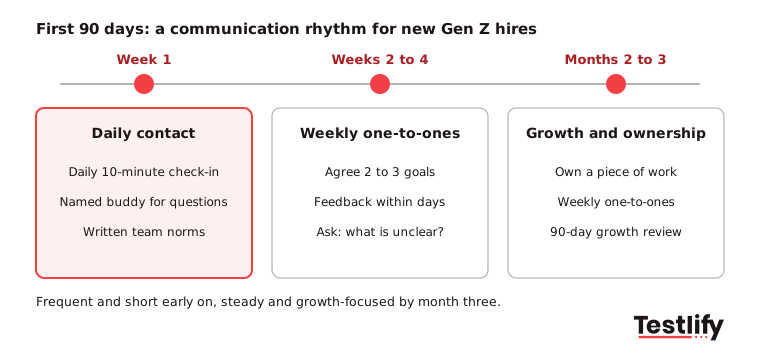
- Week 1: daily contact: A short daily check-in, a named buddy for "silly" questions and your written team norms.
- Weeks 2 to 4: weekly one-to-ones: Agree on two or three goals for the first quarter and give feedback on early work within days, not weeks.
- Months 2 to 3: growth and ownership: Hand over a piece of work they own, keep weekly one-to-ones and hold a 90-day review that covers what they want to learn next.
Deloitte found that Gen Z ranks learning and development among their top three reasons for choosing an employer, so the 90-day review is a retention conversation as much as a performance one. More onboarding pitfalls are covered in communication challenges in onboarding.
What mistakes should managers avoid with Gen Z workers?
The biggest mistakes managers make with Gen Z workers are copying their slang, relying on all-staff email, going quiet and treating every young employee the same. Each one signals that the manager cares more about looking relatable than about being clear.
- Forcing slang or memes: Clear, plain language earns more trust than borrowed phrases.
- Using email blasts as the only channel: Generic all-staff emails get skimmed or ignored. Post key updates where people already work and repeat the important ones in team meetings.
- Going silent after a hard conversation: Follow up within a day or two so feedback does not feel like a verdict.
- Messaging late at night: Even if you do not expect a reply, a 10 pm message tells people they should be online.
- Stereotyping: Labels such as "lazy" or "entitled" shut people down. Ask the same questions across the teams you manage and adjust to the person in front of you.
How is Gen Z communication different from millennials?
Gen Z communication differs from millennial communication mainly in speed, format and expectations of managers. Both generations are comfortable with digital tools, but Gen Z grew up with phones from childhood and expects shorter, more visual messages and more frequent manager contact.
Millennials | Gen Z | |
|---|---|---|
Default work channel | Email and chat | Chat and mobile messaging |
Phone calls | Comfortable when planned | Prefer a message first, then a call |
Feedback expectation | Regular reviews | Frequent, informal, close to the work |
View of hierarchy | Accepts structure, wants a voice | Expects ideas judged on merit |
What they want from a manager | Support and flexibility | Coaching and honest reasons |
Both groups still value face-to-face time for important topics. For a wider view across all age groups, see how to bridge the generation gap in employee communications.
How can Testlify help you hire and onboard Gen Z talent?
Testlify helps hiring teams reach Gen Z candidates on the channels they use and judge them on real skills instead of resumes. Candidates can complete skills tests and one-way video or Chat AI interviews on their own schedule, receive invites and reminders over WhatsApp, and take assessments in 15+ languages.
If clear communication matters in the role, the communication test lets you check communication skills before the interview, alongside 3,500+ tests for other roles and skills. You can try it with a 7-day free trial, no credit card needed.
Frequently asked questions (FAQs)

Related resources
View all
Workplace culture
Participative Leadership: Meaning, Types, Pros and Cons
Workplace culture
12 Best Employee Engagement Strategies That Work in 2026
Workplace culture
50+ Core Values Examples for Companies, Teams and Hiring
Workplace culture
How HR can support managers in layoff communication

Workplace culture
What is cultural alignment and why is important in 2026?
Workplace culture
How Toxic Company Culture Drives Employee Attrition
Get started.
Hire on proof, not resumes.
Run your first skills-based assessment free — no credit card required.