
Participative Leadership: Meaning, Types, Pros and Cons
A plain guide to participative leadership: what it means, the four types, real examples, pros and cons, and how to spot it when hiring.

Participative leadership is a management style in which the leader asks the team for ideas and input before making a decision, while keeping responsibility for the final call. It is often called democratic leadership. The aim is better decisions and stronger buy-in, because the people closest to the work help shape what happens next.
TL;DR: This guide explains what participative leadership is, the traits that define it and the four types you will see at work, from leader-decides to full consensus. It covers real examples, the main advantages and disadvantages, when the style works and when to switch to a directive approach, and how it compares with other styles. The last section shows HR and talent teams how to spot participative leaders when hiring or promoting managers.
 ChatGPT
 Gemini
 Claude
 Grok
 Perplexity
What is participative leadership?
Participative leadership is a style where managers involve employees in decisions that affect their work, collect their views, and then decide with that input in hand. The leader shares information and some decision authority but still owns the outcome. Another common name for it is democratic leadership.
The idea is not new. It grew out of early research on leadership styles in the 1930s and the participative management ideas of the 1960s, which set it against autocratic, top-down control. The Harvard Program on Negotiation describes the participative leader as someone who seeks input, shares some decision authority, and keeps final responsibility, with the amount of shared authority varying by decision. PON Harvard on participative leadership
In practice, participative leadership is less about voting on everything and more about being clear on which decisions are open, who gets a say, and how input will be used.

What are the key characteristics of participative leadership?
Participative leadership has six traits that show up in almost every definition: open information, active listening, real delegation, a clear decision owner, visible follow-through on input, and respect for dissent. A leader who asks for opinions but never shares context or acts on them is not participative, only polite.
- Open information. The team sees the facts, constraints and trade-offs behind a decision, not just the question.
- Active listening. The leader asks, then listens long enough to hear the quieter voices too.
- Real delegation. Some decisions move to the people doing the work, with the authority to act.
- A clear decision owner. Everyone knows who makes the final call and by when.
- Follow-through. People see what changed because of their input, or hear why it did not.
- Respect for dissent. Disagreement is treated as useful information, not as disloyalty.
What are the types of participative leadership?
Participative leadership comes in four types that differ by who makes the final call: autocratic, democratic, collective and consensus. In the first two, the leader decides after hearing the team. In the last two, the group decides, by majority vote or by full agreement.

Type | Who makes the final call | How input is used | Best for |
|---|---|---|---|
Autocratic participative | Leader | Leader gathers ideas, then decides, often without explaining | Time-bound calls that still need expert input |
Democratic participative | Leader | Leader decides and explains when the choice goes against the team view | Most day-to-day management decisions |
Collective participative | Group, by majority vote | Leader frames the options and runs the vote | Choices with several good options and broad impact |
Consensus participative | Group, by full agreement | Leader guides discussion until everyone can accept the plan | High-stakes changes that need everyone committed |
Democratic participative leadership is the version most people mean when they use the term, but it is only one point on the spectrum.
What are examples of participative leadership?
Participative leadership examples are easiest to see in everyday decisions: a manager asking the team to redesign a process, a hiring panel agreeing on a scorecard together, or a frontline worker being allowed to stop work to fix a problem. Each one moves part of the decision to the people closest to it.
- Process redesign. A customer support lead asks agents which steps in the ticket workflow waste the most time, tests their top three fixes, and reports back on what stuck.
- Hiring decisions. A hiring manager has the interview panel agree on the skills and scoring criteria before any interviews start, then makes the offer decision with every panel score on the table.
- Shift planning. An operations manager lets the team propose a rota within fixed coverage rules, then signs off on it.
- Stop-the-line systems. Toyota's andon system is the classic manufacturing example: any line worker can stop production to flag a defect, so quality decisions sit with the people who see the problem first.
- Strategy input. Before setting annual goals, a department head runs short one-to-one conversations and an anonymous survey, so people who do not speak up in meetings still shape the plan.
What are the advantages of participative leadership?
Participative leadership brings five main advantages: higher engagement, better decisions, stronger buy-in, more new ideas, and a deeper bench of future leaders. People who help shape a decision understand it better and work harder to make it succeed.
- Higher engagement. Feeling heard is a core part of engagement. That matters because Gallup's State of the Global Workplace found only 20% of employees worldwide were engaged in 2025, down from 23% in 2022, and puts the cost of low engagement at about $10 trillion, or 9% of global GDP.
- Better decisions. People closest to the work spot risks and options a manager would miss.
- Stronger buy-in. Teams carry out decisions faster when they understand the reasons behind them.
- More new ideas. A wider range of views pushes a team past "the way we have always done it".
- Future leaders. Employees who take part in decisions practise judgment early, which builds a pipeline for manager roles.
What are the disadvantages of participative leadership?
Participative leadership has four main disadvantages: slower decisions, conflict, diluted accountability, and the risk of asking for input that is then ignored. The style also costs leaders time, and teams without the right information or skills can give weak suggestions.
- Slower decisions. Gathering and weighing input takes time, which is a real cost in a crisis.
- Conflict and peer pressure. Group discussion can turn into a contest, and louder voices can crowd out honest views.
- Diluted accountability. When everyone decided, it can feel like no one owns the result.
- Consultation theatre. Asking for input and then ignoring it does more harm than not asking at all.
The last risk is common. A 2026 survey in Lewis Silkin's Future@Work report found that 87% of respondents said employees have strong or moderate influence in their organisation, yet only 27% said feedback is actively sought and consistently shapes decisions. Listening is widespread. Acting on what you hear is not.
When does participative leadership work best?
Participative leadership works best when the team has relevant knowledge, the decision affects how people work, and there is time to discuss it. Participative leadership works least well in emergencies, with very large groups, or when the decision is fixed and the team cannot change it. In those cases, a directive call that is explained clearly is the better choice.
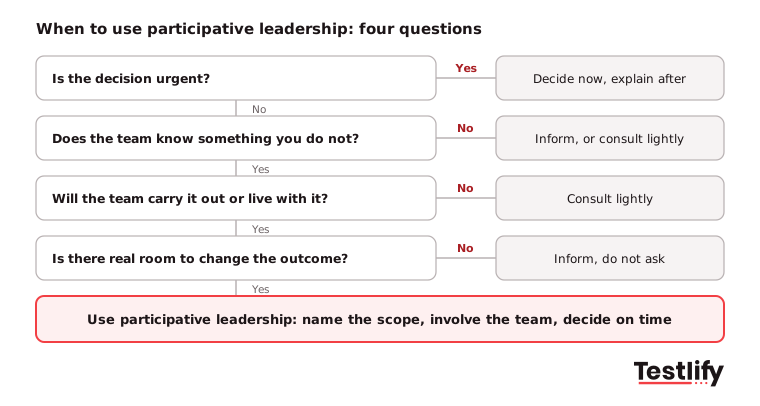
Ask four questions before opening a decision to the team:
- Is this urgent, with no time for discussion? If yes, decide and explain afterwards.
- Does the team hold knowledge you lack? If no, consult lightly or simply inform them.
- Will the team carry out the decision or live with its effects? If yes, involve them.
- Is there real room to change the outcome? If no, do not ask for input you cannot use.
Pro tip: Name the scope at the start of every discussion. Say what is open, what is fixed, who decides, and by when. Most frustration with participative leadership comes from people thinking they had a vote when they only had a voice.
How does participative leadership compare with other leadership styles?
Participative leadership sits between autocratic leadership, where the leader decides alone, and laissez-faire leadership, where the team decides with little guidance. Participative leadership shares the decision process but keeps a clear owner, which is the main difference from both extremes.
Style | Who decides | Strength | Main risk |
|---|---|---|---|
Participative | Leader, with team input | Buy-in and better ideas | Slow, can stall |
Autocratic | Leader alone | Speed and clarity | Low engagement, missed input |
Laissez-faire | Team, with little direction | Autonomy for experts | Drift and unclear ownership |
Transformational | Leader sets vision, team aligns | Energy for big change | Depends heavily on one person |
Situational | Leader adapts to each person | Fits the style to readiness | Hard to apply consistently |
Most effective managers mix styles. For a deeper look at two of them, see transformational leadership and situational leadership. Teams that focus on harmony and trust may also find affiliative leadership useful.
How do you practise participative leadership?
Practising participative leadership starts with choosing the right decisions to open up, then involving the right people early, using more than one way to collect input, and closing the loop on what changed. The Minnesota state government's leadership guidance recommends the same core steps for public-sector managers.
- Pick the decision. Choose decisions where the team has knowledge and will live with the outcome.
- Name the scope. Say what is open, what is fixed, and which participation type you are using.
- Involve the right people early. Bring in the people affected before options are locked, not after.
- Look beyond meetings. Use one-to-one conversations and short surveys for people who think before they speak.
- Decide and explain. Make the call on time and say how the input shaped it.
- Close the loop. Report back on results, and thank people for ideas you did not use.
The Minnesota Management and Budget guide to participatory leadership adds a useful reminder: engaging people early builds better working relationships and better results than asking for comments on a finished plan.
How can HR teams spot participative leaders when hiring?
HR and talent teams can spot participative leaders by testing for the behaviours behind the style: how a candidate gathers input, how they decide, and how they handle disagreement. Structured behavioural interviews, situational judgment tests and leadership style assessments give comparable evidence, which a gut-feel conversation cannot.
The stakes are high. Deloitte's 2025 Global Human Capital Trends found that 36% of managers feel insufficiently prepared to manage people, and that managers spend only 13% of their time developing their teams. Gallup reports that manager engagement fell from 27% to 22% in a single year. Hiring and promoting managers who already involve their teams is one of the few levers HR fully controls.
Across the teams we work with, the most common mistake is promoting the strongest individual contributor and assuming people skills will follow. A better approach uses three sources of evidence:
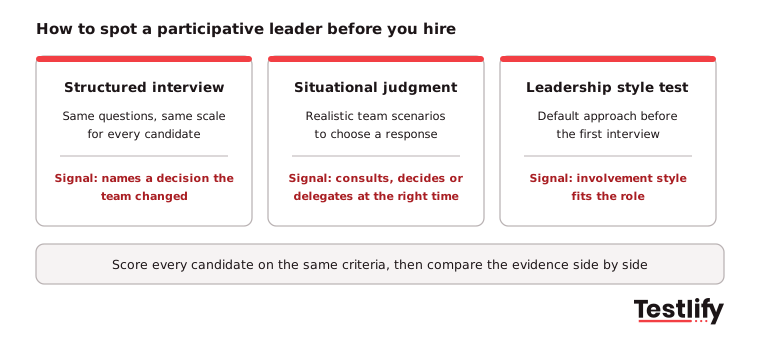
- Structured interview questions. Ask every candidate the same questions and score them on the same scale. See structured vs unstructured interviews for why consistency matters.
- Situational judgment. Present realistic team scenarios and ask what the candidate would do. A situational judgment test shows whether they consult, decide or delegate in the right moments.
- Leadership style assessment. A leadership style test shows a candidate's default approach before you ever meet them.
Interview questions that reveal participative leadership:
- Tell me about a decision where your team's input changed your mind. What did you do next?
- Describe a time you had to make a call without consulting the team. Why, and how did you explain it?
- How do you make sure quieter team members are heard?
- Tell me about a time you asked for input and could not act on it. How did you close the loop?
- How do you decide which decisions to open up and which to make yourself?
Strong answers name a specific decision, explain why that level of involvement fit, and describe what changed. Weak answers either treat every decision as a group vote or describe consultation that changed nothing. We have seen that candidates who can explain when not to consult make the most reliable participative leaders.
Key takeaway: Participative leadership is not about asking everyone everything. It is about matching the level of involvement to the decision, being clear about who decides, and showing people that their input counts. Hire and promote for that judgment, not just for friendliness.
Frequently asked questions
Find out how your next manager leads
Want evidence on how candidates lead before you hire them? Explore the leadership tests in the Testlify test library, with 3,500+ tests that run in 15+ languages. Start a 7-day free trial, no credit card required, and add a leadership style assessment to your next manager hire.

Content Writer
Yashika Khandelwal is a Content Writer with 3+ years of experience creating research-backed content on hiring, talent assessment, and HR technology. She is a registered Organizational Psychologist and subject matter expert who combines behavioral science with practical recruitment insights to produce accurate, evidence-based content.
LinkedInRelated resources
View all
Workplace culture
12 Best Employee Engagement Strategies That Work in 2026
Workplace culture
50+ Core Values Examples for Companies, Teams and Hiring
Workplace culture
How HR can support managers in layoff communication

Workplace culture
What is cultural alignment and why is important in 2026?

Workplace culture
How Toxic Company Culture Drives Employee Attrition

Workplace culture
5 most pressing issues in the workplace (with solutions)
Get started.
Hire on proof, not resumes.
Run your first skills-based assessment free — no credit card required.