
Testlify vs. Zapilio: Which Skills Assessment Platform is Best for HR Teams?
Testlify vs. Canditech: Discover which skills assessment platform best suits your hiring needs
Testlify and Zapilio both screen candidates with skills assessments, and they are built for different jobs. Zapilio is a two-product suite from a 2022 startup: HireZap for hiring and SkillZap for upskilling, sharing a library of 600+ skills. Testlify is a pre-hire assessment and interviewing platform with 3,500+ tests, AI video, voice and phone interviews, more than 20 proctoring controls, and 100+ ATS integrations.
So the choice is not really "which tool is better". It is whether you need a light screening layer that ranks a big applicant pool, or an evaluation platform that carries a candidate from first test through an AI interview to a scored, defensible decision.
A note on sourcing, because it changes how you should read the rows below. Zapilio's website blocks automated checks, so every Zapilio detail here comes from its indexed pages and from third-party software directories. Three points worth stating plainly: Zapilio does ship proctoring, it does support audio and video questions, and it does have ATS integration listings. Any comparison that marks those absent is out of date.
 ChatGPT
 Gemini
 Claude
 Grok
Grok Perplexity
TL;DR
- Zapilio suits a small team that wants ready-made tests, automatic grading and a ranked shortlist, with upskilling bolted on for people already hired.
- Testlify suits a team that needs breadth: 25+ question types, coding with a real editor, Office-app tasks, AI interviews across video, voice and phone, and item-level test analytics.
- Both platforms auto-generate assessments from a job description, and both grade with AI. The gap is what happens after the score.
- Zapilio publishes no pricing. Testlify publishes a full tier table, starting at $139 a month billed annually for 100 candidate credits.
- Proctoring is the widest gap. Testlify's dual-device setup turns the candidate's phone into a second camera and blocks the session until it is live.
- If you already run Greenhouse, Workday or Lever, check integration depth first. Both platforms connect, but the screening layer has to fit the system of record you keep.

What is Zapilio?
Zapilio is an AI skills-assessment platform founded in 2022 that sells two products on one library. HireZap handles pre-hire screening: pick or generate an assessment, invite candidates, and get a ranked list with per-skill scores. SkillZap points the same assessments inward, finding skill gaps in your existing staff and building learning paths from them.
The library runs to 600+ skills, with question banks that subject-matter experts author. You can also upload a job description and let the platform pull the required skills out of it and build a test, which is the fastest path from an open role to a live assessment.
Question formats cover objective, subjective, audio, video and picture-based items, along with images, multiple-choice and extended matching questions. Questions can be written in the tool or imported in bulk from a CSV. Proctoring is built in and monitors candidates during a live exam. Third-party listings show ATS connections, including a Greenhouse integration and a Workday Recruiting listing.
What Zapilio does not publish is a price. There is a free trial, and after that you request a quote. The interface is English only, which rules it out for multi-country hiring where candidates need their own language.
What is Testlify?
Testlify is a pre-hire assessment and interviewing platform. Teams use it to test skills, run AI interviews, proctor the session, and score candidates with multiple reviewers before anyone books a call.
The library covers 3,500+ tests across 4,500+ roles and 50+ industries, sorted into 13 categories: blue collar, coding, cognitive ability, engineering skills, language, personality and culture, programming skills, psychometric, role-specific skills, situational judgment, software skills, simulation and gamified. Each test comes in three difficulty levels.
Beyond tests, Testlify runs one-way and two-way conversational AI interviews in video and voice, plus outbound AI phone interviews. It ships more than 20 proctoring and integrity controls, item-level test analytics, reference checks, and 100+ ATS integrations. For a team with no applicant tracking system at all, there is a simple built-in hiring pipeline: post a job, take applications, move people through stages.
Testlify is not a sourcing tool, an HRIS, a background-check provider or an onboarding system. It connects to those systems rather than replacing them.
Testlify vs Zapilio: feature comparison
The table below carries only the rows where there is something real to compare. Where Zapilio documents nothing, the cell says exactly that rather than guessing, because an unverified "no" is the fastest way to lose a reader who has the other tab open.
Dimension | Testlify | Zapilio |
|---|---|---|
Library size | 3,500+ tests, 4,500+ roles, 50+ industries | 600+ skills with expert-written question banks |
Test categories | 13, including coding, psychometric, simulation and gamified | Role-specific, cognitive, technical, soft skill, psychometric, personality |
Question types | 25+, including Google and Microsoft Office tasks | Objective, subjective, audio, video, picture, MCQ, EMQ |
Build a test from a job description | Yes, up to 20 questions per generation | Yes, skills extracted from an uploaded description |
Coding assessment | In-browser VS Code editor, up to 20 test cases, SQLite cases, vibe coding | Code snippet questions |
AI interviews | One-way and two-way video, voice, and outbound phone at $0.18 per minute | Audio and video question types; no documented two-way AI interviewer |
Interview templates | 150+ | Not documented publicly |
Proctoring | 20+ controls, three presets, dual-device monitoring | Integrated proctoring during live exams |
AI-written-answer detection | Classifies answers as human, AI generated or mixed | Not documented publicly |
Item-level analytics | Difficulty index, discrimination index, quality risk per question | Skill-wise breakdown and candidate ranking |
ATS integrations | 100+, sold as a paid add-on on self-serve plans | Greenhouse and Workday Recruiting listed by third parties |
Built-in hiring pipeline | Yes, a simple one for teams with no ATS | Candidate ranking dashboard |
White labeling | Yes, custom domain and branding, paid add-on | Not documented publicly |
Candidate language support | Real-time translation of tests and custom questions | English only |
Published pricing | Full tier table on the pricing page | None; free trial then a custom quote |
How do the test libraries compare?
Testlify carries 3,500+ tests against Zapilio's 600+ skills, and both let you generate an assessment from a job description. Size matters less than category spread: if you hire warehouse staff, a sales team and two engineers, you need blue-collar, situational judgment and coding tests in the same account.
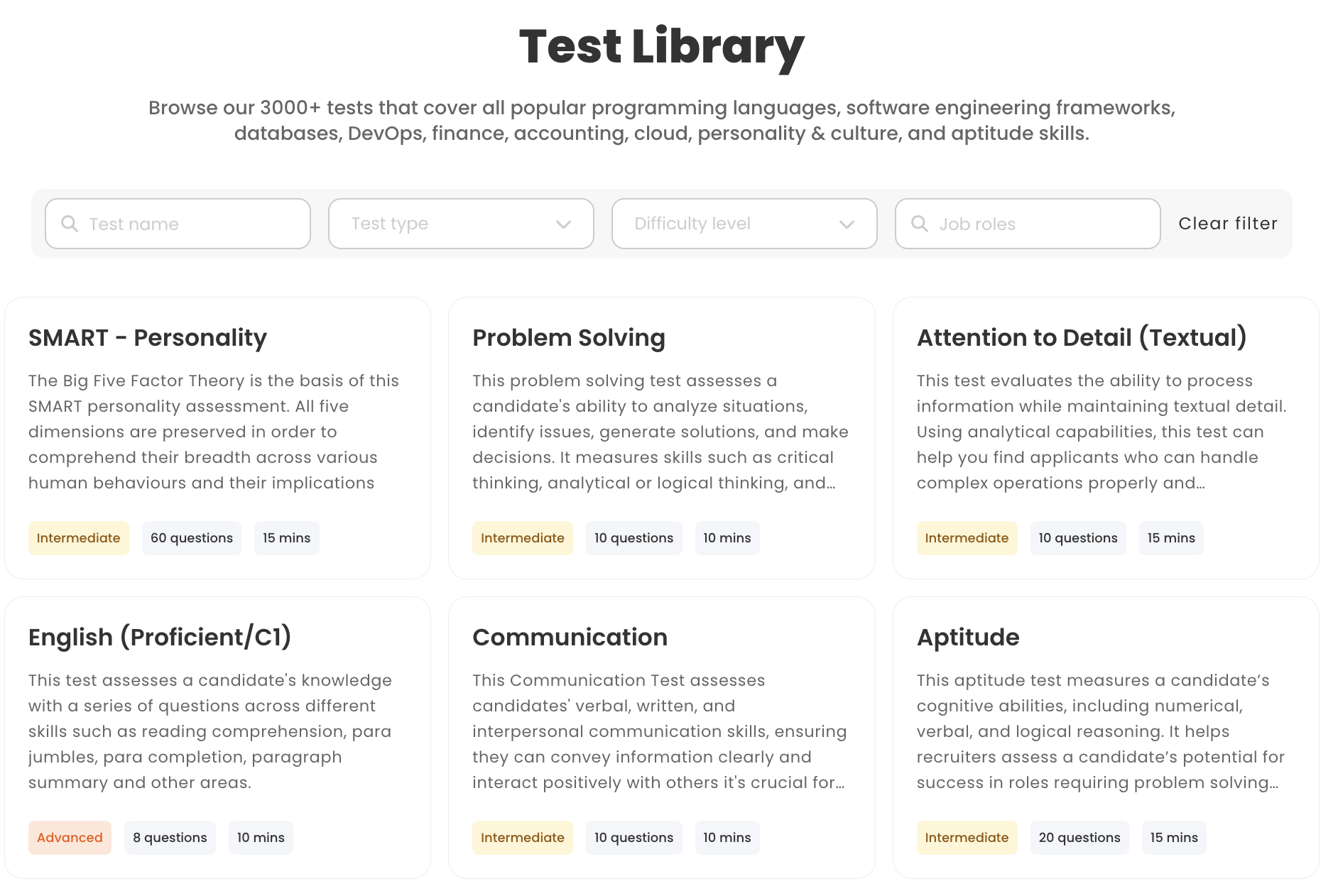
That is where the libraries separate. Testlify's 13 categories include blue-collar hiring tests, situational judgment tests, psychometric and gamified assessments alongside the usual programming and cognitive ability sets. Zapilio's coverage is role-specific, cognitive, technical, soft skill, psychometric and personality, which is a solid spread for office and technical roles and thinner outside them.
The smaller library has a real argument behind it. A 600-skill catalog is faster to search, and a hiring manager choosing between eight variants of the same test often picks none. Breadth only pays if you actually hire across a range of roles.
The case for breadth is that roles keep moving. Employers surveyed for the World Economic Forum's Future of Jobs Report 2025 expect 39% of the key skills a job needs to change by 2030. A library you outgrow in two years is a migration you will pay for later.
Both platforms let you author your own questions. Testlify adds question banks that can be fixed (everyone sees the same items) or variable, drawing unused questions at random per candidate. The product warns that small banks raise the odds of overlap, which is an honest note most vendors leave out.
Which question types does each support?
Testlify ships 25+ question types. Zapilio documents objective, subjective, audio, video and picture-based questions, plus multiple-choice and extended matching, created in the tool or bulk-imported from a CSV. For a screening round of knowledge and reasoning questions, either will do the job.
The difference shows up on work samples. Testlify binds question types to the actual software people use: Google Docs, Sheets and Slides, and Microsoft Word, PowerPoint and Excel, with the candidate signed in to a real account. An operations hire who claims Excel gets an Excel task, not a multiple-choice quiz about Excel.
Coding goes further than a code box. Candidates work in an embedded VS Code editor, single file or a multi-file project, against up to 20 visible or hidden test cases with per-case scoring, including SQLite database cases. There is also vibe coding, where the candidate directs AI tools to reach a working solution instead of typing syntax by hand. That is how a lot of engineers now work, and very little hiring software asks them to prove it.
Typing tests score on 60% accuracy and 40% speed by default, and the weighting is yours to change. The report captures accuracy, words per minute, corrected words per minute, characters per minute and error rate.
None of this is free. More question types means more assessment design, and a team that only needs a quick knowledge screen will feel the extra choice as friction rather than power.
Does either platform do AI interviews?
Testlify does, in four formats. Zapilio supports audio and video question types, so a candidate can record an answer, but nothing in its public material describes a two-way AI interviewer or an outbound phone interview.
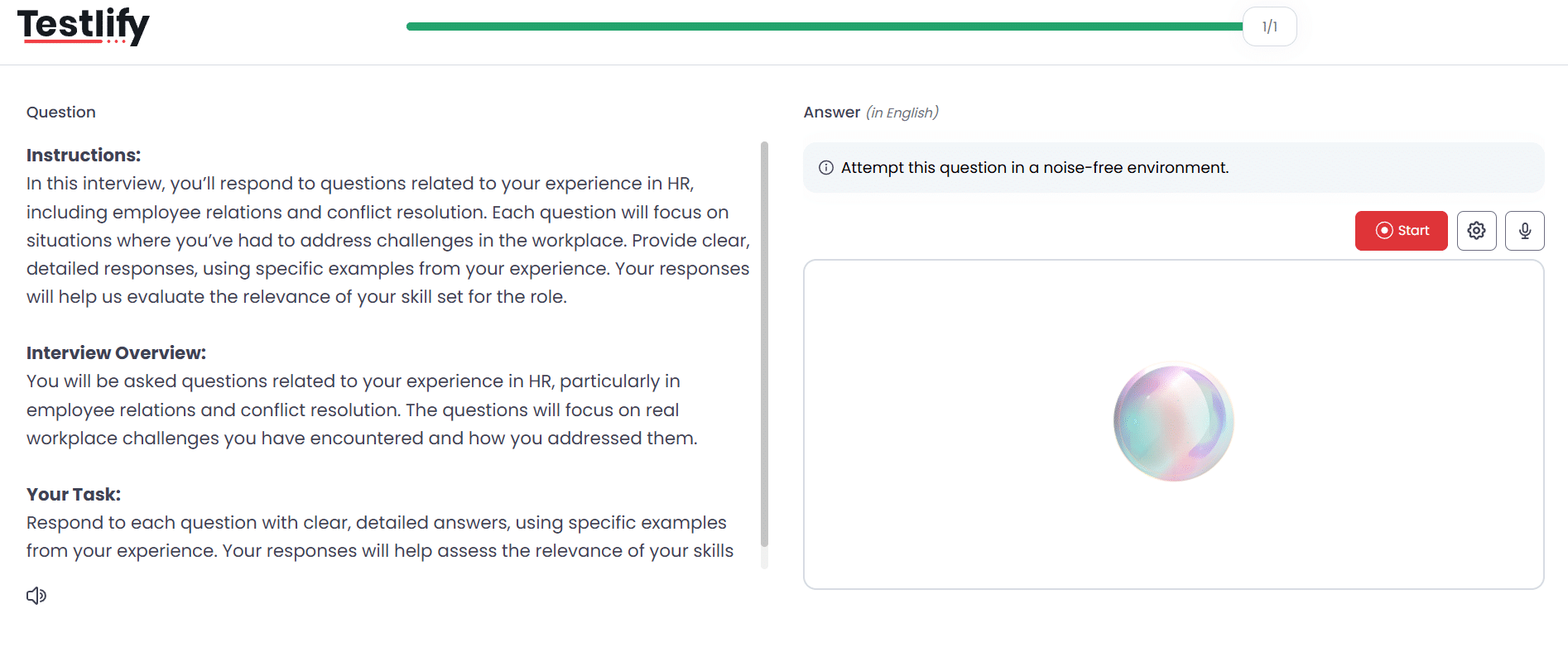
Testlify's formats are one-way asynchronous video, two-way conversational AI video, voice and audio questions, and outbound AI phone interviews billed at $0.18 per minute. During a live voice interview the candidate sees "You're muted while the AI is speaking", which tells you it is genuine turn-taking rather than a set of recorded prompts.
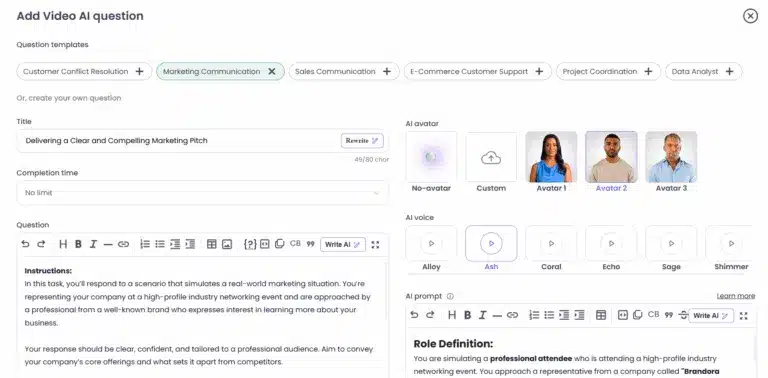
The configuration is where an interview stops being a gimmick. You choose the AI avatar, the voice, the persona and the context, write custom prompts or start from 150+ templates, set the number of attempts (including no limit), cap recording and completion time, and switch on auto-start with preparation time so nervous candidates get a moment to read the question first. Video responses run to 5 minutes each. A reattempt deletes the previous take, and candidates are told so.
Transcripts are automatic and multilingual: the AI detects the spoken language and transcribes it, for any recording of at least 30 seconds. Reviewers can watch, download the video or audio, replay the screen, regenerate the interview report and download the transcript.
Two honest limits. Chat AI, the text-based interview format, is labeled coming soon in the product and should not factor into a buying decision yet. And Testlify does not schedule live human interview panels, so calendar coordination for a four-person loop still belongs to your ATS or your scheduling tool.
How do the proctoring features compare?
Both platforms proctor. Zapilio's integrated proctoring monitors candidates during a live exam. Testlify ships more than 20 separate controls grouped into three presets, and one of them is unusual enough to decide a purchase on its own.
That one is dual-device proctoring. The candidate's own phone becomes a second camera, positioned so it captures both the person and the laptop screen. It is not advisory: the session will not start until mobile monitoring is live, disconnecting it blocks the assessment, and ending it is reported to the administrator. For a certification exam or a high-volume graduate intake, that single control is often the whole decision.
The rest of the list covers identity and environment: face detection, photo ID verification with a face match against the ID, periodic webcam snapshots, full-screen enforcement, tab-switch detection, multi-monitor restriction, copy-paste tracking, IP and location checks, AI-tool and browser-extension detection, and a candidate honesty agreement.
What matters more than the list is what the recruiter is shown. Testlify returns a three-tier flag. Green means nothing suspicious. Yellow says some behavior "wasn't ideal" and "a quick manual review is recommended". Red means cheating was confirmed. Automatic termination exists but is opt-in, with a violation threshold you set. Nobody is rejected by a color.
Privacy is handled in the same spirit: face verification data is deleted after 30 days and consent can be withdrawn at any time, while video and audio responses are removed after six months with warnings first.
Pro tip: pick the proctoring preset per assessment, not per company. Running strict controls on a 15-minute screening test costs you completions, and running standard controls on a final certification exam costs you the point of the exam.
Does Zapilio integrate with your ATS?
Yes. Third-party listings show a Zapilio integration for Greenhouse, which pushes assessment invites and pulls scores back into the ATS workflow, and a Workday Recruiting listing. An earlier version of this page said otherwise, and that was wrong.
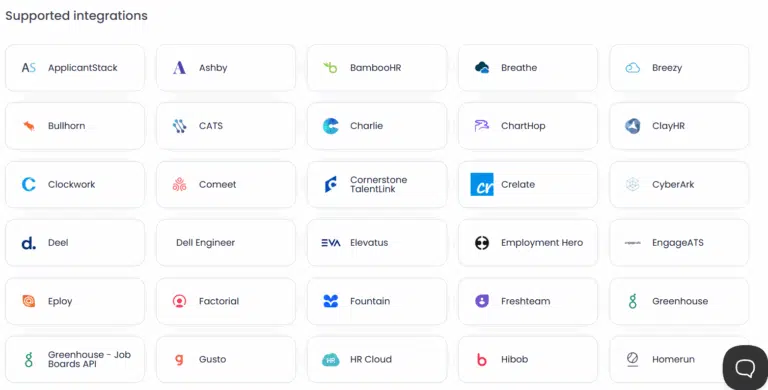
Testlify connects to 100+ applicant tracking and HR systems, plus Zapier and webhooks for anything without a native connector. One thing to budget for: on the self-serve plans those 100+ ATS integrations are a paid add-on at $2,388 a year, included on the Custom plan.
AI resume screening rides on that integration and is currently free with Greenhouse. It scores inbound applications in real time and can advance a candidate to the next ATS stage when they clear your cut-off. Rejections stay inside Testlify and do not write back to the ATS, which is a deliberate choice worth knowing before you design the workflow.
If you have no applicant tracking system at all, Testlify has a simple built-in pipeline: job requisitions, an application form, job-board publishing and an applied to reviewed to shortlisted to rejected flow. It is basic by design and it is not a substitute for a system of record. If you already run one you trust, keep it and plug the assessment layer in behind it.
What do the reports actually tell you?
Zapilio returns skill-wise breakdowns, an overall ranking and data-centric reports designed to surface top scorers quickly. That is genuinely what a screening tool should do. Testlify reports go a layer deeper, into the quality of the test itself.
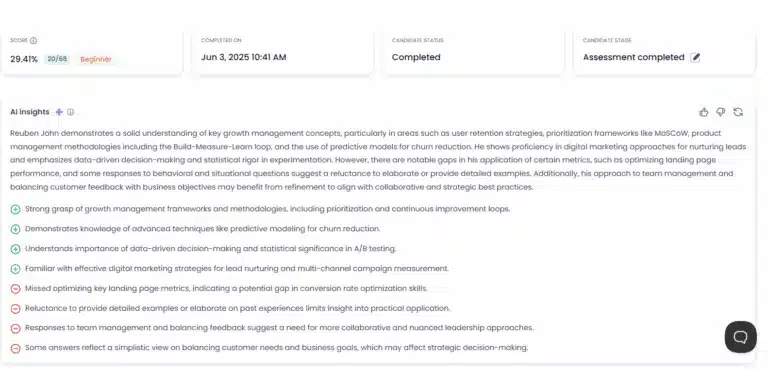
Recruiters see item-level psychometrics that usually stay inside test-publishing firms: a difficulty index and a discrimination index per question, plus a quality-risk flag when a question has very low accuracy or a high skip rate. Answer distributions, score and time distributions, and per-question AI insight sit alongside them. In practice that means you can tell the difference between a hard question and a broken one, and fix it before it screens out 40 good candidates.
On top of that: AI insights summarizing strengths and improvement areas, an AI checker that classifies an answer as human, AI generated or mixed, pronunciation insights on spoken answers, and exports to PDF, CSV, ZIP and transcript formats with granular controls over what a shared report reveals.
Both platforms grade with AI, which is exactly where a buyer should slow down. New York City's Local Law 144 requires any automated employment decision tool used there to have had a bias audit within the past year, to make the audit results public, and to notify candidates 10 business days before the tool is used. Enforcement started on July 5, 2023. Ask both vendors for their audit before you sign, not after.
Testlify's answer to that is human-in-the-loop by default. The product itself states that "AI scores and insights are for guidance only. Use human judgment for final decisions." Displaying AI scores to reviewers is a toggle, including the AI score in the final average is a separate toggle, and any question can be routed to a named human for manual review. Research supports the discipline: a meta-analysis by Kuncel and colleagues found that combining assessment information mechanically predicts outcomes at least as well as experts re-weighing the same information by hand. Use the scores. Do not let a panel quietly overwrite them at the end.
How much does each platform cost?
Zapilio publishes no pricing. You get a free trial, then a quote. That is normal for an early-stage vendor, and it does mean you cannot compare cost until you have taken a sales call.
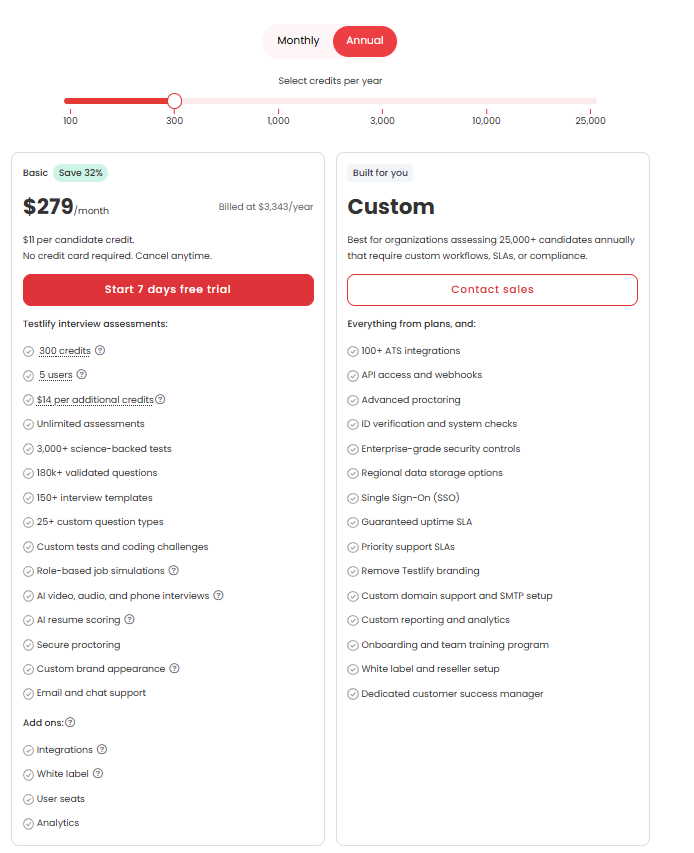
Testlify publishes its full table. On annual billing, one credit is consumed per assessment a qualified candidate starts, and credits do not roll over.
Plan | Credits per year | Price | Per credit | Seats |
|---|---|---|---|---|
Starter | 100 | $139/mo, billed $1,668/year | $16.68 | 3 |
Basic | 300 | $279/mo, billed $3,348/year | $11.16 | 5 |
Business | 1,000 | $699/mo, billed $8,388/year | $8.39 | 10 |
Premium | 3,000 | Contact sales | Volume-based | 20 |
Enterprise | 10,000 | Contact sales | Volume-based | 30 |
Custom | 25,000+ | Contact sales | Volume-based | 40 |
Monthly billing uses the same tier names with different numbers: Starter is $198 a month for 10 credits, Basic $398 for 30, Business $998 for 100. Extra seats are $15 each per month on every tier. There is a 7-day free trial with no card, a 30-day money-back guarantee, prices locked for 24 months, and a 25% non-profit discount.
Read the add-ons before you budget. White labeling is $2,388 a year, ATS integrations are $2,388 a year, and SAML SSO with two-factor authentication is also a paid add-on on the self-serve tiers. All three are included on Custom. Some items are metered: AI phone interviews at $0.18 a minute, a system check at $0.25, face verification at $0.50 an attempt. See the full plan and credit details before you model a year of hiring.
Which platform fits your team?
Zapilio fits a small team hiring for a narrow set of office or technical roles, where the job is to cut 300 applicants to 20 quickly and nobody needs an interview recorded. The upskilling side is a real bonus if you also want to find skill gaps in the people you already employ, and few assessment tools do both.
Testlify fits a team whose roles are varied, whose hiring is remote or high-stakes enough that integrity matters, or who want the interview stage inside the same tool as the test. It is also the better answer for multi-country hiring, since Zapilio's interface is English only and Testlify translates tests and custom questions into the candidate's language in real time.
Company size is the cleanest way to split them. Under about 200 people you often have no applicant tracking system and no dedicated recruiter, so a tool that posts the job, screens, interviews and scores in one place removes a purchase rather than adding one. Above that, you almost certainly run Greenhouse, Workday or Lever, and the question becomes how well the assessment layer sits behind the system you already trust.
An illustrative case, and it is hypothetical rather than a customer story. A 90-person marketing agency hiring four account managers and two designers a quarter runs a role-specific test plus a short AI video interview, and a hiring manager only sees candidates who cleared both. The shortlist is scored before the first call, so the manager spends their hour on three people instead of twelve.
This is the Testlify Multi-Signal Talent Evaluation Model in practice. It combines several role-relevant signals, including assessments, interviews, simulations, references and reviewer feedback, to help teams make more confident hiring decisions. One signal is fragile. A candidate who scores well on the test, holds up in the interview and gets a clean reference is a different bet from one who only did the first.
How to run a fair head-to-head trial
Both vendors offer a trial, so buy on evidence rather than on a feature table (including this one). Structured, job-relevant evaluation is what makes the comparison meaningful in the first place: the modern reanalysis of selection-method validity by Sackett and colleagues puts structured methods among the strongest predictors of job performance, and years of education and general experience among the weakest.
- Pick one real open role, not a hypothetical one. Test design changes completely between a warehouse hire and a backend engineer.
- Write the four or five competencies that role actually needs, before you look at either catalogue. Otherwise the catalog writes your scorecard for you.
- Build the same assessment in both tools and run it on three current employees who are good at the job. If a strong performer fails your test, the test is wrong.
- Time the setup. Minutes from job description to live invite is the number that predicts whether hiring managers will actually use the thing.
- Send both to five candidates and read the completion rates. Drop-off is your candidate-experience score, and it is more honest than any demo.
- Ask each vendor for a bias audit and a data-retention answer in writing. If either is slow, that is your answer.
Ready to see it on your own roles?
The fastest way to settle this is to run one real assessment. Start a walkthrough with the Testlify team on a role you are hiring for right now, or browse the test library and build the assessment yourself on the 7-day free trial. If you are still mapping the market, the wider list of Zapilio alternatives covers the other tools in this category.
Key takeaways
- Different jobs, not different quality tiers. Zapilio ranks a large applicant pool against ready-made tests and also handles internal upskilling. Testlify carries a candidate from test to AI interview to a scored decision. Decide which problem you have before you compare rows.
- Library breadth is a hiring-range decision. 600+ skills is plenty for office and technical roles and thin outside them; 3,500+ tests across 13 categories matters when you hire warehouse staff and engineers from the same account. With 39% of key skills expected to change by 2030, the range you need in two years is wider than the one you need today.
- Proctoring is the widest real gap. Both platforms proctor, but dual-device monitoring, where the candidate's phone becomes a second camera and the session will not start without it, is the control most buyers have never been offered. If your assessments are high-stakes or remote, weight this row heavily.
- Interviews change the shortlist, not just the score. One-way video, two-way conversational AI, voice and outbound phone at $0.18 a minute mean the first human conversation happens with a smaller, better-evidenced group. Chat AI is not shipped yet, so leave it out of the decision.
- Price the add-ons, not the headline. Testlify starts at $139 a month billed annually for 100 credits, but white labeling, ATS integrations and SSO are $2,388-a-year add-ons on self-serve plans. Zapilio publishes nothing, so budget a sales call before you can compare at all.
- Keep a human on the decision. Both tools grade with AI, and New York's Local Law 144 already requires a published annual bias audit and 10 business days of candidate notice. Ask for the audit during the trial, and keep the final call with a named person.
FAQs

Director of Marketing
Akash Patange is the Director of Marketing at Testlify, where he works closely with HR leaders and recruiters to help organizations improve hiring outcomes. He writes about talent assessment, recruitment technology, and data-driven hiring practices.
LinkedInRelated resources
View all
Competitor Comparisons
Testlify vs. TalentClick: Which Skills Assessment Platform is Best for HR Teams?
Competitor Comparisons
Testlify vs. ASC Smarter Assessment: Which Skills Assessment Platform is Best for HR Teams?
Competitor Comparisons
Testlify vs Canditech: Which Assessment Platform Wins in 2026?
Competitor Comparisons
Testlify vs. eSkill: Which Skills Assessment Platform is Best for HR Teams?
Competitor Comparisons
Testlify vs. TestInvite: Which Skills Assessment Platform Wins in 2026?
Competitor Comparisons
Testlify vs. HackerRank: Which Skills Assessment Platform is Best for HR Teams?
Get started.
Hire on proof, not resumes.
Run your first skills-based assessment free — no credit card required.