
Testlify vs Alex AI: Which AI Interviewing Platform Is Best?
Testlify vs Alex AI: A detailed feature-by-feature comparison article to help recruiters choose the best AI interviewing for efficient and scalable hiring.
If you are choosing between Testlify and Alex AI, here is the short answer: both run AI-led interviews, but Testlify is the stronger pick for teams that want to test real job skills, not just talk to candidates. Alex AI is a focused first-round AI interviewer. Testlify pairs conversational AI interviews with 3,500+ role-specific tests, chat, voice, and video simulations, and enterprise-grade proctoring, so one platform covers screening through final shortlist.
AI in hiring is no longer a fringe experiment. McKinsey reports that 78% of organizations now use AI in at least one business function, and recruiting is one of the fastest-moving. That makes the platform you pick a real decision, not a nice-to-have. This comparison looks at interview formats, assessment depth, proctoring, integrations, support, and pricing, so you can see exactly where each tool fits.
TL;DR: Testlify vs Alex AI
- Best overall for skills-based hiring: Testlify, because it measures what candidates can do, not only how they answer.
- Interview formats: Testlify supports chat, voice, and video AI plus job simulations. Alex AI focuses on conversational voice and video screening.
- Assessment depth: Testlify adds 3,500+ role-specific tests. Alex AI centers on the interview itself.
- Proctoring: Testlify offers 20+ anti-cheating controls. Alex AI covers the core checks.
- Pricing: Testlify publishes clear, tiered plans. Alex AI is custom-quote only.
 ChatGPT
 Gemini
 Claude
 Grok
Grok Perplexity
What is Testlify?
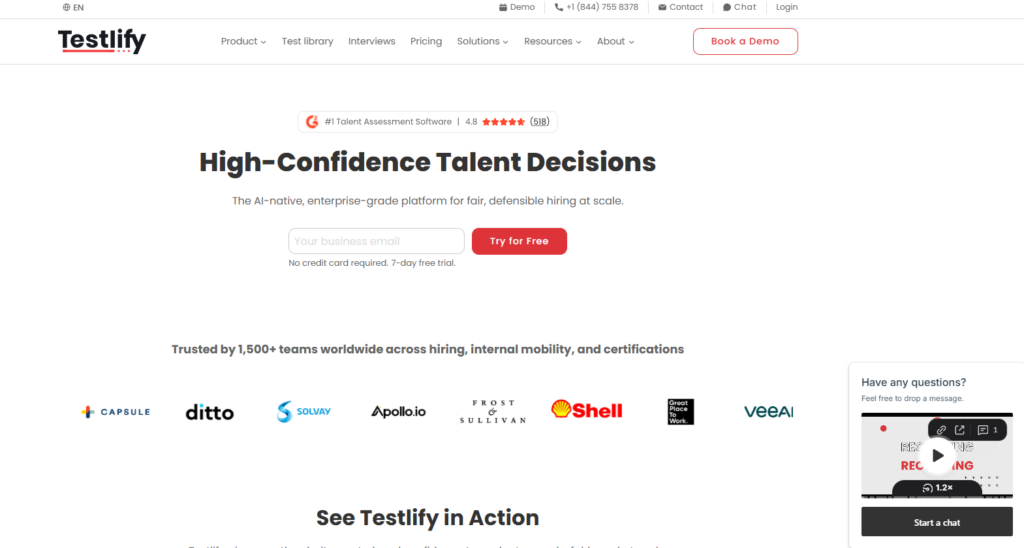
Testlify is an AI interviewing and skills assessment platform. It combines conversational AI interviews with a library of 3,500+ role-specific tests in 16+ languages, so companies can hire with confidence across global talent markets. Alongside interviews, Testlify offers cognitive, personality, and job-fit assessments to build a complete picture of each candidate.
The idea behind this design is simple: one interview rarely tells you enough. Testlify follows what we call the Testlify Multi-Signal Talent Evaluation Model, which combines several role-relevant signals, including assessments, interviews, simulations, and reviewer feedback, to help teams make more confident hiring decisions. One strong answer, or one polished resume, is a weak basis for a hire. Several signals that point the same way are a much safer bet.
That approach matters more every year. The World Economic Forum expects 39% of workers’ core skills to change by 2030, down from 44% in 2023 but still a large shift. When the skills a role needs keep moving, testing for them directly beats guessing from a job title on a CV.
How does Testlify work?
Testlify helps recruiters evaluate candidate skills and see their true potential. Here is how the platform works.
1. Create tailored AI interviews
Recruiters can design interviews and assessments tailored to specific roles. Hiring teams pick from a large library of role-based templates or build their own conversational interview flows. The platform runs AI-powered interviews in chat, voice, and video, so candidates work through realistic scenarios such as handling a customer complaint, pitching an idea, or solving a workplace problem. You can also add custom questions from the library of 3,500+ role-specific tests or generate questions with AI, in formats that include multiple-choice, open-ended, and coding challenges.
2. Send candidate invitations
Once interviews are ready, recruiters invite candidates through automated email links. Candidates start the interview without creating an account, which cuts friction and lifts completion rates. Automated reminders and follow-ups keep candidates on schedule while sparing recruiters the admin.
3. Built-in anti-cheating and proctoring
To protect the integrity of each assessment, Testlify includes anti-cheating and advanced proctoring features. These cover dual-webcam proctoring, screen recording, AI assistance detection, and location tracking, so results reflect real, unaided work.
4. AI-powered evaluation and behavioral analysis
Testlify uses AI to analyze candidate responses across every interview format. The system reviews:
- Answer relevance and accuracy
- Communication clarity and tone
- Verbal and non-verbal cues
- Confidence and emotional intelligence
- Behavioral patterns
Video and voice interviews are scored alongside written answers, so recruiters get a rounded view of each candidate’s strengths. AI supports the read, but people stay in charge: recruiters can review recordings and reports themselves before any call.
5. Reporting and analytics
Testlify scores interviews automatically and gives recruiters detailed candidate insights. Reports break down performance by skill, question type, and overall score, which makes it easier to compare candidates and decide with evidence rather than gut feel.
6. Integration with applicant tracking systems (ATS)
Testlify integrates with 100+ applicant tracking systems and HR tools, so data stays in sync across hiring stages. Candidate profiles, interview results, and evaluation reports update inside your existing systems, which keeps recruiters, hiring managers, and HR teams working from the same record and cuts manual data entry.
7. Data compliance
Testlify is GDPR compliant and treats recruitment data as sensitive by default. It includes advanced admin management, strong security integrations, strict data governance, regular audits, and clear privacy protections, backed by SOC 2 Type II, AICPA, and ISO 27001 certifications.

What is Alex AI?
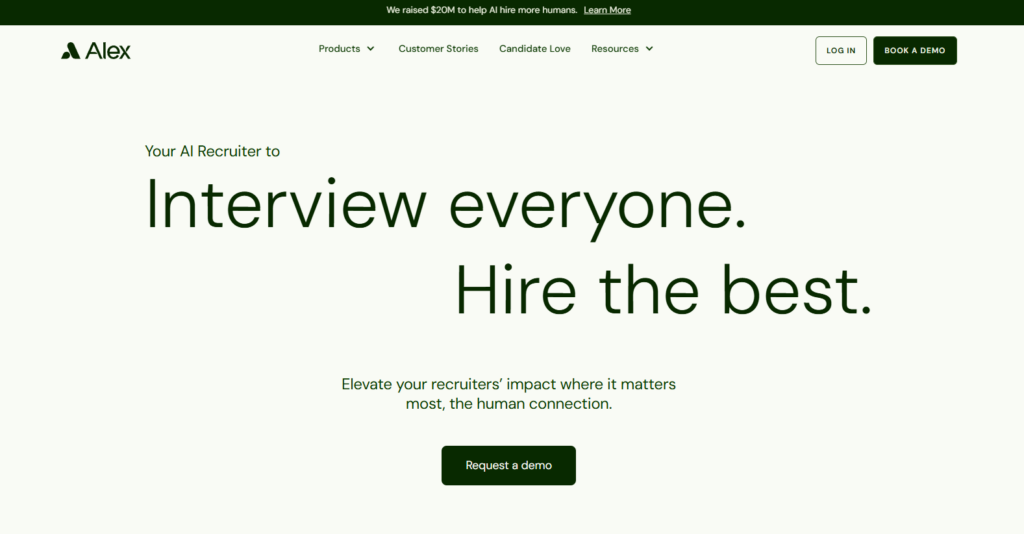
Alex AI is an AI-powered interviewing and candidate screening platform built to automate the early stages of hiring. Founded in 2023 and backed by Y Combinator, it acts as a virtual first-round interviewer, running personalized two-way screening conversations by video, phone, or chat. Its main job is to help recruiters handle large applicant volumes without adding manual work.
How does Alex AI work?
Alex AI runs first-round interviews by combining AI-driven conversations with automated candidate management. Here is how the platform operates.
1. AI-powered resume screening
Alex AI reads candidate resumes against job requirements to spot the best matches on skills, experience, and potential. It writes plain-language summaries of each candidate’s strengths, gaps, and role alignment, then moves qualified people forward automatically, which speeds up shortlisting.
2. Automated interview setup and scheduling
Alex AI handles interview coordination end to end, from personalized invitations to reminders and rescheduling. Candidates pick times that suit them, and recruiters skip the back-and-forth of manual scheduling.
3. AI-powered candidate screening
During the interview, candidates talk with an AI interviewer that asks role-specific and behavioral questions and adapts follow-ups to each answer. By probing deeper than a static questionnaire, Alex AI captures more useful detail about a candidate’s experience.
4. Fraud detection and candidate validation
To keep responses honest, Alex AI adds identity verification and monitoring. It flags external assistance tools, checks for location and device inconsistencies, and surfaces suspicious behavior for review.
5. Candidate insights
After each interview, Alex AI produces searchable transcripts, role-fit scores, and fraud flags. Recruiters can review answers in detail, validate skills, and quickly spot any integrity concerns.
6. Integration with applicant tracking systems (ATS)
Alex AI integrates with 30+ applicant tracking systems, plus tools like Microsoft 365 and Google Workspace. These connections keep candidate data in sync and centralized across hiring stages.
7. Data security and compliance
Alex AI follows major data protection rules, including GDPR and CCPA, with strict standards for how candidate information is collected, processed, and stored.
How does Testlify compare with Alex AI?
The fastest way to choose is to put both tools side by side. This feature comparison shows where Testlify and Alex AI overlap and where they split, so you can match the platform to your hiring goals.
Features | Testlify | Alex AI |
|---|---|---|
Cost per interview transparency | ✓ | ✗ |
One-way video interviews | ✓ | ✗ |
Two-way video interviews | ✓ | ✓ |
Role-specific tests | ✓ | ✗ |
AI-powered question randomization | ✓ | ✓ |
Live interview scheduling | ✓ | ✓ |
Custom question bank (MCQ, video, job simulations) | ✓ | ✗ |
Asynchronous video responses | ✓ | ✗ |
Time-limited answers | ✓ | ✗ |
Automatic candidate recording | ✓ | ✓ |
Real-time candidate monitoring | ✓ | ✓ |
Plagiarism and cheating detection | ✓ | ✓ |
Multi-language support | ✓ | ✓ |
Mobile-friendly interview experience | ✓ | ✓ |
Candidate ranking and reports | ✓ | ✓ |
Shareable interview links | ✓ | ✓ |
Team collaboration | ✓ | ✗ |
Custom branding | ✓ | ✗ |
Auto-graded / weighted scores | ✓ | ✓ |
ATS integrations supported | 100+ | 30+ |
Global candidate access | ✓ | ✓ |
Testlify vs Alex AI: interview formats
Testlify offers a multi-format interview environment built to mirror real work. By putting candidates into simulated job scenarios, it tests not just what they know, but how they adapt and handle people. It supports:
1. Chat AI: Assess problem-solving, written communication, and critical thinking through realistic text scenarios, like handling a billing dispute or calming an angry customer.
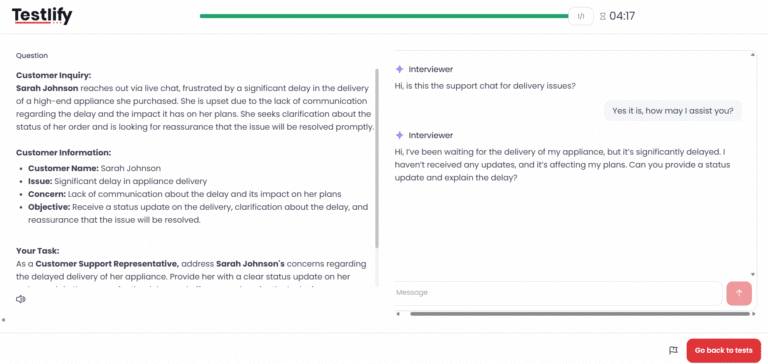
2. Voice AI: Evaluate verbal fluency, tone, and persuasion by having candidates respond to role-specific prompts, such as sales or customer support tasks.
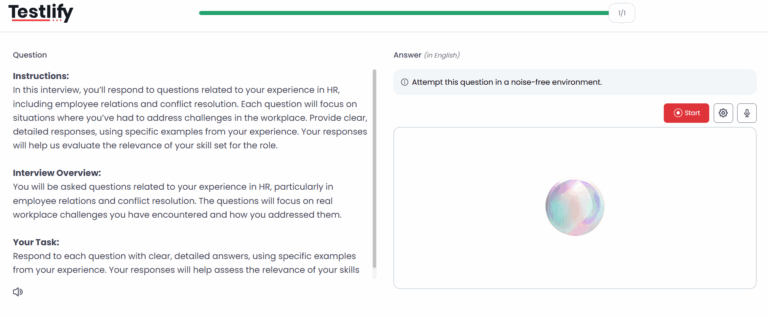
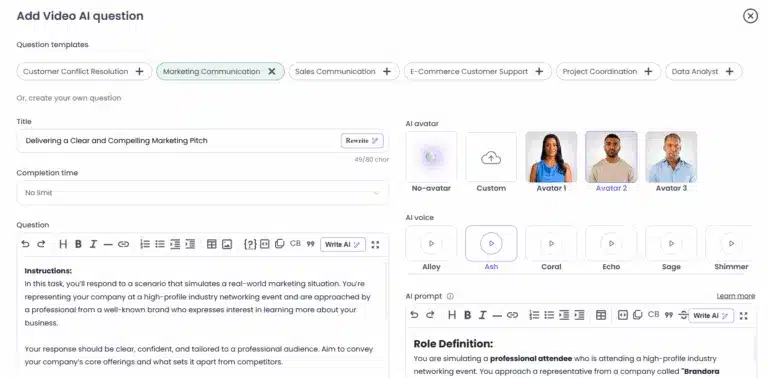
3. Video AI: AI avatars guide candidates through complex job scenarios in asynchronous video interviews, so employers can read non-verbal communication, confidence, and emotional intelligence.
Alex AI relies mainly on conversational, text and voice interviews powered by adaptive questioning. Its key features include:
- Dynamic follow-up questions
- Context-aware conversations
- Automated screening workflows
This works well for early screening and basic role-fit checks, but it stops at the conversation. Without job simulations, the read is mostly about how a candidate talks, not how they perform.
Verdict: Testlify gives a more realistic interview through chat, voice, video, and scenario simulations, which makes it better suited to judging real job readiness.
Testlify vs Alex AI: customization and interview design
Testlify gives recruiters deep control over interview design, so they can tailor interviews to specific roles and industries. Recruiters can:
- Create custom interview flows and dialogues
- Design role-based simulations
- Combine technical, cognitive, and behavioral questions
- Adjust difficulty levels dynamically
- Configure weighted scoring criteria
- Build department-specific templates
This flexibility lets organizations mirror their actual job requirements, which improves hiring accuracy.
Alex AI lets recruiters customize AI interviews through standardized tools and predefined frameworks, including:
- Domain-specific AI
- Standard interview guides
- Limited role-based configurations
This helps teams launch interviews fast, but it caps how closely they can match a company’s specific needs.
Verdict: Testlify offers more design flexibility, so teams can build interviews that line up with real job demands and internal performance benchmarks.
Testlify vs Alex AI: anti-cheating and proctoring
Testlify applies advanced anti-cheating controls and remote proctoring so every assessment reflects real skill and genuine effort. This matters because integrity is what makes a score worth trusting. The controls include:
- Face detection
- Photo ID verification
- Webcam snapshots
- Full-screen mode and force full-screen
- Dual-camera proctoring
- Copy/paste tracking
- Mouse-out tracking
- IP proctoring
- Live video monitoring
- Question randomization
- Honesty agreements
- Question-level activity logs
- AI assistance detection
- Screen recording
- Live environment and system checks
- Internet speed check
- Focus guard (anti-cheat mode)
- Talking prohibition
This is the Testlify Assessment Integrity Framework in practice: identity checks, environment control, behavior monitoring, AI assistance detection, and reviewable evidence, kept human-led so a flag prompts a review, never an automatic reject.
Alex AI uses a smaller set of anti-cheating features to monitor candidate activity and flag concerns for review. These include:
- Candidate identity verification
- AI assistance detection
- IP-based location tracking
- Behavior log tracking
Verdict: Testlify offers a more complete proctoring system, pairing AI monitoring, identity verification, behavior tracking, and environment controls to keep test integrity high. Alex AI covers the basics, which suits low- to mid-stakes screening but may fall short for enterprise-grade security needs.
Pro tip: match proctoring strictness to the stakes of the role. Full dual-camera, environment, and AI-assistance checks make sense for finance, security, or senior roles. For a high-volume frontline pipeline, lighter checks keep completion rates up without inviting fraud. Testlify lets you set that level per assessment, so you are not forced into one blanket policy.
Testlify vs Alex AI: integrations and workflows
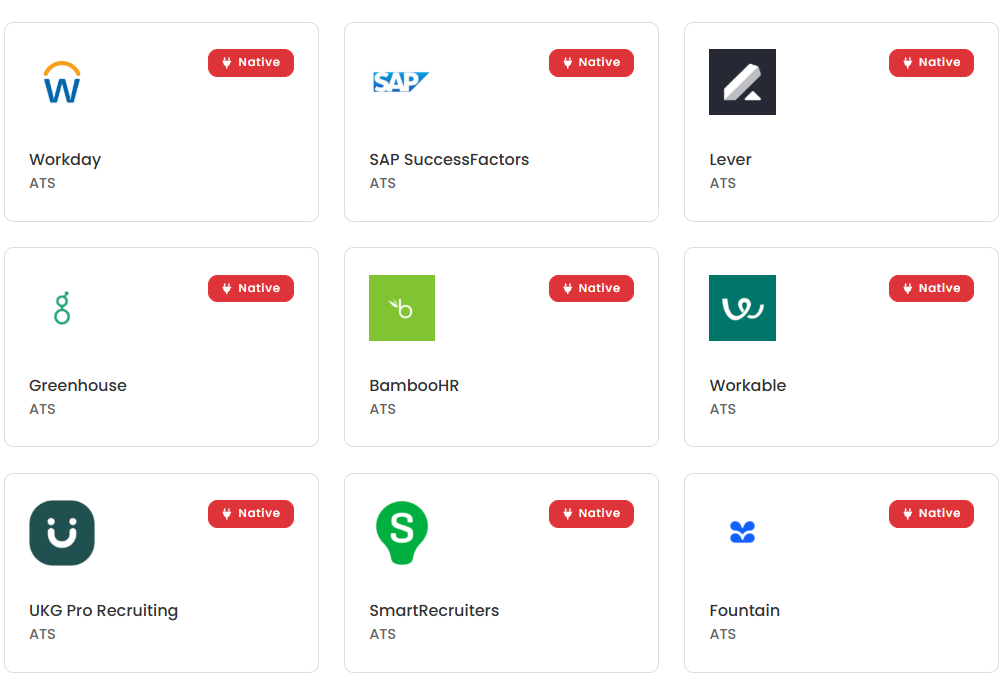
Testlify connects with 100+ ATS platforms and HRMS tools such as Greenhouse and Lever, so you can import candidate profiles, compare results, and make data-driven decisions without leaving your stack.
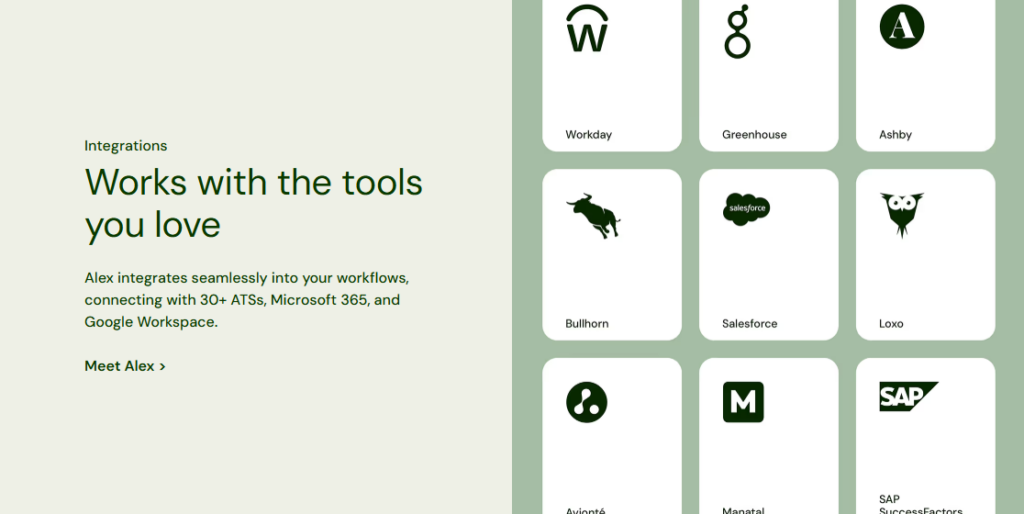
Alex AI integrates with 30+ applicant tracking systems, which makes it straightforward to manage candidates and keep hiring moving from start to finish.
Verdict: Testlify supports a wider range of ATS integrations, so it slots into more recruitment workflows and connects with more of the tools teams already run.
Testlify vs Alex AI: customer support
Testlify is known for hands-on support from human agents across several channels. New customers get dedicated onboarding, and enterprise clients get priority support. The team also acts on customer feedback and ships improvements in response to it. On top of live help, a self-serve help center covers documentation, FAQs, and best-practice guides.
Alex AI does not clearly spell out its support offering on its website, which makes it harder to judge what help you would get. It may offer basic support by email or direct contact, but there is limited public detail on onboarding, priority support, or structured help resources.
Verdict: Testlify stands out with a structured, responsive support system, including multiple channels, onboarding, and self-service resources. Alex AI’s thin public support information makes it less predictable for teams that value consistent guidance.
Testlify vs Alex AI: pricing plans
Testlify offers flexible pricing plans that scale with your business, providing everything from basic assessments for startups to advanced features for enterprise-level hiring.
- Starter plan: Ideal for small teams and startups, this plan starts at $139/month (billed at $1,663/year) and includes 100 candidate credits at $17 per credit with support for 3 users.
- Starter: Designed for growing businesses, the Starter starts at $279/month (billed at $3,343/year) and includes 300 credits at $11 per credit with support for 5 users.
- Starter: Built for scaling teams, this plan costs $699/month (billed at $4,192/year) and includes 1,000 credits at $8 per credit with 10 users.
- Premium plan: Suited for high-growth organizations, the Premium plan includes 3,500 credits and supports 20 users, with pricing available upon contacting the sales team.
- Enterprise plan: Designed for large enterprises, this plan includes 10,000 credits and supports 30 users with pricing available upon contacting the sales team.
- Enterprise Plus plan: Designed for large-scale hiring programs, this plan includes 25,000 credits and supports up to 40 users, with pricing details available after contacting the sales team.
- Unlimited plan: For companies seeking unrestricted access, Testlify offers an unlimited plan that includes unlimited candidate credits and full platform functionality, with pricing available on request from the sales team.
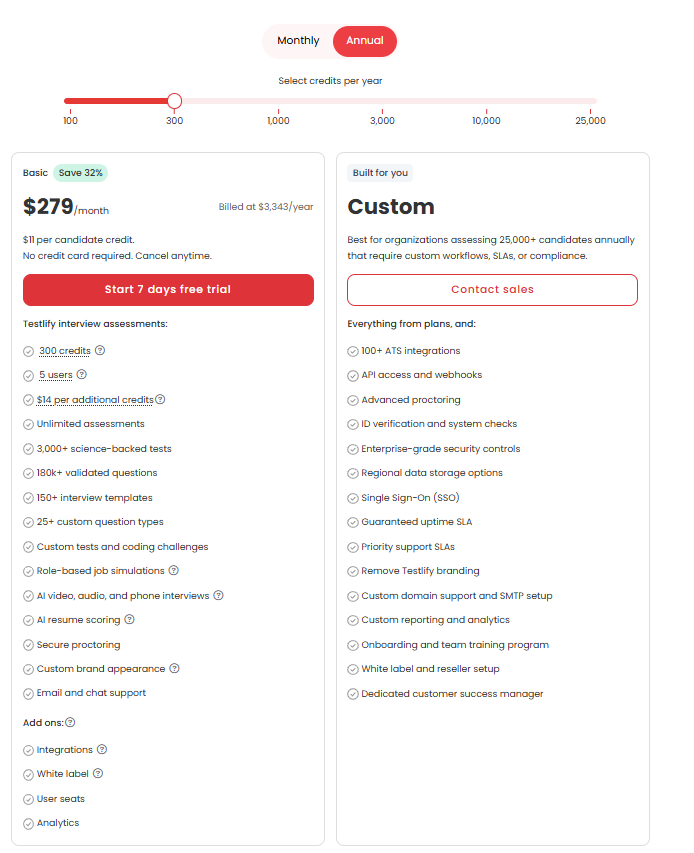
Alex AI offers custom pricing only, shaped around each organization’s hiring needs, team size, and usage. Instead of fixed tiers, you contact sales for a quote.
Verdict: Testlify’s transparent, tiered pricing makes it easier for businesses of any size to pick a plan that fits their budget. Alex AI’s custom-only model makes cost planning and side-by-side comparison harder.
Which platform should you choose?
Getting the pick right is worth real money. Gallup found that companies choose the wrong person for a management role 82% of the time, a reminder that a good conversation is not the same as a good hire. The more evidence you gather before the decision, the lower that risk.
Alex AI is a strong fit if your main need is fast, high-volume first-round screening and you already run a mature ATS to sit it inside. It does the interview well. Testlify is the better fit if you want one platform to screen, test, and shortlist, with role-specific assessments, job simulations, deeper proctoring, and clear pricing. With hiring pressure set to climb, the World Economic Forum projects 170 million new roles by 2030, so a platform that scales from screening to decision saves you stitching several tools together later.
See Testlify in action
Want to see how conversational AI interviews, 3,500+ role-specific tests, and enterprise proctoring work together? Book a walkthrough and screen your next shortlist with evidence, not guesswork.
Key takeaways
- Match the tool to the job, not the hype. Alex AI is built for fast first-round screening; Testlify is built to screen, test, and shortlist in one place. Naming your primary need first makes the choice obvious and stops you paying for scope you will not use.
- Interviews alone are a thin signal. A candidate can talk well and still not do the job. Testlify’s role-specific tests and simulations add the performance evidence a conversation misses, which lowers the odds of a confident but wrong hire.
- Proctoring depth decides how much you can trust a score. Testlify’s 20+ controls suit enterprise and high-stakes roles; Alex AI’s core checks fit lighter screening. Set strictness by role risk so integrity never comes at the cost of completion.
- Integrations shape day-to-day speed. Testlify’s 100+ ATS connections mean less manual data entry and cleaner handoffs than Alex AI’s 30+, which adds up across a busy pipeline.
- Transparent pricing helps you plan. Testlify’s tiered plans let you budget and compare up front; Alex AI’s custom-only quotes slow that down. For finance-approved rollouts, clarity is a feature.
- Keep the decision human. Both tools use AI to gather evidence, but the hire should stay a human call. Testlify’s reports and reviewer scoring are designed to support that judgment, not replace it.
Frequently asked questions (FAQs)

Related resources
View all
Video Interviewing Tools Comparison
Testlify vs Jobma: Which interviewing platform is best for recruiters in 2026
Video Interviewing Tools Comparison
Testlify vs Talently.ai: Detailed Comparison
Video Interviewing Tools Comparison
Testlify vs VeloxHire: Which AI interviewing platform is best for recruiters?
Video Interviewing Tools Comparison
Testlify vs Ribbon.ai: Which is the best AI video interviewing platform
Video Interviewing Tools Comparison
Testlify vs Metaview: Which AI recruiting platform in 2026?
Video Interviewing Tools Comparison
Testlify vs Willo: Which Interviewing Platform is Best for You?
Get started.
Hire on proof, not resumes.
Run your first skills-based assessment free — no credit card required.